
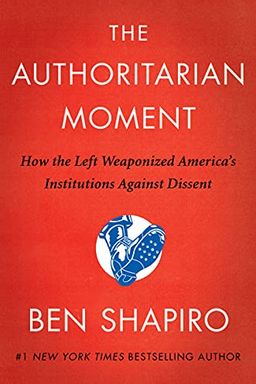
The Authoritarian Moment cover

The Authoritarian Moment

by Ben Shapiro

In ''The Authoritarian Moment,'' Ben Shapiro exposes the rise of authoritarianism within America''s institutions, urging citizens to defend foundational freedoms. By rejecting censorship and embracing independent thought, readers can help preserve democracy against the pressures of conformity and silence.

The Authoritarian Instinct and the Battle for Freedom

Why do societies oscillate between liberty and control? Ben Shapiro argues that beneath modern politics lies a fixed human impulse: the craving for order. Across civilizations, people have traded freedom for the comfort of authority, especially when fear or uncertainty rises. This book traces how that instinct manifests today—whether in right-wing mobs, bureaucratic paternalism, or left-wing institutions that claim moral clarity while wielding coercive power.

Shapiro’s thesis unfolds as a psychological and institutional analysis. He sees authoritarianism not as the monopoly of any ideology but as a structural temptation: the human preference for stability, submission, and moral certainty. From the Israelites’ demand for a king to Madison’s warnings about faction and Tocqueville’s fear of democratic despotism, the problem is perennial. The question has always been: how do you build institutions strong enough to protect liberty but weak enough to restrain domination?

The Two Faces of Authoritarianism

Shapiro distinguishes between two archetypes: reactionary authoritarianism (which seeks to reassert a mythical past) and utopian authoritarianism (which promises redemption through social engineering). Both exploit fear and both weaponize moral certainty. He draws on psychology research such as Theodor Adorno’s Authoritarian Personality and Bob Altemeyer’s Right-Wing Authoritarianism scale, but he adds Lucian Conway and Costello’s findings: the same authoritarian traits appear on both sides of the spectrum when questionnaire content is reversed. The structure—submission, aggression, conventionalism—remains constant even when the ideals change.

This duality reframes current polarization. Conservatives may succumb to angry populism that lashes out at elites or minorities; progressives may turn equality into moral compulsion, suppressing dissent in academia and media to protect “vulnerable” groups. Both stem from the same human drive—to impose order by authority rather than persuasion.

Institutions as Guardians and Engines of Authoritarianism

The American founders, aware of this impulse, built friction into the system. Checks and balances, slow procedures, and competing powers were designed as “speed bumps” against authoritarian momentum. The book uses the January 6 riot as an instructive episode. Rioters acted with fury and delusion, yet their efforts failed because institutions—Congress, courts, and officials like Mike Pence—refused complicity. The event became a live test of Madisonian design: emotion met structure, and structure held.

But Shapiro warns that the same mechanisms can invert when institutions themselves internalize authoritarian ideology. If the gatekeepers—corporations, universities, scientific panels—become moral arbiters of permissible thought, then the mob wears a suit. The danger no longer comes from rebellion against power but from power captured by ideology. That is why institutional independence and viewpoint diversity are central to maintaining a free society.

From Fear to Control

What triggers the authoritarian appeal? Shapiro points to crisis moments: pandemics, protests, and cultural upheavals. Each offers the temptation to surrender judgment to experts or moral crusaders. The phrase “trust The Science™” becomes a shield not for inquiry but for conformity. Similarly, corporations and media proclaim social responsibility to mask ideological enforcement. This is how the modern craving for moral certainty—once satisfied by religion or nation—now expresses itself through technocracy or social-justice bureaucracy.

Key idea

Authoritarianism is not an ideology but a psychological constant. The contest is not Left versus Right but order versus freedom—whether institutions will defend citizens’ agency or mold their souls.

The Path Forward

The rest of the book explores this theme across multiple arenas: media, academia, corporate activism, entertainment, sports, and technology. In each, Shapiro shows how a small, determined faction can “renormalize” norms and lock the doors behind itself. Yet he also offers a practical antidote: build alternative institutions, practice intellectual courage, and refuse to outsource moral judgment. Freedom, he contends, survives only when individuals resist the siren call of safety through control.

(Parenthetical note: Shapiro’s analysis parallels Jonathan Haidt’s moral foundations theory and echoes Hayek’s The Road to Serfdom. All describe liberty as fragile—not because freedom fails, but because people quietly stop wanting it.)


The Institutional Double Bind

You witnessed it in real time: institutions simultaneously defend democracy and consolidate control. Shapiro uses January 6 as a hinge moment—the day mobs attacked the Capitol and elites redefined dissent. Institutions worked as intended to preserve lawful succession, yet soon afterward, those same institutions expanded censorship and surveillance. The paradox is central: the same impulse that secures order in crisis can justify technocratic overreach once the danger has passed.

Checking Mobs, Empowering Elites

During the riot, constitutional actors—especially Vice President Pence and state officials—demonstrated how checks prevent a coup without institutional complicity. But within weeks, tech companies, publishers, and universities invoked January 6 to police dissenting viewpoints. Apple, Google, and Amazon deplatformed Parler; Twitter banned the sitting president; Harvard and Simon & Schuster cut ties with conservative politicians. What began as legitimate law enforcement became cultural purification.

Shapiro labels this pattern post-crisis authoritarianism: the reflex to translate moral panic into institutional power. Private entities enforce ideological conformity not by law but by access control—who can speak, publish, bank, or earn a living. The process mirrors traditional censorship while maintaining democratic facades.

Speed Bumps and Capture Points

America’s system of delayed power transfer—electoral certification, judicial recourse, the Senate’s deliberative pace—functioned as intended. Yet once threats appear to come from within, elites often argue for bypassing checks “for safety.” That logic, Shapiro argues, risks flipping constitutional design inside out: from brakes to accelerants of ideological enforcement. When officers, bureaucrats, or boards act as moral custodians rather than neutral regulators, legitimacy erodes even when procedures appear intact.

The same structure that shields you from the mob can, once captured, impose the mob’s ideology from above.

For Shapiro, the challenge is perpetual vigilance—not merely defending institutions from populist violence but from internal moral colonization that converts guardians of liberty into priests of orthodoxy.


Renormalization and Cultural Capture

Social change rarely arrives through open revolt. Shapiro explains that ideological transformation often works through “renormalization,” a concept borrowed from Nassim Taleb: small, persistent minorities shift norms until compliance feels polite and dissent feels rude. The Left, he argues, mastered this three-step strategy—win the emotional argument, domesticate institutions, and lock the doors behind newly accepted orthodoxy.

From Emotion to Moral Monopoly

The first move reframes debate around feelings. You’re told that words cause harm and silence equals violence. Compassion replaces reasoning as the measure of virtue. Courtesy becomes a weapon: disagreement violates empathy. Once this logic spreads, emotional imagery beats rational argument because nobody wants to seem cruel or bigoted.

Institutional Domestication

Next, activist minorities capture institutions. Universities revise curricula; HR departments adopt DEI frameworks; journalists adopt advocacy language. The American Civil Liberties Union, once synonymous with free speech absolutism, now balances speech with “equity.” Coca-Cola’s “be less white” materials illustrate how moral messaging embeds in corporate policy. When institutions reward compliance through hiring and funding, conformity turns structural.

Locking the Doors

Finally, dissent becomes costly. Hiring norms, grants, and peer review exclude nonconformists. Taleb and sociophysicist Serge Galam’s models suggest only 20 percent intransigent believers can shift the whole culture. Once victory consolidates, polite conformity becomes enforced orthodoxy. You see it in the language policing on campuses or social media platforms determining what counts as misinformation.

Key insight

Renormalization weaponizes politeness and bureaucracy: first empathy, then policy, then exclusion.

To resist it, Shapiro urges you to build counter-institutions and defend tolerance for discomfort. Freedom, he insists, survives through friction, not feelings.


Credentialism and the New Ruling Class

In Shapiro’s framework, the modern elite is defined less by money than by credentials. Degrees, professional titles, and mastery of activist vocabulary form admission tickets to influence. He calls this the rise of a “New Ruling Class”—a self-reinforcing network of educated elites who dominate culture, science, and media while defining what counts as legitimate knowledge.

Degrees as Status, Not Competence

Colleges serve as filters rather than educators. Diplomas substitute for testing and create a hierarchy insulated from merit. Scandals like Olivia Jade’s admissions scheme reveal how status, not learning, drives participation. Employers use degrees as moral shorthand—a symbol of reliability, not evidence of skill. The result: social closure and widening distrust between credentialed and non‑credentialed Americans.

The Language of Belonging

Shapiro calls activist terminology “wokabulary.” Terms like “systemic racism,” “microaggression,” or “Latinx” operate as moral passwords. Knowing them signals that you belong to the enlightened class. The Sokal-style academic hoaxes demonstrated how this rhetorical code can produce nonsense accepted as scholarship if wrapped in the right moral packaging. In this way, language preserves power just as Latin once did for the clergy.

Cultural Polarization

This ruling class shares cultural tastes, urban geography, and political allegiances distinct from the broader nation. The credential gap maps onto the political divide: degree holders increasingly vote Left while working-class communities shift Right. Shapiro interprets this as a class realignment—elites guard moral authority while common citizens sense disdain. (Charles Murray and J.D. Vance describe similar rifts in Coming Apart and Hillbilly Elegy.)

The insight is sobering: when education becomes a moral filter rather than a civic bridge, institutions of learning shape oligarchy, not enlightenment.


Science, Expertise, and Ideological Drift

Shapiro differentiates between science—a method of inquiry—and The Science™, an authority claim used to silence dissent. In this transformation, experts move from presenting evidence to demanding obedience. The COVID-19 era, identity politics in research, and politicized journals illustrate how traditional scientific humility gives way to moral absolutism.

The Ultracrepidarian Problem

Experts often extend beyond their lane. During 2020’s protests, thousands of health professionals endorsed demonstrations despite lockdown rules—an inconsistency that Shapiro calls “ultracrepidarianism.” The selective silence toward politically favored causes exposes science’s institutional bias. When Harvard and Yale epidemiologists describe public protest as “vital to public health,” neutrality dies.

Policy by Ideology

He shows how bureaucratic priorities merge with activism. The CDC, for example, considered racial equity ahead of death risk in vaccine allocation. Journals like Nature endorsed political candidates; Scientific American published op-eds on “antiracism” unrelated to experimental evidence. These actions politicize public trust. Legitimate science suffers collateral damage because citizens cannot tell when data ends and doctrine begins.

The antidote, Shapiro argues, is transparency: force researchers to reveal assumptions, separate moral claims from empirical ones, and reassert method over mania. (Note: this echoes Karl Popper’s emphasis on falsifiability over authority.)


Corporate Wokeism and Stakeholder Control

How did business turn activist? Shapiro shows corporations replacing market neutrality with moral messaging. After George Floyd’s death, nearly every major firm declared allegiance to progressive causes. Walmart, Apple, Netflix, and Ben & Jerry’s issued pledges and training programs. But underneath slogans lies structural convergence—corporate incentives now align with political activism.

Why Companies Comply

Firms fear public outrage, regulation, and internal revolt. Liberal consumers reward political statements; conservative ones rarely retaliate with equal organization. HR departments staffed by graduates steeped in social-justice theory act as internal enforcers. Add media’s ability to weaponize social media scandals, and compliance becomes risk management. “Silence is complicity” turns marketing into morality policing.

Stakeholder Capitalism as Soft Authoritarianism

Klaus Schwab’s Great Reset vision and the Business Roundtable’s “stakeholder” pledges redefine CEOs as political governors. When NASDAQ demands diversity quotas or banks debank unpopular groups, corporate discretion becomes coercive governance without democratic consent. Consumers and workers live inside a private bureaucracy of values they never voted for.

The free market now enforces moral orthodoxy through access and employment rather than legal decree.

The only remedy is reciprocal accountability: use market choices and alternative ecosystems to restore pluralism in commerce.


Media, Cancel Culture, and Digital Gatekeepers

The modern media landscape, Shapiro contends, has fused journalism, activism, and enforcement. Legacy outlets dropped objectivity in favor of “moral clarity,” while digital platforms act as censors under the pretense of fact-checking. Together they create a new information monopoly that polices moral boundaries as effectively as the old church once did.

Newsrooms as Ideological Communities

Cases such as James Bennet’s resignation at The New York Times or Bari Weiss’s departure reveal internal mobs dictating editorial policy. The 1619 Project exemplifies institutional advocacy labeled as scholarship. Objectivity morphs into activism justified by moral urgency. Readers see bias and withdraw trust, further radicalizing outlets toward their remaining sympathetic audience.

The Machinery of Cancellation

Cancel culture enforces this order externally. Viral outrage—like Justine Sacco’s tweet or Gina Carano’s meme—leads companies to fire, ban, or erase figures to prove virtue. HR departments, publishers, and studios act before facts settle. The chilling effect breeds self-censorship even among moderates. Shapiro’s slogan “They can’t cancel us if we don’t let them” encapsulates the proposed remedy: create parallel platforms that reward open discourse.

Digital Platforms as Editors

Social media once promised equal voice. Under regulatory and political pressure, companies transformed from neutral platforms to gatekeepers. Section 230 protections remain while editorial power expands. The suppression of the New York Post’s Hunter Biden story illustrates the point: unelected moderators decided what millions could read during an election. Partnerships with “fact-checkers” recenter power in establishment hands, effectively restoring the pre-internet editorial cartel.

(Parenthetical note: Shapiro aligns with critics like Glenn Greenwald and Matt Taibbi who view platform coordination as the digital successor to press monopoly.)


Entertainment, Sports, and the Soft Power of Culture

Culture, Shapiro argues, is where politics gestates. Hollywood, music, and sports no longer merely reflect society; they instruct it. Streaming monopolies, activist producers, and politicized athletes now shape virtue narratives for global audiences. What used to be leisure has become liturgy.

Film and Television as Sermon

Studios and streaming platforms—Netflix, Disney, Amazon—renormalize by narrowcasting to activist subsets. The Academy’s inclusion quotas for Best Picture eligibility transform art into compliance checklist. Historical works are edited or contextualized; critics reward virtue signaling over quality. The result is a feedback loop where ideology measures artistry.

Sports as Political Theater

Sports once united fans across race and class through meritocracy. As leagues embraced political slogans and kneeling rituals, they fractured their appeal. ESPN’s partisan coverage and declining ratings reflect the cost of politicization. When leagues presuppose fan ideology, the shared civic ritual of sports erodes.

Shapiro’s conclusion echoes Andrew Breitbart’s maxim, “Culture is upstream of politics”: if entertainment defines virtue, then elections simply ratify the stories people have already internalized. Resisting authoritarian drift therefore demands cultural, not just political, diversity.

Dig Deeper

Get personalized prompts to apply these lessons to your life and deepen your understanding.

Go Deeper

Get the Full Experience

Download Insight Books for AI-powered reflections, quizzes, and more.