
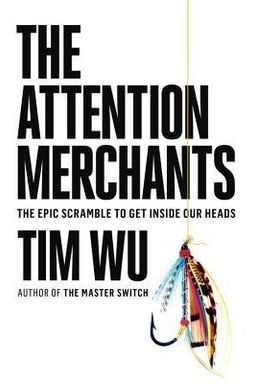
The Attention Merchants cover

The Attention Merchants

by Tim Wu

The Attention Merchants unveils the captivating journey of advertising, from its humble beginnings to today''s sophisticated digital landscape. Discover how advertisers capture our attention, create demand, and leverage media and celebrity influence to shape consumer behavior.

The Rise of the Attention Economy

How do you live in a world where your focus is a commodity? Tim Wu’s The Attention Merchants traces the long arc of industries built to seize, package, and sell human attention. From Benjamin Day’s penny press to Google’s AdWords, Wu shows that the most powerful businesses in modern history mastered the art of trading distraction for profit.

Wu’s central claim is that media history is not just about technology—it’s about psychology. Every era invents new ways to capture, measure, and monetize what you look at and think about. By uncovering these stages, you learn how your informational environment evolved from print posters to smartphones. You also discover a consistent trade-off: free content in exchange for your sustained gaze.

From Penny Press to Digital Screens

The book begins with Benjamin Day’s New York Sun (1833). He flips the economics of news: sell papers for a penny, make up losses by selling readers’ attention to advertisers. This move—turning audiences into products—creates the template for every free-media model that follows. Parallel to Day’s innovation, Jules Chéret paints massive Parisian posters that transform public walls into proto-billboards, proving that physical space itself could harvest passerby attention.

From there, Wu tracks the refinement of persuasion. Patent medicine hucksters such as Clark Stanley laid the groundwork for Claude Hopkins’s scientific advertising. Hopkins formalized tricks of urgency and credibility into testable mechanisms. Even after Samuel Hopkins Adams’s exposé ended the medicine boom, the persuasion machinery lived on in regulated advertising agencies—and later in modern marketing departments.

States, Propaganda, and Ownership of Mind

The next leap comes during wartime. Governments discover the same persuasive power advertisers already wield. Lord Kitchener’s recruitment poster and George Creel’s Committee on Public Information mobilize millions through emotional appeals, coordinated repetition, and simplified slogans. Walter Lippmann coins “manufactured consent” to describe how mass persuasion could steer entire democracies. His student Edward Bernays rebrands propaganda as Public Relations, selling its methods to corporations eager to mold consumer will. This moment blurs the moral boundary between salesmanship and ideology.

The Broadcast Era: Rituals of Mass Attention

When radio and later television arrive, attention harvesting becomes synchronized. Shows like Amos ’n’ Andy create nightly rituals that advertisers such as Pepsodent monetize. Television scales this rhythm, binding households to “prime time” while networks compete for Nielsen ratings. Ratings become currency, converting cultural attention into measurable inventory. Scandals like the rigged quiz shows reveal the moral fragility of this system, yet it endures because measurement promised efficiency for advertisers and predictability for networks.

Revolts and Co-option

The public periodically resists. In the 1930s, consumer advocates battle deceptive advertising; in the 1950s, Vance Packard exposes “hidden persuaders.” The 1960s counterculture urges people to “drop out” of corporate spectacle. Yet marketers quickly reabsorb protest energy. Pepsi’s “Pepsi Generation” and Wells Rich Greene’s countercultural campaigns prove rebellion itself can be branded. Wu terms this a recurring pattern: revolt, withdrawal, reinvention, and co-option.

Digital Fragmentation and Data Monetization

Late twentieth-century inventions decentralize attention but preserve its monetization. Remote controls introduce “zapping,” forcing advertisers to create ever more jarring hooks. Email and early games (like Space Invaders and Pac‑Man) reshape attentional habits through variable rewards—psychological conditioning that later underlies social media notifications. AOL transforms online connection into commerce, turning user interaction into sellable advertising space. The rise of Google, AdWords, and precision targeting professionalizes behavioral capture: instead of broadcasting, ads now meet you at the moment of intent.

From Celebrity to Platform Culture

Parallel to these technological shifts, the cult of personality becomes its own economic engine. People magazine, Oprah’s moral brand, and later reality TV convert human curiosity and confession into repeatable formulas for engagement. By the time you reach YouTube, Instagram, or TikTok, ordinary people and corporations alike act as attention merchants—curating personas for clicks and sponsorships.

The enduring bargain

Throughout the centuries, attention has been the invisible currency of culture. Whether through posters, radio serials, or personalized feeds, the exchange persists: you receive free content, but your focus—and often your data—are the true products sold. Understanding this cycle empowers you to decide where your attention—and therefore your life—truly belongs.


The Age of Persuasion

Persuasion evolved from traveling salesmanship to a science of influence. At the heart of this transformation stand two icons: the huckster and the engineer. Clark Stanley, the so-called Rattlesnake King, created spectacle through theatrics, while Claude Hopkins turned spectacle into a disciplined craft. Hopkins’s “reason-why” approach introduced testability to advertising—early A/B testing before digital analytics existed.

The Patent Medicine Laboratory

Patent medicines flourished in a regulatory vacuum. Remedies like Stanley’s snake-oil liniment or Liquozone promised miracle cures and financed newspapers. The ads weren’t about truth; they were about emotional language—speed, relief, discovery. Hopkins refined this with sampling campaigns and coupon tracking to measure sales lift. He made manipulation scientifically rigorous.

Scandal and Regulation

Samuel Hopkins Adams’s “Great American Fraud” series exposed the deception. Public outrage led to the 1906 Food and Drugs Act—the first major check on advertising claims. But instead of prohibiting persuasion, regulation pushed advertisers to become more creative, focusing on lifestyle appeal over false medical promises.

Wu’s lesson: persuasion continually mutates to survive. Whenever reform arrives, commerce reinvents its tools. The patent-medicine era’s spirit of sensational storytelling and data-driven results still powers the marketing engines you face online today.


Manufacturing Consent

When states discovered propaganda’s efficacy, the logic of advertising merged with politics. During the First World War, Allied governments transformed private attention into national will. Kitchener’s “Your Country Needs YOU” poster and George Creel’s Committee on Public Information showed how repetitive, emotionally charged messaging could create unity—and suppress opposition.

From War Rooms to PR Rooms

Edward Bernays, Freud’s nephew, mastered this pivot. His campaigns—whether selling cigarettes to women as “Torches of Freedom” or orchestrating corporate press events—refined psychological manipulation for consumer markets. He declared that managing public opinion was essential to democracy, calling it “the engineering of consent.”

The insight is unsettling: the very skills that built national unity in wartime become tools of commerce and politics in peace. Simplified narratives, emotional repetition, and curated visibility form the psychological infrastructure of both governance and marketing.

Core warning

When control over attention becomes total—whether by state or corporation—free thought itself becomes precarious. You stop noticing manipulation because it feels like your own conviction.


Broadcast Rituals and Prime Time

Radio and television transformed dispersed spectators into synchronized audiences. Broadcasters learned that the real product was not entertainment—it was coordinated human time.

Radio: Learning to Own the Hour

Programs like Amos ’n’ Andy created household rituals. At 7 p.m., millions listened together, turning evenings into predictable slots for advertising. Companies like Pepsodent gained measurable sales through embedded sponsorships. Ritual replaced randomness; attention became schedulable inventory.

Television: Measured Faith

In the television age, metrics dictated content. Nielsen and Elder’s devices translated viewers into numbers, transforming airtime into tradeable commodities. William Paley’s CBS and David Sarnoff’s NBC mastered programming as industrial design. Quiz‑show scandals exposed the danger of metrics: when ratings drive everything, truth bends to spectacle. Yet the ratings economy survived because profitability demanded predictable visibility.

Broadcasting showed attention merchants a profound lesson: control ritual, control markets. Every modern platform’s algorithm echoes this pursuit—defining prime time for every individual screen.


Cycles of Revolt and Co-option

Public fatigue with manipulation recurs like clockwork. Each technological epoch spawns a cultural backlash—then corporations learn to monetize that very rebellion.

Critique and Regulation

From the Depression-era consumerists to Packard’s The Hidden Persuaders, critics spotlighted deceptive practices. Regulators tried to intervene with measures like the Tugwell Bill, but economic incentives blunted reform. Advertising simply shifted strategies: replacing factual appeals with self‑expression marketing.

Counterculture Turned Commodity

The 1960s Great Refusal sought liberation from mass persuasion. However, youth rebellion was quickly reframed as style. Pepsi’s “Pepsi Generation” and Wells Rich Greene’s ad campaigns sold anti-establishment imagery to the very establishment. Wu calls this inversion a critical truth: even dissent can be merchandised if framed as identity.

Pattern recognition

The cycle repeats—commercial excess sparks revolt, the revolt spawns markets, and the market absorbs revolution. Awareness of this loop helps you evaluate whether resistance today is transformation or just rebranding.


Digital Habits and Fragmented Attention

The late twentieth century splintered mass attention into niches but made it more measurable than ever. Tools like the remote control, email, and games introduced interactive habits that reward microbursts of focus.

Interfaces That Shaped Behavior

The remote gave viewers agency to skip ads, forcing advertisers to design zap-proof spectacles. Email introduced the “check-in” habit powered by variable rewards—the same psychology that makes smartphones addictive. Video games perfected engagement through “flow,” matching challenge to skill until attention locks in. Each device reframed agency as both freedom and compulsion.

Segmentation and Data Precision

By the late 1970s, Jonathan Robbin’s PRIZM clusters allowed advertisers to microtarget audiences by lifestyle. Cable television capitalized on these insights, launching niche channels for every demographic. Fragmentation looked liberating but served a deeper goal: to track, profile, and price attention at the smallest scale possible.

Fragmented media didn’t destroy the merchant system—it optimized it. Each click, view, or level completed became traceable currency. The modern algorithmic economy begins here.


Social Connection as Commodity

AOL marks the moment social life becomes monetizable. Once email and chat turned communication into ritual behavior, corporations learned that social connection itself could be resold.

Walled Gardens and Attention Rent

Under Jan Brandt’s aggressive CD-mailing campaigns, AOL conquered distribution. Then Bob Pittman’s leadership converted that user base into an ad-based network. Exclusive partnerships turned AOL into a pay-to-enter ecosystem where every click carried rent for startups like 1‑800‑Flowers or CBS content. The dot-com crash revealed how fragile this commercial garden was when greed overtook trust.

The Ethical Collapse

The same urge to boost ad revenue led to accounting fraud and privacy violations—Project Confidence and user-data sales that angered subscribers. Wu uses AOL as a parable: when community becomes commerce, trust erodes. Yet the pattern survives in today’s platforms, where personal interactions generate data sold to advertisers.

In essence, AOL proves that social participation, once mediated by digital networks, becomes a harvestable resource—the prelude to Facebook’s and Twitter’s economies of presence.


From Celebrity to Reality Empire

Media’s love affair with fame evolves from fascination to industrial process. Wu names this the celebrity-industrial complex—a system in which identity itself becomes entertainment inventory.

People, Oprah, and Moral Capital

People magazine codified the formula: sell faces, not facts. Emotional intimacy, vulnerability, and recognizable stars replaced hard news. Oprah Winfrey perfected this alchemy—turning empathy and trust into commercial assets. Her book club and endorsements displayed how moral authority could drive massive consumption while seeming uplifting.

Reality TV: Fame on Demand

MTV’s Real World and later reality formats democratized stardom. Cheap production turned ordinary people into attention producers, sustaining low-cost, high-engagement programming. The Kardashians extended this into an empire of self-branding, proving that spectacle could replace scriptwriting. Fame became algorithmic—replicable, optimized, and ephemeral.

When everyone can be a brand, attention becomes a self-managed career. This shift foreshadows influencer culture, where personal identity is both labor and product.


Search, Social Media, and Algorithmic Capture

The final transformation integrates precision with scale. Search engines and social platforms complete the merchant system by monetizing metadata—your clicks, queries, and dwell times—rather than just eyes on screens.

Google’s AdWords Revolution

Larry Page and Sergey Brin design AdWords to auction search terms by relevance and performance. Advertisers pay only when users click; users believe results are meritocratic. It’s the perfect fusion of value and invisibility: commerce feels like service. However, the model inevitably encourages data collection, personalization, and continuous engagement to sustain growth—an architecture of surveillance capitalism before the term existed.

From Commons to Captured Platforms

Early blogging and user-generated communities promised democratization. Yet aggregation sites like HuffPost and YouTube professionalized and monetized amateur creativity. Viral optimization and clickbait replaced curiosity with statistical predictability. The participatory commons evolved into algorithmically curated walled gardens, echoing AOL’s earlier closure but at planetary scale.

The ultimate lesson

Your online freedom hides an economy engineered to track, predict, and monetize every pause. Understanding this helps you reclaim agency: attention, not money, is your most valuable resource.

Dig Deeper

Get personalized prompts to apply these lessons to your life and deepen your understanding.

Go Deeper

Get the Full Experience

Download Insight Books for AI-powered reflections, quizzes, and more.