
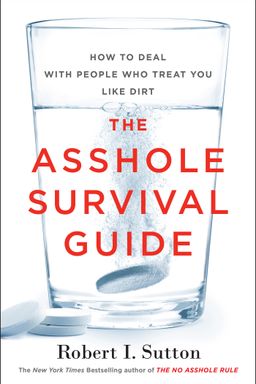
The Asshole Survival Guide cover

The Asshole Survival Guide

by Robert I Sutton

The Asshole Survival Guide provides practical strategies to identify, confront, and manage toxic individuals in your life. With insightful anecdotes and actionable tips, this guide empowers you to protect your emotional well-being and navigate difficult relationships effectively.

Surviving Assholes Without Losing Your Soul

What do you do when you’re surrounded by people who make your life miserable—bosses who belittle you, coworkers who gossip and undermine you, or customers who explode with fury over trivial things? In The Asshole Survival Guide, Stanford professor Robert Sutton argues that the key to surviving and transcending these toxic personalities isn’t to become one yourself, but to develop the awareness, tools, and resilience that allow you to escape, endure, or reform them while protecting your dignity. Sutton contends that assholery—the act of treating people like dirt—is not just a personal flaw but a contagious social disease that can infect entire workplaces, families, and communities.

This book builds on Sutton’s earlier bestseller The No Asshole Rule—a manifesto for creating civilized workplaces free of chronic bullies—and takes it one step further: what to do when you’re stuck with them. It’s about survival, not idealism. As Sutton writes, sometimes you can quit or escape; sometimes you must endure; and other times you must fight—and occasionally even win. Across research, stories, and thousands of emails from readers, he constructs a practical playbook to diagnose asshole problems, reduce your exposure, rethink how you interpret their behavior, fight back intelligently, and ensure you don’t become the very thing you despise.

Why Assholes Matter—and Why They’re Dangerous

Sutton insists we take assholes seriously because their damage isn’t just emotional—it’s measurable. Studies he cites reveal that rudeness and incivility lower productivity, suppress creativity, increase health problems, and spread like a virus across teams. He calls this the total cost of assholes (TCA), a devastating combination of demoralized employees, ruined relationships, and poisoned environments. The harm seeps beyond the workplace: rude bosses create depressed subordinates who then mistreat their families, and bullied children often carry scars into adulthood. Even witnessing bad behavior induces stress. Sutton’s message is blunt—the psychological, financial, and moral costs of assholes are too high to ignore.

The Bias-Busting Mantra: Slow to Label, Quick to Self-Reflect

His defining mantra, “Be slow to label others as assholes, be quick to label yourself as one,” captures the paradoxical empathy at the heart of the book. Sutton warns that the reflex to vilify others blinds us to our own complicity. Every person, he reminds us, has temporary asshole moments—bad days when fatigue, stress, or power transform civility into cruelty. He urges readers to slow down, gather facts, and consider whether they may share blame or misinterpret intent. This humility stems from decades of psychological research (notably Daniel Kahneman’s work on bias and self-delusion) showing that we tend to excuse our behavior and exaggerate others’ faults. Recognizing your own “inner jerk” helps break cycles of hostility and opens the door to compassion, strategy, and change.

A Practical Survival Playbook

The book’s core argument unfolds through six major moves: diagnosing how bad the problem is, making clean getaways when possible, reducing exposure, reframing your thoughts to protect your soul, fighting back with intelligence, and ultimately committing to live the No Asshole Rule personally. In each, Sutton bridges science and story—the West Point cadet who reframed hazing as comedy, the restaurateur who fired abusive clients, or the CEO who literally muted a yelling board member while doing her nails to regain control. Psychology, management theory, and humor intersect to form practical coping techniques anyone can apply.

The Moral Undercurrent

At its heart, The Asshole Survival Guide isn’t just about protecting yourself—it’s about preserving decency in a world where cruelty often masquerades as strength. Sutton argues that real success comes from dignity, empathy, and self-awareness, not domination or humiliation. He shows how power and overload breed assholes, yet also how kindness and cooperation can make people stronger and more effective. His closing image of porcupines huddling for warmth—close enough to share heat but far enough not to spike each other—embodies his vision of humanity: finding the balance between connection and protection. For readers, the ultimate lesson is that surviving assholes means safeguarding your integrity while building environments where fewer thrive.


Diagnosing the Asshole Problem

Before you fight back or flee, Sutton urges you to perform an “asshole assessment.” Becoming aware of what you’re facing helps you avoid reacting impulsively, escalating conflicts, or misjudging situations. He provides six diagnostic questions that help you measure the scale of the problem: Do you feel treated like dirt? How long will the ugliness persist? Is your tormentor temporary or certified? Is it an individual or systemic disease? How much power do you have? And how much are you really suffering?

Temporary vs. Certified Assholes

Everyone has bad days. A boss who snaps under pressure or a colleague who loses their temper may simply be a “temporary asshole.” In contrast, a “certified assholes” displays a sustained pattern of abuse that leaves a trail of damaged people. Sutton uses gripping examples—from Captain Holly Graf, the U.S. Navy officer infamous for seven years of public humiliation and cruelty, to the raving managers and family bosses at one employee’s “A$$hole Factory.” Certified assholes, he insists, are the ones that require deliberate intervention, not just patience.

Systemic Disease and Power Poisoning

Sometimes the problem isn’t just one person—it’s the entire system. Sutton illustrates how toxic cultures spread through similarity-attraction (“assholes breed more assholes”) and emotional contagion. Rudeness is infectious, as Trevor Foulk’s research shows: even one rude encounter can trigger a chain of mimicked behavior across a workplace. Once bullying becomes structural, newcomers either adapt or flee. Adding power to the mix magnifies the harm. Studies by psychologist Dacher Keltner demonstrate that power erodes empathy, prompting those at the top to see rules as optional and people as obstacles. That’s how bullies evolve into enduring tyrants.

Facing Reality and Resistance

Sutton warns about Asshole Blindness—the self-deception that keeps victims stuck in toxic settings. People justify abuse with “ten lies,” such as “It’s not that bad,” “Things will get better soon,” or “I’m learning so much that it’s worth the suffering.” These rationalizations trap people in degrading jobs or relationships for years, as illustrated by the marketing manager who endured seven years of torment before quitting. Recognizing your pain and the permanence of the situation is the first act of liberation. Sutton integrates lessons from behavioral economics—the “sunk cost fallacy”—showing that staying just because you’ve already invested time or effort only deepens the damage.

Ultimately, diagnosing the problem isn’t about blame—it’s about clarity. Once you measure the severity, you can decide whether to escape, to limit exposure, or to fight. Sutton’s approach encourages you to replace emotional reaction with analytical thinking. Like medical triage, you diagnose before acting, ensuring that your energy is spent on strategies that heal rather than hurt.


Making a Clean Getaway

Sutton celebrates quitting—the act most people see as weakness—as an act of wisdom and self-respect. He contrasts Vince Lombardi’s famous dictum “Winners never quit” with countless real-life stories showing that leaving an asshole-rich environment is often the bravest move you can make. He recounts the case of cashier Misty Shelsky, who resigned when her boss offered a $10 prize to employees who could predict which of them would be fired next. A judge later awarded Shelsky unemployment benefits, declaring the contest “egregious and deplorable.” For Sutton, Shelsky’s story makes quitting a moral stand against indignity.

Asshole Blindness and Self-Deception

Many of us fail to leave when we can because we convince ourselves that things are improving or that quitting would make us look weak. Sutton names these patterns “Asshole Blindness.” Victims of prolonged abuse normalize cruelty—the way our noses stop smelling a bad odor after a while. He lists “Ten Lies That People Tell Themselves,” ranging from “I’m tough, it doesn’t affect me,” to “The grass will be even browner elsewhere.” These cognitive traps are tragic because they bind good people to bad places, sometimes until it’s too late. A police officer stayed decades despite humiliation, thinking he could ‘fix things from within,’ only to realize he was trapped in self-righteous suffering.

Smart vs. Reckless Quitting

Of course, Sutton cautions, leaving must be strategic. Dramatic exits like JetBlue attendant Steven Slater’s—grabbing two beers, cursing passengers, and sliding down an emergency chute—may be cathartic but disastrous. You need to weigh your risks and options. Sometimes, enduring a toxic year is wiser, as with the young attorney who finished a two-year clerkship under an abusive judge because leaving would cripple her career. Quitting is about timing and trade-offs, not impulsive rebellion. Knowing your financial security, career prospects, and support systems defines how bold you can afford to be.

Better Transitions and Internal Moves

Not all escapes require resigning. Sutton praises organizations like Salesforce that encourage internal transfers, giving employees ways to “move teams” instead of quitting outright. Even simple physical relocations—a bus driver switching to a tram route or a family attending an earlier church service to avoid bullies—can change emotional climates. Escaping assholes isn’t betrayal; it’s survival. Sutton’s practical advice is to always keep fire exits open: look for escape routes before you’re desperate, whether through new jobs, side projects, or geographical moves.

Leaving the wrong people behind can be painful, but staying too long can be soul-eroding. Sutton sums it up with advice from venture capitalist Michael Dearing: “There’s a big difference between what you do and how you do it.” Depart gracefully, avoid retaliation, and preserve your dignity. Quitting may not fix them—but it always frees you.


Avoiding and Reducing Exposure

If you can’t leave, Sutton’s next strategy is about distance—physical, psychological, and social. Drawing on research by MIT’s Tom Allen, Sutton shows that sitting just twenty feet farther from a jerk dramatically reduces interactions. He calls this “riding the Allen Curve.” Even small physical separations—different floors, separate offices—act as emotional air filters. When university administrators relocated a pompous professor miles away from campus, harmony was instantly restored. Proximity, Sutton reminds us, equals exposure.

Duck, Dodge, and Delay

Other methods are stealthier. “Ducking” refers to avoiding or limiting contact without confrontation—arriving late, leaving early, or conveniently “having meetings elsewhere.” These moves are not cowardice; they are survival techniques. Sutton recounts using them himself with a narcissistic colleague who made him nauseous in meetings. Even simple exits or silence can protect emotional health. A former doctoral student mastered the “rhythm method”—delaying responses to her abusive advisor for hours or days, until he lost interest. By depriving bullies of attention—their reinforcement—she reduced their satisfaction and, over time, their frequency of attack.

Hide in Plain Sight and Recruit Shields

Some assholes target visibility. Sutton describes employees who embrace invisibility—doing solid but unremarkable work, blending in, and avoiding notice from volatile superiors. He cites Harvard’s Michel Anteby and Curtis Chan’s study of TSA officers who learned to “float under the radar,” avoiding tasks that drew verbal abuse. Likewise, finding allies who act as human shields—bosses or colleagues who intercept the abuse—can be lifesaving. Good leaders see their role as umbrellas catching the “shit from above,” as one hospital director proudly put it.

Safety Zones and Early Warning Systems

No battlefield is complete without refuges. Nurses’ lounges, smoke breaks, or even bathrooms become “backstage regions” where people recover and support each other. Goffman’s theatrical metaphor—public life as performance—applies here: backstage equals healing. Sutton also reveals ingenious “early warning systems” used by teams to alert peers to incoming jerks. Whether through discreet Slack messages or joking codes like “The witch is on her broom,” forewarning lets people prepare emotionally and tactically.

Avoidance, Sutton writes, is not surrender—it’s strategy. It minimizes contagion so that incivility doesn’t infect you. Limiting exposure, even in small doses, helps preserve sanity, promote empathy, and prevent the dangerous temptation to retaliate in kind.


Mind Tricks That Protect Your Soul

Even when you can’t escape, you can reshape how your mind interprets abuse. Sutton draws deeply on cognitive behavioral therapy to show how reframing—changing your perception—can convert emotional wounds into manageable thoughts. Instead of fighting jerks directly, you learn mental agility: detachment, humor, and forgiveness. Each reframing trick turns psychological torment into something lighter, even absurd.

You Aren’t to Blame and It’s Not That Bad

Targets often internalize attacks. Sutton references Stanford research by Jens Blechert proving that reframing anger images (“imagine they had a bad day”) reduces stress dramatically. Prison guards use similar logic—seeing inmates’ insults as attacks on authority, not on themselves. By depersonalizing aggression, they preserve empathy. Becky Margiotta, the West Point cadet who survived hazing, turned humiliation into amusement, viewing tormentors as creative comedians rather than oppressors.

Silver Linings and Rising Above

Optimism can be armor. Journalists who endured harsh editors later valued the skills they acquired—finding “ponies under the poop.” Michelle Obama’s famous mantra “When they go low, we go high” encapsulates moral transcendence. At Philz Coffee, baristas turned rude customers into redemption stories: they killed them with kindness until grumpy clients softened. Sutton notes that self-restraint and civility are sources of pride, not weakness.

Forgiveness, Humor, and Time Travel

Forgiving your tormentors—without excusing them—liberates you. Research from psychologist Charlotte Witvliet shows that imagining forgiveness lowers blood pressure and distress. Humor, as Danish and Canadian studies reveal, buffers daily bullying. Even silly nicknames like “boardholes” or “grinf**kers” transform outrage into amusement. Temporal distancing, or “looking back from the future,” reminds you that today’s pain will fade; “This too shall pass” becomes a calming mantra that shifts perspective from suffering to endurance.

Emotional Detachment Hierarchy

Sutton describes detachment as a hierarchy of self-defense—from mild to extreme. Level 1: tune out during downtime, resist ruminating after work. Level 2: detach selectively in tough moments—respond blandly, act clinical, and give nothing for bullies to exploit. Level 3: complete disengagement in toxic environments—offer only “Minimum Viable Effort” to keep your soul intact. His warning is clear: total numbness is dangerous, but partial indifference is sanity-saving.

Reframing doesn’t fix assholes—it fixes your internal narrative. Yet Sutton cautions that relying solely on mind tricks can slide into denial. For severe abuse, reframing alone isn’t enough—you may need to escape or fight. Still, as temporary medicine, these mental flak jackets protect your soul until real change is possible.


Fighting Back Without Becoming One

Once you’re ready to confront assholes, Sutton’s tone shifts from introspection to strategy. Fighting back is risky—you must plan carefully, gather evidence, and manage emotions. He divides smart counterattacks into four types: calm confrontation, righteous anger, love bombing, and systemic reform. Above all, he warns you not to fight stupidity with stupidity.

Calm and Rational Confrontation

Gentle honesty often works wonders. Sutton highlights wives, teammates, and executives who defuse cruelty by presenting facts without rage—like Winston Churchill’s wife Clementine, who wrote him a letter about his “rough sarcastic manner” and urged “Olympian calm.” Feedback delivered with dignity reforms those unaware of their impact. Similarly, a manager invoked company core values—respect and teamwork—when a colleague mocked employees for “just being lucky to have a job.” Moral clarity, not aggression, won the day.

Porcupine Power and Passive-Aggressive Wit

Sometimes firmness matters. Sutton borrows Rod Kramer’s phrase “porcupine power”: sharp dignity that tells bullies you won’t tolerate abuse. One manager stared down a raging ex–Army major until he retreated. A software engineer delayed an executive’s tantrum by calmly saying, “Twenty-five minutes,” and shutting the door—assertive, not explosive. Humor can help too. When moviegoers refused to stop talking, a simple joke—“What do YOU want to talk about?”—broke tension without escalation.

Love Bombing, Manipulation, and Redemption

Sutton’s most surprising tactic is flattery. Loving your enemy can reform them—or at least protect you. His daughter Claire transformed a hostile cook into an ally by complimenting his food and smiling until he softened. Likewise, employees trapped under narcissists sometimes “kiss up strategically,” using fake praise to distract tyrants while quietly plotting their exit. These counterintuitive tactics turn power games into self-protection.

Using Systems and Allies

One person’s resistance rarely changes institutions; systems must step in. Sutton praises organizations with explicit “no asshole” rules—Baird Financial, Google, Netflix—and leaders who act swiftly on evidence. Documentation, unity, and collective pushback amplify power. Still, he warns that rules and HR departments often fail victims because bureaucracy protects the powerful. When systems are rigged, silence or escape can be safer than frontal attacks.

Fighting assholes, Sutton concludes, is ultimately a battle for dignity. Even if you lose materially, asserting boundaries restores psychological control. Courage paired with civility is strength—the mark of someone who refuses to stoop to the level of those who wound them.


Be Part of the Solution

Sutton closes with a call to conscience: don’t just survive assholes—stop being one. Living the No Asshole Rule means making kindness and respect habitual, not conditional. This philosophy is both moral and pragmatic. Assholes breed stress and fear; givers breed trust and innovation. The cure for cruelty, Sutton insists, begins with self-awareness and accountability.

Protect Others, Not Just Yourself

Empathy expands survival into stewardship. Like the hospital staff who mark “safe colleagues” with badges to help newcomers avoid abuse, Sutton encourages creating safe havens and mentoring kindness. The “Attending Asshole of the Week” ritual among surgeons turned complaint into learning—participants vowed never to emulate cruelty they witnessed. Protecting others proves civility scales.

Self-Awareness and Power Control

Many assholes are blind to their own behavior. Sutton integrates David Dunning’s research showing that incompetent people overestimate their skill and underestimate their jerkiness—the Dunning–Kruger effect. He urges deliberate feedback from truth-tellers, like Churchill’s wife or his own department chair who forced him to apologize to a student. Power and overload amplify arrogance; humility and rest counteract it. IDEO CEO Tim Brown modeled humility by giving up his private office to work publicly among employees. Reducing power distance, Sutton notes, prevents “power poisoning” and fosters empathy.

Apologizing and Forgiving

When you screw up, own it. Director John Carney’s unqualified public apology to Keira Knightley—acknowledging “petty, mean and hurtful” words—shows how sincerity restores trust. Sutton analyzes apology research by Roy Lewicki: effective apologies require full responsibility, genuine regret, repairs, and no excuses. Beware, however, of serial apologizers whose words replace real change. Forgiveness, as Sutton repeats from earlier chapters, is healing only when coupled with behavioral growth.

Time Travel and Porcupine Wisdom

Sutton’s final metaphor—the German fable of porcupines huddling for warmth—summarizes his philosophy: true decency means staying close enough to connect but far enough not to wound. Using “mental time travel,” imagine your future self reflecting with pride: did you treat others with dignity? No one, Sutton reminds us, ever says on their deathbed, “I wish I’d been meaner.”

Being part of the solution transforms survival into leadership. It means creating pockets of humanity where respect is contagious. The reward isn’t just peace—it’s pride in building spaces where people can share warmth without pain.

Dig Deeper

Get personalized prompts to apply these lessons to your life and deepen your understanding.

Go Deeper

Get the Full Experience

Download Insight Books for AI-powered reflections, quizzes, and more.