
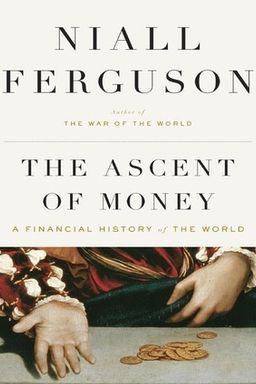
The Ascent of Money cover

The Ascent of Money

by Niall Ferguson

The Ascent of Money explores the fascinating evolution of the global financial system, revealing how it has shaped human history. Despite its crises and inequalities, finance drives economic progress and offers unexpected routes out of poverty. Niall Ferguson masterfully unravels the complexities of money, credit, and markets, offering insights into their profound impact on our world.

The Ascent of Money: Trust, Risk, and Civilization

Money is not merely metal or paper — it is a network of trust, promises and institutions that shape civilization itself. In The Ascent of Money, Niall Ferguson argues that financial history is human history: every major leap forward — from empires and industry to revolutions and global trade — is powered by the evolution of money and credit. Finance has made modern life possible, but every innovation also brings its own fragility and recurring crises.

You learn how money began as tangible metals and evolved into intangible promises. From Mesopotamian clay tablets to modern digital ledgers, what makes money 'real' is not its substance but collective faith that it can be exchanged for goods or services. Finance, by this logic, becomes an institutionalized form of trust. To understand its ascent is to grasp how societies manage risk, allocate capital, and confront uncertainty.

From Metal to Memory

Early societies used silver or gold not because of beauty, but because of durability and divisibility. Yet even ancient Babylonians wrote loans onto tablets, showing that money always functioned as a promise more than a thing. The Spanish Empire’s flood of silver from Potosí did not create lasting wealth; instead, it triggered inflation — proof that excess money erodes value. This historical tension between material abundance and trust underlies every monetary system since.

When the Bank of England wrote “I promise to pay the bearer,” it formalized trust as policy. Today, nearly 90 percent of money exists as numbers in computers. The story that begins in temple storerooms now runs through central banks — institutions that preserve faith through credibility, signals, and intervention.

Credit, Confidence, and Catastrophe

Finance expands when promises multiply. Banks, beginning with the Medici, professionalized lending and created credit systems that transformed economies. Credit encourages investment and entrepreneurship but is always vulnerable to panic. Whenever confidence breaks — from the 1873 crisis to Northern Rock in 2007 — liquidity vanishes and promises collapse into fear.

Bond markets then taught governments the cost of trust. Venice and Florence financed themselves through public debt; later Britain and the Rothschilds used bonds to sustain wars and empires. Investors discipline states through yields, forcing good fiscal behavior or punishing mismanagement. From Weimar inflation to modern defaults, sovereign credibility defines economic survival.

Risk and Human Nature

Every financial innovation — stocks, insurance, securitization, derivatives — arose to manage risk. Insurance turned gambling into statistical science; equity markets spread ownership and optimism; securitization extended credit to millions. But human biases — euphoria, greed, and herd behavior — repeatedly distort rational design. John Law’s Mississippi bubble, the 1929 crash, and the dot-com mania reveal our impulse to believe that prices always rise.

The crises of 2007–2008 exposed complexity itself as risk. Mortgage-backed securities and credit derivatives diffused exposure worldwide. What began in Detroit or Memphis homes propagated through shadow banks and global investors, proving that trust can multiply faster than transparency.

Global Imbalances and the New Divide

Finance has become planetary. China’s savings and America’s spending formed “Chimerica,” a symbiosis that produced cheap credit and the housing bubble. The same flows created sovereign wealth funds powerful enough to rescue Western banks while shifting geopolitics. As capital globalized, inequality widened between those who can hedge, diversify and leverage — hedge funds and corporations — and those who cannot: ordinary households tied to jobs and mortgages.

Evolution and Lessons

Finance evolves like biology — through mutation and selection. Institutions that adapt survive; others perish. LTCM’s collapse shows how mathematical arrogance can meet reality’s volatility. The evolutionary analogy explains why markets periodically reset through crises and why regulation changes the environment in which they evolve. Ferguson closes by reminding you that history repeats because human psychology doesn’t change — arrogance, greed, and short memory remain constants.

Core Message

Money is not neutral machinery; it is the social technology that binds trust, risk and power. If you understand how promises become credit, how confidence fuels bubbles, and how crises cleanse excess, you can read the world — and your own financial choices — with historical insight instead of fear.

In short: finance is civilization’s mirror. It reflects our ingenuity and our folly, our capacity for cooperation and our vulnerability to panic. To understand its ascent is to understand ourselves.


Money and the Architecture of Trust

Money began as tangible materials but matured into intangible trust. Ferguson guides you through the transition from silver coins in Potosí to the digital balances in your bank account. What makes money viable is not its physical form but its credibility: a shared belief that others will accept it.

From Metal to Credit

Gold and silver conquered ancient anxieties about durability and divisibility, forming global standards for centuries. Yet the clay tablets of Mesopotamia prove that written promises preceded coinage. The English banknote’s phrase “I promise to pay the bearer” crystallizes the concept: value lies in the issuer’s trustworthiness, not intrinsic substance.

Inflation and False Abundance

Spain’s sixteenth-century influx of silver might feel like prosperity, but the outcome — Europe’s price revolution — teaches a timeless truth: more money without more production makes each unit worth less. Today’s printing presses and digital entries continue the same dance between abundance and trust.

Insight

Money is trust inscribed — whether stamped in silver or stored as data, it functions because we collectively believe the promise will hold.

Understanding money as belief explains modern policy: central bank communication, interest rates and quantitative easing work by shaping expectations. The architecture of trust remains the cornerstone of economic order.


Credit, Banking, and Fragile Confidence

If money is promise, banks mechanize that promise into credit. Ferguson shows how families like the Medici and institutions like the Bank of Amsterdam transformed simple lending into vast interlinked systems of investment, exchange and state finance.

The Logic of Credit Creation

Banks hold deposits but lend out most of them, setting off multipliers that swell the money supply. Fractional reserves enable growth — turning $100 of base money into multiples as loans cycle. This system creates prosperity but also potential panic when confidence fails.

Runs, Risk and Regulation

Because deposits can be withdrawn at any time while loans extend for years, banks live with maturity mismatch. Bagehot’s rule — lending freely at a penalty rate — defines a central bank’s role in crises. From the Medici’s fall to Northern Rock’s collapse, each run reveals how fragile confidence can wipe out institutions.

The Intelligence Function

Banks collect data about borrowers, enabling smarter resource allocation. Scale and diversification make that function efficient and protect against predatory lending. The Medici’s networked model anticipates modern global banks and even today's shadow banking entities that mimic their advantages off-balance-sheet.

In essence, banks are promise engines: they magnify trust into productive credit. But the same machinery, poorly managed, magnifies fear into financial contagion.


Markets, Bubbles, and Human Psychology

Finance thrives on imagination as much as numbers. Ferguson’s treatment of stock markets and speculative episodes exposes our emotional side: desire, herd instinct and overconfidence drive cycles of boom and bust. Markets are arenas of narrative as much as calculation.

From VOC to Wall Street

The Dutch East India Company pioneered joint-stock ownership that let investors fund colossal ventures without kings. Its shares appreciated steadily, showing disciplined capitalism. Yet other cases — the South Sea bubble or John Law’s Mississippi scheme — demonstrate the anatomy of mania: displacement, euphoria, distress, revulsion.

Recurring Patterns

The 1929 crash, 1987’s Black Monday, and the dot-com bust replay the same psychology. New technologies and cheap credit produce excitement; models and leverage amplify risk. Enron adds a moral twist — fraud and incentives intensify collapse. Each episode shows that 'irrational exuberance' is recurrent, not rare.

Lesson

If you invest, remember bubbles are built on stories, not balance sheets. Diversify and respect liquidity; prices fall faster than models predict.

Markets discipline enterprises but mirror collective mood. They reward rational patience and punish leveraged optimism. Ferguson calls bubbles timeless symptoms of human nature — reminders that finance cannot outgrow psychology.


Risk, Insurance, and the Birth of Mathematics

Centuries before quants and algorithms, merchants and mathematicians fused commerce and probability to form modern insurance. Ferguson presents this evolution as the moment humanity learned to quantify risk rather than fear it.

From Maritime Deals to Actuarial Science

Early contracts like bottomry loans spread voyage risk across investors. Lloyd’s of London professionalized underwriting; Scottish ministers created collective pension funds using precise statistics. Figures such as Pascal, Fermat and Halley transformed probability into a humanitarian technology.

Mathematical Foundations

Halley’s life table and Bernoulli’s Law of Large Numbers proved that pooling many independent risks stabilizes losses. Bayes’ theorem taught inference from limited data. Mathematical forecast replaced guesswork, letting insurers and pension funds plan for decades with reliability.

Why It Matters

Insurance converts catastrophe into manageable cost — transforming uncertainty into stable expectation. That conceptual leap supports industries, homes, and even nations today.

The actuarial revolution linked rationalism to compassion. It made society collectively resilient, proving that science can tame randomness but never eliminate it entirely.


Housing, Securitization, and Global Crisis

Few financial stories touch your life like the mortgage saga. Ferguson explains how government-driven homeownership ideals, securitization, and loose credit combined to trigger the subprime debacle that shook the world.

Constructing the Property Dream

U.S. agencies like the FHA and Fannie Mae built the 'property-owning democracy' after the 1930s, making mortgages affordable and politically desirable. Thatcher’s Britain repeated the formula through council house sales and tax relief. By the 1980s, mortgage debt became a pillar of identity and policy.

Financial Engineering and Fragility

Lewis Ranieri’s mortgage-backed securities transformed illiquid loans into global investments. Securitization spread risk but also obscured it. Brokers chased volume, offering adjustable-rate and teaser loans to risky borrowers, betting prices would always rise. Subprime neighborhoods like Detroit’s 48235 illustrate how local defaults turned into worldwide losses.

Shadow Banking and Contagion

Off-balance-sheet vehicles (SIVs) financed themselves short-term; when confidence broke, they imploded. BNP Paribas’s frozen funds and Bear Stearns’s hedge failures signalled contagion. Banks, forced to absorb hidden assets, triggered systemic panic. By 2008, losses surpassed hundreds of billions, echoing historic crashes.

Understanding the Chain

Mortgages in small towns can ripple to Oslo or Shanghai because finance is now a global ecology — interconnected, leveraged and vulnerable.

The subprime crisis revealed the thin line between democratization of credit and unsustainable speculation. Policy ambition and market innovation merged into a feedback loop of unrealistic trust.


Derivatives, Hedge Funds and the Power of Leverage

Derivatives turn risk into commodity. Ferguson’s exploration of hedging and hedge funds demonstrates how sophistication redistributes exposure — but also divides society between those protected and those naked to shocks.

From Farmers to Quants

Farmers once used forwards to stabilize crop prices. By the twentieth century, traders expanded this principle into futures, options, swaps and credit default swaps. The Chicago Mercantile Exchange systematized these contracts; by 2007, OTC derivatives amassed notional values near $600 trillion, reflecting an intricate web of commitments.

Who Gets Protected

Hedge funds like Citadel and managers such as Ken Griffin use derivatives to hedge volatility, credit defaults or even hurricanes. Ordinary people, lacking scale or expertise, cannot access bespoke protection. Ferguson calls this the new divide: a world split between the hedged and the unhedged.

The LTCM Cautionary Tale

Long-Term Capital Management epitomized mathematical brilliance undone by leverage. With Nobel laureates on board, it bet that historical correlations would hold — they did not. In 1998, Russia’s default shattered its models, forcing a bailout to prevent systemic collapse.

Moral

Sophisticated instruments can hedge against normal volatility, but not against hubris. Leverage magnifies human error faster than mathematics can correct it.

Derivatives let global players transfer risk across continents; they also transfer moral hazard. What began in crop fields now defines modern uncertainty.


States, Bonds and Geopolitical Finance

Governments borrow to survive and thrive. Ferguson’s discussion of bond markets links fiscal policy, politics and warfare across centuries — from Italian city-states to modern treasuries.

Origins of Sovereign Debt

Venice and Florence invented tradable public debt, turning citizens into creditors. This alignment made credit legitimate and enduring. Later, Britain’s funded debt system and the Rothschild network scaled the model internationally, financing wars and infrastructure.

Bond Markets as Discipline

Bond yields set benchmarks for all long-term interest rates. Market mistrust raises yields, punishing governments. James Carville’s quip — wanting to come back as the bond market — captures its invisible power over policy and taxation.

Defaults and Inflation

The Confederate cotton bonds lost value as territory fell; Weimar Germany’s hyperinflation erased domestic debt. Such episodes show that fiscal credibility outlasts weapons but not mismanagement. Inflation is a stealthy form of default.

Takeaway

The bond market isn’t just finance—it’s politics quantified. It translates trust in language of yield spreads.

Understanding bonds means understanding state power. Every budget, every deficit and every promise ultimately faces its day of reckoning in the market.


Finance, Inequality, and Evolution

Finance doesn’t just shape economies; it shapes society itself. Ferguson describes the rise of financial specialization, the concentration of wealth and the Darwinian dynamics that determine winners and losers across centuries.

Darwinian Competition

New instruments — from bonds and derivatives to hedge funds — evolve through competition. Successful innovations replicate; failures become extinction events. The Savings & Loan crisis, the Great Depression and the 2007 meltdown are evolutionary resets where weak species vanish, and survivors adapt.

Concentration and Inequality

Finance's share of GDP tripled from mid-century to 2005; compensation ballooned. Elites captured exponential returns while wages stagnated. Yet finance also funds pensions, science and global trade — it’s producer of prosperity and asymmetry simultaneously.

Evolutionary Policy

Regulation acts like environmental pressure. Basel rules, central bank policies and deposit insurance shift incentives and survival odds. Ferguson warns policymakers to design rules anticipating adaptation, not static compliance.

Final Reflection

Finance is not parasitic on civilization—it is its bloodstream. But unchecked growth without empathy produces instability and inequality. Learn history’s cycles to thrive, not just to profit.

The ascent of money thus culminates in self-awareness: to prosper, societies must pair innovation with humility, leverage with wisdom, and wealth with purpose.

Dig Deeper

Get personalized prompts to apply these lessons to your life and deepen your understanding.

Go Deeper

Get the Full Experience

Download Insight Books for AI-powered reflections, quizzes, and more.