
Idea 1
Act As If: How Behavior Shapes Emotion, Motivation, and Identity
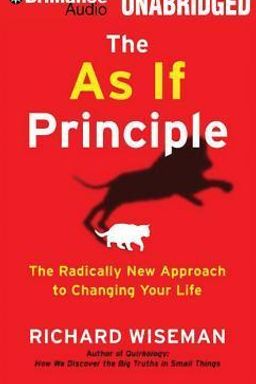
Have you ever tried to think yourself into happiness only to find it didn’t last? In The As If Principle, psychologist Richard Wiseman argues that trying to change your mind from the inside out—through positive thoughts or affirmations—often fails because thinking doesn’t directly produce change. Instead, Wiseman shows that lasting transformation begins with your actions. The book revives the radical idea first proposed by nineteenth-century philosopher William James: If you want a quality, act as if you already have it.
Wiseman’s central claim is simple but revolutionary: rather than forcing yourself to feel confident, courageous, or joyful, you must behave as if you already do. The emotional and mental state will follow your behavior, not precede it. Drawing from decades of psychological experiments, brain research, and practical exercises, Wiseman argues that everything from happiness and love to willpower and persuasion is governed by this powerful law of human behavior. Once you act the part, your physiology, memory, and emotion adjust to match it.
The Body-Mind Reversal
Wiseman opens with the story of Wilhelm Wundt, the first psychologist to study the mind scientifically through tedious reaction-time experiments with brass balls. William James rebelled against this sterile approach, proposing instead that emotions stem from bodily reactions. James declared that we don’t cry because we’re sad—we feel sadness because we cry. This inversion was shocking in the nineteenth century but proved prophetic. The book revisits James’s forgotten theory and builds on its revival through twentieth-century experiments that tested how behavior leads emotion: smiling creates happiness, running induces fear, and posture generates confidence.
Why Actions Matter More Than Thoughts
Across the book, Wiseman structures his exploration around key life domains—mental health, relationships, motivation, persuasion, confidence, and identity. In each, he demonstrates that our everyday behaviors are like levers for our emotions and beliefs. For instance, if you smile, you’re not only performing happiness but producing it through neural feedback. If you move with energy, mimic confidence, or act kindly, the internal feelings will catch up. Governments, corporations, and therapists have often focused on changing thoughts—through therapy, advertising, or slogans—while ignoring that behavior is faster, easier, and more effective.
From Philosophy to Practice
The book unfolds like an experiment kit on how to live as if. You learn to adopt behaviors that trigger emotional and mental change: smiling when low, moving confidently, acting kindly to cultivate empathy, or engaging in disciplined routines to build willpower. Wiseman shows this principle’s reach—from managing depression through behavioral activation, to sparking attraction by acting romantically, to boosting self-esteem through confident posture.
The author walks readers through striking experiments: smiling participants recalled more joyful memories; angry facial expressions elevated stress hormones; dancing alleviated depression; posture improved persistence. Even beliefs can shift this way. Political opinions, moral positions, and prejudices often follow public actions—people come to believe what they see themselves doing. From soldiers in wartime to children in classrooms, behavior rewires belief.
Why It Matters
This behavioral route to change holds immense promise. Wiseman contends that focusing on what you do rather than what you think resolves the paradox of many self-help methods that emphasize affirmations but fail to stick. By starting outside—through movement, posture, speech, and expression—you tap into the brain’s built-in mechanism that mirrors bodily states. This makes change rapid and physiological rather than intellectual.
Ultimately, The As If Principle reveals that we are not prisoners of our moods or personalities. You are constantly shaping yourself—emotionally, mentally, and socially—through the simplest of signals: how you move, talk, stand, smile, or act. Whether you want to feel happier, stronger, more persuasive, or more compassionate, behaving “as if” creates real transformation. Wiseman brings science to its simplest possible directive: Don’t think better—act better first.