
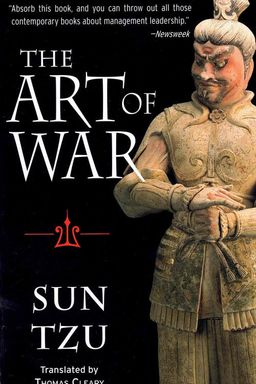
The Art of War cover

The Art of War

by Sun Tzu

Sun Tzu''s The Art of War offers timeless strategies that transcend the battlefield, guiding leaders in business, politics, and personal life. Discover how to choose your battles wisely, leverage intelligence, and lead with integrity and empathy.

The Psychology and Philosophy of Winning Without Fighting

Have you ever wished you could resolve conflict—at work, home, or in society—without confrontation? Sun Tzu’s The Art of War, written over two thousand years ago, answers that question with profound simplicity: the greatest victory is to win without fighting. In this ancient masterpiece of Chinese philosophy and strategy, Sun Tzu presents a worldview that merges tactical brilliance with deep psychological insight and moral awareness. Far beyond being just a manual for generals, the book offers a philosophy for handling competition, leadership, and human relationships.

Sun Tzu argues that all conflict—whether military, political, or personal—follows certain laws of nature, and he urges us to master these laws through understanding rather than aggression. Translator Thomas Cleary emphasizes that this is not merely a text about war; it is fundamentally a work of Taoist wisdom. It shows how balance, adaptability, perception, and inner discipline create the power to navigate conflict with minimal violence and maximal efficiency.

Conflict as an Expression of Nature

In the Taoist worldview underlying The Art of War, conflict is not an aberration—it is a natural expression of yin and yang, the interplay of opposing forces. Just as night turns to day, strength alternates with weakness, and every action provokes a counteraction, conflict must be seen as part of the life cycle. To resist it blindly is futile; to understand it is empowering. Sun Tzu teaches you to observe these patterns so deeply that you can predict when tensions will crest, when they will weaken, and how to move so that outcomes favor you long before battle begins.

In this sense, “war” becomes a metaphor for all forms of competition—business rivalries, political struggles, even personal challenges. The same strategies that governed ancient campaigns also apply to office negotiations or internal battles of self-discipline. The Taoist influence here tempers aggression with humanity, urging the strategic mind to value harmony.

From Force to Flow: Taoism and Strategy

Cleary’s introduction highlights that The Art of War can be fully understood only through its Taoist lens. Taoism teaches action through nonaction, spontaneity, and sensitivity to circumstances—a concept known as wu wei. The best leaders are not those who dominate with power, but those whose calm awareness bends circumstances their way without visible effort. Thus, the book’s military advice often sounds paradoxical: conceal strength under weakness, advance by retreating, win by yielding. Victory depends not on brute force but on mastery of perception.

Taoist texts like the Tao Te Ching and the I Ching—both major influences on Sun Tzu—stress this same wisdom. Just as water flows around obstacles, the wise strategist adapts fluidly to changing situations. Instead of insisting on control, you align yourself with nature’s currents. This makes The Art of War timeless: it teaches you to unleash potential energy (what Sun Tzu calls “momentum”) rather than to force outcomes through willpower alone.

Victory as Self-Mastery

At its deepest level, The Art of War is a treatise on psychology. Sun Tzu repeatedly reminds the reader that the mind, not the sword, determines triumph. To know the enemy and to know oneself ensures perpetual safety. Emotional detachment—freedom from anger, greed, or fear—is what separates the wise from the reckless. A general who acts out of wrath brings ruination; a calm, patient leader converts danger into opportunity.

This self-mastery extends to all aspects of life. The strategist must plan carefully (“measure, assess, calculate, compare, and then win”) while remaining inwardly serene, never succumbing to impulsiveness. Like a physician who prevents disease rather than curing it, the great general prevents conflict before it erupts. Sun Tzu compares himself to a healer who “sees the spirit of sickness and removes it before it takes shape.” You, too, can use foresight and self-control to defuse crises before they become battles.

A Framework of Universal Principles

Across its thirteen chapters, The Art of War unfolds a comprehensive system of strategic thinking grounded in five key categories: the Way (moral alignment), the Weather (timing and context), the Terrain (environmental conditions), Leadership (virtues and character), and Discipline (organization and law). These principles weave together military, political, and psychological insight. They apply to armies and organizations alike, establishing that right conduct and social coherence are as crucial as tactics and weaponry.

When these five factors align—when leadership inspires trust, timing fits the situation, preparation matches conditions, and discipline sustains morale—victory arises naturally. It is not a matter of luck or brute strength, but of harmony within and without. Cleary points out that postwar Japan adopted these same principles for economic competition, exemplifying Sun Tzu’s dictum that “to win without fighting is best.”

Why It Matters Now

Modern readers may never lead troops into battle, yet they face conflicts no less real: workplace rivalries, political polarization, internal anxieties, and global crises. Sun Tzu’s central offering is psychological clarity amid chaos. He teaches you to see conflict as a system of patterns and probabilities, to minimize wasteful aggression, and to lead through intelligence and compassion rather than intimidation.

“Those who assist a leader by means of the Tao do not use arms to coerce the world,” says an old Taoist text quoted by Cleary. It is a reminder that true power arises from restraint. Applied wisely, The Art of War transforms competition into creativity, replacing the fear of confrontation with the mastery of understanding. In a world that still glorifies domination, Sun Tzu’s enduring genius lies in revealing that peace, properly understood, is the highest form of strategy.


The Five Foundations of Victory

Every successful endeavor—whether a military campaign, a business plan, or a personal goal—depends on preparation. Sun Tzu begins his work with “Strategic Assessments,” outlining five constant factors that determine the outcome of all conflict: the Way, the Weather, the Terrain, Leadership, and Discipline. These correspond to moral, temporal, physical, personal, and organizational dimensions of strategy. The genius of this system lies in how universal it is. You can apply it to war, politics, negotiations, or even relationships.

The Way: Moral Alignment

The first and most important principle, the “Way” (Tao), refers to harmony between leader and people. When a ruler acts with fairness, justice, and benevolence, people willingly share danger and hardship. This is not sentimentality—it’s recognition that morale and shared purpose outweigh coercion. The general who wins hearts wins campaigns without firing a shot. In modern terms, this means aligning a team or organization around shared values and mutual respect rather than fear.

The Weather and Terrain: Timing and Context

Next comes the Weather, signifying timing, seasons, and rhythm. Every action must fit its moment. Just as a wise farmer plants according to the seasons, a strategist must sense when to move, pause, or change direction. Terrain, meanwhile, represents situational awareness—the literal and figurative environment that shapes all action. Knowing the “terrain” means knowing your market, team dynamics, or emotional context. As Sun Tzu says, “When you know sky and earth, victory is inexhaustible.”

Leadership and Discipline: The Human Factor

Leadership, in Sun Tzu’s catalogue, is a balance of five virtues: intelligence, trustworthiness, humaneness, courage, and sternness. Each requires careful proportion. Too much compassion weakens authority; too much severity destroys morale. The best leaders combine firmness with empathy. Discipline complements leadership by ensuring order. Clear rules for reward and punishment, fairly enforced, create unity of purpose. (Management experts often echo this, stressing clarity and consistency as the basis of effective teams.)

The Mathematics of Preparation

After considering these five elements, the strategist must calculate relative strength—measuring the conditions of self and opponent. This process of comparison, called “strategic assessment,” transforms intuition into insight. Sun Tzu insists that victory can be foreseen long before battle: “Victorious warriors win first and then go to war; defeated warriors go to war first and then seek to win.” The wise leader spends more energy on analysis than on combat.

By applying these five lenses—moral, temporal, environmental, human, and procedural—you learn to act with foresight rather than impulse. You can ask yourself, before any major decision: Do I have alignment? Is timing right? Do I know the terrain? Are my people led well? Are our systems sound? When these answers are yes, conflict may never even need to occur.


Momentum, Energy, and the Power of Flow

One of Sun Tzu’s most insightful ideas is that effective action comes from momentum rather than individual heroism. In his chapter on “Force,” he introduces the concept of shi—the accumulated energy of a situation, like the potential energy in a stretched bow. The wise general harnesses this energy and releases it at the right moment, achieving disproportionate results with minimal effort.

Force Without Forcing

To operate by momentum means to align with conditions rather than fight them. Just as water flows downhill naturally, energy will find the path of least resistance if directed wisely. Sun Tzu observes: “Good warriors seek effectiveness in battle from the force of momentum, not from individual people.” A commander should focus less on commanding courage than on designing systems that make courage inevitable. If your organization’s structure and timing are right, even ordinary people perform extraordinarily.

The Art of Timing

Momentum depends on rhythm. Sun Tzu compares it to the precision of a hawk striking its prey: swift, deliberate, and in tune with opportunity. Too early or too late, and energy dissipates. This principle mirrors modern behavioral science and performance psychology, which emphasize states of flow—moments when effort feels effortless because it follows the natural pace of events.

Unity and Coordination

Momentum also arises from collective alignment. Sun Tzu likens a coordinated army to rolling logs down a mountain—the mountain provides the momentum; the logs merely follow gravity. In teamwork, the same holds true: when goals and methods are unified, individuals feel carried by shared motion rather than burdened by isolated exertion. The best leaders, therefore, spend more time shaping structures and morale than giving orders.

Adaptation Through Energy

Force without adaptability becomes rigidity; adaptability without force becomes confusion. The Taoist key is balance—moving with circumstances, aware but unresisting. “The unorthodox and the orthodox give rise to each other,” Sun Tzu writes, meaning that creative strategy emerges from blending stability with surprise. Modern innovation principles echo this duality: structure plus spontaneity yields vitality. Whether you lead a company or a personal project, cultivating momentum—internal, collective, and environmental—is how you turn potential into inevitable success.


Know Yourself, Know Your Enemy

Perhaps the most famous line from The Art of War sums up its psychological wisdom: “If you know others and know yourself, you will not be imperiled in a hundred battles.” This principle underlies every strategy Sun Tzu teaches. Knowledge, not aggression, defines mastery. Ignorance, both of self and of others, leads to predictable ruin.

Self-Knowledge: The Inner Battlefield

To know yourself is to understand your strengths, weaknesses, and motivations. Many lose battles not from external threats but from inner blindness—overconfidence, fear, or emotional instability. Sun Tzu reminds leaders that “to see victory when it is apparent to all is not true skill.” True skill lies in recognizing invisible patterns—the subtle balance of readiness and restraint. This requires emotional composure, critical honesty, and the capacity to learn from correction rather than pride.

Knowing the Enemy: Empathy as Strategy

Understanding opponents means more than gathering information. It involves empathy—the ability to perceive others’ fears, hopes, and habits. Sun Tzu devotes his final chapter to intelligence work, describing five types of spies to ensure “foreknowledge.” But this isn’t just espionage; it’s the discipline of perspective-taking. In negotiation or competition, the most prepared person anticipates how others will think, then acts accordingly. As Cleary notes, this is the essence of Taoist awareness: knowledge without hostility.

The Mathematics of Awareness

When both sides are known, outcomes become calculable. When even one side is obscured, danger multiplies. Sun Tzu’s triad—know yourself, know others, know the environment—creates a foundation of predictability amid chaos. Modern strategists from Clausewitz to corporate thought leaders reiterated this law: clarity of perception precedes clarity of action. To practice it, you cultivate both humility and curiosity, seeing every encounter as data for wisdom rather than fuel for ego.


The Economics of War: Efficiency as Ethics

Sun Tzu’s warnings about prolonged warfare form one of the world’s first treatises on sustainable economics. In “Doing Battle,” he condemns long campaigns not only as inefficient but as morally corrupting. Extended operations drain treasuries, exhaust citizens, and demoralize troops. “War is like a fire,” he says; “if you do not put it out, it will burn itself out.”

Speed and Precision Over Persistence

Victory should be swift, not because haste is virtuous but because delay breeds decay. The strategist must avoid unnecessary exertion. In modern business or politics, this translates to decisive, informed action—not endless meetings or campaigns that erode morale. Energy, time, and resources are precious; to waste them is to weaken one's base.

Feeding Off the Enemy

Sun Tzu advises feeding off the enemy’s supplies—an early lesson in resource optimization. By minimizing dependence on one’s own reserves, a smart leader converts adversity into advantage. In personal terms, this means using obstacles as sources of energy: transforming criticism into insight, or competition into motivation. Efficiency becomes not only a logistical skill but a moral duty, ensuring that victory does not destroy what it intends to protect.

The Ethical Economy

Cleary notes that Sun Tzu’s emphasis on restraint reflects Taoist humanism. Like Lao Tzu’s teaching that “weapons are instruments of ill omen,” Sun Tzu’s frugality with force expresses compassion disguised as pragmatism. Real leaders minimize cost—human, economic, and environmental—because unnecessary expenditure is a form of cruelty. Thus, efficiency and ethics coincide. To act economically is to act justly.


Deception, Adaptability, and the Unseen Path

“All warfare is based on deception,” declares Sun Tzu early in the book. But this does not advocate dishonesty; it advocates wisdom in perception. Deception, in Sun Tzu’s sense, means concealing your intentions, revealing only what benefits you, and responding fluidly to changing conditions. This becomes the framework for adaptability—the art of moving with invisibility.

Formlessness as Freedom

The concept of being “formless” mirrors Taoist mysticism: water takes the shape of its container. The general who has no fixed plan cannot be anticipated; he adjusts like nature itself. This adaptability gives rise to the paradoxical teaching that “victory arises from emptiness.” Just as an opponent’s rigidity creates vulnerability, your flexibility ensures strength. Modern strategy echoes this in “agile” thinking—reducing predictability increases effectiveness.

Deception as Insight

In life, people reveal their intentions by what they conceal poorly. To read their energy correctly, you must practice perspective without prejudice. Sun Tzu’s art of deception is therefore an art of deep observation, not trickery. He writes, “Appear weak when you are strong, and strong when you are weak.” This is not about manipulation, but about protecting your essential power from unnecessary exposure—an early lesson in emotional intelligence.

The Unseen Path

Cleary notes that Taoist strategy elevates secrecy to spiritual practice. To “hide in the deepest depths of the earth” or “move in the highest heights of the sky” is metaphoric for transcending duality—operating beyond visible extremes of aggression and submission. True mastery lies in subtlety: by remaining unseen, you direct outcomes without confrontation. This is how you win the world without owning it.


The Harmony of Strategy and Character

Sun Tzu closes his philosophy with a return to moral psychology: leadership is fate. The character of those in charge determines the destiny of nations. The great general, like the “sage” of Taoism, fuses wisdom with compassion, intellect with calm courage. In contrast, leaders driven by anger, greed, or vanity destroy themselves and their people.

Virtue as Strength

Sun Tzu’s five virtues of leadership—intelligence, trustworthiness, humaneness, courage, and sternness—echo Confucian ethics. But he warns that imbalance in any virtue becomes vice: “Humaneness alone breeds weakness, courage alone breeds recklessness.” The effective leader thus balances empathy with discipline, mirroring the Taoist balance between yin and yang. Modern leadership theory concurs: emotional intelligence without accountability collapses; authority without compassion corrodes.

The Moral Economy of Power

For Sun Tzu, morality is not sentimental but pragmatic. A just ruler inspires loyalty; a corrupt leader breeds rebellion. His concept of the Way ensures that power and ethics reinforce each other. The general who fights for self-interest loses legitimacy; the one who fights for balance gains both loyalty and endurance. Compassion thus becomes an instrument of resilience, not weakness.

Peace as the Highest Art

Ultimately, The Art of War is about avoiding war through wisdom and virtue. Its closing lesson—“Weapons are instruments of misfortune, to be used only when unavoidable”—anchors its philosophy in humanism. The book reminds you that true power lies not in conquest but in calm control, not in expansion but in understanding. In mastering yourself, you end war before it begins. In mastering compassion, you turn strategy into peace.

Dig Deeper

Get personalized prompts to apply these lessons to your life and deepen your understanding.

Go Deeper

Get the Full Experience

Download Insight Books for AI-powered reflections, quizzes, and more.