
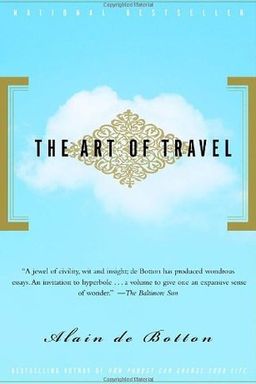
The Art of Travel cover

The Art of Travel

by Alain De Botton

In ''The Art of Travel,'' Alain De Botton invites readers on a philosophical journey through the nuances of travel. More than a typical guide, this book explores the motivations behind our wanderlust and offers insights to enrich every adventure, from appreciating mundane details to finding joy in the unexpected.

The Art and Philosophy of Travel

Why do we travel, and what do we really seek when we board a plane or embark on a long journey? In The Art of Travel, philosopher and essayist Alain de Botton invites you to reconsider every trip you’ve taken—or ever will take—by asking not where we go, but why and how. He argues that travel is not simply a change of geography but a deeper voyage into our own perceptions, expectations, and emotions. Drawing together philosophy, literature, art, and psychology, de Botton shows that the way we experience place is shaped as much by the mind that sees as by the destination itself.

In essence, de Botton contends that traveling well is an art: it demands awareness, curiosity, and the ability to tie inner experience to outer landscapes. This book is not a manual of destinations but an inquiry into human flourishing—what the Greeks called eudaimonia—through the lens of travel. We are all, he says, voyagers in search of happiness and meaning, yet most of us travel with little reflection about what we are truly after. By exploring the experiences of historical travelers and thinkers—from J.K. Huysmans and Flaubert to Wordsworth, van Gogh, and Ruskin—de Botton reveals that travel can be both a mirror and a compass for self-understanding.

Anticipation vs. Reality

One of the book’s opening insights contrasts the delicious hopes we attach to travel with the mundane realities that follow. Using the story of Huysmans’s antihero Des Esseintes, de Botton illustrates how anticipation often outshines experience. The dreaming mind edits reality into vivid, curated images—a palm tree here, a turquoise bay there—while the real trip delivers immigration lines, rain-soaked taxis, and digestive complaints. When de Botton arrives in Barbados, he realizes that, despite the beauty around him, he has “brought himself along”—his anxieties, irritations, and thoughts of unfinished projects. The paradise outside cannot cure the turmoil within. This irony, he suggests, exposes a paradox at the heart of travel: we go elsewhere to escape ourselves, only to discover how inseparable we are from our mental baggage.

The Deeper Meaning of Travel

Drawing on philosophy, de Botton argues that travel is an implicit expression of our idea of happiness. Where we choose to go reflects what we feel is missing in our lives: the calm of the sea when we’re overworked, the grandeur of mountains when feeling small, or the anonymity of a city when restrained by routine. Like the ancient philosophers, he sees this quest as moral and philosophical—travel as a form of life education, a way to test what “the good life” might mean. To travel well, then, requires introspection: can we understand what we are seeking before we seek it?

Art, Curiosity, and Seeing Anew

Throughout The Art of Travel, de Botton shows how artists and writers help us truly “see” places. Flaubert’s Egypt and van Gogh’s Provence taught Westerners to notice colors, textures, and scenes they had overlooked. Art, he writes, doesn’t simply copy beauty—it teaches us to recognize it. The painter’s vision becomes a set of lenses we can borrow. Just as Ruskin argued that drawing teaches us to notice rather than to produce art, de Botton suggests that attentive seeing is the real act of possession. This transforms travel from consumption into contemplation.

Habit, Sublimity, and Wonder

The book closes with reflections on habit and perception. After we return home, familiarity dulls our senses: we cease to see our streets, rooms, and skies. Yet de Botton asks, must wonder depend on novelty? Inspired by Xavier de Maistre’s Journey Around My Bedroom, he shows that the same alertness of mind that transforms a foreign desert into a sublime revelation can also make us rediscover beauty in a London street or an unmade bed. The challenge is not just to go further but to look deeper—to train the imagination to treat even our home as a foreign land.

Why This Matters

In an age when travel is easier than ever but meaning harder to find, The Art of Travel is a philosophical antidote to the checklist mentality of tourism. It suggests that true exploration is measured not by miles but by mindfulness; that we can enrich our lives not merely by seeing new places but by learning to see with new eyes. By combining personal narrative with cultural history, de Botton reframes travel as a spiritual practice—an invitation to patience, curiosity, and humility toward the world and ourselves.


Anticipation and the Reality of Travel

Our love affair with travel often begins long before we pack our bags. De Botton illustrates this through his reflection on anticipation—how a travel brochure, with its airbrushed paradise of turquoise seas and leaning palms, creates potent fantasies of happiness. Looking at those glossy images, we imagine not just a place but a transformed version of ourselves: relaxed, sunlit, and whole. The hope that such places can rescue us from routine reveals how images of happiness drive our journeys more than rational plans.

Des Esseintes and the Trap of Imagination

To dramatize this paradox, de Botton recounts J.K. Huysmans’s decadent protagonist Des Esseintes from A Rebours, who plans a trip to London after reading Dickens. Before he even departs, though, his fantasies about fog, beef, and brick streets delight him so much that he never boards the train. He realizes he can “travel wonderfully sitting in a chair.” The imagination, free from fatigue, heat, and boredom, provides its own perfect itinerary. De Botton calls this a revealing pessimism: perhaps anticipation—not arrival—is the purest form of travel.

When Reality Intrudes

Upon reaching Barbados, de Botton confronts the inevitable gap between fantasy and fact. Where his mind conjured simplicity and serenity, reality offers taxi queues, customs officials, and Formica bathrooms. Like a film condensed from “He journeyed through the afternoon,” travel is an endless sprawl of detail—the fly buzzing in the arrivals hall, the faded posters above baggage claim. Life refuses the artful editing of imagination. Only memory, in retrospect, restores coherence, smoothing the chaos into snapshots of meaning.

Bringing Yourself Along

Even so-called paradises cannot outrun the self. De Botton’s sore throat, anxiety, and petty arguments ensure that his internal weather eclipses the Caribbean sun. “I had inadvertently brought myself with me,” he admits. Here his insight resonates with Stoic and Buddhist philosophy: external circumstances—whether island or apartment—cannot guarantee joy. The mind’s habits follow us like luggage. Lasting happiness depends less on environment than on awareness, and travel’s usefulness lies in revealing this truth with humor and humility.

In the end, as Des Esseintes learned and de Botton confirms, whether we sit at home with a travel brochure or beneath a palm tree, our experiences are filtered through the restless mind. Travel can delight and refresh, but it cannot deliver us from ourselves unless we learn to meet our thoughts as willingly as we meet new landscapes.


The Beauty of Liminal Places

What if poetry hides not only in scenic coastlines but also in service stations and airports? In one of the book’s most surprising chapters, de Botton explores the beauty and melancholy of modern traveling places—those transitional spaces where movement defines identity. Perched in a motorway café or an empty airport terminal, he feels a haunting empathy with Edward Hopper’s lonely diners and Baudelaire’s yearning city wanderers.

Baudelaire's Desire to Depart

Charles Baudelaire, the poet of modern life, confessed to “the horror of home.” He dreamed always of being ‘elsewhere,’ whether in Lisbon or the North Pole. Yet he often found solace not in destinations but in departures—in harbors, train stations, and ships. Borrowing T. S. Eliot’s phrase, de Botton calls this the poésie des départs: the poetry of leaving. These places, charged with expectancy and anonymity, mirror our longing for renewal without demanding fulfillment.

Hopper’s Solitary Spaces

Edward Hopper, an American painter inspired by Baudelaire, turned diners, motels, and petrol stations into sanctuaries of solitude. In paintings like Automat or Gas, lonely figures sit in stark light, their isolation dignified by stillness. De Botton notes that these transient spaces—so often dismissed as dreary—become mirrors for our own disconnectedness. When we stop at a service station or watch planes land in the dark, we glimpse what connects modern souls: a collective loneliness tempered by a quiet grace.

The Liminal as Liberation

De Botton suggests that such anonymous “non-places” possess a strange freedom. In airports or motels, we are liberated from identity and expectation; no one knows us, and we belong temporarily to nowhere. Raymond Williams once noted that modern poetry celebrates isolation’s moral clarity—what he called “the instinct of fellow-feeling derived from being a wanderer.” For de Botton, traveling places embody this sentiment: amid fluorescent light and fast food, we encounter the humility and transience that make us, paradoxically, more human.


The Allure of the Exotic

Why do certain cultures or landscapes fascinate us more than others? De Botton answers through the story of Gustave Flaubert, who fled 19th‑century bourgeois France to find “authenticity” in Egypt. His letters reveal both the illusions and insights of the exotic imagination. The foreign, de Botton shows, often serves as a mirror: we project onto distant lands the virtues lacking at home.

Flaubert’s Search for Egypt

Flaubert grew up suffocating under French prudery and snobbery. When he envisioned the Middle East—with its camels, minarets, and chaos—he imagined a world free from hypocrisy, alive with sensuality. Accompanied by his friend Maxime du Camp, he sailed to Alexandria in 1849 expecting transcendence. Yet what he found was more complex: filth beside beauty, tedium amid wonder. His ideal shattered, but a wiser love replaced it—an appreciation of life’s “bewildering chaos of colors,” its mixture of shit and spirit.

The Meaning of Exoticism

From this, de Botton infers that the exotic is not primarily about geography but psychology. We deem a place exotic when it seems to express values missing in our own environment—Dutch restraint to an Englishman’s eccentricity, or Egyptian sensuality to French repression. To love a foreign culture, then, is to confess something about our inner discontent. “What we find exotic abroad may be what we hunger for at home,” de Botton writes, echoing Flaubert’s ironic awakening.

Beyond Stereotype

Instead of condemning Flaubert’s Orientalist fantasies, de Botton urges us to see their instructive value. The mind’s projections can lead us not only to ignorance but also to self-revelation. A careful, humble traveler learns, as Flaubert did, that knowledge deepens when fantasy collides with fact. The “Orient” ceases to be a stage for Western desires and becomes a teacher in difference. True travel enlarges identity by letting multiple worlds coexist within us—a lesson more vital than ever in a global age.


Curiosity and the Art of Attention

De Botton defines curiosity as the traveler’s most precious virtue—the willingness to ask questions about what seems ordinary. In Madrid, he finds himself paralyzed by indifference: listless in his hotel, guilty for not sightseeing. Against this spiritual inertia, he contrasts the relentless curiosity of Alexander von Humboldt, the 18th‑century explorer who measured every mountain, insect, and air current he encountered. Where de Botton succumbs to ennui, Humboldt discovers entire worlds in a cactus.

Humboldt’s Active Curiosity

For Humboldt, measuring altitude or noting the temperature of a spring was no pedantic task but a way to understand universal harmony. His eye was trained by questions: “Why don't the same plants grow everywhere?” Curiosity, for de Botton, is precisely this chain of questions extending outward from wonder. To have the right questions is to see meaning where others see monotony. (Nietzsche later echoed this when he urged knowledge ‘for life’ rather than for sterile facts.)

How Guidebooks Kill Wonder

In Madrid’s “star-rated” attractions, de Botton feels the tyranny of prescribed significance. Where the guidebook gives three stars, he feels obliged to feel awe; where it gives none, he feels nothing. His rebellion is to trust his own curiosity—to find fascination in Spanish names, city architecture, or the lack of vegetables on menus. Travel, he concludes, only becomes meaningful when we let our interests meander like Humboldt’s, free from authority and expectation.

Curiosity Beyond Geography

For you, curiosity need not involve exotic adventures. It means resisting habit—looking at your own home as if through a magnifying glass. When you reawaken curiosity, your world expands endlessly. A fly in a Madrid church or cracks in a city wall can become as revealing as Humboldt’s Andes. The goal, as de Botton notes, is not to collect facts but to cultivate a style of attention that redeems even boredom into insight.


Nature as Moral Teacher

When de Botton travels to England’s Lake District, he follows in the footsteps of poet William Wordsworth, who believed that nature heals the moral wounds inflicted by cities. In the 18th century, as industrial life alienated people from simplicity, Wordsworth claimed that mountains, trees, and lakes could restore perspective and dignity to the soul.

Wordsworth’s Vision of Nature

Wordsworth insisted that communion with nature made people “sane, pure, and permanent.” The oak’s patience, the waterfall’s persistence, the bird’s cheerfulness—these were not sentimental metaphors but moral lessons. Cities, by contrast, were engines of envy and anxiety. To look at a cloud or hillside was to glimpse eternity, to feel one’s troubles shrink before vastness. His poetry turned sight into empathy, urging readers to attend to humble things—a daisy, a skylark, or a lonely shepherd—until they revealed the universal pulse of life.

De Botton’s Modern Pilgrimage

While retracing Wordsworth’s landscapes, de Botton acknowledges his own restlessness. Yet he experiences what the poet called “spots of time”: fleeting yet durable flashes of meaning that we can carry home. Sitting by trees after an argument or looking at mist over the hills, he realizes that such images can comfort us later, long after the trip ends. The beauty of nature imprints serenity in memory, becoming an inner refuge during chaos.

Moral Perspective

Wordsworth’s insight—echoing Stoicism and modern mindfulness—is that aesthetic experience can cultivate virtue. To attend to nature’s patience is to practice patience. To notice beauty without ownership is to learn humility. Travel through landscapes, then, is not escapism but ethical education. In learning to see mountains clearly, we may also learn to see ourselves rightly.


The Sublime and the Small Self

In the Sinai desert, de Botton seeks a more formidable lesson: the sublime. Standing before mountains and empty valleys, he experiences both fear and wonder. Edmund Burke, in his 1757 Philosophical Enquiry, defined the sublime as the feeling evoked by greatness beyond our control—vast, dangerous, and humbling. The beautiful soothes us; the sublime unsettles us, yet makes us feel vividly alive.

Why the Sublime Matters

De Botton distinguishes between ox-like landscapes, benign and serviceable, and bull-like ones, indifferent to our existence. The desert is a bull: immense, unpitying, but noble. It reminds us that not everything powerful has to be hateful. The sublime trains us to revere what exceeds us—to trade arrogance for awe. It is an emotional rehearsal for accepting life’s uncontrollable forces: fate, time, death.

Spiritual Echoes

In the emptiness of Sinai, biblical resonances return. God once spoke to Job from a whirlwind, asking: “Where were you when I laid the foundations of the earth?” The divine answer was not explanation but perspective: suffering and insignificance are parts of a vast order we cannot grasp. For believers and secular seekers alike, the desert—or any immense natural scene—can evoke the same humility. Against such scales, our personal grievances shrink, replaced by reverent acceptance.

To stand before the sublime is to rehearse surrender—to feel the smallness of the self not as defeat but as relief. The mountains and clouds remind us, quietly and grandly, that being tiny within eternity is part of the art of living.


Art as an Education in Seeing

After nature, de Botton turns to painting as another teacher of perception. In Provence, he initially feels nothing—just dull fields and short olive trees. Then he discovers van Gogh’s letters and realizes that art can awaken us to beauty. Seeing the world through an artist’s eyes changes not the landscape but our attention.

Van Gogh’s Eye

Van Gogh, arriving in Arles in 1888, felt that no one had painted the South “as he saw it.” His cypresses were black flames, his skies electric orange and blue. He exaggerated not to distort but to express essence. Art, he believed, makes the invisible visible; it captures emotional truth where the “God-fearing photographer” records only surfaces. For de Botton, van Gogh’s genius was to show observers how to notice the play of mistral winds, the green in shadows, and the holiness of ordinary fields.

Learning to See

When de Botton revisits those same landscapes, painted plaques mark van Gogh’s viewpoints. A tourist protests that reality doesn’t look “like that.” But de Botton sees precisely why it should: painting isn’t duplication but revelation. As Nietzsche remarked, artists teach us what to value by selecting features worth seeing. After van Gogh, even a humble olive tree shimmers with expressive energy. Art recalibrates the senses, turning the stale world radiant again.

The lesson extends beyond Provence. From Turner’s skies to Hopper’s diners, great art refines our aesthetic literacy. It reminds you that beauty is a skill, not a coincidence—and that traveling with the eyes of an artist can transform any street or sky into a masterpiece.


Possessing Beauty Through Attention

When faced with beauty—an Alpine view, a brick wall, a train in twilight—we instinctively want to keep it. But cameras and souvenirs, de Botton warns, promise possession without perception. To truly possess beauty, we must first understand it. This was the conviction of Victorian critic John Ruskin, for whom art was not about talent but about learning to see.

Ruskin's Discipline of Attention

In his Elements of Drawing (1857), Ruskin taught ordinary workers to sketch—not to make artists of them but to make them “happier carpenters.” Drawing, he said, forces the eye to slow down, to register what habit overlooks: the moss on a rock, the curve of a windowpane. Similarly, de Botton finds that even clumsy sketches awaken sight. The world reveals its architecture—the angles of leaves, the color hidden in white paint—once we pause long enough to study it.

Word-Painting the World

For those less drawn to pencils, Ruskin advocated “word-painting”: describing clouds, light, or trees in vivid language. Writing becomes a method of comprehension. When de Botton, inspired by this idea, sits in his car beside fog-draped skyscrapers, he writes his observations—not in clichés (“pretty”) but in psychological language (“calmly indifferent,” “melancholy and noble”). In translating sensation into words, he clarifies why something moves him, converting fleeting awe into lasting insight.

True possession of beauty, de Botton concludes, comes from such mindful study. To see, draw, or describe attentively is to convert outer form into inner growth. Beauty, then, is not a souvenir to collect but a lesson in perception, gratitude, and patience—a way to make life itself the gallery we inhabit.


Rediscovering Home Through Habit and Wonder

After all his journeys, de Botton returns to London only to find his old despair: the rain, the grey skies, the unchanged streets. Yet he refuses to end in melancholy. Instead, he asks: must the familiar always be dull? Perhaps, he suggests, the true art of travel is not to keep moving but to keep noticing. His guide this time is Xavier de Maistre, an 18th‑century French writer who “traveled” around his bedroom as if it were a continent.

De Maistre’s Lesson

Confined to his chamber, de Maistre explored his bed, sofa, and night sky with the curiosity of an explorer. His insight was profound: “The pleasure we derive from a journey depends more on the mind-set we travel with than on the destination.” To apply a traveling mind at home is to rediscover life’s overlooked wonders—the hallway, the window, the evening cloud—as if seen for the first time.

Renewing Vision Through Habit

De Botton tries this experiment in Hammersmith. Walking his daily route as if it were foreign, he starts to see again: the architecture of guttering, the rhythm of buses, the patchwork of faces. Habit, he realizes, is a filter that dulls our senses. “Of the four thousand things in a street,” he writes, “we end up aware of only a few.” By lifting this self-imposed blindness, we retrieve the raw texture of experience usually reserved for first arrivals in a new land.

Making Little of Much

Nietzsche once divided humankind into those who make much of little and those who make little of much. The secret of joyful living—and of travel—is to belong to the first group. For de Botton, travel teaches us this capacity: to make significance out of ordinary sights, to live inquisitively rather than restlessly. The art of travel, finally, leads back home, transforming even a rainy London street into a landscape of discovery.

Dig Deeper

Get personalized prompts to apply these lessons to your life and deepen your understanding.

Go Deeper

Get the Full Experience

Download Insight Books for AI-powered reflections, quizzes, and more.