
Idea 1
The Architecture of Human Error
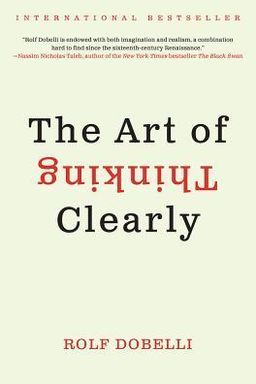
You live inside a mind built for survival rather than truth. Rolf Dobelli’s central argument is that your brain, shaped by evolution, prefers shortcuts, stories, and emotions over sober reasoning. In everyday life that bias works—it lets you decide quickly, empathize, and cooperate—but in modern complexity it betrays you. His book is a guide through the architecture of human error: a catalog of thinking mistakes that distort judgment, inflate confidence, and waste time or money.
Dobelli insists that mental errors rarely arise from stupidity; they are the default software of human cognition. You see the world through biased lenses: the lens of visibility (you notice successes and stories), of simplicity (you prefer causal narratives), of belonging (you imitate peers), of emotion (you trust what feels right), and of optimism (you misjudge risk and prediction). He stitches together insights from psychology, behavioral economics, and philosophy—with anecdotes drawn from Nassim Taleb, Daniel Kahneman, Dan Ariely, and empirical classics like Milgram’s obedience study or Tetlock’s forecasting research.
How patterns deceive you
You crave patterns because order feels safe. Dobelli calls this the root of many illusions: survivorship bias, clustering illusion, conjunction fallacy, and coincidences misread as destiny. You notice winners—successful entrepreneurs, famous musicians—and mistake their visibility for proof that success is common. When you see shapes in clouds or faces on Mars, you commit clustering illusion, finding meaning where none exists. Tversky and Kahneman’s conjunction fallacy shows how your taste for coherent stories overrides logic, making narrow, vivid events feel more probable than broad ones. These errors share one cause: narrative hunger. (Note: Kahneman’s later work Thinking, Fast and Slow frames this same pattern as System 1’s overactive storytelling.)
How groups and institutions amplify bias
Humans copy one another. Social proof and authority bias spread errors through crowds and hierarchies. Dobelli demonstrates how Asch’s conformity experiments and Milgram’s obedience studies explain bubbles, panics, and bureaucratic disasters. Groupthink silences dissent; social loafing reduces effort; strategic misrepresentation wins bids for projects that later fail. Institutions collapse when personal incentives reward optimism and conceal risk. You inherit these dynamics in business boards, academic committees, and government planning. To survive, Dobelli advises structural fixes: devil’s advocates, transparent accountability, and external benchmarks.
Emotion and intuition as double-edged tools
Your intuition is fast and economical—but dangerously seductive. Shane Frederick’s Cognitive Reflection Test shows that first impressions often mislead (the bat‑and‑ball puzzle’s “obvious” answer is wrong). Yet overthinking skilled acts can also hurt: the centipede story reminds you that deliberate analysis can paralyze practiced motor skills. Dobelli’s balanced view: use slow thinking for consequential, unfamiliar choices, and let intuition operate where expertise is internalized. Emotions, while adaptive, distort risk via the affect heuristic—positive feelings shrink perceived dangers; negative feelings inflate them. Vivid faces like Rokia’s in charity appeals elicit generosity unrelated to statistical need. Feelings are powerful signals but false measures of frequency.
Money, motivation, and the illusion of rational reward
Dobelli extends bias into economics. Incentives often backfire: Hanoi’s rat bounty caused more rats, not fewer; monetary rewards eroded civic pride in Wolfenschiessen. People respond super‑strongly to incentives but not always in the direction intended. Sunk‑cost fallacies, endowment effects, and effort justification lock you into poor investments simply because you paid or worked for them. His prescription: design systems that reward outcomes, not manipulative metrics, and cultivate intrinsic motivators—autonomy, mastery, and purpose.
Time, memory, and false certainty
You rewrite the past and misread the future. Hindsight bias makes yesterday’s chaos look inevitable; overconfidence shrinks your uncertainty interval; forecast illusions let pundits pose as prophets. Memory itself is a storyteller: vivid flashbulb memories of tragedy differ from contemporaneous records. Gregory Markus’s interviews prove you edit your political past to match current beliefs. Dobelli links these with the hedonic treadmill and hyperbolic discounting—you mispredict what will make you happy and prefer immediate rewards, even when they are smaller. His advice: keep prediction diaries, compare expected versus actual outcomes, and revise process rather than justify result.
Risk, uncertainty, and black swans
At the extreme of unpredictability lie Black Swans. Risk is measurable; uncertainty is not. You pretend the world runs on probabilities when it often runs on surprises. The Ellsberg paradox shows aversion to unknown odds, but Taleb’s concept of anti‑fragility suggests you can position yourself to exploit shocks if your downside is limited. Maintain buffers, avoid debt, favor small experiments with large potential upside. The book closes on humility: you will always see too little of reality, but deliberate reflection, checklists, and probabilistic thinking can keep you from ruin—and occasionally let you profit from randomness.