
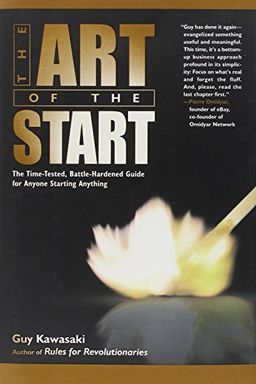
The Art of the Start cover

The Art of the Start

by Guy Kawasaki

The Art of the Start by Guy Kawasaki delivers practical guidance for aspiring entrepreneurs. It covers essentials like making impactful pitches, managing without external funding, and creating innovative products that resonate with customers. Discover how to navigate unexpected opportunities and build a successful, meaningful business.

Turning Ideas into Action: The Heart of Entrepreneurship

Have you ever had an idea that you knew could change the world—if only you could figure out how to start? In The Art of the Start, entrepreneur and venture capitalist Guy Kawasaki answers that question by offering a field manual for anyone who wants to turn an idea into a living, breathing enterprise. Kawasaki contends that successful entrepreneurship is not about grand strategy, detailed forecasts, or perfect plans—it’s about starting, acting ethically, recruiting wisely, and executing relentlessly.

Kawasaki, who helped launch the original Macintosh at Apple and later founded Garage Technology Ventures, argues that anyone can be an entrepreneur—whether they’re launching a business, building a nonprofit, or driving innovation inside a large company. At its core, the book insists that entrepreneurship is less about a business model and more about a mindset: a devotion to what he calls making meaning. That sense of mission—creating a product or service that improves the world—motivates everything else from recruiting talent to building a brand that endures.

The Essential Art of Starting

Kawasaki opens by dismantling the mythology of entrepreneurship. Too often, people imagine that innovation requires a complex business plan, perfect timing, or venture capital from day one. Instead, Kawasaki argues that startups thrive by beginning small and acting with purpose. His “five arts” of starting—make meaning, make mantra, get going, define your model, and weave a MAT (Milestones, Assumptions, and Tasks)—provide a simple framework for momentum. A winning venture emerges not from obsessing over forecasts but from creating something valuable and learning from iteration.

Meaning drives motivation; mantra focuses communication; action fuels progress. Kawasaki even jokes that “the hardest thing about getting started is getting started.” His examples—from Steve Jobs’s user-focused passion to Hewlett-Packard’s garage scrappiness—remind readers that simplicity and speed matter far more than polish.

From Positioning to Pitching: Telling Your Story

Once you’ve made something real, Kawasaki teaches you to tell your story. Positioning means explaining what you do in words your customers can instantly understand. It isn’t about corporate jargon or misleading slogans—it’s about clarity and relevance. He urges founders to “seize the high ground” by highlighting how their idea improves people’s lives. Great positioning, he writes, is both simple and energizing: instead of saying “we sell server software,” you might say, “we help businesses work without losing sleep.”

From there, pitching becomes the entrepreneur’s most vital skill. Kawasaki’s famous “10/20/30 rule” (10 slides, 20 minutes, 30-point font) sets the standard for clear, compelling presentations. Drawing from years of listening to terrible pitches as a venture capitalist, he insists that simplicity wins over jargon every time. A good pitch, he says, gets to the heart of your product and leaves people saying, “Tell me more.”

Execution, Integrity, and the Long Game

The book’s later chapters pivot from vision to execution. Entrepreneurs learn how to bootstrap on limited resources, build cohesive teams, and recruit believers instead of mercenaries. Kawasaki’s hiring advice—“A players hire A players; B players hire C players”—remains one of the book’s most quoted lines. He explores how to raise capital honestly, partner strategically, and design brands that spread through contagious enthusiasm rather than expensive campaigns.

Yet, as the book progresses, Kawasaki’s message becomes increasingly moral. In a world obsessed with billionaires and exits, he reminds readers that character is the ultimate competitive advantage. His final chapter, “The Art of Being a Mensch,” argues that the measure of a founder’s success is not how much they gain but how much they give—through generosity, honesty, and service to others. You don’t just build companies, he implies; you build legacies.

Why It Matters Today

Nearly two decades after its publication, The Art of the Start feels more relevant than ever. In an era where anyone can launch a startup from their laptop, Kawasaki’s advice bridges timeless principles with practical action. His overarching message—that entrepreneurship thrives on meaning, momentum, and morality—challenges you to build not just a company but a cause. Whether you’re in a garage, a nonprofit, or a boardroom, his voice rings clear: stop overthinking, start doing, and never forget that real success comes from helping others succeed.


Make Meaning, Not Money

In the book’s opening chapter, Kawasaki challenges a dangerous myth: that startups exist primarily to make money. In his view, the best ventures begin with the desire to make meaning—to make the world a better place. He points out that founders who chase profits often build shallow companies, while those driven by purpose create lasting impact. The key question he poses for every aspiring entrepreneur is simple: “If your organization disappeared, would the world be worse off?”

Finding Meaning Before the Money

Kawasaki offers four forms of meaning that drive great ventures: increasing quality of life, righting a wrong, preventing the end of something good, and creating something new that brings joy. Think of how eBay empowered individuals to gain financial independence or how Apple made technology personal and joyful. These examples show that purpose attracts people far more effectively than greed does. Meaning, he argues, isn’t fluffy idealism—it’s motivational physics: it pulls talent, customers, and investors toward you.

From Mission Statements to Mantras

Too many companies drown in corporate jargon when they should express their mission in three words. Kawasaki mocks the overcomplicated mission statements that promise “uncompromising excellence” and “premier market leadership.” Instead, he champions the simplicity of mantras like Nike’s “Authentic athletic performance” or Disney’s “Fun family entertainment.” For entrepreneurs, a mantra is a guiding light—it defines what you do and why you exist in a way that everyone can remember.

He even suggests writing a quick mantra before you do anything else—it sets the tone for culture and direction. And unlike a mission statement, a mantra isn’t for customers—it’s for your team.

Getting Going

Once you know your meaning and mantra, Kawasaki’s next command is simple: get going. Don’t wait for the perfect plan, the perfect investor, or the perfect moment. Entrepreneurs thrive through action, not analysis. He jokes that “no one ever achieved success by planning for gold”—referring to the endless cycle of business plan tweaking instead of execution. Great ideas evolve through feedback, not imagination alone.

Ultimately, making meaning transforms entrepreneurship from a selfish act into a moral calling. It invites you to measure success not by valuation but by contribution. As Kawasaki puts it, if you begin with meaning, the money will follow; begin with money, and you may end with nothing.


Bootstrap with Discipline

Kawasaki is famous for his realism. In the chapter “The Art of Bootstrapping,” he dismantles the romantic illusion that every startup begins with millions in funding. Most, he reminds you, start with little more than ramen noodles and stubborn faith. Bootstrapping isn’t just a financial tactic—it’s a mindset of resourceful discipline.

Manage for Cash Flow, Not Profit

Instead of chasing paper profits, bootstrappers obsess over cash. Cash keeps the lights on when optimism runs thin. Kawasaki argues that the lifeblood of a young company comes from simple transactions, not lofty valuations. He encourages entrepreneurs to shorten sales cycles, improve payment terms, and prioritize recurring revenue models. As he quips, “Paper profits are a secondary consideration for a bootstrapper.” Success means staying alive long enough for your idea to evolve.

Simple, Scrappy, Fast

Kawasaki’s examples illustrate how speed and scrappiness often beat elegance. Apple, in its early days, released imperfect products because feedback mattered more than perfection. He calls this approach “ship, then test”—deliver quickly, learn, and iterate. To him, a good question for any founder is, “Would I let my mother use it?” If yes, it’s ready to ship.

Similarly, he encourages starting as a service business. Services generate immediate cash flow and customer insights that later shape scalable products. Many software giants—including Microsoft, Dell, and HP—began by offering services before they built products.

Pick Your Battles

A good bootstrapper, Kawasaki says, focuses on what truly matters—product, customers, and cash—not fancy offices, Aeron chairs, or perks. His motto: “Do the small stuff cheap and the big stuff right.” Success depends on execution, not expenses. This disciplined practicality, he believes, separates entrepreneurs who dream from those who endure. In hard times, bootstrapping isn’t a limitation—it’s liberation; it forces creativity, integrity, and focus.


Pitch Like a Pro

In “The Art of Pitching,” Kawasaki turns from building to storytelling. Whether you’re convincing investors, recruiting talent, or selling to customers, your ability to pitch clearly and concisely often determines your success. Having sat through thousands of painful presentations as a venture capitalist, he rewrote the rules of persuasion with realism and humor.

The 10/20/30 Rule

Kawasaki’s golden rule for pitching is iconic: 10 slides, 20 minutes, and 30-point font. Ten forces clarity; twenty respects attention; thirty ensures readability. This limit, he explains, forces you to distill your story down to its most compelling essence. No jargon, no endless data dumps—just relevance and heart. He warns that every founder believes their idea is special enough to break the rule, but that’s the very sign of inexperience.

Catalyze Fantasy

Instead of quoting consultants who predict trillion-dollar markets, Kawasaki advises you to catalyze your audience’s imagination. Paint a picture of what life looks like when your product works. For example, when TiVo launched, people didn’t care about technical specs—they cared about skipping commercials. Investors should feel—and see—the problem you’re solving, not just read about it on a slide.

Keep It Human

Finally, Kawasaki reminds founders that people fund people, not spreadsheets. This means showing integrity, humility, and genuine enthusiasm. Answer questions honestly. Listen more than you speak. And always follow through on every promise. As he jokes, if you cause tinnitus (ringing in the ears) with your pitch, you’ve missed the mark. The best pitches, he says, start with heart and end with honesty.


Recruit Great People, Not Perfect Ones

Hiring is one of the greatest arts in Kawasaki’s entrepreneurial playbook. In “The Art of Recruiting,” he explores why extraordinary startups attract extraordinary people—and how mediocre leaders create mediocrity. His warning is blunt: “A players hire A players; B players hire C players.” If you compromise early, your organization will spiral into a “bozo explosion.”

The Three Hiring Questions

Kawasaki advises every founder to ask three questions about candidates: Can they do what you need? Do they believe in your mission? Do they bring a key strength (not just lack weaknesses)? Great teams are made of believers, not mercenaries. He argues that startup recruits must be “infected” with passion—the kind that drives them to work eighty-hour weeks because they love the product.

Ignore the Irrelevant

Forget résumés filled with big-name companies or Ivy League degrees. Experience in large corporations, he warns, often doesn’t translate to startup life. A vice president from IBM may not thrive in a two-person garage, where “being the boss” means fixing the printer. Likewise, failure isn’t disqualifying. Often, those who’ve survived flops have learned the lessons that textbooks never teach.

Culture over Credentials

Kawasaki champions diversity of skill and thought. He encourages hiring people with opposing strengths so that the team collectively becomes brilliant. Above all, he reminds founders to choose those they’d enjoy meeting at the “Stanford Shopping Center test”: if you saw this person in public, would you excitedly walk over or pray they didn’t see you? If it’s the latter, don’t hire them. Work is too short—and too hard—to share with people you don’t like.


Raise Capital Without Losing Soul

Fundraising, for Kawasaki, is both art and endurance test. “The odds of raising venture capital,” he quips, “are equal to getting struck by lightning while standing at the bottom of a swimming pool on a sunny day.” Still, he insists that capital follows great businesses—not the other way around.

Build a Business, Not a Pitch

Kawasaki stresses that you must first build something worth investing in. Investors are drawn to traction—proof that people will pay for your product. Sales trump forecasts. Until you have customers, forget “exit strategies” and focus on value creation. His motto: “If you build a business, the money will find you.”

Traction and Transparency

He urges founders to be transparent about flaws and risks. Disclose everything early; it builds trust. Never claim that you have “no competition”—that only reveals ignorance. Instead, demonstrate that you understand competitors and can position wisely against them. Good investors, he notes, prefer entrepreneurs who know what could go wrong but still have the courage to try.

Understanding Investors

Kawasaki demystifies venture capitalists with wit: they’re not clairvoyant geniuses with superhuman insight, he says—they’re just people managing other people’s money. Respect them, but don’t romanticize them. The moment you take investment money, you lose “control” in the sense that accountability now belongs to all shareholders. Thus, raise capital carefully and only when you understand what game you’ve entered.


Build Partnerships That Win-Win

Partnerships, Kawasaki warns, can be seductive illusions. Every startup says 2 + 2 will equal 5, but most partnerships end up equaling 3. In “The Art of Partnering,” he explains that success lies in mutual value, not hype or flattery. Good partnerships accelerate cash flow, increase revenue, and reduce costs. Anything else is PR theater.

The Aldus–Apple Example

Kawasaki shares one of his best stories from his Apple days: the company’s smart alliance with Aldus Corporation. Aldus created PageMaker, the software that launched desktop publishing. Apple provided marketing muscle and a platform. Together, they gave the Macintosh a mission—and saved Apple from irrelevance. This was true synergy: both sides strengthened each other’s strengths.

Win-Win or Walk Away

If one side dominates, a partnership will collapse. Kawasaki insists on cutting only “win–win” deals—agreements where both parties truly benefit. Being bullied by a larger partner, he warns, is wasting your time; it’s better to walk away than to die slowly. He also recommends inserting an “out clause”—ironically, allowing each side to leave makes people more comfortable staying.

Schmoozing and Karma

No section is more entertaining than Kawasaki’s on schmoozing. Networking, he says, is not manipulation—it’s “discovering what you can do for someone else.” Give favors without expecting return. Follow up promptly. Make it easy for people to reach you. His mantra: “There’s a karmic scoreboard in the sky.” Help enough people and, in time, opportunity will help you back.


Practice the Art of Being a Mensch

The final and perhaps most profound chapter, “The Art of Being a Mensch,” elevates entrepreneurship from strategy to character. A mensch, a Yiddish term, means an ethical, decent, admirable person. For Kawasaki, great founders aren’t just smart—they’re decent. The true measure of success isn’t how you treat those who can help you, but how you treat those who can’t.

Help Many People

A mensch, he writes, helps widely and generously. The highest “karmic class” comes from helping people who can do nothing for you in return. His levels of altruism—helping for future benefit, for spiritual insurance, or for intrinsic joy—culminate with helping simply because it brings joy. Meaningful entrepreneurship thrives on this spirit of abundance.

Do What’s Right

Integrity, not cleverness, sustains companies. Kawasaki offers vivid examples: paying an investment bank even after a contract expired, reporting an undercharge from a supplier, or swapping your hockey team’s best players to make the league more fun. Doing what’s right may cost money today, but it builds a reputation that money can’t buy. As he reminds readers, “There absolutely are absolutes in life.”

Pay Back Society

Finally, a mensch pays back, not forward. That means giving because you’ve already received blessings—family, health, opportunity—not to manipulate future returns. Money is only one “currency” of repayment; others include time, expertise, and empathy. For Kawasaki, living ethically and gratefully isn’t just good karma; it’s the ultimate entrepreneurial strategy. Because when all is said and done, there’s no greater startup than your own character.

Dig Deeper

Get personalized prompts to apply these lessons to your life and deepen your understanding.

Go Deeper

Get the Full Experience

Download Insight Books for AI-powered reflections, quizzes, and more.