
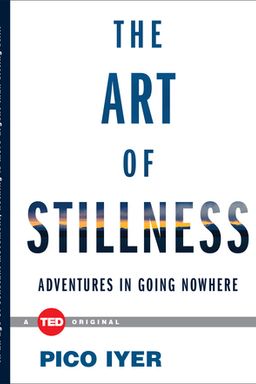
The Art of Stillness cover

The Art of Stillness

by Pico Iyer

In ''The Art of Stillness,'' Pico Iyer explores the transformative power of embracing quiet moments in a frenetic world. Through stories of renowned figures like Leonard Cohen and Marcel Proust, Iyer reveals how stillness can unlock creativity, clarity, and emotional resilience, offering readers a pathway to deeper understanding and fulfillment.

The Transformative Power of Stillness

When was the last time you truly did nothing—no phone, no tasks, no mental to-do list—just sat with yourself? That simple act might sound radical in our fast-spinning world, but Pico Iyer’s The Art of Stillness suggests that such moments of quiet can be the most transformative journeys you’ll ever take. He argues that going nowhere—in other words, choosing stillness over perpetual motion—is not escapism, but the key to rediscovering sanity, clarity, and genuine connection in an era of overload.

Iyer, a celebrated travel writer who has crossed borders for decades, takes the reader inside his paradoxical realization: despite a lifetime devoted to movement, he found his deepest experiences when staying still. Using stories of figures like Leonard Cohen, who retreated into a Zen monastery, and his own seasons of contemplative quiet in Japan, Iyer contends that stillness allows the world to move through us in ways that travel alone never can.

Meditation as an Adventure

Instead of seeing stillness as inaction, Iyer redefines it as a form of adventure—a journey inward. Leonard Cohen called sitting still the “real feast” of existence, the most voluptuous entertainment he had ever known. In an age when everyone feels permanently on call, Iyer asks us to consider the luxury of logging off, of creating inner space for thought and renewal. He notes that, historically, philosophers like Marcus Aurelius and poets like Dickinson and Rilke also cultivated solitude, seeing it as essential to grasping life’s larger truths.

Why Stillness Matters Now

The author emphasizes how modern life has inverted the value of quiet. Once, access to information and movement defined success; now, the ability to escape information overload and be fully present has become the rare luxury. According to Iyer, we’re suffering from a “mad acceleration” where technology has turned us into emergency-room doctors—always on call, perpetually reacting. Stillness isn’t about withdrawing from responsibility; it’s about recovering the invisible resources that constant noise erodes: patience, attentiveness, and compassion.

Stillness as Clarity

Iyer distinguishes between physical and inner travel. Every external journey only becomes meaningful once we return home and sit still long enough to interpret it. He recalls how the quiet of a hermitage overlooking the sea felt more profound than any worldly destination. Paradoxically, being in one place can make you feel more awake, alive, and alert to beauty than incessantly moving from one thrill to another. Movement becomes richer when it alternates with stillness.

A Universal Need

The wisdom of going nowhere crosses cultures. From Buddhist monks and Benedictine hermits to Silicon Valley engineers, people everywhere are rediscovering stillness as both a practice and a necessity. Iyer writes for modern readers—frequent fliers, multitaskers, and screen-tied souls—who may think stillness belongs only to saints or retirees. His message is counterintuitive but practical: slowing down doesn’t diminish our productivity; it deepens it. He invites you to reclaim small pockets of quiet—a few minutes a day, a walk without headphones, a Sabbath from emails—as steps toward lucidity.

A Call to “Go Nowhere”

Ultimately, The Art of Stillness offers an invitation rather than a prescription. Talking about stillness, Iyer insists, is really talking about sanity and the joys that endure. He concludes that stillness doesn’t mean isolation; it means presence. In an age of restless motion, the ultimate travel destination might be something intangible: the awareness, peace, and perspective found when you pause and simply be. Going nowhere, he suggests, may be the most adventurous journey of all.


Passage to Nowhere: The Inner Journey

In the first chapter, Pico Iyer recounts how he abandoned what looked like a dream life—a Manhattan office, world-travel assignments, and a Park Avenue apartment—for a small room in Kyoto. He felt overstimulated, constantly moving yet never arriving. This radical decision inaugurated his lifelong exploration of what he calls “Nowhere”: a place where we meet our inner life free from distractions.

Leaving Movement for Meaning

Iyer’s experiment mirrored what seekers like Thomas Merton and artists like Mark Rothko had done before him—turn movement inward. He realized his whirlwind existence wasn’t bringing happiness but agitation. In Kyoto, he discovered that stillness could be as vast and rich as any landscape on earth. Instead of pursuing external novelty, he began to cultivate internal discovery, echoing Merton’s insight that retreating into silence doesn’t reject the world but allows deeper love for it.

Perspective, Not Location

Drawing on philosophers like Epictetus and William James, Iyer concludes that happiness is largely a matter of perspective, not circumstance. Travel and experience shape us only through the thoughts we choose about them. Changing your view can alter life far more than changing your GPS coordinates. “Heaven is the place where you think of nowhere else,” he writes after realizing that peace arises when attention stops darting toward future destinations.

Movement Within Stillness

Rather than condemning travel, Iyer reframes it: movement gathers meaning only through its relationship to stillness. In the silence of a hermitage or a quiet Japanese apartment, he felt as exhilarated as he ever did exploring distant nations. The external journeys become metaphors for the internal one—the move from compulsive motion to deliberate awareness. When you pause long enough to observe, every fox or grazing deer outside a window becomes miraculous.

Making Stillness Practical

Iyer translates this into simple guidance: take periodic retreats, even brief ones; let a few quiet minutes surface emotions and ideas; balance the business of “making a living” with the act of “making a life.” Stillness isn’t a permanent destination but an ongoing practice—a lens through which movement gains depth and purpose. In that sense, “going nowhere” prepares you to return to everywhere with eyes open.

(Note: Writers like Jon Kabat-Zinn and Thich Nhat Hanh echo this wisdom—mindfulness and stillness don’t demand monasteries; they thrive amid ordinary moments when you simply stop long enough to notice your breath and the world around you.)


The Charting of Stillness: Science and Spirit

This section bridges the ancient art of stillness with modern science. Iyer juxtaposes the solitude of poets and monks with the findings of neuroscience and psychology, revealing that stillness is not mystical—it’s measurable. Sitting still transforms the brain and heightens happiness in ways researchers can quantify.

Leonard Cohen and Matthieu Ricard

Both Leonard Cohen, the singer who became a Zen monk, and Matthieu Ricard, the molecular biologist turned Buddhist interpreter, illustrate the world’s movement toward quiet. Cohen withdrew into a mountain monastery, while Ricard retreated to the Himalayas after earning a PhD at the Institut Pasteur. Their lives show that profound contentment often follows radical simplicity. Ricard’s story is underscored by scientific proof: his brain activity during meditation registered unprecedented levels of positive emotion—he was literally “the happiest man in the world.”

The Science of Stillness

Through Ricard’s experience, Iyer reveals a practical truth: happiness isn’t luck; it’s trainable. Researchers at the University of Wisconsin found that meditation alters brain architecture, enhancing compassion and emotional regulation. Stillness works like exercise for the mind—it strengthens the neural muscles that sustain joy and patience. Ricard’s metaphor of flight as “a retreat in the sky” captures this perfectly: stillness is available anywhere if you stop struggling and let awareness expand.

Art of Observation

Ricard’s photographs—his Motionless Journey series—distill the philosophy visually. He took the same picture from his mountain cabin each week for a year. Clouds changed; the scene stayed. The beauty lies in seeing transformation within constancy. For Iyer, these portraits mirror the mind: changing moods drift across an unchanging sky of awareness. The point isn’t physical travel but discovering how perception evolves when you’re still.

Mindfulness Across Cultures

By connecting Cohen’s poetic discipline and Ricard’s scientific meditation, Iyer shows that stillness bridges art, religion, and science. It’s not confined to monasteries or laboratories—it’s a global experiment in consciousness. As Ricard reminds us, the blue sky is always behind the clouds; stillness isn’t escape but the steady awareness underneath life’s storms.


Alone in the Dark: Facing Inner Restlessness

Stillness sounds idyllic until you meet its challenges. In “Alone in the Dark,” Iyer admits that solitude can expose one to hidden fears and discontent. You confront the devils behind your thoughts, the memories and missing pieces of life that constant motion once helped you avoid. He explores both the beauty and the terror of silence through figures like Emily Dickinson and Thomas Merton.

Stillness as Confrontation

Dickinson’s near-seclusion in her Amherst home produced passionate, burning poetry, showing that quiet can intensify rather than dull emotion. Merton’s monastic years revealed similar paradoxes—the closer you get to stillness, the more vividly shadows emerge. Iyer recounts visiting Merton’s hermitage and reading his private journals describing his late-life, forbidden love affair with a nurse. The monk’s struggle exposed how even spiritual calm can coexist with longing and imperfection.

The Risk and Reward of Isolation

Iyer warns that choosing “Nowhere” must be voluntary. For prisoners or forced invalids, silence becomes torment, not liberation. But for those who choose it consciously, stillness can unlock creativity and truth. He writes of sitting through fog and rain at a monastery, miserable at first, until realizing that discomfort was part of the process—through emptiness, meaning reforms itself. As Merton said, contemplation cannot be chased; it must be renounced before it reveals itself.

The Discipline of Stillness

Ultimately, stillness demands persistence. You might begin with romance, but sustain it through discipline. Iyer likens this to a love affair—you fall for peace easily, but remaining faithful through the dark nights of doubt is the true challenge. Those moments in the dark are what deepen stillness from escapism into wisdom. Facing yourself honestly becomes the gateway to freedom.


Stillness Where It’s Needed Most

Iyer moves from monasteries to boardrooms, showing how the art of stillness is not just for mystics—it’s vital for modern professionals. He explores how Silicon Valley engineers, corporate leaders, and even Marines use meditation and pauses to maintain focus, resilience, and compassion.

Technology and the Tyranny of Speed

We process as much information daily as Shakespeare absorbed in a lifetime, Iyer notes. Our devices connect us constantly, yet rob us of recovery time. The answer isn’t rejection but rhythm—periods of conscious unplugging. Within Google, employees practice yoga and mindfulness under programs like “Search Inside Yourself.” Wired co-founder Kevin Kelly keeps technology at arm’s length to preserve identity. These examples embody Pascal’s warning: all unhappiness stems from our inability to sit quietly.

Stillness as Performance Enhancement

Corporations have noticed that silence yields measurable outcomes. Meditation lowers blood pressure, improves focus, and reduces stress-related costs by billions. Intel’s “Quiet Periods” and General Mills’s mindfulness programs reveal how pausing leads to smarter decisions and deeper listening. Even soldiers benefit: a study led by Emma Seppälä at Stanford showed PTSD symptoms declined markedly after yoga-based breathing training. Her Marine colleague Andrew testified that meditation made him both calmer and more effective on duty—the paradox of becoming “harder” through softness.

Life-Saving Presence

Iyer recounts Andrew’s story of an officer who used mindful breathing after losing his legs in Afghanistan—staying conscious long enough to save lives. Stillness here isn’t philosophy; it’s survival skill. In a chaotic age, learning to be still can literally preserve clarity when adrenaline would otherwise take over.

Practical Mind Training

For Iyer, these modern examples affirm that stillness is medicine, not mysticism. Training minds matters as much as training bodies. Whether through an Internet Sabbath or ten minutes of silence, reclaiming space from acceleration heals both thought and community. Stillness, he suggests, belongs exactly where speed is greatest.


A Secular Sabbath: Creating Space in Time

In “A Secular Sabbath,” Iyer shifts from cultural to personal practice—how you can weave stillness into ordinary life. Drawing on religious notions of rest, he argues that pausing weekly, daily, or even during a flight creates psychological balance. Taking time off restores creativity and presence.

The Case for Rest

Iyer reminds us that “Sabbath” is the only commandment described as holy, emphasizing that rest itself sanctifies existence. Modern minds resist it; we fear that stopping work means falling behind. Yet as Gandhi quipped, he needed double his meditation time on busy days. Paradoxically, rest makes you more efficient, not less.

Sacred Time vs. Sacred Space

Drawing on theologian Abraham Joshua Heschel, Iyer describes Sabbath as “a cathedral in time.” You may never own a countryside retreat, but anyone can carve a few holy hours each week within their routine. Just as silence gives music form, pauses give life meaning. You can create mini-retreats—morning quiet, Sunday phone-off hours—turning time itself into sanctuary.

Travel and the Practice of Not-Doing

Iyer recounts meeting a German social worker who sat motionless through a 12-hour flight to Hawaii, using that enforced stillness to shed her stress before vacation. Her discipline inspired him to try it himself: avoiding screens mid-flight, just watching clouds. The experiment left him feeling renewed, proving that Sabbath moments can be spontaneous—any enforced pause holds potential if embraced consciously.

Rediscovering Time Wealth

Leaving New York for Japan, Iyer found himself “richer in hours,” the ultimate currency of fulfillment. He invites readers to view simplicity as abundance. Whether religious or secular, choosing stillness one day a week reconnects you to joy, attention, and gratitude—the essentials often lost in speed.


Coming Back Home: Integrating Stillness into Life

In the final chapter, Iyer explores how stillness isn’t a retreat from life but its renewal. After periods of quiet, you return home more open and empathetic. He warns against idealizing solitude—it should serve daily compassion and creativity. The goal is not to live on mountaintops but to bring their clarity into crowded streets.

Dynamic Stillness

Stillness, paradoxically, is full of movement. Beneath calm waters lies a vibrant world, just as beneath silence pulse unseen ideas. Thomas Merton said, in contemplation you don’t solve problems; you outlast them. For writers like Annie Dillard, sitting with a book or with pain reveals insights that chasing solutions never would. Stillness allows life to “solve itself.”

The Courage to Pause

Iyer admits that stepping away from busyness can feel selfish, but he insists it serves others. True empathy arises from attention; quiet makes you present enough to listen and care. As artist Bill Viola put it, the man who steps away from the world comes back with “his sleeve wet with tears for it.” You enter Nowhere only to rejoin the world more fully.

Stillness in Motion

Leonard Cohen exemplifies this balance. After decades of Zen meditation, he re-entered the world at 73 with concerts brimming with calm intensity. Standing motionless onstage, he radiated stillness through sound. His album Old Ideas—slow, dark, and contemplative—became an international hit, suggesting a hunger for wisdom over noise. For Iyer, this phenomenon confirms that people crave the authenticity that silence yields.

Making Stillness a Way of Living

Ultimately, Iyer encourages us to visit Nowhere regularly—through daily rituals, walks, or moments of breath—so that work, relationships, and creativity are infused with calm. In an age of speed, going slow is power; in an age of distraction, attention is luxury. Stillness becomes the compass that keeps you home wherever you are.

Dig Deeper

Get personalized prompts to apply these lessons to your life and deepen your understanding.

Go Deeper

Get the Full Experience

Download Insight Books for AI-powered reflections, quizzes, and more.