
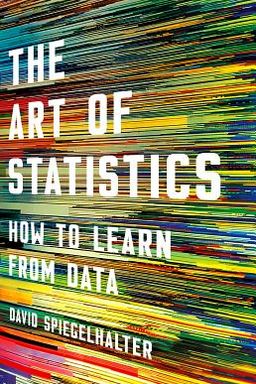
The Art of Statistics cover

The Art of Statistics

by David Spiegelhalter

The Art of Statistics offers a human-centric introduction to statistical science, revealing how data shapes our world. Learn to critically evaluate statistical claims and uncover hidden biases in media and scientific literature. Equip yourself with the skills to make informed decisions in a data-driven age.

Making Sense of the World through Data

How can you truly understand the world from numbers without falling for misleading patterns or spurious correlations? In The Art of Statistics, David Spiegelhalter argues that statistical thinking is not about formulas or software—it’s a disciplined way of asking questions, collecting evidence, and reasoning under uncertainty. His central claim is that reliable insight only emerges when you treat data analysis as an investigative cycle, not a mechanical process.

Spiegelhalter structures the entire book around the evolution of inquiry: how you define a problem (Harold Shipman’s murders), plan measurement (tree counts), handle messy data (hospital records), analyze patterns (visual plots, regression models), and draw conclusions that communicate truthfully with appropriate humility. Across this arc, he broadens statistics from a technical exercise into an ethical craft—one that demands transparent design, careful visualization, and honest uncertainty reporting.

From Problems to Patterns

Every statistical journey begins with a clear question. Spiegelhalter’s PPDAC cycle—Problem, Plan, Data, Analysis, Conclusion—anchors the entire narrative. Without defining the problem, even perfect algorithms yield meaningless results. He illustrates this with Shipman’s patient records: asking “which ages and times of death stand out?” led to revealing visual patterns that simple lists obscured. That precision in problem definition distinguishes genuine inquiry from spreadsheet chaos.

Planning and Cleaning Data

Planning means deciding what counts, how to measure it, and where to look. The Bristol heart‑surgery inquiry and global tree‑counting surveys show that definitions and selection rules shape results. Found data are notoriously messy—Spiegelhalter’s story of mismatched hospital databases reminds you that coding errors or missing fields can undermine the most sophisticated analysis. Good science therefore begins not in modeling but in cleaning.

Seeing Distributions and Uncertainty

Visualization is not decoration—it’s reasoning. From Galton’s height plots to jelly‑bean guessing competitions, Spiegelhalter demonstrates how dots, boxes, and histograms expose skewness, clusters, and outliers. Understanding distributions leads directly to understanding uncertainty: confidence intervals, margins of error, and probability models express how sure you can be. He explains bootstrapping (sampling your own sample many times) and Poisson models for rare events like homicides to quantify variability even when full data are available.

Inference, Causation, and Modeling

Statistical inference connects data to broader claims. Spiegelhalter teaches how sampling links observed individuals to target populations, how experiments establish causation by random allocation, and how regression captures predictable structure while recognizing residual unpredictability. From the Heart Protection Study on statins to Cambridge admissions data, he exposes bias and confounding and shows why randomized design is gold but not always feasible.

Communicating Risk and Responsibility

Numbers don’t speak for themselves—their framing shapes perception. Spiegelhalter’s insights into relative versus absolute risk, icon arrays, and graphical scales show why truthful communication is a moral duty. Machine‑learning chapters extend this ethic to algorithms: predictive models must be validated, calibrated, interpretable, and fair. Whether evaluating hospital survival rates, doping tests, or criminal‑justice tools, transparency and accountability define truly responsible statistics.

Reproducibility and Cultural Reform

Finally, Spiegelhalter confronts the reproducibility crisis. Low power, flexible analysis, and publication bias make false discoveries common. He advocates pre‑registration, open data, and intelligent transparency—echoing thinkers like Onora O’Neill who insist that information must be intelligible and assessable. Audiences should demand both absolute numbers and uncertainty ranges, not rhetorical claims. In this vision, statistical literacy becomes civic literacy.

When you adopt Spiegelhalter’s principles, you learn to treat every dataset as evidence, not proof; every graph as a question; and every conclusion as a communication of uncertainty. The book turns numbers into stories of judgment, responsibility, and understanding—a toolkit for thinking clearly in a world ruled by data.


The PPDAC Cycle of Inquiry

Spiegelhalter’s PPDAC framework—Problem, Plan, Data, Analysis, Conclusion—is the backbone of good reasoning with data. It prevents you from mistaking raw numbers for insight and pushes you to treat analysis as a process.

Problem: Asking the Right Question

If you start without a precise question, you’ll collect meaningless data. The Harold Shipman case illustrates this: specifying the question about victims’ ages and times of death revealed deadly patterns. Effective problems are narrow enough to analyze yet broad enough to matter.

Plan and Data: Designing for Reliability

Planning translates messy reality into structured evidence. Clear definitions (what counts as a tree?) and representative sampling ensure fairness. Data collection, often ignored, requires auditing and cleaning—Spiegelhalter’s Bristol inquiry and forest studies show how overlooked coding errors distort truth.

Analysis and Conclusion: Thinking Beyond Calculation

Analysis explores patterns and quantifies uncertainty. Visualization turns numbers into insight, from time‑series shifts to scatterplot relationships. Conclusions must report limitations and uncertainty honestly—Spiegelhalter reminds you that statistical communication is part of the scientific act, not its afterthought.

Iterative Learning

Each conclusion generates new problems. You refine definitions, redraw graphs, or revise models—the scientific cycle in action. PPDAC thus becomes both method and mindset: disciplined curiosity grounded in structure.


Seeing Data and Distributions

To understand data, you must first see its shape. Spiegelhalter combines visual, numerical, and computational methods to teach how distributions reveal patterns, error, and meaning.

From Plots to Pattern Recognition

Simple dot plots or histograms uncover outliers and skewness invisible to averages. In the jelly‑bean crowd experiment, the mean was distorted by huge guesses while the median approached reality. This demonstrates why you must choose summaries appropriate to your data’s structure.

Robustness, Transformation, and Comparison

Spiegelhalter highlights the robustness of median and inter‑quartile range against extremes, and teaches transformations (like logs) to reveal symmetry. Comparing groups via scatterplots or time series—such as surgeon volume vs survival or name popularity over time—illustrates how visualization drives further questions.

Visual Reasoning

Graphs are reasoning tools. They help you ask why patterns arise, not just show that they exist—and thus transform data exploration into discovery.


From Samples to Populations

Moving from a measured sample to claims about wider populations requires statistical induction. Spiegelhalter exposes the fragile chain that connects raw data to representativeness and inference.

Four Stages of Representation

He describes the links from recorded data → truth about sample → study population → target population. Each step can break through measurement bias, sampling flaws, or interpretive leaps. The Natsal sexual‑behaviour survey shows how recall and social desirability biases distort reported averages.

Randomization and Bias

Random sampling ensures representativeness. Gallup’s soup analogy makes this intuitive—stir, then sample—and Spiegelhalter contrasts it with the Vietnam draft lottery fiasco where capsules weren’t mixed. Administrative datasets may seem complete, yet report only what gets recorded (as seen when police data diverged from crime surveys).

Populations as Concepts

Literal, virtual, and metaphorical populations represent different lenses—real enumerated sets, possible measurements, and hypothetical alternative histories. You must be explicit about which you invoke when making generalizations.

Understanding these distinctions teaches humility: collecting data does not guarantee truth about the target population unless design, measurement, and inference align.


Causation and Confounding

Correlation alone cannot reveal causes. Spiegelhalter dissects how we infer causality probabilistically and why randomization remains our strongest defense against confounding.

Randomization and Trials

Through the Heart Protection Study on statins, he explains blinding, control groups, and intention‑to‑treat principles. Randomization balances confounders, letting effect size differences plausibly indicate causation. He contrasts this rigor with observational pitfalls in everyday data.

Confounding and Paradox

Cambridge admissions data demonstrate Simpson’s paradox: grouping data can invert relationships. Beyond academic puzzles, this warns you against relying on aggregated associations. Spiegelhalter also decodes reverse causation, as in the Waitrose‑house‑price correlation—it’s location selection, not store impact.

Bradford Hill’s Guidance

When trials are impossible, practical criteria—temporality, dose‑response, effect magnitude, mechanism, and replication—help judge causation responsibly.

True causal reasoning combines design, statistical control, and theoretical plausibility—a fusion of science and skepticism.


Probability and Uncertainty

Understanding uncertainty transforms guesses into knowledge. Spiegelhalter revisits probability from its gambling origins to modern inference and bootstrapping, teaching that uncertainty is quantifiable and communicable.

Expected Frequencies

Thinking in frequencies clarifies confusion. In mammogram problems, expressing numbers per 1,000 women makes it evident that positive tests mostly reflect false alarms. Probability trees, he shows, translate abstract percentages into intuitive counts.

Bootstrapping and Variability

When you lack replicates, resampling your data mimics repetition. Bootstrapping estimates variability without strict distributional assumptions. Spiegelhalter uses jelly‑bean guesses and Natsal surveys to demonstrate how this technique yields credible intervals informed by data itself.

Probability Models for Counts

The Poisson model for daily homicide counts exemplifies how modeling allows inference even with complete data. Modeling rare events gives you the tools to assess if visible clusters are statistically surprising.

Probability functions as your language of uncertainty—honestly articulating what we know and how much we don’t.


Testing and Statistical Evidence

Statistical testing formalizes how you assess evidence. Spiegelhalter demystifies P-values, confidence intervals, and multiple testing, emphasizing caution in interpretation.

Understanding P-values

The P-value measures how incompatible your data are with a null hypothesis, not the probability the hypothesis is false. Arbuthnot’s 82‑year baptism example and the Heart Protection Study illustrate both extremes—astronomically small P-values emerge from large samples and strong effects.

Confidence Intervals and Margins

Intervals express plausible ranges under sampling variability, built from standard errors and the Central Limit Theorem. Yet Spiegelhalter warns that reported margins ignore systematic biases; polls’ ±3% is optimistic.

Multiplicity and Sequential Monitoring

Running many tests inflates false positives—the dead salmon fMRI joke proves that. Sequential testing (SPRT) in the Shipman case shows that continuous monitoring could have detected suspicious data earlier. Bonferroni correction and False Discovery Rate control keep results honest.

Use testing tools not as verdicts but as prompts for deeper scrutiny and replication—the antidote to “significance” obsession.


Bayesian Thinking and Updating Beliefs

Bayesian reasoning offers a coherent framework for combining prior beliefs with evidence. Spiegelhalter moves seamlessly from forensic analysis to political polling to illustrate its practicality.

Bayes’ Core Logic

Posterior odds = prior odds × likelihood ratio. This equation governs rational updating. In doping tests, low prevalence makes false positives common despite accurate tests—proof that context (the prior) dominates interpretation.

Combining Evidence

Richard III’s skeleton identification demonstrates cumulative reasoning: radiocarbon dating, wounds, scoliosis, and DNA each add multiplicative support, yielding overwhelming overall posterior odds. (UK courts use similar logic when evaluating forensic likelihood ratios.)

Modern Hierarchical Bayes

Bayesian hierarchical models let you “borrow strength” across related groups. Multi‑level regression and post‑stratification (MRP) generated accurate election predictions by combining demographic priors with survey data. These methods embody rational updating in complex systems.

Explicit priors foster transparency: instead of pretending objectivity, you reveal your assumptions and how evidence reshapes them.


Models, Algorithms and Evaluation

Modern data science merges classical modeling with algorithmic prediction. Spiegelhalter bridges regression, machine learning, and ethics to teach not just how to predict but how to judge predictions responsibly.

From Regression to Algorithms

Galton’s regression to the mean evolves into logistic, tree, and neural‑network models that classify and forecast. The Titanic Kaggle example lays out training/testing splits, confusion matrices, ROC curves, and calibration checks.

Evaluation and Overfitting

Comparing algorithms requires paired testing to judge if differences are statistically real—small edges may be noise. Cross‑validation and regularization maintain generalizability by balancing bias and variance.

Ethics and Fairness

Real-world consequences demand calibrated, explainable systems. Spiegelhalter warns of hidden bias when proxies substitute for protected attributes and praises open, validated models like Predict (breast cancer prognostics). A model’s transparency often outweighs marginal accuracy gains.

In algorithmic society, statistical ethics become civic ethics—insisting that predictions be explainable and evidence fair.


Reproducibility and Transparency

A final theme binds Spiegelhalter’s work: trustworthy statistics depend on openness. The reproducibility crisis exposed that many “discoveries” stem from low power and questionable research practices.

Failures and Lessons

Mass replications in psychology found most original results disappear. P‑hacking, HARKing, and selective reporting inflate false positives. From Bem’s ESP study to the chocolate‑diet hoax, he shows how incentives to publish drive distortion.

Transparency Remedies

Pre‑registration, data sharing, and reproducible pipelines restore credibility. Press offices must report uncertainty rather than hype, and audiences should practice “intelligent transparency”—asking who funded studies, how data were gathered, and what uncertainties remain.

The Cultural Shift

Effective evidence communication demands collaboration among producers, communicators, and audiences; only this triad can turn statistical literacy into public trust.

Spiegelhalter’s call ends where it began: statistics is a social responsibility. Its integrity lies in openness about how questions were asked and how uncertainty was conveyed.

Dig Deeper

Get personalized prompts to apply these lessons to your life and deepen your understanding.

Go Deeper

Get the Full Experience

Download Insight Books for AI-powered reflections, quizzes, and more.