
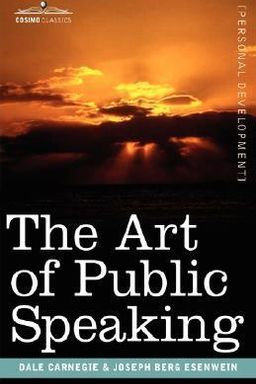
The Art of Public Speaking cover

The Art of Public Speaking

by Dale Carnegie, with JB Esenwein

The Art of Public Speaking by Dale Carnegie, with JB Esenwein, is a timeless guide to mastering the craft of oratory. Offering actionable tips to overcome stage fright, use dynamic delivery, and engage audiences emotionally, this book transforms novices into confident speakers. Its century-spanning wisdom remains relevant, making it an essential read for anyone seeking to improve their public speaking skills.

The Inner Power Behind Public Speaking

Public speaking, Dale Carnegie and J. Berg Esenwein insist, is not mechanical—it is the public projection of the speaker’s inner life. The book teaches that eloquence begins with substance rather than style: audiences respond not to tricks of training but to conviction, presence, and disciplined will. Speaking is thus a moral and psychological exercise as much as a technical one. You must cultivate ideas worth saying, master your will, and then practice relentlessly until expression and thought fuse into unity.

Substance Before Style

The book opens with Esenwein’s axiom: no technique can mask emptiness. Beecher, Webster, and Gladstone serve as examples of speakers whose words rose from lived conviction. Without inner material, gesture and cadence are hollow. The practical command: read widely, think deeply, and form opinions that matter. The more you store within, the more force your words acquire.

Will and Self-Mastery

Will governs thought, emotion, and body. When fear arises, your will must occupy the throne—commanding breath, movement, and voice. Discipline breeds calm authority, and that mental sovereignty transmits confidence to listeners. (Note: this idea parallels William James’s psychology of voluntary action—the will generates its own emotional state through controlled behavior.)

Speak to Learn

You learn to speak only by speaking. Carnegie repeats Webster’s own story of early failure: nerves and imperfection are necessary tutors. Begin to speak at once, then refine through reflection and criticism. Action precedes mastery. The book rejects passive study; real oratory grows through repetition and feedback.

The Purpose of Public Speech

Speech is treated not as entertainment but as an instrument of leadership. To stand before others is to share conviction. Your goal is to transmit truth through personality. Confidence arises when mission replaces self-consciousness—when you care more for the message than for yourself. Carnegie’s practical formula: substance first, then will, then technique, then practice. Every later chapter—from vocal training to crowd psychology—builds upon this foundation.

Core Insight

Public speaking reveals your inner character. Master the voice, gesture, and rhythm only after you have mastered your ideas and your will; otherwise you fashion a lifeless mask instead of a living instrument.

In short, this opening message reframes the art entirely: speaking is the audible will of the mind. Practice and patience make expression a moral act of sincerity and discipline. Once you embody conviction, every technical detail—pitch, pause, gesture—becomes natural rather than artificial.


From Fear to Presence

Stage fright, Carnegie says, is universal—but curable. Fear is a learned reflex that dissolves through exposure and preparation. Great speakers—Webster, Gladstone, Beecher—felt anxiety yet conquered it through repeated experience. You master fear by replacing self‑consciousness with mission: think of your subject, not your nervousness.

Practice as Therapy

Like a horse desensitized to trains or a swimmer who must jump into the water to learn, you overcome fear only by speaking before others. Theory cannot replace exposure. Begin small—two‑minute remarks at meetings—and lengthen gradually. Every repetition rewires your nervous response from panic to presence.

Preparation and Mastery

Know your subject thoroughly. Confidence grows from competence. Have the opening and closing sentences memorized; they form anchors that steady your start and your finish. Do not apologize or speak too rapidly—pause, breathe, and talk conversationally. The audience mirrors your attitude: assume calm mastery and they will feel secure beneath it.

Visualization and Controlled Energy

Carnegie’s exercises blend psychology and physiology. Visualize a sympathetic audience, drop your shoulders, relax the jaw, and take deep diaphragm breaths. These signals tell the body that safety exists; the mind follows. Fear’s energy turns into expressiveness rather than paralysis.

Essential Reminder

Courage is a habit. Each time you speak you rehearse bravery; repeated brave actions will outgrow fear entirely.

Stage fright, then, becomes a doorway: it tests how much you care about your message. Channel the nervous energy into focus on your subject. As Carnegie insists, practice with persistence and psychological intent until the will replaces trembling with command.


Expressive Variety and Vocal Mastery

To avoid monotony—the cardinal sin of the platform—you must vary your vocal and physical expression. Carnegie expands this principle into four coordinated tools: pitch, pace, pause, and inflection. Each arises naturally when thought changes. Effective speakers imitate the rhythms of life, not machinery.

Variety Over Sameness

Monotony drains listener energy. Like a city of identical brownstones, a steady tone dulls imagination. Practice changing pitch and tempo deliberately. Observe children or birds—their speech and songs shift continually. Natural variety is the model for public vitality.

Pitch, Pace, Pause, Inflection

Pitch marks emotional level; low for gravity, high for excitement. Pace (tempo) adds dynamism—slow for importance, quick for levity. Pause introduces suspense and clarity; silence often speaks louder than sound. Inflection shades meaning within syllables—rising for questions, falling for authority. Combine them to sculpt your audience’s emotional map.

Emphasis and Contrast

Treat sentences as mountains—select key words as peaks. Emphasize them through contrast, not mere loudness. Patrick Henry’s cry for liberty is powerful because every syllable carries intent, not volume. Practice marking your mountain‑peak words and subordinating the valleys around them.

Training Rule

If your voice remains unchanged for more than a paragraph, vary one element—pitch, speed, or pause—and watch interest return instantly.

Mastering variety transforms plain language into living rhythm. Speak as thought moves: the listener hears your mental changes through vocal contrast. Variety becomes not artifice but authenticity—the outward music of inward conviction.


Preparing Mind and Material

Real fluency requires mental storage and disciplined concentration. Carnegie describes speaking as a craft riding three rails: preparation, concentration, and delivery method. You must know your topic deeply, attend to the present sentence while speaking, and rehearse until mechanics become instinct.

Concentration: The Mental Microscope

Divided attention ruins expression. When you think of the next line while uttering this one, endings weaken. Train your focus to remain on the present idea until spoken, then pause to turn to the next. The pause itself forms mental punctuation that keeps precision alive.

Preparation and Reserve Power

Knowledge is confidence. Read, observe, and accumulate resources until your mind resembles an artesian well—speech flows naturally from abundance. Examples such as Schiller’s collaboration with Goethe and Russell Conwell’s thousands of rehearsals show that reserve power makes fluency effortless.

Methods of Delivery

Choose between manuscript, memorized, notes-based, or extemporaneous speaking. Beginners may rely on brief notes but strive toward extemporaneous speech—prepared ideas, spontaneous language. That balance creates naturalness and authority.

Practical Application

Commit the outline, not every word. Speak conversationally from prepared headings, allowing phrasing to shift while ideas stay firm.

Preparation hones security; concentration guards flow; thoughtful method makes delivery alive. When these merge, you cease to perform—you communicate with intellectual precision and emotional force.


Using Imagination and Memory

Imagination and memory are practical engines of persuasion. Imagination paints ideas so listeners can see them; memory makes fluency possible without artificial cues. Both are trainable habits, not innate gifts. Napoleon’s dictum—“The human race is governed by its imagination”—frames the principle: audiences think in pictures.

Reproductive and Productive Imagination

Reproductive imagination recalls vivid past scenes; productive imagination invents credible new ones. You should practice both daily—describe remembered events with sensory richness, and create plausible stories that illustrate principles. Mix visual, auditory, and tactile cues; multi-sensory detail anchors persuasion.

Memory Through Association

Effective memory relies on attention, organization, and linking. Associate ideas with objects or acronyms, repeat aloud, and record thoughts to reinforce them using different senses. Concentrated focus at first exposure guarantees later recall. Fear of forgetting only ensures forgetfulness; calm confidence restores connection.

Daily Training

Memorize short passages, visualize scenes, and practice recalling outlines. Write, speak, and hear your materials to imprint them deeply. If you blank out on stage, restart at your last remembered keyword and rebuild through association—the mind regains momentum through linked ideas.

Guiding Principle

Imagination makes thought visible; memory makes thought stable. Combined, they form the unseen architecture supporting every convincing speech.

Develop both faculties systematically. The result is expressive clarity: your speech will flow from vivid mental pictures recalled without strain, creating impact that remains in listeners’ minds long after you finish.


Persuasion, Emotion, and Leadership

The book’s culminating lessons treat persuasion and leadership—the ability to move minds and hearts. Carnegie blends classical rhetoric with modern psychology: exposition clarifies, narration illustrates, suggestion opens receptivity, argument proves, and persuasion fuses them all. Effective influence marries reason with feeling and demands ethical responsibility.

Know Your Audience

You cannot persuade strangers to themselves. Study who sits before you—their desires, fears, and ideals—and begin from their perspective. Like advertisers who first speak to pain before praising cures, begin with immediate interests and rise to nobler motives such as duty and justice.

Emotion and Story

Stories make arguments human. Antony’s funeral speech converts reasoning into shared emotion. Use narrative detail, pauses, and concrete images to turn abstract issues tangible. Emotion is contagious when genuine; artifice repels. Sincerity is therefore the highest technical skill.

Crowd Psychology and Ethical Leadership

Crowds feel collectively; they catch emotion like flame. Leaders must channel this energy toward constructive ends. Use communal symbols, songs, or repeated phrases to unify attention, but never descend into demagogy. The difference between a master and a manipulator lies in purpose: one uplifts, the other exploits.

Voice and Personality

Voice charm—built from relaxation, openness, and sincerity—embodies moral quality. A warm, resonant tone arises from both physical health and goodwill. Daily practice combines breathing drills, articulation, and joyful reading. Personality and ethical will, more than melody, make voices memorable.

Moral Center

Use persuasion to expand conscience, not trick impulse. The lasting influence of speakers like Lincoln or Beecher comes from integrity wrapped in passion.

By combining clear fact, vivid story, honest emotion, and disciplined ethics, you not only persuade—you lead. The book ends where it began: the true art of speaking is the art of character made audible.


Everyday Eloquence

The final chapters bring theory down to daily life—conversation, after-dinner talks, commemorations. Eloquence survives when it adapts to occasion and remains appropriate. You practice public identity constantly, not just on stage. Each exchange is rehearsal for larger address.

Adapt to Occasion

An after-dinner speech requires humor, brevity, and warmth. A memorial demands restraint and dignity. Match tone and length to mood. Mark Twain’s short wit or Blaine’s tender eulogy of Garfield illustrate how fit matters more than grandeur. Always leave audiences wanting more, never less.

Conversation as Laboratory

Gladstone called conversation a training ground of intellect. Practice listening, asking questions, and tailoring remarks to interest others. Avoid self-centered monologues and tired platitudes. A speaker who converses well always brings freshness to the stage.

Guiding Principle

Appropriateness and brevity make both public and private talk memorable. The same rule that wins a dinner table will win a hall.

Through daily speech you form your style and character. Use each encounter to test judgment, tone, and empathy—the ordinary moments refine the extraordinary speaker.

Dig Deeper

Get personalized prompts to apply these lessons to your life and deepen your understanding.

Go Deeper

Get the Full Experience

Download Insight Books for AI-powered reflections, quizzes, and more.