
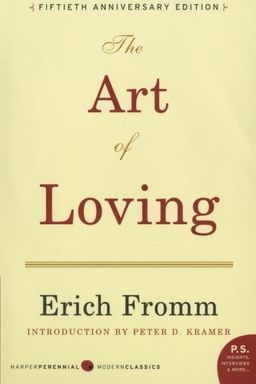
The Art of Loving cover

The Art of Loving

by Erich Fromm

In The Art of Loving, Erich Fromm explores the complexities of love, presenting it as a skill that requires practice, much like any art. He examines the impact of modern society on our ability to love and offers insights into the various forms of love, encouraging readers to cultivate deeper, more meaningful relationships.

Love as a Learned Art

When was the last time you asked yourself whether you truly know how to love? In The Art of Loving, psychoanalyst and social philosopher Erich Fromm argues that love is not a mysterious emotion we simply fall into—it’s an art that requires knowledge, effort, and personal development. He insists that most people see love as something passive, an experience that happens to them, rather than an active skill they can cultivate. This confusion, he claims, is why so many relationships fail and why modern life leaves us feeling isolated and unfulfilled.

Fromm’s central claim is radical: love is a capacity that must be learned like music or painting. It demands practice, self-discipline, and commitment. To love intelligently, you first need to understand human nature, your own inner dynamics, and the distortions society produces in how you relate to others. Only then can love become a productive orientation—a way of relating to the world itself.

The Problem of Separateness

For Fromm, love begins with recognizing a deep existential reality: human beings are separate. We are conscious beings who experience our individuality as isolation, and this isolation causes immense anxiety. Every action of human civilization—religion, art, science, or war—is, in its deepest sense, an effort to overcome separateness. Love, then, is life’s most profound solution to this problem. It is the mature attempt to unite with others without sacrificing individuality. As Fromm writes, love is the paradox of two beings becoming one and yet remaining two.

This sets love apart from immature or symbiotic bonds, such as the dependence of a child on its parent or the submission of one lover to another. True love involves freedom, responsibility, and respect for the other’s separateness. The journey from infantile dependence to mature love mirrors humanity’s historical evolution—from tribal worship and submission to gods toward a spiritual unity grounded in compassion and reason.

Love as Active Power

Unlike transient emotion, love is an active power that breaks barriers between human beings. It requires four basic elements: care, responsibility, respect, and knowledge. To love is to nurture the growth of another while preserving their autonomy. Motherly love epitomizes care—the unconditional affirmation of a child’s life. Fatherly love complements it through guidance and structure. Romantic or erotic love integrates both, seeking unity through body and spirit while respecting individuality. All genuine forms of love share one essence: the expression of life through giving.

“Love is primarily giving, not receiving,” Fromm writes. “In the very act of giving, I experience my strength, my wealth, my power.”

Why We Fail to Love

Modern capitalist society, Fromm warns, makes true love almost impossible. By teaching us to treat ourselves and others as commodities, we learn to seek affection as an exchange: we market our personalities to find the best bargain. We confuse being lovable with being loving. The result is pseudo-love—relationships built on convenience, sex, or security rather than compassion and shared growth. In a culture obsessed with consumption, even emotions are packaged for sale.

Fromm contrasts this with the love of God known in mystical traditions—Eastern and Western—that emphasize being one with existence rather than believing in a deity as an external father figure. In both romantic and divine love, the mature individual integrates motherly warmth and fatherly principle within themselves, attaining unity not through dependence but through self-realization.

The Art of Practice

Ultimately, Fromm argues that learning to love is no easier than mastering any professional skill. You wouldn’t expect to perform surgery or play a symphony without years of patient practice—and the same goes for love. The prerequisites are discipline (staying committed even when you don’t feel like it), concentration (being fully present), and patience (understanding that growth takes time). Above all, loving demands the development of character traits such as humility, faith, and courage—the courage to give yourself without guarantee that you’ll be loved in return.

In the end, the art of loving is also the art of living. Just as the painter becomes one with the canvas, you must bring the same awareness and devotion to the act of loving others. This requires faith in your own capacity for love—a faith grounded not in dogma but in your experience of being alive, creative, and connected to humanity. As Fromm reminds us, love isn’t a sentiment you fall into; it’s a discipline you must consciously create, nurture, and practice every day.


Love as the Answer to Human Existence

Fromm begins The Art of Loving with a profound observation: to understand love, you must first understand what it means to be human. Humans are born conscious and separate, aware of their mortality and isolation. This awareness creates an inner tension, a longing to reconnect—to find unity despite individuality. Love, then, isn’t a luxury or emotional indulgence; it’s humanity’s answer to the existential problem of separateness.

The Anxiety of Separateness

Fromm argues that being separate from nature and from one another is the source of all human anxiety. In mythic terms, Adam and Eve’s expulsion from Eden symbolizes this condition: self-awareness leads to isolation—and shame. Without reunion, man must invent ways to overcome loneliness. Some turn to orgiastic union through sex, drugs, or ritual ecstasy, seeking to feel one with others temporarily. Others choose conformity, blending into the social herd to avoid standing alone. Still others bury themselves in productive work, losing self in the creation of things.

But none of these substitutes offer lasting connection. The ecstatic moment fades; conformity sacrifices individuality; and work, though rewarding, unites only man and matter, not man with fellow man. Only love provides an enduring solution because it achieves unity while preserving individuality.

Symbiotic and Mature Love

To grasp love’s true nature, Fromm distinguishes between symbiotic union—dependent, immature relationships—and mature love. Symbiotic union comes in two forms: masochistic (submissive dependence) and sadistic (domineering control). In both, individuals try to escape freedom through fusion, but at the cost of integrity. Mature love, by contrast, allows two people to become one without ceasing to be two. It recognizes that real love involves both autonomy and union, freedom and commitment.

In this sense, love is not an emotion but an attitude—a way of being that involves effort and an active concern for life and growth. The partner becomes a mirror of one’s own capacity to give, not simply someone who fulfills needs. In mature love, both people experience themselves from the center of their existence, sharing a spiritual and emotional vitality rather than using each other as escape routes from loneliness.

Love as an Act of Giving

Fromm’s definition of love centers on giving rather than consuming. He reverses the modern view that associates love with possession or exchange. True love, he argues, is the overflow of inner strength. In the act of giving, you experience your abundance and vitality. Whether giving knowledge, affection, joy, or understanding, you enrich both yourself and the loved one.

“Not he who has much is rich, but he who gives much,” Fromm reminds us.

Love, then, is not sacrifice or loss but the joyful realization of potency. In giving, you become more alive, because giving expresses the essence of life itself—the movement of energy outward toward connection.

Care, Responsibility, Respect, and Knowledge

Every act of love involves these four intertwined elements. Care means an active concern for another’s growth, as a gardener cares for plants. Responsibility is the ability to respond to another’s needs voluntarily, not out of duty. Respect means seeing another person as they truly are—not as an instrument for your gratification. And knowledge is the empathy that perceives the other’s reality beyond surface appearances. Without these elements, what passes for love is only dependency or exploitation masked as devotion.

In the end, to love means to live responsibly—to direct one’s powers toward unity with others while maintaining one’s own integrity. This, Fromm concludes, is humanity’s deepest task: to master love as both an art and a moral calling, the only antidote to the modern condition of alienation.


The Many Forms of Love

Fromm believed that love isn’t confined to romance. It takes multiple forms, each reflecting a particular human relationship. By understanding these varieties of love—brotherly, motherly, erotic, self-love, and love of God—you can see love not as one emotion but as a universal attitude toward life itself.

Brotherly Love

Brotherly love is the foundation of all loves. It is the sense of care, responsibility, and solidarity you feel for humanity. This form of love means recognizing yourself in others. “If I love one person,” Fromm writes, “I love all persons.” When you see others from their center, not through your ego, you experience what he calls “central relatedness”—connection from essence to essence. Compassion for the poor, the stranger, or even the sinner expresses this type of love, which religions have described as agape or charity.

Motherly and Fatherly Love

Motherly love is unconditional. It says, “I love you because you are.” Like God’s creation in Genesis, it affirms: “It is good.” Such love gives a child both life and the love for living—milk and honey. But motherly love must also evolve; to truly love, a mother must want her child to grow free from her. Fatherly love, on the other hand, is conditional. It rewards obedience, discipline, and achievement. It symbolizes authority, structure, and reason. Healthy maturity, Fromm argues, comes when an individual internalizes both—developing a “motherly conscience” of compassion and a “fatherly conscience” of self-discipline and principle.

Erotic Love

Erotic love is the desire for complete physical and emotional union with one particular person. It’s exclusive, passionate, and often confused with infatuation. Fromm warns that our culture mistakes the excitement of falling in love for lasting connection. True erotic love, though, includes brotherly love—it respects, cares, and seeks mutual growth. It isn't possessive; it includes the world within the beloved, not the annihilation of both for the sake of fusion. Love, in this sense, is a daily act of commitment, not a passing emotion.

Self-Love

Few ideas confuse people as much as self-love. Society teaches you that loving yourself means selfishness, but Fromm flips this: self-love and love for others are inseparable. If you cannot care for yourself, you cannot truly care for another. The selfish person doesn’t love himself too much; he doesn’t love himself at all. Self-love is the affirmation of one’s own life, happiness, and potential. Like Meister Eckhart wrote, “If you love yourself, you love everybody else as you do yourself.”

Love of God

Finally, love of God represents the yearning to transcend the limitations of separateness. In primitive times, this love was directed toward mother goddesses or father gods—figures reflecting childhood dependence. But as civilization evolved, so did our concept of God: from punishing patriarch to a symbol of unity, truth, and love itself. For mystics like Meister Eckhart or the Sufis, to love God was to experience oneness with all existence, transcending dogma and duality. Fromm suggests that even in a secular world, this spiritual longing matters—it’s our way of affirming human potential and ethical unity with life.

By integrating these forms—caring for humanity, nurturing life, embracing passion responsibly, respecting oneself, and seeking unity beyond ego—Fromm believes you learn not only to love others better, but also to live more completely.


Love in a Consumer Society

Fromm’s most striking critique is reserved for contemporary Western society, which he sees as structurally hostile to love. Modern capitalism, he writes, has reduced everything—including emotions—into commodities for exchange. You don’t simply love; you market yourself. Relationships are built on the same logic as buying a car or phone: get the best deal, the most attractive model, at the right price.

Love as a Transaction

In this system, love becomes a form of barter. People ask not “Do I know how to love?” but “Am I lovable?” Success, status, and charm replace sincerity, compassion, and understanding. Romantic relationships dissolve into consumer contracts—mutual attempts to satisfy psychological needs while maximizing emotional profit. As Fromm says, “The marriage counselor tells us that the husband should ‘understand’ his wife and she should listen ‘tolerantly.’” This politeness masks alienation; couples function like well-oiled teams rather than kindred souls.

Automaton Conformity

Modern capitalism requires conformity: people who cooperate smoothly, consume endlessly, and feel independent while following social scripts. Fromm calls this the rise of the marketing character—a person who experiences themselves as a commodity. You sell your personality as a brand, obeying the laws of the market rather than the voice of conscience. But automatons cannot love. They can only “exchange personality packages.” Hence, love in such a world degenerates into pseudo-love—temporary alliances to ease loneliness, team partnerships, or escapism through sex and entertainment.

“The world,” Fromm writes, “is one great object for our appetite, a big apple, a big bottle, a big breast. We are the sucklers—and the eternally disappointed ones.”

Religion, Science, and Alienation

Even religion isn’t immune. Western Christianity, influenced by consumerism, often preaches a market-friendly God—a cosmic business partner who ensures success through faith. Fromm contrasts this with authentic spirituality, which emphasizes unity, justice, and compassion. Science too, though necessary, has fed alienation by prioritizing thought over being, knowledge over experience. In both cases, the human need for oneness has been replaced by the cult of success and intellectual abstraction.

The Path Back to Love

The antidote, Fromm suggests, is to recover our humanity—to rebel against the dehumanizing forces of the market and rediscover the simplicity of being. Genuine love cannot flourish in a culture that prizes consumption over character. Only when society shifts from having to being—from commodity exchange to cooperation, from competition to compassion—can love become not just a private emotion but a social principle. Until then, those who try to live with love must do so as creative rebels, keeping alive what culture suppresses: the spontaneous, giving heart of humanity.


The Practice of Love

After diagnosing society’s failures, Fromm turns to the question everyone asks: How can I learn to love? His answer is both practical and sobering. Love cannot be learned through tips or formulas; it must be practiced as any art is practiced—with discipline, concentration, and patience. He warns that anyone looking for quick techniques of seduction or “winning love” will be disappointed. The real question is not how to be loved, but how to become a loving person.

Discipline, Concentration, and Patience

First, discipline: to master an art, you must dedicate yourself to regular practice. But Fromm points out that most people’s discipline is limited to their jobs, not their inner life. After work, they drift into laziness, consuming entertainment rather than creating meaning. True discipline means living with intention every day—reading thoughtfully, meditating, nurturing your relationships, resisting the distractions of triviality.

Next, concentration: the ability to be fully present. Our culture fragments attention—phones, media, multitasking. But love requires deep presence, the capacity to listen, to be alone with yourself, and to meet others from that stillness. Fromm suggests daily exercises in solitude, quiet breathing, or mindfulness that reconnect you with your inner life. As he says, “Paradoxically, the ability to be alone is the condition for the ability to love.”

Finally, patience: just as mastery in painting or music takes years, so does mastering love. Impulsiveness and haste—hallmarks of modern life—destroy the slow rhythm in which trust and intimacy grow. To love is to plant, water, and wait, not demand quick harvest.

Faith, Humility, and Courage

Fromm expands practice to spiritual discipline. Love requires faith—not blind belief, but trust in the growth potential of yourself and others. It is faith in your power to love, to nurture, even when results are uncertain. Humility means recognizing limits; arrogance shuts down genuine connection. Courage is essential because to love is to risk loss, rejection, and pain. “Love,” Fromm writes, “is an act of faith, and whoever is of little faith is also of little love.”

Love Through Action

Love is not separate from life. You cannot divide work from love, or family from society. Every moment—speaking honestly, performing your job with integrity, helping others—is practice for loving. Fromm argues that love must extend beyond romance into civic life: justice, care for others, ecological respect. “To speak of love is not preaching,” he insists. It is speaking of humanity’s deepest need.

The challenge is systemic: our capitalist and bureaucratic institutions make love marginal. But individuals can resist by living differently—cultivating inner aliveness, sensitivity, and awareness. To love, you must remain “awake” to life, not numbed by conformity. In this sense, love is both a personal art and a form of social rebellion. Practicing it is not merely about romance but about reshaping yourself—and, ultimately, the world—into something more human.

Dig Deeper

Get personalized prompts to apply these lessons to your life and deepen your understanding.

Go Deeper

Get the Full Experience

Download Insight Books for AI-powered reflections, quizzes, and more.