
Idea 1
Logic as an Art of Understanding an Illogical World
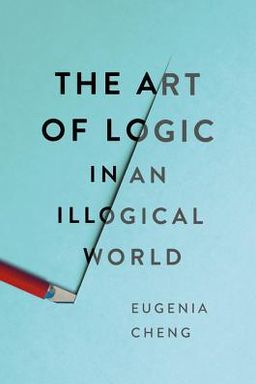
Have you ever found yourself in a heated argument where facts didn’t matter, logic fell apart, and emotion won anyway? In The Art of Logic in an Illogical World, mathematician and educator Eugenia Cheng tackles this very human dilemma. She argues that while logic offers clarity and rigor, it’s not enough to navigate a world ruled by emotion, bias, and social complexity. Her central claim is provocative yet hopeful: logic and emotion are not enemies—they are partners in understanding truth and connecting with others.
Drawing from her background in pure mathematics and category theory, Cheng contends that if mathematics can model infinitely abstract ideas, then its logical mindset can also help us reason through daily life. But to do so, we must first accept that logic has limits—it can illuminate truths, but it cannot tell us everything about humans, relationships, or morality. In this light, Cheng offers a blend of mathematics, philosophy, and social reflection to teach you how to think, not what to think.
Logic as Illumination, Not Domination
Cheng begins by redefining logic’s purpose. Logic, she writes, is a form of illumination—a way to shine light on complex issues, revealing their structure so we can see them more clearly. Like adjusting a flashlight, abstraction allows us to view both fine detail and broad context. When we misuse logic—to nitpick, dominate, or oversimplify—we turn precision into pedantry. But when we use logic thoughtfully, we can transform confusion into clarity.
The author uses a simple but powerful metaphor: logic is like a bicycle. It won’t take you everywhere—it can’t fly—but it’s still incredibly effective within its limits. “When your bicycle can’t fly,” Cheng writes, “you don’t throw it away—you use it for what it does best.” The point is that logic doesn’t fail us; we fail when we misuse logic in realms where human emotion, ambiguity, and social context rule.
Mathematics as a Framework for Thinking
Part of Cheng’s unique approach comes from her deep love of math—not as a toolbox for numbers, but as a lens for thinking. For her, mathematics is “the logical study of how logical things work.” In it, every system is built on axioms—assumptions taken to be true. From those axioms flow all other logical conclusions. Similarly, our personal beliefs rest on unspoken assumptions. Whether you’re arguing about healthcare, morality, or parenting, your “axioms” shape what you think is reasonable, even if you can’t see them directly.
By drawing parallels between mathematical reasoning and human reasoning, Cheng aims to show that logic is more than an academic exercise: it’s a method for examining the roots of our disagreements. Much like scientists test physical laws through experiments, logical thinkers test the soundness of arguments through structure and implication. But as Cheng reminds us, unlike math, life doesn’t always behave logically—humans add noise, emotion, and bias to every calculation.
The Limits of Logic and the Role of Emotion
After guiding you through how logic works, Cheng introduces a crucial twist: logic alone can’t win hearts or build trust. In both mathematics and life, justification is social. Mathematicians rely on peer review—a jury of peers who must be convinced, not merely shown a formal proof. Similarly, in conversation, truth isn’t just about what’s logically correct; it’s about what’s convincing to humans. To bridge the gap between logic and persuasion, Cheng argues for harnessing emotions—not suppressing them, but aligning them with reasoning.
She points out how internet memes, catchy slogans, and political propaganda succeed not because they’re logical, but because they’re emotionally resonant. Instead of despairing, Cheng invites us to learn from them: logical truth must also be emotionally engaging. Enlightened reasoning, she insists, happens when logical rigor and emotional empathy reinforce, not oppose, each other.
An Ethical Use of Logic
By the book’s end, Cheng evolves her argument into an ethical vision. To be both intelligent and rational, she says, is to use logic not for power but for connection. True intelligence—the kind that advances society—is the ability to help both yourself and others simultaneously, not to win debates. Rationality, in this sense, is collaborative, compassionate, and creative.
“Logic gives us rigor. Emotions give us conviction. Together they can give us understanding.”
In sum, The Art of Logic in an Illogical World is both a philosophical and practical guide to thinking clearly when clarity seems impossible. Cheng invites you to use logic as an act of empathy—to understand before judging, to illuminate before arguing, and to reason together without assuming that winning is the point. Through vivid examples—from airline scandals to gender politics—she shows that the art of logic isn’t about being right; it’s about seeing rightly.