
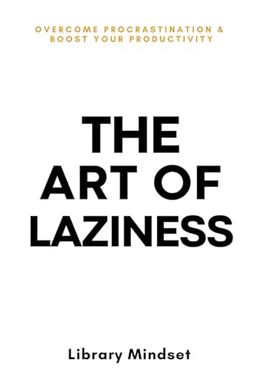
The Art of Laziness cover

The Art of Laziness

by Library Mindset

The Art of Laziness is a transformative guide for anyone seeking to overcome procrastination and enhance productivity. Through practical strategies and mindset shifts, this book empowers readers to achieve personal and professional growth by focusing on meaningful actions and self-discipline.

The Art of Laziness: Turning Awareness into Action

When was the last time you said you'd start tomorrow? In The Art of Laziness, Library Mindset challenges one of the most deeply ingrained patterns in modern life: the habit of waiting, excusing, and procrastinating. At its heart, this book argues that laziness is not a lack of ability but a lack of awareness, discipline, and purpose. The author contends that every act of avoidance today creates regret tomorrow, and that overcoming laziness is not about working more—it’s about living more deliberately.

Drawing from philosophy, psychology, and practical self-improvement, the book provides a clear structure. Part One focuses on mindset—the beliefs and habits that shape whether you act or delay action. Part Two covers techniques and daily practices designed to transform mental clarity into tangible productivity. These sections build on each other to show how laziness is a choice of comfort over creation—and how to reverse it through conscious effort.

Time Is Slipping Away

The author opens with a sobering reminder: if the average life expectancy is about 72 years, that’s only about 3,700 weeks. If you’re 30, you’ve already lived 1,500 of them. This simple calculation triggers a profound realization—life is a countdown, and every moment of procrastination is a week you’ll never get back. This theme—time as a finite and precious currency—runs throughout the book, forming its emotional and motivational foundation. You are reminded that there is no perfect time to start; the best time is always now.

The Meaning Behind Laziness

Laziness, the author argues, is rarely about physical fatigue. It’s a psychological defense mechanism. People cling to the comfort zone because change is uncertain, and uncertainty feels risky. So they rationalize waiting: “I’ll start when things calm down,” “when I have more money,” “after the weekend.” But waiting doesn’t protect you—it numbs you. Library Mindset calls laziness “the art of comfortable regret.” Every hour spent scrolling social media or aimlessly watching TV is an investment not in rest, but in future disappointment. That lens—seeing time as invested or wasted—reframes the meaning of everyday decisions.

Responsibility as Freedom

A central premise is that radical responsibility creates personal freedom. When you take 100% responsibility, you stop waiting for others to fix your problems. One of the book’s early lessons declares, “If you’re lazy, it’s your fault. If you’re unhappy, it’s your fault.” While blunt, this statement isn’t meant to shame—it’s meant to empower. Only when you accept full responsibility for your life do you gain the power to change it. This mindset shift echoes concepts from stoic philosophy (Epictetus: “Keep your attention focused on what truly concerns you.”) and modern thinkers like Jocko Willink, who champions “extreme ownership.”

Stepping Beyond Comfort

The author illustrates how laziness thrives in the comfort zone—a “beautiful place where nothing ever grows.” Leaving that zone is the only path to growth. Here, examples from history and daily life are vivid: entrepreneurs who risked failure, writers who faced blank pages, athletes who trained through exhaustion. Each story underscores the same truth: laziness is not erased by motivation but by movement. Doing something, even imperfectly, beats waiting to do it perfectly later.

From Awareness to Action

Throughout the book, the author ties awareness to small, repeatable actions. Laziness isn’t overcome in one grand gesture—it’s undone one decision at a time. The strategies explored include creating a daily routine, saying no to time-wasters, delegating low-value tasks, and using techniques like Pomodoro or the 80/20 rule. The goal is not to work endlessly but to work meaningfully. Productivity is seen not as endless acceleration but efficient alignment—working on what truly matters.

The Emotional Cost of Delay

One of the book’s most powerful images is of future regret. It invites you to imagine yourself at 80, looking back and wishing you had started sooner—at the business you never built, the trips you never took, or the dreams you postponed “for the right time.” The author insists that “someday” is a dangerous illusion. The fear of failure that fuels laziness is nothing compared to the pain of permanent regret. In this way, laziness becomes an existential threat, not just a time-management issue.

A Blueprint for a Life of Purpose

By the end, The Art of Laziness reframes productivity as purpose in motion. Every technique, from writing daily goals to the Japanese philosophy of ikigai (having a reason to wake up), serves this larger goal: to ensure that your time on earth feels lived, not lost. Laziness isn’t just an obstacle; it’s a mirror showing what you value least. The cure isn’t punishment—it’s awareness followed by consistent, meaningful action. The author’s final plea is both simple and urgent: “Time is running out. Start living now.”


Taking 100% Responsibility

Library Mindset starts with a harsh but liberating truth: no one is coming to save you. The chapter '100% Responsibility' insists that all significant change begins when you stop blaming others—your job, family, environment—and own everything that happens in your life. This isn't meant to guilt you but to release you from powerlessness. The moment you accept responsibility is the moment you reclaim agency.

The Illusion of Blame

Blame is comforting because it absolves you. If your boss is unfair or your schedule too crowded, then you're not at fault for being unproductive—at least that's the story you tell yourself. But as the author points out, no amount of blame changes reality. Like a farmer waiting for someone else to harvest his crops, you’ll wait forever if you expect help. The parable of the sparrow and the farmer drives this home: only when the farmer decided to harvest the field himself did anything happen. The lesson? Stop outsourcing your destiny.

Mistakes as Stepping Stones

The author urges readers to see mistakes as natural feedback, not failure. Quoting George Bernard Shaw, he reminds us that success isn’t the absence of mistakes but the refusal to repeat them. If you’re moving forward, you’re bound to err. But standing still out of fear—that’s the real mistake. Mistakes are tuition you pay for progress.

Focusing on What’s Yours

Drawing on Stoic ideas from Epictetus, the book advises focusing on what you can control—your actions, thoughts, and effort. You can’t control others’ opinions, the weather, or luck. Worrying about uncontrollables drains energy from what actually matters. Responsibility isn’t about controlling everything; it’s about mastering yourself.

Persistence Defines People

Library Mindset classifies people into three types: those who never start, those who start and quit, and those who start and persist through hardships. Only the third group achieves lasting success. Persistence is portrayed as the convertor of responsibility into results—a universal quality of achievers across history. Like the Stoics, the author urges focusing on internal discipline rather than luck or circumstance.


Escaping the Comfort Zone

If responsibility is ownership, then stepping out of your comfort zone is ignition. The author argues that comfort is the enemy of progress, describing it as “a beautiful place where nothing ever grows.” You may feel cozy scrolling your phone or binge-watching series, but deep down, you sense that stagnation is slowly eroding your potential.

Why Comfort Feels So Good—and So Deadly

Comfort tricks you. It offers momentary relief yet breeds long-term frustration. Dopamine-driven activities—social media, snacks, streaming—give tiny hits of pleasure that mimic satisfaction. But unlike real fulfillment, they fade quickly and leave a craving for more. That’s why the author insists that the key to lasting happiness is not escaping discomfort but choosing the right discomfort—the kind that builds you rather than numbs you.

Keep It Simple, Move Fast

The remedy? Simplicity and urgency. Perfectionism and overplanning are just sophisticated forms of procrastination. Instead of waiting for all the details, start with what you have and adjust as you go. Citing Jeff Bezos, the author advises: make decisions with 70% of the information you wish you had—waiting for 90% makes you slow. Growth belongs to those who act before they feel ready.

Think Differently

Progress demands originality. Quoting General George S. Patton (“If everyone is thinking alike, then somebody isn't thinking”), Mindset argues that laziness often hides in conformity. You can’t live an extraordinary life by copying ordinary patterns. Thinking differently—like setting unconventional goals or defying social expectations—often feels risky, but it’s the only path to growth.

Long-Term Focus

Delayed gratification is a recurring theme. Laziness provides instant relief; discipline provides eventual freedom. The author echoes psychologist Walter Mischel's marshmallow test: those who wait for the bigger reward later are more successful long-term. Your choice between immediate comfort and future fulfillment defines your future self. As the author warns, “You will always regret being lazy.”


The Power of Self-Discipline

Jim Rohn once said, “We must all suffer from one of two pains: the pain of discipline or the pain of regret.” Library Mindset builds this idea into a practice: self-discipline is the hinge that turns intention into achievement. Laziness is easy, discipline is hard, but regret is unbearable.

Do What Needs to Be Done

Discipline, the author writes, isn’t about pushing yourself mercilessly; it’s about doing what should be done—especially when you don’t want to. Seth Godin’s reminder fits here: “There’s no shortage of great ideas; only the will to execute them.” The disciplined person acts even when motivation vanishes.

Fight Procrastination

Procrastination disguises itself as rational delay—“I’m waiting for the right time.” But that time never arrives. The cure is action before certainty. Picasso’s quote frames it well: “Only put off until tomorrow what you are willing to die having left undone.” The author encourages immediate action and learning through experience rather than waiting for confidence to magically appear.

Embrace Failure and Keep Going

One memorable parable about a king’s secret ring reveals the mantra “This too shall pass.” It encapsulates the core of emotional discipline: both success and failure are temporary. You’ll face highs and lows, but steady, consistent effort will outlast them all. The disciplined person rides the wave instead of resisting it.

No Shortcuts, No Hacks

The author criticizes modern culture’s obsession with “life hacks.” Learning is helpful, but learning without action is mental procrastination. Discipline demands consistent doing. It’s less glamorous than reading productivity articles, but infinitely more transformative. Change, as the book reminds you, “happens the moment your actions align with your intentions.”


Doing the Hard Thing First

The hardest tasks are usually the most important—and the most avoided. One of the book’s most practical lessons urges you to start your day with the hardest work. When you delay it, you carry its weight all day, draining your focus. When you tackle it first, you feel lighter, accomplished, and ready for everything else.

Why Hard Choices Lead to Easy Lives

Here, Mindset introduces a profound principle: “Hard choices = easy life. Easy choices = hard life.” Choosing comfort today guarantees struggle later. The authors connect this to concepts popularized by psychologist Scott Peck (The Road Less Traveled), where discipline—doing what’s hard first—is the foundation of growth and peace.

Picturing Your Future Self

To beat resistance, picture your future self benefiting from your present effort. Every workout, study session, or creative project is a gift to that self. Likewise, every skipped effort is a setback. Framing tasks as acts of service to your future turns discipline from punishment into compassion.

Unbalancing for Growth

Contrary to the “balanced life” ideal, the author suggests that temporary imbalance can be healthy. Great achievements demand phases of focused intensity—writers spending weeks on a manuscript, athletes training obsessively, entrepreneurs pushing through long nights. Balance returns later; first, commitment must take center stage.


Mindful Productivity Techniques

Beyond mindset, The Art of Laziness provides actionable systems to structure your energy and remove friction. Instead of glorifying hustle, it celebrates smart simplicity—doing less but meaning it more.

Prioritize What Matters

The 80/20 principle teaches that 20% of actions create 80% of results. Identify those high-impact tasks and eliminate the rest. Similarly, Parkinson’s Law reminds you that work expands to fill the time available—so set deliberate time limits. Constrain your time, and you’ll expand your progress.

Simple Routines and Tools

The Pomodoro technique (25 minutes focus + 5 minutes rest) and the Five-Minute Rule (do anything that takes under 5 minutes immediately) restore momentum in small, achievable pieces. The Two-Day Rule—never skip something twice—builds powerful consistency. Together, they form a flexible framework that prioritizes focus over frenzy.

Reflection and Rating Each Day

Each night, the author recommends reviewing what you did, what you wasted time on, and planning tomorrow’s top three “arrows.” This brief reflection aligns with behavioral psychology’s principle of feedback loops—awareness precedes adjustment. Over time, this nightly ritual transforms scattered effort into self-guided improvement.


Living an Intentional Life

The book ends where it began: with awareness of time. “Wake up!” the author writes, echoing Marcus Aurelius, reminding you that every sunrise is a gift and a countdown. You don’t need to live by others’ expectations or societal scripts. The story of the man, his son, and the donkey serves as a humorous but profound parable—if you live by everyone else’s opinion, you end up “carrying the donkey” instead of riding it.

Choosing Authenticity Over Approval

Library Mindset’s closing argument is for authenticity. The right time never comes, the perfect plan never arrives, and total approval never happens. The sooner you start doing what you love and spending your time meaningfully, the sooner you escape the gravitational pull of regret. It’s not about being constantly productive—it’s about being fully alive.

The Final Wake-Up Call

The book’s final chapters strike a balance between urgency and serenity. Live with ikigai—a reason to rise each morning. Surround yourself with people who lift you higher. Stop multitasking and start living deliberately. Above all, realize that time isn’t your enemy; wasting it is. “Time is running out,” the author warns—not to frighten, but to focus you. Because, as every page reminds you, the art of laziness is simply the art of forgetting what matters most.

Dig Deeper

Get personalized prompts to apply these lessons to your life and deepen your understanding.

Go Deeper

Get the Full Experience

Download Insight Books for AI-powered reflections, quizzes, and more.