
Idea 1
The Biology of the Impossible
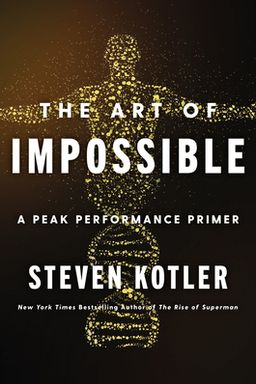
What does it really take to accomplish something no one thought could be done—to step past the limits of imagination and skill? In The Art of Impossible, Steven Kotler argues that extraordinary achievements—from breaking sporting records to transforming entire industries—are not random strokes of genius. They are the predictable result of mastering four intertwined skills: motivation, learning, creativity, and flow. Together, these create a repeatable formula for human greatness—a biological blueprint for turning the impossible into the achievable.
Kotler’s central claim is deceptively simple: human beings are hardwired for peak performance. Evolution designed our brains to solve resource scarcity through creative innovation and focused exploration. When we align our inner psychology with this biological design, we tap into an astonishing wellspring of drive, resilience, and creativity. The problem, he suggests, is that most people live far below their true capacity—what William James once called the “habit of inferiority.” We fail to access the full potential of our biology. This book, Kotler explains, is designed to correct that mistake.
Peak Performance as Biology, Not Personality
Kotler’s argument flips traditional self-help ideas on their head. People often believe greatness depends on personal traits—grit, charisma, talent, or luck. Kotler dismisses this as “personality doesn’t scale.” Instead, biology scales. Every person shares the same fundamental neurochemical systems and cognitive architecture. Motivation and creativity operate through dopamine, norepinephrine, and oxytocin. Flow—the total absorption state where time vanishes and performance peaks—is not a mystical experience; it’s the brain’s optimal mode of efficiency. By learning to trigger these mechanisms deliberately, anyone can cultivate high performance.
To demonstrate how this works, Kotler starts with his own journey. As a journalist covering action sports in the 1990s, he watched young athletes redefine what was physically possible in skiing, surfing, and skateboarding. In just a few years, they shattered decades-old limits—sometimes achieving feats literally considered fatal. The key wasn’t better equipment or training. It was flow. These athletes had learned, often unconsciously, to access flow so frequently that their progress accelerated exponentially. When Kotler studied this phenomenon in depth, he realized the same conditions apply to innovators like Elon Musk, entrepreneurs like Peter Diamandis, and creatives across disciplines.
The Four-Part Formula for Impossible
Motivation fuels the journey. It starts with curiosity—those small sparks of interest that evolve into passion, purpose, and eventually mastery. Learning keeps you on the path, turning experience into expertise. Creativity charts direction through inventive problem-solving and the courage to take risks. And flow amplifies everything, locking you into hyper-focused, high-energy states where effort feels effortless. Each stage powers the next, forming an upward spiral of progress. As Kotler puts it, “With intrinsic drivers properly stacked, our biology does the heavy lifting for us.”
Throughout the book, Kotler dives deep into how each layer works psychologically and neurologically. He offers concrete tools for cultivating curiosity, establishing “clear goals,” maintaining the challenge-skills balance central to flow, and managing recovery so your cognitive systems can refuel. His approach isn’t mystical; it’s mechanical. Just as athletes condition their bodies for repeated peak states, thinkers and creators can condition their minds for sustained breakthroughs.
Why This Matters: The Infinite Game of Excellence
Kotler uses the metaphor of finite versus infinite games (borrowed from philosopher James Carse). Finite games—like politics, sports, or business competitions—have winners and losers. Infinite games, like art, science, or personal growth, have no endpoint. The goal is simply to keep playing. Peak performance, he argues, is an infinite game. To “win,” you must cultivate systems that allow continuous evolution—learning faster, thinking deeper, creating better, and entering flow more often. The only way to lose is to stop playing.
In that sense, The Art of Impossible is less about achieving single victories and more about designing a life of sustained excellence. Kotler weaves together decades of neuroscience, psychology, and personal experience to show that the impossible isn’t reserved for prodigies or superheroes—it’s built into human biology. The art lies in learning how to activate it intentionally. If you’re willing to align curiosity with purpose, cultivate grit, and learn the rhythm of flow and recovery, you’ll transform your life’s limits into launchpads.
Key Takeaway
Kotler reminds you that greatness isn’t magic—it’s architecture. You already possess the machinery for extraordinary performance. The art of impossible is the blueprint for learning how to use it deliberately, again and again, until the extraordinary becomes routine.