
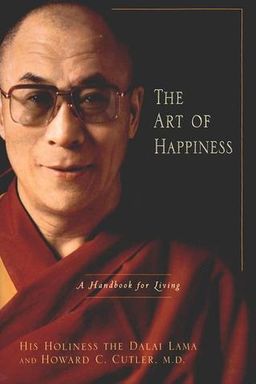
The Art of Happiness cover

The Art of Happiness

by Dalai Lama

The Art of Happiness combines the Dalai Lama''s spiritual wisdom with Dr. Howard C. Cutler''s therapeutic insights, offering a profound guide to achieving lasting happiness. Through mental training, compassion, and spiritual practice, this book provides practical tools to cultivate inner peace and joy, regardless of external circumstances.

The Art and Discipline of Happiness

What does it really mean to live happily—not for a moment, but day after day? In The Art of Happiness, the Dalai Lama and psychiatrist Howard Cutler explore this enduring question in profound yet practical terms. They argue that happiness isn't a product of luck or external success, but a skill—a mental discipline that can be trained. Drawing on Buddhist philosophy and modern psychology, the book contends that happiness arises from compassion, purposeful living, and mental balance rather than wealth, pleasure, or prestige.

The Dalai Lama’s central claim is disarmingly simple: the purpose of life is to be happy. This premise might sound obvious, but it becomes radical in his hands, because he defines happiness not as fleeting pleasure but as lasting inner peace. To cultivate it, you must actively train your mind to quiet destructive emotions like anger, hatred, and anxiety while nurturing qualities such as patience, kindness, and forgiveness. These simple shifts outline a blueprint for transforming not just your emotions but your experience of existence itself.

Why Happiness Requires Effort

It’s easy to assume happiness follows when circumstances align—when you find success, love, or comfort. Yet the authors overturn that assumption: the brain’s natural tendency is to adapt quickly to gains and to focus on dissatisfaction. Neuroscience now echoes this truth, showing that our moods depend far more on our perception of events than on the events themselves. The Dalai Lama calls this the 'training of the mind'—a disciplined focus on recognizing thoughts that lead to suffering and deliberately replacing them with compassionate ones. Through such mental training, he believes anyone can reset their emotional baseline upward.

The Balance of Compassion and Reason

Central to happiness, in his view, is compassion. Compassion broadens your perspective, pulling you out of self-absorption and helping you see your troubles in proportion. Modern psychological research backs this up: studies show altruistic acts boost wellbeing, immune function, and longevity. Interestingly, the Dalai Lama blends the moral with the empirical, showing that compassion is not just virtuous—it’s strategically smart for mental health. You learn to quiet the mind’s turbulence through acts of service, cultivating warmth toward others, and recognizing the shared human desire to avoid suffering.

The Practical Science of Happiness

The book bridges Eastern spirituality and Western science seamlessly. Cutler’s perspective as a psychiatrist illuminates the Buddhist insights with evidence from cognitive therapy and neuroscience (noting parallels between mental discipline and cognitive restructuring). Just as Western therapists encourage patients to replace distorted thoughts, the Dalai Lama teaches replacing hatred with patience and desire with contentment. Both approaches rest on the principle that mental habits can be rewired—a concept modern science calls neuroplasticity. This blend offers hope: our minds can change, regardless of age or background.

Why These Ideas Matter Today

Across the book, the Dalai Lama’s gentle humor and deep humanity remind you that happiness isn’t self-centered or naive—it’s an act of courage. He equates practicing compassion with opening an 'inner door' that connects you to others and shields you against despair. At a time when modern life feels saturated with anxiety, comparison, and division, his message feels essential: happiness is possible through mastering the art of your own thoughts. Once you recognize that kindness, empathy, and mental clarity are not luxuries but practical tools, happiness becomes less a dream and more a discipline—a daily act of training your mind, just as you train your body.


Training the Mind for Happiness

The Dalai Lama teaches that happiness starts not from acquiring more but from transforming how you think. He likens the mind to a garden: without deliberate cultivation, weeds like anger and greed flourish naturally. Emotional discipline, therefore, is the art of weeding out these destructive forces through awareness, learning, and practice. The goal is not suppression but transformation—the realization that mental states can be studied, shaped, and mastered.

Identifying Helpful and Harmful Thoughts

In conversation with Cutler, the Dalai Lama emphasizes that the first step in cultivating happiness is becoming aware of your thoughts. Some lead to serenity; others create suffering. Anger, jealousy, and hatred disturb the mind, while compassion and patience restore it. It’s crucial to understand causality: happiness and suffering are results of your mental states. By recognizing these laws of cause and effect, you reclaim power over your inner world.

Using Familiarity and Discipline

It’s not enough to grasp these insights intellectually; you must make them habitual. Repetition is the path to mastery. The Dalai Lama admits even decades of practice haven’t eradicated anger completely—it dissipates more quickly now. This mirrors behavioral psychology’s idea of conditioning: constant repetition rewires neural circuits. For example, practicing gratitude or compassion daily can expand the part of the brain associated with joy (as shown by neuroscientist Richard Davidson’s studies of Tibetan monks).

Ethical Discipline and Self-Control

Ethical behavior forms the foundation of mental training. A disciplined mind brings peace; a chaotic mind leads to misery. Ethics here isn’t external punishment—it’s self-regulation. The Dalai Lama warns that undisciplined indulgence in anger, greed, or deceit magnifies suffering. But small daily reflections—asking yourself if you used your day wisely—anchor you in awareness, fostering self-respect and stability. Every night, he recommends reflecting: ‘Did I act as I planned today?’ This mental check cultivates continuous growth.

Key Insight

Through deliberate mental training, happiness becomes predictable—not a matter of fate but of focus. As the Dalai Lama puts it, “Once you realize that your own secret to happiness is within your hands, you cannot miss that opportunity.”


Compassion as the Source of Joy

For the Dalai Lama, compassion is both the method and the result of happiness. Unlike attachment, which is possessive and conditional, compassion opens your heart unconditionally. It’s an awareness of our shared humanity—a profound understanding that everyone desires happiness and seeks to avoid suffering. When you practice compassion, you diminish fear and isolation and strengthen feelings of connection and security.

Distinguishing Compassion from Attachment

Cutler asks whether compassion can sometimes become controlling or self-interested. The Dalai Lama distinguishes genuine compassion from emotional attachment. True compassion remains stable even under stress because it’s grounded in respect, not possession. This emotional maturity—caring for others without expecting reward—echoes philosopher Erich Fromm’s idea that love arises from strength, not dependence.

How Compassion Creates Happiness

Studies now confirm what Buddhist sages intuited centuries ago: compassionate people are happier. Experiments by Sonja Lyubomirsky show that performing five acts of kindness weekly significantly increases wellbeing. The Dalai Lama frames compassion as an antidote to self-centeredness, which he calls the primary cause of suffering. When you help others, your focus widens, your own problems shrink, and your mind releases tension. Compassion brings freedom from the prison of ego.

Cultivating Compassion Daily

The practice of compassion can be trained like a muscle. Buddhism offers meditations such as Tong-Len (“giving and receiving”) where you visualize taking others’ pain and giving them your happiness. Even if symbolic, the act shifts your emotional state from fear to empathy. You begin seeing others not as threats but as extensions of yourself. Over time, compassion becomes spontaneous—an instinctive source of joy.

Key Insight

Compassion multiplies happiness; suffering shared is halved, joy shared is doubled. Genuine connection through kindness turns the pursuit of happiness from a solitary endeavor into a collective harmony.


Transforming Suffering into Meaning

Suffering, according to the Dalai Lama, is inevitable—but needless suffering isn’t. He urges you to face pain directly, treating it not as punishment but as a teacher. Pain reveals impermanence and interdependence, helping you grow more tolerant and wise. Accepting suffering is not resignation; it’s courage—the kind that enables healing rather than resistance.

Facing Versus Avoiding Pain

Escape only deepens distress. The Dalai Lama compares avoidance to ignoring an infected wound: it festers. Western psychology agrees: repression leads to neurosis. He recommends confronting pain with awareness—acknowledging its reality and investigating its cause. This transforms anxiety into understanding. Viktor Frankl, in Man’s Search for Meaning, expressed this similarly: if suffering has meaning, it becomes bearable.

Finding Meaning in Adversity

Meaning emerges when you link personal suffering to universal growth. For example, the Dalai Lama recounts Tibetan monks tortured in prison who viewed their pain as an opportunity to deepen compassion toward their captors. This mindset exemplifies resilience—choosing response over reaction. When you stop asking 'Why me?' and start asking 'What can this teach me?', suffering transforms into wisdom.

Practical Methods to Transform Suffering

Meditations like Tong-Len and reflections on impermanence help shift perception. Pain ceases to be an enemy and becomes a messenger. Modern studies echo this: mindfulness reduces chronic pain’s psychological impact by reframing sensations rather than fighting them. The Dalai Lama suggests daily reflection on mortality and change—not to invite sadness, but to foster gratitude and perspective. When you accept that everything changes, even sorrow softens.

Key Insight

By embracing pain rather than resisting it, you reclaim control of its impact. In recognizing suffering as a universal truth, you move closer to compassion—finding meaning where despair once dwelled.


Overcoming Anger and Fear

Anger and fear are the twin saboteurs of happiness. The Dalai Lama calls them 'arrows'—mental poisons that pierce peace. The antidotes, he says, are patience and analytical thought. To conquer anger, you must first understand its nature: it’s a distortion of reality where judgment collapses and empathy vanishes. Fear, similarly, arises from false projections, imagining threats that often don’t exist.

Understanding the Mind’s Response

When anger flares, your reasoning dissolves. Neuroscience now confirms what ancient wisdom taught: intense emotion overrides executive function in the prefrontal cortex. The Dalai Lama suggests observing anger as it arises—“catch it at the very moment of birth.” By labeling and analyzing it, you dissolve its grip. If you fail to catch it, distract yourself; once calm returns, reflect on its futility.

Patience as a Heroic Act

Patience isn’t weakness—it’s strength. The Dalai Lama praises those who meet adversity with composure as “true heroes.” Patience prevents the cycle of retaliation and transforms enemies into teachers. He encourages seeing rivals as rare opportunities for growth, echoing Stoic philosophers like Seneca who saw insult as practice for virtue. Each moment of irritation can train endurance and compassion.

Turning Fear into Clarity

Fear, like anger, distorts reality. The Dalai Lama recommends reasoning through fear: if a problem has a solution, act; if not, accept it. This logic dismantles worry’s power. He recalls feeling anxious before public talks but neutralized it through honesty and purpose—reminding himself his motivation was to serve, not impress. Transparency, he says, breeds confidence.

Key Insight

Patience and honesty are shields against anger and fear. The more transparent your motives, the more fearless your mind. Courage begins not with aggression but with understanding.


Living with Inner and Outer Compassion

Human connection is the lifeline of happiness. The Dalai Lama views compassion not only as personal virtue but as social necessity. He insists that isolation breeds misery, while interdependence nurtures security and meaning. Loneliness, rampant in Western culture, is healed by recognizing our reliance on one another—every object we touch, from shirt to meal, is the product of countless hands.

Realizing Interconnectedness

Cutler describes a profound moment when he realized just how interconnected everything is—while listening to the Dalai Lama describe all the people involved in making his shirt. That realization brings humility and gratitude. You start seeing yourself not as alone but as a node in a shared web of kindness. Gratitude itself becomes meditation—a way to feel the human family’s invisible support.

Expanding Intimacy Beyond Romance

Western society often equates intimacy with romantic love. The Dalai Lama reframes it: intimacy is any deep connection based on mutual respect and empathy. You can share it with family, friends, colleagues, or strangers. He himself forms bonds easily—even with a hotel sweeper—because he meets every person as equal. This redefinition opens countless opportunities for closeness and dissolves loneliness.

The Practical Value of Compassion

Through compassion you not only help others but safeguard your own mind from self-pity and depression. Modern research shows that altruism activates neural circuits of reward similar to those triggered by pleasure. The Dalai Lama merges moral and empirical wisdom: in caring for others, you become psychologically stronger. Compassion is not abstract—it’s biological.

Key Insight

Connection generates compassion, and compassion sustains connection. When you see yourself as part of an unbroken chain of mutual dependence, loneliness melts and joy expands.


Spirituality Beyond Religion

In the book’s closing reflections, the Dalai Lama defines spirituality far beyond religious doctrine. True spirituality, he says, is cultivating kindness, honesty, and self-discipline—qualities that make life meaningful regardless of faith. Religion can nurture these values, but they belong to humanity itself. As he puts it, 'You can be a good person with or without religion, but you cannot be happy without compassion.'

Two Levels of Spirituality

He identifies two levels of spirituality: religious and basic. Religious spirituality involves rituals, beliefs, and devotion—varied paths that suit different temperaments. Basic spirituality, however, is universal: kindness, awareness, patience, and love. Even nonbelievers can live spiritually by practicing these. “Without basic human warmth,” he warns, “life becomes dry and society troubled.”

Religion as Diversity, Not Division

Rather than competition among faiths, he advocates dialogue and mutual respect. He likens religions to restaurants: different menus for different palates, all nourishing the human spirit. When faith inspires compassion, it fulfills its purpose; when it fuels division, it betrays it. Spirituality must build bridges, not walls—a point echoed by figures like Thomas Merton and Desmond Tutu.

Living a Spiritual Life Daily

Spiritual discipline isn’t reserved for monasteries or morning prayers. It’s practiced moment to moment—in patience when insulted, honesty when tempted, compassion when tired. The Dalai Lama notes we can’t chant while cooking, but we can cook with mindfulness and kindness. Every action is spiritual when guided by awareness. Spirituality, then, becomes no longer an escape from life but a way of living it fully.

Key Insight

Spirituality begins where kindness meets awareness. Whether you pray or simply act with compassion, you participate in the same truth: happiness cannot exist without love.

Dig Deeper

Get personalized prompts to apply these lessons to your life and deepen your understanding.

Go Deeper

Get the Full Experience

Download Insight Books for AI-powered reflections, quizzes, and more.