
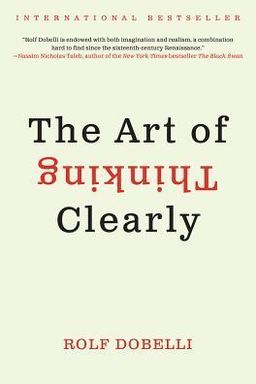
The Art of Clear Thinking cover

The Art of Clear Thinking

by Hasard Lee

The Art of Clear Thinking offers a unique perspective on decision-making through the eyes of a US fighter pilot. Learn to navigate complex choices using the ACE Helix framework, enhancing your ability to thrive under pressure, whether at work or home.

The Fighter Pilot’s Art of Decision-Making

How can you think clearly when the stakes are life and death? In The Art of Clear Thinking, fighter pilot Hasard Lee argues that decision-making—the ability to choose wisely and swiftly under pressure—is the most vital skill of our age. Drawing lessons from air combat, cutting-edge training, and psychological science, Lee contends that sound judgment isn’t innate; it’s built deliberately through clear frameworks, disciplined reflection, and emotional control.

Lee’s underlying claim is simple: you can learn to think as clearly as a fighter pilot. But doing so requires understanding how expert decisions are made in high-velocity, high-risk environments. In the cockpit of an F-16 or F-35, every action is a bet—with incomplete data and seconds to react. From those crucibles, Lee extracts principles that apply to business, leadership, and everyday life. The same methods that prevent pilots from crashing can help leaders avoid poor financial, professional, or personal decisions.

The book is built around a framework called the ACE Helix—Assess, Choose, Execute—a flexible model for making decisions that adapts to changing conditions over time. These three stages mirror a fighter pilot’s thinking loop: first, assess what’s going on; second, choose among options using creativity and logic; third, execute decisively while managing emotion and revisiting the process as new information arises. The helix spirals through continuous assessments, much like pilots spiraling in a dogfight—each decision reshaping circumstances.

From Cockpit to Everyday Life

Lee opens with gripping stories of flight tests and combat missions—moments when survival hinges on pure judgment. As he accelerates past Mach 1.6, facing structural vibration that might tear his aircraft apart, he remembers a long-ago conversation about pushing through turbulence by going faster instead of slowing down—an instinct that saves his life. The anecdote is more than thrilling aviation storytelling; it illustrates how knowledge, memory, and emotion interact in decision-making. The same pattern plays out in nonmilitary life: each decision—career, health, relationship—aggregates into outcomes that define us.

Why Clear Thinking Matters Today

Lee argues that modern technology has dramatically increased the leverage of decisions. Computers, automation, and AI amplify every choice you make. A single good decision can create enormous gains; a bad one can cascade catastrophically. Yet formal education rarely teaches decision-making as a skill. Schools emphasize convergent thinking—finding one correct answer to prescribed problems—while real-world success demands divergent, creative thought in ambiguous situations. Lee’s message is urgent: in a world of accelerating change and information overload, clarity of thought is the new competitive edge.

How the Book Is Organized

Across seven major sections, Lee builds a systematic guide for mastering deliberate decisions. You’ll begin with Assess, learning how to understand problems deeply, avoid tunnel vision, and identify nonlinear dynamics known as power laws—situations where small inputs lead to huge consequences. You’ll then move to Choose, discovering how humans learn lessons, form intuition, forecast outcomes quickly, and unlock creativity through effects-based thinking. Next, you’ll explore Execute, where mental toughness, prioritization, and decisiveness become critical to acting under stress.

Throughout, Lee interweaves chilling historical and modern examples to illustrate principles—an Air France crash caused by poor situational assessment, business failures like Excite’s rejection of Google due to linear bias, and battlefield successes powered by creative collaboration between Army and Air Force units. By merging stories of tragedy and triumph, he shows not only how decisions succeed but also why they fail.

The Promise and Challenge

Ultimately, Lee’s promise is that you can think clearly even in chaos. Clear thinking isn’t about having perfect information—it’s about cultivating frameworks, habits, and emotional discipline that let you act confidently when details are scarce. You’ll learn how to “wind the clock”—pause briefly before acting—to override impulsive behavior. You’ll learn the mathematics behind exponential growth and tipping points so that intuition becomes informed by logic. And you’ll explore how to build mental resilience to stay calm under stress, whether you’re landing a fighter jet, running a company, or parenting through crisis.

By the end, you’ll see that The Art of Clear Thinking isn’t an academic treatise; it’s an actionable manual forged from the frontlines of human decision-making. It teaches how to think clearly, decide deliberately, and act boldly when life feels uncertain—qualities that, in Lee’s words, “separate those who rely on luck from those who consistently win.”


Assess Problems Like a Fighter Pilot

Lee begins the first stage of the ACE Helix—Assess—by showing how catastrophic failures often happen because people act before understanding the problem. Through riveting reconstructions, such as the crash of Air France Flight 447, he demonstrates that assessment is not passive observation but active exploration. Pilots, doctors, and leaders must first stabilize their situation—“maintain aircraft control”—then analyze causes before taking corrective action.

The Air France Lesson

Flight 447’s pilots faced a minor instrumentation malfunction: their pitot tubes—the sensors measuring airspeed—froze midflight over the Atlantic. The aircraft was otherwise stable, but fear and confusion led the copilot to pull the stick back, causing an unnecessary climb and eventual stall that killed all 228 onboard. The tragedy reveals how stress narrows perception. Instead of assessing data across instruments—a practice called the cross-check—they fixated on one faulty indicator. In cognitive psychology, this is tunnel vision or "soda-straw" focus, where attention constricts until situational awareness collapses.

Winding the Clock

To combat that bias, veteran pilots use a strange ritual: before making decisions, they physically “wind the clock.” The act takes mere seconds but interrupts the instinct to act prematurely. Those seconds of enforced reflection allow the brain to switch from reaction to assessment. The same applies to everyday decisions—when your boss sends an alarming email or your project breaks, pause before executing. Ask: What’s actually happening? Which variables matter most? This brief mental circuit-breaker improves judgment dramatically.

Building a Mental Model

Effective assessors create dynamic mental models of reality. Fighter pilots track multiple signals—instrument readings, vibrations, eye movements, smells, and sounds—to construct a three-dimensional understanding of the aircraft’s state. Each sense contributes information; integrated together, they uncover the full picture. The same technique applies outside aviation: CEOs reading market trends or surgeons interpreting patient vitals synthesize many channels of data before acting. Those who isolate one input—like a quarterly profit number—risk crashing their metaphorical plane.

Key takeaway:

Clear thinking begins with slowing down to see clearly. The more complex the situation, the more deliberate your first step must be.

From Reaction to Reason

Lee warns that most people skip assessment entirely, rushing into fixes with false confidence. The result is wasted time, resources, or even lives. Proper assessment demands divergent thinking—considering multiple plausible explanations—and nonlinear awareness of tipping points. It trains you to separate noise from signal. When mastered, the Assess phase becomes second nature: you automatically stabilize, gather facts, and identify leverage points before moving forward. In the cockpit or in leadership, this ability defines professionals who stay calm while others panic.

Lee’s reminder is timeless: Don’t fix a problem you haven’t understood. Take those few seconds to wind the clock—because every clear decision starts with clarity of perception.


Understanding Power Laws

In the second stage of assessment, Lee introduces power laws—the hidden nonlinear relationships that govern life and business. Most people think linearly: twice the effort produces twice the result. But the world doesn’t work that way. A tiny input can cascade into massive change, while huge effort might yield minimal benefit. Recognizing these nonlinearities is essential for accurate judgment.

Nonlinear Thinking in Action

One vivid story illustrates this: a fighter trainee nearly crashes because he assumes an airspeed shortage is harmless—“just five knots slow.” At that scale, however, aerodynamic tolerance shifts sharply; the jet stalls, plunging thousands of feet before recovering. Small differences near critical points create exponential consequences—what engineers call the “knee in the curve.” You’ve seen this in finance (compound interest), viral growth, and technology adoption (S-curves). Doubling time and tipping points are everywhere.

The Trillion-Dollar Miss

Lee transports readers from the skies to Silicon Valley, where Excite.com’s CEO George Bell ignored exponential growth and network effects—two crucial power laws—by rejecting Google’s search algorithm for $750,000 in 1997. Bell couldn’t see how scalability and compounding data would explode online value. Within years, Excite collapsed and Google soared to a trillion-dollar valuation. The lesson is clear: failing to account for nonlinear dynamics—such as feedback loops and Metcalfe's Law (network value grows by the square of users)—creates blind spots even for seasoned leaders.

Three Universal Power Laws

  • Exponential Growth: Represents phenomena that double consistently—like technology or compound returns. Quick estimation through the “Rule of 70” (divide 70 by growth rate) helps predict doubling time.
  • Diminishing Returns: Every additional input yields less output, such as adding more chefs into a crowded kitchen. Recognizing this curve prevents wasted effort.
  • Long Tail: A few causes create most results—the Pareto 80/20 principle. Focus on the vital 20 percent that drives 80 percent of impact.

Identifying these curves transforms how you prioritize projects and evaluate risk. You learn to see tipping points—the moment where an incremental change triggers a phase shift, like water suddenly freezing or markets suddenly collapsing.

Key takeaway:

Linear minds fail in exponential worlds. Understanding nonlinear dynamics—whether in speed, growth, or influence—helps you spot leverage before others do.

Lee urges readers to graph data, zoom out to extremes, and test boundaries; seeing patterns visually reveals nonlinear relationships. Whether piloting jets or running startups, clear thinkers learn to navigate curves—not lines.


Learning Lessons and Building Intuition

To move from assessment to choice, Lee explores how humans learn from experience. Fighter pilots spend years distilling countless missions into intuition—hardwired pattern recognition that guides split-second decisions. That intuition isn’t magic; it’s refined feedback. Through structured debriefs and deliberate practice, their brains fuse theory with action until lessons become instinct.

The Red Flag Revolution

After Vietnam exposed deep training failures, the Air Force created the Red Flag exercise—a realistic mock war where pilots learned through mistakes in a controlled environment. The insight was profound: real learning comes from critical reflection on failure. Pilots review missions for eight hours after ninety-minute flights, dissecting every judgment. Rank is stripped away so truth—not hierarchy—drives improvement. Everyone owns their mistakes. That culture of open debriefing became the backbone of U.S. air dominance.

Concepts over Facts

When teaching F‑35 pilots, Lee emphasized “concepts over facts.” Memorizing checklists doesn’t create clarity; understanding cause and effect does. He compares learning to growing a tree: facts are leaves, but concepts form the trunk and branches that support them. A student who knows why a procedure matters can improvise under pressure. A student who only memorizes answers panics when reality diverges from the textbook. This approach mirrors Daniel Kahneman’s System 1 and System 2 thinking—refining fast intuition through conceptual depth.

The Apprenticeship Model

Lee shows that humans learn best from mentors who model the thought process. Instructors at fighter schools walk students through real tactical problems, making their mental maps visible. This apprenticeship activates mirror learning; novices internalize the expert’s framework. Similarly, in business, shadowing skilled professionals builds tacit knowledge faster than manuals ever could.

Key takeaway:

Growth comes from iteration and reflection—debrief, don’t just perform. Intuition is feedback made automatic.

Through this lens, Lee redefines intelligence not as quick recall but as the ability to organize experience into concepts, connect them, and use them flexibly. Whether running companies, teaching students, or managing crises, mastery means building an inner web of lessons—and reviewing it continually, just like a pilot analyzing every sortie.


Fast Forecasting and Expected Value Thinking

One skill that separates clear thinkers from the rest is the ability to forecast outcomes quickly. Lee calls this method fast forecasting—using rough logic and probability instead of waiting for perfect data. In combat, hesitating for more information can be fatal; in business or life, delay wastes opportunity. Fast forecasting approximates expected value: weighing upside and downside against their likelihoods.

Expected Value Made Simple

Expected value isn’t just for gamblers. It’s how you decide rationally when outcomes are uncertain: multiply possible gains by chance of success, subtract possible losses multiplied by chance of failure, and act if the balance is positive. Lee uses vivid in-air scenarios—a bomb malfunction, fuel shortage, or combat decision—to show how mental arithmetic beats emotional panic. A rough estimate, he insists, is better than paralysis caused by chasing perfect precision.

The Afghan Fuel Crisis

During one harrowing mission over Afghanistan, Lee nearly ran out of fuel after Bagram Air Base came under mortar attack. Facing multiple bad options—land on a damaged runway, eject over mountains, or intercept a distant tanker—he performed a quick mental forecast: landing risked a 3 percent fatality rate; ejecting, 2 percent but near-certain injury; interception, 5 percent if refueling failed but complete safety if successful. He chose the hybrid plan—meet the tanker halfway—and survived. His logic wasn’t precise math; it was reasoned intuition under pressure.

Fail Fast, Iterate Often

Fast forecasting aligns with entrepreneurial principles of failing fast. Make provisional decisions, monitor outcomes, then adjust with new data. Each iteration refines predictions, much like pilots improving through debriefs. The goal is accuracy in direction, not precision in numbers. Richard Feynman, the famous physicist, used similar “rough understanding” before deriving equations—qualitative insight before quantitative detail.

Key takeaway:

Don’t wait for certainty—approximate wisely and act. Each decision is a bet; regular small bets compound into mastery.

Fast forecasting teaches you to trust logic over perfection, speed over hesitation, and adaptability over control. It’s not recklessness but disciplined agility—the art of making complex choices simple enough to execute when seconds count.


Creativity Under Pressure

Lee’s chapter on creativity explodes the myth that imaginative thinking requires calm. True creativity, he says, often emerges in chaos. By tracing military innovations like Task Force Normandy—the joint helicopter raid that opened the Gulf War—he shows how unconventional collaboration and effects-based thinking achieved a near-perfect victory.

Effects-Based Operations

Traditional planning focuses on processes and tools—what resources we have. Effects-based operations reverse this: start with the desired outcome and work backward. In the Gulf War, planners needed to blind Iraq’s radar network. Instead of endless bombing campaigns, they paired Pave Low and Apache helicopters to destroy radar posts surgically—a creative coalition conceived by asking, “What effect do we need?” rather than “Which tools do we have?”

From War Rooms to Boardrooms

Lee extends this logic to any organization: define the end state, not the method. Companies that fixate on tools (software, policies, committees) smother creativity. Innovators prioritize effects—customer delight, efficiency, impact—and then select any tool that can produce them. Steve Jobs, similarly, insisted that Apple’s design start from user experience backward to technology.

Flexibility and Uncertainty

After showcasing Task Force Normandy’s success, Lee recounts its opposite: the 1999 shootdown of an F‑117 stealth fighter by Serbian commander Zoltán Dani. Dani’s creativity—mobility, decoys, and timing—defeated superior technology. His improvisation proves that flexible, adaptive minds can overwhelm rigid systems. Creativity, Lee argues, is an exponential advantage; it multiplies limited resources into outsized impact.

Key takeaway:

Creative thinkers ask for outcomes, not permission. Begin with effects, stay flexible, and innovate through constraint.

In times of uncertainty—like war or rapid technological change—rigidity fails. Creativity under pressure, Lee concludes, is decisive not because it avoids risk, but because it transforms risk into strategy.


Mental Toughness and Emotional Control

If you can’t control your emotions, you can’t think clearly. Lee’s section on mental toughness dives into neuroscience and training methods for maintaining composure when fear floods the system. From battlefield stress to boxing rings, he reveals that mental toughness isn’t about suppressing emotion—it’s about managing it through preparation and physiological awareness.

The Biology of Stress

Under threat, cortisol and adrenaline hijack the brain’s prefrontal cortex—our logical center—forcing reactive, instinct-based decisions. Fighter pilots call it “losing 20 IQ points.” Biochemically, shallow breathing and rapid heart rate degrade reasoning. Lee translates decades of Air Force research into practical tools: recognize emotional hijack early, and apply focus-based breathing to activate relaxation pathways.

Training the Mind

Lee helped design the first official U.S. Air Force mental-training syllabus. Pilots practiced meditation and visualization much like elite athletes at the Olympic Training Center. Techniques such as box breathing (inhale, hold, exhale, hold) and reframing—replacing negative self-talk with positive narratives—proved transformative. Students who previously panicked during minor failures learned to stay calm and recover.

Applying in Everyday Life

The same methods apply when speaking in public, making critical business decisions, or handling crises. You can’t eliminate pressure, but you can train your mind to operate through it. Repetition breeds confidence. Visualization creates familiarity. Controlled breath restores clarity. Lee’s mantra—“You don’t rise to the occasion; you fall to your preparation”—captures the essence: true calm is practiced, not spontaneous.

Key takeaway:

Mental toughness is emotional intelligence under stress—train your physiology so your mind stays sharp when everything shakes.

Through physiology and mindset, Lee redefines courage as clarity—the ability to think well when fear would normally destroy thought. It’s the foundation that supports every other skill in decision-making.


Prioritization and Decisive Action

In the final stage of the helix—Execute—Lee explores prioritization and decisiveness. Using Dwight Eisenhower’s legendary D-Day decision as a study, he shows how great leaders manage uncertainty without paralysis. The storm over the English Channel mirrors the chaos of any high-stakes choice. Eisenhower’s calm logic—testing forecasts, polling experts, waiting for brief clarity, then saying “Okay, we’ll go”—showcases clear execution.

The Eisenhower Matrix

Lee revives Eisenhower’s prioritization system, dividing tasks into four quadrants: urgent/important, important/not urgent, urgent/not important, and trivial. This mental map helps leaders focus time and energy on what truly matters instead of reacting to noise. Clear thinkers delegate quadrant III tasks (urgent but minor) and eliminate quadrant IV distractions entirely. What remains are strategic actions—those with compounding long-term impact.

Decisiveness Under Fire

Lee recounts his own near-death at Bagram Air Base when a suspicious fuel truck sped toward his parked jet after a suicide bombing. In that frozen moment, he performed mental triage—evaluating risk, commanding action, and executing with composure. Anxiety vanished; curiosity took over. That instinct for decisive clarity is what he trains pilots to cultivate. For civilians, it means not overthinking choices—stop at 90 percent certainty, act, and adjust later.

Acceptance of Uncertainty

Most people delay decisions hoping for perfect information. Lee argues that perfection is impossible; delay itself carries cost. The goal is not certainty but removing obviously bad options and then choosing any remaining viable path. In life, he prefers the “riskiest acceptable” choice—it yields the greatest growth. Sometimes, he jokes, if logic fails, “pick the finger that hurts most”—a playful reminder that action beats indecision.

Key takeaway:

In uncertainty, boldness clarified by logic is superior to hesitation seeking perfection. You only win when you execute.

For Lee, decisiveness is serenity in motion—choosing deliberately, focusing on essentials, and acting despite imperfect knowledge. It’s the final art of clear thinking: making decisions that move you forward when others freeze.

Dig Deeper

Get personalized prompts to apply these lessons to your life and deepen your understanding.

Go Deeper

Get the Full Experience

Download Insight Books for AI-powered reflections, quizzes, and more.