
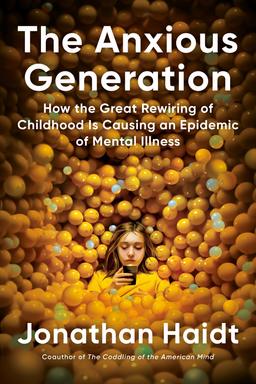
The Anxious Generation cover

The Anxious Generation

by Jonathan Haidt

The Anxious Generation explores how the decline of traditional play and the rise of smartphones have led to increased mental distress in Generation Z. Offering psychological insights and practical advice, it empowers parents and caregivers to foster healthier development in today''s digitally connected world.

The Great Rewiring of Childhood

How did children's lives transform in just one decade—from running outdoors to scrolling indoors? In The Anxious Generation, Jonathan Haidt argues that the arrival of smartphones and social media around 2010–2015 dramatically rewired childhood and adolescence. He calls this epic transformation the Great Rewiring: the shift from a play-based, in-person childhood to a phone-based, online life. Haidt’s claim is not about mere screen exposure but about a complete change in developmental inputs—how children learn, bond, experiment, and grow resilient. The book connects technology, parenting, neuroscience, and social trends into one generational story of fragility and healing.

From play-based to phone-based childhood

Between 2010 and 2015, multiple innovations converged: the front-facing camera, push notifications, the App Store, and social algorithms rewarding likes and retweets. These combined with overprotective parenting trends that had already reduced independent play since the 1980s. The outcome was double-edged: children were overprotected in the physical world but underprotected online. The result: a generation whose social development occurred inside algorithmic feeds rather than through embodied exploration.

Why it matters

Haidt likens this technological and psychological shift to “growing up on Mars.” When ordinary social work—reputation management, play negotiation, and self-discovery—moved online, the very neural architecture of adolescence changed. Platform design exploited attention and social-validation loops (as admitted by Facebook’s Sean Parker and Google’s Tristan Harris), encouraging comparison, anxiety, and dependence. Instagram’s selfie culture and TikTok’s algorithmic feedback replaced the reciprocal rhythm of real social life with solitary performance and judgment.

The evidence of harm

Across nations—from the U.S. and U.K. to the Nordics—mental health data show a synchronized spike in depression, anxiety, self-harm, and suicide beginning around 2012. These aren’t just survey artifacts: hospital admissions and suicide rates confirm them. Preteen and young teen girls are hit hardest, especially those immersed in social comparison and emotion-contagion networks. Boys’ troubles look different—withdrawal into gaming, pornography, and disengagement from real-world challenges—but the timing also centers on the smartphone era.

What childhood needs but lost

Evolution designed childhood to calibrate the mind through free play, attunement, and social learning. Outdoor, mixed-age play teaches risk management, rule negotiation, and cooperation. Embodied synchrony—marching, singing, joint attention—builds trust and empathy. And cultural learning peaks between ages 9 and 15, when children absorb local norms and identities. When that sensitive window happens inside algorithmic culture rather than real communities, identity formation shifts toward influencer-driven microcultures instead of grounded social apprenticeships.

The developmental toggle: discover vs. defend

Haidt uses a vivid metaphor from neuroscience—discover mode versus defend mode. Healthy childhoods let the brain oscillate towards curiosity and play (discover mode). Overprotective and anxious childhoods trap kids in vigilance (defend mode). Smartphones intensify this trap: constant alerts mimic danger and reward avoidance. When children don’t experience manageable risk or failure—what Nassim Taleb calls antifragility—they lose psychological immunity, becoming more fragile and reactive.

Core insight

The Great Rewiring wasn’t just a technological revolution—it was a developmental one. Smartphones removed the physical world’s trial-and-error learning and replaced it with algorithmic reinforcement, reshaping the generation’s coping systems, social instincts, and sense of meaning.

The rest of Haidt’s argument follows from this central event: the collapse of unsupervised play, the rise of online adolescence, and a global surge in fragility. Understanding this timeline helps you see why both personal and policy-level actions—phone-free schools, play-centered education, and community independence laws—can begin to reverse it. The book becomes both diagnosis and prescription for building stronger, more antifragile childhoods again.


The Surge and Who It Hit Hardest

Haidt marshals a wealth of global data to prove the suffering is not imagined: anxiety, depression, self-harm, and suicide among adolescents rose sharply and simultaneously across rich countries after 2012. The timing mirrors the widespread adoption of smartphones and image-based social media.

Evidence from multiple sources

National panels like the U.S. NSDUH show the percentage of teens reporting major depressive episodes skyrocketing after 2012. Hospital and emergency-room data confirm the subjective trends, with self-harm among girls ages 10–14 tripling between 2010 and 2020. Canada, the U.K., Australia, and Nordic countries reveal parallel curves. The synchronization across cultures rules out local causes like economics or politics.

Girls’ digital vulnerability

Girls gravitate toward visual, socially performative platforms—Instagram, Snapchat, Pinterest—and develop greater exposure to filtered comparison culture. These apps amplify four risk channels: visual perfectionism, relational aggression, emotional contagion, and sexualized predation. Internal company slides (revealed by Frances Haugen) confirmed that Instagram worsened body image issues among teen girls. TikTok’s algorithms intensified exposure to self-harm and eating disorder content.

Boys’ parallel drift

Boys face different psychological pulls. Safetyism removed real-world risk-taking; video games and pornography supplied exciting virtual substitutes—status and desire without practice or responsibility. Disengagement grew as physical agency disappeared. Education gaps widened, and loneliness spread among boys who replaced embodied leadership with digital escape. The result: many intellectually capable but socially cautious young men struggling to launch.

Key takeaway

The simultaneous mental health crisis among adolescents cannot be explained by cultural reporting shifts alone. It matches the timeline and design logic of the phone-based ecosystem, especially harming girls via comparison and boys via withdrawal.

For you as a reader or citizen, Haidt’s data serve as wake-up calls: the suffering is measurable, transnational, and causally linked to the replacement of physical community by virtual validation. Gender differences illuminate how algorithms exploit psychologies differently, but all roads lead back to early online immersion during sensitive years of development.


Childhood’s Missing Curriculum

To rebuild childhood, you must know what evolution designed it to teach. Haidt synthesizes research across play theory, attachment science, and cultural learning to argue that healthy childhoods train three intertwined systems: free play, attunement, and social learning.

Free play teaches mastery and cooperation

Outdoor, unsupervised play is a neural training ground for resilience. Children learn through small mistakes—falling off bikes, arguing over rules, losing games. Peter Gray’s research shows mixed-age play builds social negotiation and autonomy. When adults remove natural risk from play, children lose these feedback loops and enter adulthood unsure of how to handle conflict or failure.

Attunement builds trust and regulation

Early “serve-and-return” face interactions wire emotional regulation. Singing, marching, dancing, and clapping synchronize movement and attention, deepening connection. These rhythmic experiences—Durkheim called them “collective effervescence”—teach emotional timing and empathy. Screens simulate visibility but not synchrony; video calls are hollow substitutes for shared movement.

Social learning needs embodied models

Between ages 9 and 15, children absorb their culture by watching real people succeed and fail. Anthropologist Minoura’s study of Japanese children abroad shows identity formation depends on this sensitive window. In the digital age, that window happens under algorithmic influence, where mentors are influencers, not community elders. When identity formation occurs in virtual microcultures, belonging becomes volatile, dependent on likes rather than reliability.

Key reminder

The play-based curriculum was nature’s design for mental strength. By outsourcing learning to screens, you interrupt the lessons only failure and feedback can teach.

This missing curriculum drives Haidt’s proposed remedies: revive play and synchrony before adolescence, delay full-time digital immersion until after puberty, and treat embodied experience as sacred developmental nutrition.


Antifragility and Risky Play

Children grow stronger through small stress. Haidt draws on Nassim Taleb’s idea of antifragility—systems that thrive on challenge—to explain why eliminating risk makes kids brittle. Over-safety pushes them into permanent defend mode, blocking curiosity and resilience.

The discover–defend balance

Biological systems toggle between exploring opportunities and scanning for threat. Overprotective care keeps kids permanently alert, producing anxiety. Rough-and-tumble play, manageable risk, and temporary exclusion restore balance and teach children the world is survivable.

Risk categories in childhood play

Researchers Ellen Sandseter and Mariana Brussoni identify six vital “risky play” types: heights, speed, tools, elements (fire or water), rough-and-tumble, and wandering out of sight. These aren’t hazards—they’re micro doses of competence training. Over-sanitized playgrounds deprive children of anti-phobic experiences; safe fear helps emotional calibration.

Attachment and exploration

Healthy attachment provides a secure base. Children must leave safety to explore, fail, and return stronger. Safetyism keeps them tethered at the base, preventing autonomy. When parents act like constant lifeguards instead of gardeners, growth stops. Cultivating antifragility means creating environments of bounded risk and emotional safety—so children’s own internal compass can learn confidence.

Practical truth

Risky play is not irresponsibility—it is rehearsal for competence. Controlled risk inoculates children against lifelong anxiety and teaches mastery.

You can start small: let children walk alone, light bonfires, climb trees, and argue without adult arbitration. Each act of faith in their resilience strengthens their psychological immune system. Staying slightly unsafe is the path to being truly strong.


The Smartphone’s Four Harms

Smartphones harm youth in four fundamental ways—each measurable and reinforcing the others. Haidt calls them social deprivation, sleep deprivation, attention fragmentation, and addiction. Together they form an ecosystem of mental decline.

1. Social deprivation

Online interaction replaced the embodied synchrony of friendships. Face-to-face meetups declined steadily after 2013, according to time-use data. Even visible phones on a table reduce conversational intimacy. The result: unprecedented loneliness amid hyper-connectivity.

2. Sleep deprivation

Puberty delays sleep onset; phones make that problem worse. Bright screens at night hijack circadian rhythms. Studies linking screen bans to better sleep show causal benefits for mood and attention. Girls, whose ruminative cycles are amplified by social media, suffer most.

3. Attention fragmentation

Smartphones train divided focus. William James foresaw such problems; Nicholas Carr documented how attention erodes with constant interruption. The mere presence of a phone cuts working-memory capacity. For teens building executive function, the cost is severe—less deep thought, more impulsivity.

4. Addiction

Platforms use variable-ratio reinforcement (like slot machines) and dopamine cues to capture attention. Facebook insiders admitted their designs created “social validation loops.” Addiction overlaps with sleep loss and isolation, compounding vulnerability. Haidt references Anna Lembke’s research: withdrawal isn’t boredom—it’s measurable dysphoria.

Systemic insight

Each harm amplifies the others—fragmented attention encourages late-night use (sleep loss), which deepens addiction, which erodes real friendships, inviting further withdrawal. The cycle feeds itself until broken deliberately.

To break the loop, you need to act communally—remove phones from schools, block nighttime access, and design communities that make real-world play attractive again. No single measure fixes all four harms; combined, they can begin the healing process.


Spiritual and Communal Repair

Beyond depression and distraction lies something deeper: spiritual erosion. Haidt describes phone-based life as a downward pull on the human “divinity axis”—away from awe, gratitude, and community, toward envy, outrage, and performative judgment. Social media dissolves sacred rhythms and replaces reflection with reaction.

What vanished

Traditional societies protected elevation through shared rituals—meals, music, silence, nature, and forgiveness. In digital spaces, those practices disappear. Constant connectivity replaces sabbath-like boundaries. The body’s role in worship and bonding is neglected; you scroll while the physical world waits.

Restoring elevation

Haidt and Dacher Keltner’s research shows that awe regulates ego and expands moral concern. Simple practices like phone-free family dinners, communal singing, or brief “awe walks” rebuild moral elevation. Group activities—choir, team sports, volunteering—recreate embodied synchrony. Silence and nature re-anchor meaning.

Practical restoration

Meaning returns when you build phone-free rituals: meals, sabbaths, play, and shared adventure. These practices heal attention and restore collective sacredness.

The book’s moral horizon expands here: digital harm isn’t only psychological—it’s existential. To thrive again, cultures must reconstruct communal scaffolds that raise eyes upward rather than downward into the feed.


Rebuilding Policies and Spaces

Haidt dedicates the book’s later chapters to pragmatic repairs through policy, education, and design. He sketches four governmental levers: duty of care, raising the age of internet adulthood, age verification frameworks, and phone-free schools. Combined with social initiatives—play-full schools and independence laws—they provide a plan for cultural rebalancing.

Policy levers

The U.K.’s Age Appropriate Design Code (2020) shows platforms can be compelled to protect minors through design. COPPA’s 13-year cutoff was arbitrary; Haidt urges Congress to raise digital adulthood to 16 and require privacy-protecting age checks. Device-level parental age flags and third-party yes/no verifiers are feasible and respect privacy.

Phone-free and play-full schools

Schools that ban smartphones all day—like Mountain Middle School in Colorado—see rapid improvements: more conversation, less distraction, better academics. Likewise, Play Club and Let Grow programs revive free, unstructured activity and independence. Teacher Kevin Stinehart’s pilot saw huge drops in behavior referrals and increases in kindness.

Reasonable Independence laws and urban design

States like Utah and Texas passed laws clarifying that letting kids play or run errands unsupervised is not neglect. Such measures reverse cultural fear and enable community trust. Urban design—better sidewalks, play streets, neighborhood events—supports spontaneous social learning.

Collective leverage

No parent can fix the Great Rewiring alone. But governments, schools, and neighborhoods acting together can make independence and connection normal again.

The prescription is hopeful: reverse overprotection, rebuild physical community, set developmental age thresholds for digital access, and align all social institutions toward real-world engagement. The cure for the anxious generation is collective courage—starting with one playground, one classroom, and one phone locker at a time.


Parenting the Anxious Generation

Finally, Haidt speaks directly to parents. Be a gardener, not a carpenter. You cannot engineer a perfect child; you can nurture a thriving environment. Modern parenting must balance independence, connection, and digital delay in age-appropriate ways.

Ages 0–5: embodied beginnings

Provide abundant face-to-face interaction and zero passive screens. Toddlers need to see facial cues and practice helping behaviors. Early exposure to real conversation and touch wires empathy far more than apps ever could.

Ages 6–13: practice independence

Encourage errands, autonomous play, and small responsibilities. Coordinate with other families to create “Playborhoods.” Keep phones out of bedrooms; limit leisure screen time to manageable daily chunks. Supervised freedom beats monitored isolation.

Ages 13–18: expand freedom with guardrails

Let teens explore work, travel, and mentorship. Delay social media until at least sixteen. Teach them why algorithms exploit attention. Remove phones at night. Reduce surveillance gradually so autonomy can bloom.

Gardener mindset

Like a gardener, prepare fertile soil and accept slow growth. Coordinate rules with neighbors so your child isn’t the odd one out. Create phone-free family rituals and model your own healthy device habits. Courage is contagious; your restraint helps other parents hold firm too.

Parent insight

The antidote to anxiety is agency. Each act of independence—earned trust, risk taken, responsibility embraced—builds antifragile confidence that screens can never give.

In Haidt’s closing vision, the anxious generation can recover not through apps or clinics but through play, freedom, and embodied life. Parents who act bravely together plant the seeds of resilience that repair childhood itself.

Dig Deeper

Get personalized prompts to apply these lessons to your life and deepen your understanding.

Go Deeper

Get the Full Experience

Download Insight Books for AI-powered reflections, quizzes, and more.