
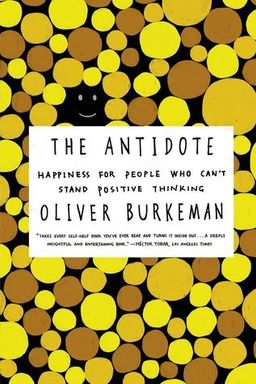
The Antidote cover

The Antidote

by Oliver Burkeman

In ''The Antidote'', Oliver Burkeman dismantles the myth of positive thinking as a path to happiness. Instead, he presents a transformative approach embracing failure, uncertainty, and negativity, drawing from Stoicism and Buddhism to uncover authentic joy and resilience.

The Backwards Law: Finding Happiness Through Negativity

What if chasing happiness was the one thing keeping you unhappy? In The Antidote: Happiness for People Who Can’t Stand Positive Thinking, Oliver Burkeman invites you to rethink everything you’ve been told about positivity, success, and peace of mind. His core argument is simple but radical: the harder you try to eliminate the negative—failure, uncertainty, insecurity, sadness—the more these emotions grow stronger. Happiness, Burkeman contends, emerges when you stop resisting negativity and learn to coexist with it.

Burkeman calls this paradoxical approach the ‘backwards law’, borrowing from philosopher Alan Watts, who observed that the more you try to float, the more you sink. This counterintuitive principle runs throughout human experience: striving for control amplifies anxiety; seeking security makes us insecure; and pursuing happiness too intently drives despair. The solution? A ‘negative path’ to happiness built on accepting life’s imperfections, embracing uncertainty, and transforming how you relate to negative emotions.

A Culture Obsessed with Positivity

Burkeman begins by skewering the $10-billion self-help industry—the seminars, slogans, and affirmations that promise to make you unstoppable. He recounts his undercover visit to a megamotivational seminar, “Get Motivated!,” featuring self-help legend Dr. Robert Schuller and even George W. Bush. Amid pyrotechnics and patriotic speeches, Burkeman notices the peculiar emptiness behind the participants’ forced optimism. Schuller’s message—“Cut the word impossible from your life!”—epitomizes what Burkeman calls the cult of positivity: the belief that success and happiness depend on suppressing all negative thoughts.

Research, however, tells a different story. Psychologist Daniel Wegner’s “white bear” experiments showed that trying not to think about something (like a white bear) makes it invade your mind even more. Similarly, Joanne Wood’s studies found that affirmations like “I am lovable” make people with low self-esteem feel worse, not better, because the statements clash with their self-image. Burkeman uses these examples to expose the flaw in positive thinking: it’s based on denial, self-monitoring, and an exhausting fight against reality.

The Negative Path: Ancient Wisdom Reconsidered

Burkeman’s antidote draws from Stoicism, Buddhism, and modern psychology. Stoics like Seneca and Marcus Aurelius advised people to regularly imagine worst-case scenarios—not to wallow, but to reduce fear and cultivate resilience. In Buddhism, happiness arises from non-attachment—observing thoughts and emotions without clinging or pushing them away. Both traditions reject the Western obsession with conquest over mood and outcome. Burkeman also explores cognitive therapies like Albert Ellis’s Rational Emotive Behavior Therapy, which teach that suffering stems not from events themselves but from irrational beliefs about them. Together, these thinkers form his philosophy of negative capability: the skill of living peacefully amid doubt, imperfection, and change.

Why Negativity Works

Each chapter of The Antidote builds on the revelation that discomfort and happiness may be inseparable. In trying to drown insecurity, you amplify it; in learning to accept insecurity, you become free from it. The book offers stories—like a silent vipassana meditation retreat where Burkeman learns to face his chaotic thoughts without judgment—that show how surrender, not control, brings peace. “When you stop running from unhappiness,” he writes, “you find it was never chasing you at all.” The negative path doesn’t promise bliss on demand, but a deeper serenity—anchored in realism and resilience.

Why You Should Care

Burkeman’s argument matters because it challenges a civilization that equates optimism with success and vulnerability with weakness. In a world of curated happiness—Instagram smiles, corporate pep talks, and motivational slogans—his book reminds you that you can live well even when things aren’t perfect. True happiness isn’t a permanent high. It’s the ability to stand calmly amid uncertainty, failure, and change. In a sense, The Antidote is not about achieving happiness at all—but about learning to stop fighting against life, making peace with impermanence, and discovering joy through humility and acceptance.


The Stoic Power of Negative Visualization

Can imagining your worst fears make you calmer? According to the Stoic philosophers and Oliver Burkeman, yes. In Chapter 2, he explores how ancient thinkers like Seneca, Epictetus, and Marcus Aurelius developed techniques to transform anxiety not through positive visualization, but through vivid contemplation of failure and loss—a method called negative visualization.

Facing Fear Instead of Denying It

Burkeman describes testing a modern Stoic exercise devised by psychologist Albert Ellis, a follower of Stoicism and founder of Rational Emotive Behavior Therapy. Ellis asked his patients to deliberately embarrass themselves in public—such as announcing subway stops out loud—to face their fear of shame and realize it wasn’t fatal. When Burkeman tried this in London, he discovered his anxiety faded quickly; embarrassment wasn’t nearly as catastrophic as his mind predicted. This echoes Stoic ideas that judgment, not circumstance, causes suffering.

How Stoics Calm the Mind

Ancient Stoics believed tranquility came not from erasing emotions, but from rationally examining beliefs. Seneca advised periodically living like a pauper—wearing rough clothes and eating poor food—to see that one could survive hardship. Marcus Aurelius reminded himself that “things do not touch the soul.” By practicing awareness of impermanence, Stoics made peace with uncertainty, cultivating a strength philosophy calls amor fati, or the love of fate.

Modern Lessons from Stoicism

Burkeman shows how Stoic ideas inspired therapies like cognitive behavioral therapy (CBT) and techniques used by thinkers such as William Irvine (A Guide to the Good Life) and Donald Robertson (Stoicism and the Art of Happiness). Negative visualization works because imagining loss prevents complacency and deepens gratitude. When you picture life without your loved ones or comforts, their value sharpens. And by confronting fear—instead of promising yourself nothing bad will happen—you reduce its hold.

In essence, the Stoic method turns pessimism into power. You stop fleeing fear, face what might go wrong, and learn that survival—and serenity—are possible even in adversity. As Burkeman and Ellis both argue, “The worst thing about any event is usually your exaggerated belief in its horror.”


Buddhist Non-Attachment and Mindfulness

The third major idea in Burkeman’s book explores Buddhism’s deep insight into happiness through non-attachment—letting go of the need to control experience. He attends a silent vipassana meditation retreat in Massachusetts, hoping to quiet his mind but confronting what Buddhists call the ‘storm before the calm.’ His mind races with song lyrics, anxieties, and impatience. Yet this chaos becomes precisely the lesson: happiness is not the absence of noise but the ability to accept it.

What Non-Attachment Really Means

Burkeman explains that non-attachment doesn’t require withdrawal from life or suppression of desire. Instead, it means relating to emotions and situations without clinging or aversion. You can enjoy pleasant moments without fearing their end, and face pain without defining yourself by it. Barry Magid’s Ending the Pursuit of Happiness taught him that meditation is not a technique for bliss but a practice of watching thoughts without judgment—an act of relaxation into “groundlessness.”

The Science of Surrender

Modern research supports Buddhist psychology. Experiments by Fadel Zeidan showed that even short meditation training dramatically reduced pain sensitivity. Participants learned to perceive discomfort without labeling it “bad,” thus lessening distress. Similarly, Japanese psychiatrist Shoma Morita’s therapy teaches that you can act wisely even when you don’t feel motivated—an approach echoed in the creative discipline of artists like Chuck Close, who said, “Inspiration is for amateurs.” The essence is to act alongside your emotions, not depend on them.

Why It Matters

Burkeman’s retreat culminates in a profound shift: by observing his thoughts rather than trying to fix them, he glimpses freedom within chaos. This awareness mirrors the Buddhist idea that thoughts and feelings are like weather—changing constantly. As Zen master Seung Sahn put it, “Clouds go away, then the moon shines brightly.” Happiness, from this view, comes not from possessing control, but from recognizing that presence itself—the calm behind thoughts—is always available. That, Burkeman realizes, may be the calm we’ve been seeking all along.


Embracing Uncertainty and Letting Go of Goals

In Chapter 4, Burkeman dismantles another pillar of modern happiness: goal obsession. He recounts the 1996 Mount Everest disaster, where climbers died because they refused to abandon their mission to summit. Psychologist Chris Kayes later called this fatal fixation goalodicy—the worship of goals even when they destroy you. The problem, Burkeman reveals, is that we mistake planning for safety, seeking certainty in an uncertain world.

When Goals Backfire

Studies show how rigid goals distort behavior. Lisa Ordóñez’s paper “Goals Gone Wild” demonstrated that highly specific targets motivate cheating and short-term thinking. At General Motors, executives wore lapel pins engraved “29” to symbolize their market-share goal—but this number blinded them to innovation. Similarly, New York cab drivers quit early when they met daily income targets, losing higher earnings they could have gained later. In chasing precision, we sacrifice adaptability.

Learning to Love Uncertainty

Burkeman contrasts rigid goal-setting with effectuation, a model proposed by researcher Saras Sarasvathy. Successful entrepreneurs don’t forge detailed roadmaps—they “start with their means,” using available resources to explore possibilities, adjusting as they go. Steve Shapiro calls this goal-free living: making progress through curiosity, like jazz improvisation. Instead of chasing certainty, you cultivate trust in uncertainty, treating life as a series of experiments rather than a test you must pass.

Freedom in Flexibility

The real challenge isn’t uncertainty itself but our fear of it. We decide impulsively just to escape indecision, mistaking relief for clarity—what psychologist David Cain calls “the need to scramble to firm ground.” Burkeman urges the opposite: linger in doubt. As philosopher Martha Nussbaum writes, “To be a good human is to trust uncertain things.” Uncertainty becomes not an obstacle to meaning but its source—the fertile space where creativity, compassion, and true security emerge.


The Self Illusion and Freedom from Ego

Burkeman’s fifth idea draws from Eckhart Tolle and philosopher Alan Watts to question the most fragile assumption in happiness: that you have a solid, separate self to protect. Happiness collapses, Burkeman argues, because we build our identities on a mental fiction—the ego—and spend our lives defending it. When you see that the ego’s boundary is imaginary, insecurity loses its power.

You Are Not Your Mind

Tolle’s story begins with a spiritual breakdown in a London bedsit where he realized “I cannot live with myself much longer”—then saw this sentence implied two selves: the “I” and the one he couldn’t live with. When thinking stopped, peace appeared. To recognize this gap is to find freedom: you are not your thoughts but the awareness behind them. Burkeman calls this disidentification—ceasing to mistake the voice in your head for your identity.

The Illusion of Separation

Drawing on Alan Watts, Burkeman describes how defining yourself as a “skin-encapsulated ego” isolates you from reality. At the cellular level, there’s no clear boundary between you and the world. Inside and outside depend on each other—like a wave and the ocean. When you see this, chasing security becomes futile: it’s the separation itself that creates fear. Watts called this truth “the wisdom of insecurity”—that peace comes from realizing you are part of life, not apart from it.

Practical Liberation

Burkeman interprets this not as mystical dogma but psychological realism. When you watch your thoughts, emotions, and worries without identifying with them, inner space opens up. Problems shrink because they no longer define you. He applies this to everyday stress—asking Tolle’s question, “Do you have a problem right now?” Usually, the answer is no. Most problems exist only in time—the future or past your mind invents. Living in the “now” doesn’t promise eternal bliss, but grants simple freedom: the ability to stop fighting yourself.


Finding Strength in Insecurity

In one of the book’s most striking chapters, Burkeman reveals security itself as a mirage. He draws lessons from pilot Elwood Menear’s arrest for joking about crashing a plane and from security expert Bruce Schneier’s concept of “security theatre”—ineffective rituals that soothe fear but don’t improve safety. The human craving for certainty, Burkeman argues, makes us chase feelings of safety that paradoxically leave us more vulnerable.

The Psychology of Safety

Why do we feel unsafe even in peace? Cognitive biases—the availability bias, fear of loss of control, and evolutionary instincts—make modern risks feel larger than they are. We fear airplane crashes more than car accidents, though cars kill far more people. Our ancient biology isn’t built for global news cycles or complex societies. Yet the pursuit of absolute safety—through gated communities, wealth accumulation, or rigid planning—isolates us and breeds anxiety.

Insecurity as Freedom

Burkeman contrasts our sterile safety culture with insights from philosophers Alan Watts and Pema Chödrön. Watts declared, “The desire for security and the feeling of insecurity are the same thing.” Trying to secure the self only reinforces the illusion of separation that creates fear. True peace lies in embracing vulnerability: recognizing that change, decay, and loss are not errors in the system but the system itself. As Chödrön puts it, “Becoming a Buddhist is about becoming homeless.”

Lessons from Kenya

Burkeman visits Kibera, one of Africa’s largest slums, and finds surprising evidence that security is overrated. Despite poverty and danger, residents display resilience and community joy. Their happiness arises not from possessions but from facing insecurity daily—and learning cooperation rather than avoidance. “When there’s less to hold onto,” one local tells him, “you have to cut the crap.” Vulnerability, Burkeman concludes, offers strength and authenticity that no illusion of safety can match.


The Wisdom of Failure

Failure, Burkeman reminds us, is not the opposite of success but its foundation. Visiting a warehouse of discontinued products—the “Museum of Failed Products” in Michigan—he discovers thousands of doomed innovations, from yogurt shampoo to caffeinated beer. These artifacts show how deeply people fear failure, yet how much truth it reveals. Success stories dominate culture, but it’s in our flops that wisdom hides.

Why We Avoid Failure

From corporate executives to scientists, Burkeman finds people reluctant to analyze mistakes. Psychologist Kevin Dunbar’s studies show that even researchers ignore contradictory data because their brains filter out “failure signals.” This bias distorts our view of achievement. Jerker Denrell calls it the “undersampling of failure”—we study only winners, assuming their traits cause success. But perseverance or charisma often lead to disaster, too. Survivorship bias hides these lessons, making happy endings appear universal.

Failure as Freedom

Burkeman contrasts American glorification of success with Britain’s humorous embrace of defeat—“the museum of disasters,” as columnist Ros Coward described the Millennium Dome project. He argues for reclaiming this honesty. Failure strips away pretense, revealing common humanity and flexibility. Psychologist Carol Dweck’s research on mindsets supports this: if you view intelligence as fixed, failure crushes you; if you see it as evolving, failure becomes learning. Growth mindset turns defeat into fuel.

Embracing the “Great Failure”

Zen writer Natalie Goldberg calls the confrontation with failure “the Great Failure”—a total surrender that births authenticity. The antidote to perfectionism, Burkeman says, is not achievement but humility. In losing control, you find life. J.K. Rowling, in her Harvard speech, put it plainly: “Failure stripped away the inessential.” When you’ve lost the illusion that success will save you, you gain the one thing success can’t give—freedom from fear.


Memento Mori: Happiness Through Mortality Awareness

In the book’s most haunting chapter, Burkeman confronts death. Drawing from Ernest Becker’s The Denial of Death, he shows how humans build civilizations to avoid thinking about mortality. Yet confronting death, he argues, can paradoxically make life sweeter. He travels from philosophical reflections in New York to Mexico’s Día de los Muertos to witness a culture that celebrates death as part of life.

Why We Deny Death

Becker believed we create “immortality projects”—religion, ambition, art—to escape the terror of extinction. When reminded of death, people become more moralistic, nationalist, or disgust-sensitive, clinging to symbols of permanence. Burkeman notes that this denial underpins the Western self-help obsession with “living your best life.” Yet death is unavoidable. Philosophers from Epicurus to Thomas Nagel remind us that fearing it is irrational: when we are, death is not; when death is, we are no longer.

Death as the Antidote

Burkeman interviews philosophical counselor Lauren Tillinghast, who teaches that awareness of finitude clarifies meaning. When you accept that the meal of life will end, you savor it more deeply. Psychotherapist Irvin Yalom likens this to living as if the “last burst of your heart” will close your life’s work—making each day matter not through fear but gratitude. Remembering death, paradoxically, keeps you awake to life’s brevity.

Lessons from Mexico

In San Gregorio Atlapulco, Burkeman witnesses families spending the night in a candlelit cemetery—feasting, singing, and conversing with their dead. Death isn’t hidden; it’s folded into the rhythms of life. As writer Victor Landa said, people die three times: when their bodies stop, when they’re buried, and when they’re forgotten. Memento mori—the reminder of death—becomes a celebration of remembrance. Facing mortality, Burkeman discovers, isn’t morbid. It’s the doorway to genuine aliveness.


Negative Capability: The Art of Living with Mystery

Burkeman concludes The Antidote with one of literature’s most beautiful ideas: poet John Keats’s concept of negative capability—“the ability to be in uncertainties, mysteries, doubts, without irritable reaching after fact and reason.” Keats defined genius as comfort with ambiguity. Burkeman extends that insight to happiness itself: life’s deepest peace comes not from solving problems but from learning to coexist with them.

The Strength of Not-Knowing

To live with negative capability is to stop demanding closure—to resist both forced optimism and fatalistic gloom. In practical terms, it means cultivating patience, accepting paradox, and finding calm in the middle. Buddhist non-attachment, Stoic rationality, and the acceptance therapies of Albert Ellis and Shoma Morita all embody this balance between doing and not-doing. You stop struggling to eliminate uncertainty and instead learn to rest inside it.

Practice in Everyday Life

Burkeman closes with his own experiments: applying the “Stoic pause” during irritation, brief morning meditation, and invoking Tolle’s question—“Do you have a problem right now?” These small acts of awareness soften worry. They reveal that freedom and happiness aren’t future destinations but the capacity to inhabit present ambiguity. Awe, psychologist Paul Pearsall argued, is the emotion that fuses all others—it arises when you experience mystery rather than banish it.

The Mystery Is Enough

Ultimately, Burkeman shows that true happiness isn’t constant joy—it’s openture, a receptive stance toward life’s uncertainty. Like Keats, he suggests that the search for permanent positivity misses the point. To live well is not to reach the end of confusion but to marvel that confusion exists at all. As Lao Tzu wrote, “A good traveler has no fixed plans and is not intent upon arriving.” Burkeman leaves us with this paradoxical truth: it’s only by stopping the race for happiness that you finally arrive there.

Dig Deeper

Get personalized prompts to apply these lessons to your life and deepen your understanding.

Go Deeper

Get the Full Experience

Download Insight Books for AI-powered reflections, quizzes, and more.