
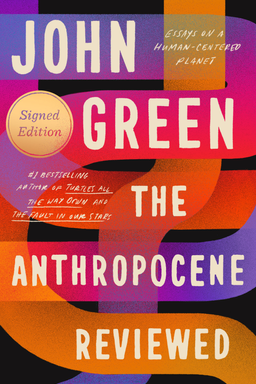
The Anthropocene Reviewed cover

The Anthropocene Reviewed

by John Green

In ''The Anthropocene Reviewed,'' John Green humorously and insightfully examines the human experience in our current geological age. Through a unique five-star review format, he explores how our actions shape the world and our lives, offering fresh perspectives on creativity, technology, and our environmental impact.

Finding Meaning and Humanity in the Age We’ve Shaped

What does it mean to be human in a time when humans have reshaped the Earth itself? In The Anthropocene Reviewed, John Green asks this question not as a scientist but as a participant in history, emotion, and everyday wonder. He argues that the Anthropocene—the age of human impact on the planet—is not just a geological era but a deeply personal one. The book becomes a mosaic memoir built from essays that review ordinary and extraordinary aspects of life—from sunsets to viral meningitis—in the language of five-star internet reviews.

Green contends that human experience in this era is characterized by contradiction: we are powerful enough to change the planet’s climate but too weak to control our suffering; capable of immense compassion and horrific cruelty; obsessed with rating and reviewing everything, even the world itself. Through this paradox, he invites you—as reader and participant—to practice one small act of radical attention: to fall in love with the world anyway.

The Personal Meets the Planetary

Green frames each short essay around personal reflection that expands into philosophical inquiry. In his hands, the Anthropocene isn’t only defined by fossil fuel emissions or plastic waste—it’s also marked by digital intimacy, nostalgia, and our incessant need for reviews. He writes about Canada geese, Diet Dr Pepper, or the Piggly Wiggly supermarket with the same emotional weight he assigns to the Plague or climate anxiety. The trivial and the tragic coexist; both shape what it means to live during humanity’s reign.

From a dizzying illness called labyrinthitis that left him bedridden to reviewing sunsets and his hometown Indianapolis, Green uses vulnerability as his instrument. His recovery from despair mirrors humanity’s ongoing effort to regain balance amid the ecological and emotional chaos we’ve created. As he says, there are no observers left in the Anthropocene—only participants. That line becomes the book’s moral center.

Five Stars for Paying Attention

One of Green’s recurring metaphors is the omnipresence of the five-star review system—the simplified metric by which we now judge everything from books to sunsets. He repurposes it to rate fragments of existence, reminding you that quantifying the ineffable is both absurd and beautiful. The scale becomes a meditation on subjectivity: who decides what’s worth five stars? Is humanity’s survival a three-star effort or a four-star hope? (In the essay “Humanity’s Temporal Range,” he literally gives our species four stars for persistence.)

The device also lets Green practice gratitude amid imperfection. By rating things he loves and fears, he acknowledges the flawed goodness of being alive. His reviews teach you that nothing is perfect—but so much is enough. In the same spirit as Annie Dillard’s “Pilgrim at Tinker Creek” or Oliver Sacks’s “Gratitude,” Green’s judgments are emotional data points reminding us that wonder persists even in pain.

Why It Matters

Ultimately, The Anthropocene Reviewed is about rediscovering attention in a world that has lost it. Green invites you to notice—your city’s ordinary beauty, the humans who suffer far from your view, the fragility of your own body. This noticing, he argues, is an act of hope and participation. When he reviews “You’ll Never Walk Alone,” a Liverpool anthem, or the Bonneville Salt Flats, he doesn’t just describe them; he shows how shared human awe can conquer isolation.

For readers navigating the chaos of information age and climate crisis, Green offers a tender philosophy of coexistence. Falling in love with the world—while fully aware of its flaws, failures, and finite future—is his response to despair. It isn’t about solving the Anthropocene; it’s about bearing witness to it mindfully, rating its joys and heartbreaks on the impossible, glorious scale of human feeling.

Key Takeaway

John Green turns reviewing into reverence. He shows that when you pay attention to both the magnificent and the mundane, you find meaning not above the world but inside it. His ultimate message is simple yet radical: live your life—fall in love with the world anyway, even knowing how it ends.


The Paradox of Human Power

Green presents humanity as a species caught between extremes of power and frailty. We are capable of altering the Earth’s climate and biodiversity but not of choosing wisely how we reshape it. We can escape our planet’s atmosphere but cannot prevent the suffering of people we love. This paradox—being both omnipotent and impotent—runs through the entire book, framing our existential dilemma.

Too Powerful, Yet Not Powerful Enough

In “Humanity’s Temporal Range,” Green compares modern humans’ short existence—a mere 250,000 years—to species millions of years older, like tuataras and elephants. Despite our youth, we’ve already driven countless creatures to extinction. We are the apocalypse for others. Yet even faced with knowledge of our destructive habits, we choose not to change them. This contradictory behavior stands as the Anthropocene’s signature.

Still, Green doesn’t surrender to cynicism. He argues that despair about humanity’s end only worsens our slim chances for survival. Hope is not naïve optimism but refusal to believe extinction is inevitable. He cites Octavia Butler’s vision of adaptability—“The Destiny of Earthseed is to take root among the stars”—as evidence that change remains possible. His verdict on humanity’s temporal range, four stars, honors the persistence that lets us go on despite everything.

Endurance as Meaning

Persistence becomes Green’s most human trait. He recalls ancient hunters who practiced persistence hunting, following prey until exhaustion overcame strength. That stubborn “humaned determination” reveals how we’ve always survived: not through intelligence alone but through relentless motion. In Green’s view, meaning arises not from conquering the world but from continuing within it.

Being human means living in contradiction—strong enough to build rockets, fragile enough to fear our own hearts—and still choosing to move forward. As Green writes, “We just keep going.”


Falling in Love with the World Anyway

At the book’s emotional center lies a declaration learned from author Maurice Sendak: “I’m finding out as I’m aging that I’m in love with the world.” Green confesses it has taken him his entire life to reach that feeling—to look at the stars, hold his children, and love existence despite its impermanence. Falling in love with the world, he writes, does not mean ignoring its suffering; it means choosing tenderness within catastrophe.

Loving Against Certainty

After the illness that left him dizzy and bedridden, Green realized how precarious consciousness truly is. Love, too, is precarious but worth embracing. To fall in love with the world is to let it crack you open—to abandon irony and feel directly, even though every act of love ends in loss. In his words, “We all know how loving ends. But I want to fall in love with the world anyway.”

This philosophy contrasts starkly with modern disconnection. You might scroll endlessly through reviews, news feeds, or complaints—habits that mask feeling. Green urges you to deflect less and gaze more: look up at sycamore leaves in June or listen to your child whispering secrets. The world’s beauty doesn’t erase pain; it coexists with it.

The Courage of Earnestness

Throughout the essays—from “Sunsets” to “Sycamore Trees”—Green confronts his own fear of vulnerability. He admits wearing the armor of irony because sincerity feels dangerous. Yet he discovers that loving beauty requires turning toward it, belly exposed, like his dog rolling on the grass beneath a fading sun. “To me, the most beautiful thing is vulnerability,” photographer Alec Soth once said; Green goes further, arguing you cannot see beauty unless you become vulnerable to it.

Love in the Anthropocene is defiance against despair. Its reward isn’t survival—it’s presence. “Live your life,” Sendak urged. Green’s five-star rating for sunsets is his answer: some things really are perfect.


Illness, Fragility, and Hope

Physical illness recurs throughout Green’s narrative—as labyrinthitis, meningitis, and even infection by staphylococcus aureus. These experiences aren’t metaphors for imbalance; they are lived reminders of vulnerability. Through them, Green rejects the idea that disease must mean lesson or punishment. Illness is not cosmic instruction; it’s simply the body living with itself as best it can.

The Reality of Pain

In “Viral Meningitis,” Green channels Virginia Woolf’s lament that English lacks words for the shiver and headache. He argues that pain destroys language—it isolates because no one else can inhabit it. At the hospital, he learns that hearing about someone’s pain breeds doubt, while having pain creates certainty. This gulf, he says, defines human empathy’s limits. We must listen and believe what we cannot feel.

Learning to Live with Fragility

Rather than romanticizing recovery, Green describes the long, fearful waiting between moments of agony. He finds solace not in cure but in companionship. While working as a student chaplain, he held dying children’s hands; years later, he recalls that simple presence as the truest form of healing. His compassion is not triumph—it’s coexistence with suffering.

Hope Without Metaphor

Green’s refusal to assign cosmic meaning to illness echoes Susan Sontag’s warning that disease used as metaphor becomes punitive. Still, he gleans one truth: consciousness itself is temporary and miraculous. Hope, then, is less about believing in recovery than committing to awareness—the “room of attention” Ashbery described. To wake, to notice, to go on: these acts define resilience better than miracles ever could.

When illness unmakes language, compassion must fill the silence. Green gives even pain a star—not for its merit, but for what it teaches about listening and care.


Attention as an Act of Mercy

“Pay attention to what you pay attention to,” wrote Amy Krouse Rosenthal, Green’s mentor and friend. This line becomes his guiding ethic. Amid constant noise—rating systems, consumer demands, and digital distraction—attention becomes sacred. It’s how you participate rather than observe in the Anthropocene.

The Discipline of Care

Green’s essays on topics like scratch ’n’ sniff stickers or the Notes app prove that care can exist in triviality. When we notice the ordinary, it becomes extraordinary. He writes with reverence about the microencapsulation technology that preserves scents for decades or the obsolete design cues on the QWERTY keyboard. To him, every small human invention reflects our yearning to preserve experience—to say, “I was here.”

Attention Versus Indifference

In a world saturated by CNN headlines and five-star data points, genuine attention requires resistance to speed. Green contrasts context-free news with deep noticing: a child whispering secrets, a groundhog devouring a garden, or a friend dying in a hospital. Each vignette shows mercy through awareness. To pay attention is to care—even when you cannot cure or change anything.

Attention, Green suggests, is our most ethical use of consciousness. In the Anthropocene, noticing itself becomes a form of love.


Art, Connection, and Collaboration

Green redefines art as participation rather than perfection. In “The World’s Largest Ball of Paint,” he praises ordinary creation—a man painting a baseball repeatedly until it becomes a two-ton masterpiece. The ball’s beauty lies not in genius but in accumulation: tens of thousands of contributors leaving ephemeral traces. This metaphor frames all human art as collaboration across time.

From Individual Genius to Collective Making

Rejecting the myth of solitary genius—Newton, Michelangelo, or Twain—Green sees creativity as communal. Each layer of paint, each sentence written, adds color to shared history. His own essays join this collective mural of human attention. Art, he argues, is less about permanence than participation: “You paint the ball knowing it will soon be painted over—and paint anyway.”

Connection Through Creation

This theme resonates through the book’s structure itself. The Anthropocene Reviewed was born from collaboration—a podcast with his brother Hank and friends that invited listeners to suggest topics. By sharing authorship, Green turns art into conversation. The act of reviewing becomes an act of communion, echoing Rilke’s idea that “works of art are of an infinite solitude” only until someone sees them. Making—and reading—is how we hold each other’s gaze.

Creation, Green reminds us, need not last forever to matter. In the Anthropocene, beauty is collective, transient, and enough.


Wonder as Resistance

For Green, wonder is not naïveté—it’s rebellion. In essays like “Our Capacity for Wonder” and “Sunsets,” he insists that marveling at the world opposes despair. Wonder makes life bearable in times of chaos and loss. Amid pandemics and climate breakdowns, awe becomes activism.

The Practice of Awe

Green recounts showing his son a forest valley one morning, urging him to admire the vastness. The boy, instead, looks at a single leaf. That moment transforms Green’s understanding of wonder—it reveals that beauty lies not in what you see, but how you see. The leaf’s veins “compelled aesthetic contemplation” equal to Fitzgerald’s sailors beholding America. True wonder asks you to look closely, not far away.

Against Cynicism

Wonder, Green admits, exhausts him because irony feels safer. But fear of sentimentality is itself a symptom of despair. Like Toni Morrison’s claim that “the world’s beauty becomes enough,” Green learns that enoughness is radical acceptance. Reviewing sunsets, he wrestles with cliché, concluding that naming beauty isn’t mawkish—it’s honest. Beauty exists even when you’re broken enough to doubt it.

To wonder, Green shows, is an act of survival—a refusal to let catastrophe blind you to color, sound, and stillness. In loving the world's details, you resist disappearing into its despair.

Dig Deeper

Get personalized prompts to apply these lessons to your life and deepen your understanding.

Go Deeper

Get the Full Experience

Download Insight Books for AI-powered reflections, quizzes, and more.