
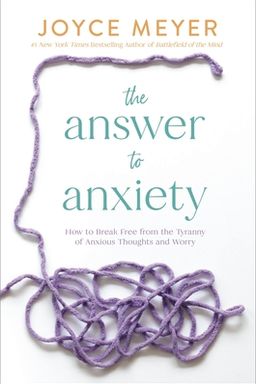
The Answer to Anxiety cover

The Answer to Anxiety

by Joyce Meyer

In ''The Answer to Anxiety,'' Joyce Meyer guides readers through overcoming anxiety by applying insights from a single Bible passage. Discover how prayer, gratitude, and trust in God can transform anxious thoughts into lasting peace.

Finding the Biblical Path to Peace in a Worried World

Have you ever felt trapped in a cycle of constant worry, running possible problems through your mind until you can’t sleep, eat, or even focus? In The Answer to Anxiety, Joyce Meyer argues that anxiety doesn’t have to be an inevitable companion in a stressful world. Instead, she insists that through a biblical understanding of peace and the disciplined practice of prayer, gratitude, and trust, you can live with a quiet, resilient heart no matter what circumstances surround you.

Drawing primarily from Philippians 4:6–7—“Be anxious for nothing, but in everything by prayer and supplication, with thanksgiving, let your requests be made known to God; and the peace of God which surpasses all understanding will guard your hearts and minds”—Meyer builds an entire framework for spiritual calm. The book unpacks four actions embedded in that passage: refuse anxiety, pray immediately, practice gratitude, and receive divine peace. Each step becomes a lifeline for modern believers facing everything from small daily worries to chronic stress and fear.

A Life Plagued by Worry—and Redeemed by Trust

Joyce Meyer opens vulnerably, admitting that despite decades of teaching faith, she has personally battled anxiety. After collapsing from overwork and stress in 2017, she realized that simply believing in God wasn’t enough—her mind had to be renewed to respond His way instead of hers. This turning point shaped the purpose of the book: to teach readers to replace worry with worship, analysis with prayer, and fear with faith.

Her reflections are deeply practical. She contrasts herself with her husband, Dave, who naturally refuses worry with a calm confidence that “God will take care of it.” Dave models the “casting your cares on Him” mindset from 1 Peter 5:7. That contrast shows that peace isn’t about personality; it’s a practice available to anyone willing to surrender control. Meyer illustrates her personal transformation with honesty, showing how worry only stole years of her peace while solving nothing.

Why Anxiety Is So Persistent

Modern life bombards us with reasons to worry—health, finances, relationships, and world instability. Meyer acknowledges legitimate clinical anxiety and encourages readers to seek medical or therapeutic help when necessary. Yet her focus is the everyday, creeping anxiety that grows when we fail to manage ordinary stresses spiritually. She notes that stress is a response to a threat, and anxiety is a reaction to that stress; left unchecked, they can evolve into disorders of the mind and body. “People don’t want to worry,” she writes, “but most think they can’t help it.” To that belief, she answers bluntly: if Jesus commanded, “Do not worry,” He must know it’s possible.

Meyer offers statistics from the Anxiety and Depression Association of America to show the scope of the problem, but she pivots quickly from data to discipleship. Worry, she explains, stems from fear—the fear of losing something valuable or not being cared for. It’s a trap that replaces trust in God with obsessive self-reliance. The spiritual cure, then, is not control but surrender.

From Worry to Worship: The Philippians Formula

The entire book can be seen as an unfolding of Paul’s “formula” for peace in Philippians 4:6–7. Meyer interprets these verses as an active sequence: first, refuse to entertain anxious thoughts; second, turn immediately to prayer; third, fill those prayers with gratitude; and finally, enjoy peace instead of panic. She warns that peace doesn’t come automatically—it results from choosing spiritual responses daily. “We can meditate on God’s promises or our problems,” she explains, “and what we meditate on will multiply.”

This formula shapes every chapter. The first section explores what anxiety is and why worry steals our joy. The middle of the book introduces her five “keys to overcoming anxiety,” each focusing on trust, perseverance, remembrance, and love. Later chapters unpack the power of prayer, thanksgiving, and discipline, culminating in a description of “the peace that passes understanding.”

Why This Message Matters

For Meyer, learning to live without anxiety is not a luxury—it’s obedience. “Peace,” she writes, “is God’s will for us.” She contends that lifelong worry isn’t merely exhausting but spiritually corrosive, distracting believers from trusting God’s faithfulness. Her core argument is that anxiety and relentless reasoning show a lack of trust, while peace demonstrates childlike faith. In this sense, anxiety becomes not only a psychological burden but a spiritual battleground.

“Worry is like rocking in a rocking chair—it keeps you busy but gets you nowhere.”

Readers find here not abstract theology but accessible, motivational counsel. Meyer’s tone often sounds like a wise friend sharing lessons learned the hard way. She urges readers to practice gratitude deliberately, pray promptly, forgive quickly, and live one day at a time—a reflection of Jesus’ words in Matthew 6 about not worrying for tomorrow. Her own example of beating worry through trust and thanksgiving provides encouragement to anyone stuck in endless mental loops of “what if.”

A Faith-Based Manual for Emotional Health

While rooted in Christian doctrine, The Answer to Anxiety intersects with insights from psychology and mindfulness about focusing on the present. But whereas secular mindfulness centers on self-regulation, Meyer’s peace depends on divine partnership. “Trusting God is our rest,” she says. Her approach intertwines spiritual growth and mental resilience: resisting worry strengthens faith muscles the same way exercise strengthens the body.

Ultimately, the book isn’t about escaping emotion but transforming it. Worry becomes a cue to worship; trials become opportunities to remember God’s past deliverance. Meyer invites you not simply to manage anxiety but to step into a life of daily peace through trust, prayer, thanksgiving, and love—the simple but powerful path to freedom that, she insists, God always intended.


Be Anxious for Nothing: Living One Day at a Time

Joyce Meyer begins her message with Jesus’ teaching in Matthew 6:25–34, where He commands His followers not to worry about food, clothing, or tomorrow. She reinterprets this passage as a lifestyle instruction: worrying wastes the present and deprives us of joy without changing the future. The central challenge is whether we will live each day fully, trusting that God already sees tomorrow.

Worry vs. Faith

Meyer paints a vivid picture: birds and flowers thrive without anxiety because God provides for them daily. She invites readers to take this literally—birdwatching becomes a spiritual exercise reminding us that divine provision is constant. Her personal life illustrates this principle: unexpected bills, appliances breaking, health procedures, and ministry demands all created opportunities to practice “one-day faith.” She didn’t always succeed, but she saw that worry only multiplied exhaustion, while faith produced creative solutions and serenity.

Quoting Hudson Taylor and Charles Spurgeon, she connects their missionary trust with modern life—you don’t have to be preaching in China to experience anxiety; you just need a late electric bill. Yet the remedy is the same: believe that God’s timing and care are perfect. By combining humor and realism, she assures readers that even daily frustrations—like her cataract surgery fear—can be reclaimed as lessons in reliance.

Understanding Anxiety

Meyer distinguishes between clinical anxiety (which may require therapy or medication) and garden‑variety everyday worry. The first should be treated medically without shame; the second must be handled spiritually before it grows out of control. Her practical definition of anxiety is “spending today trying to figure out tomorrow,” a mental habit that prevents rest. Citing both biblical and scientific perspectives, she observes that most imagined disasters never happen—about 85%, according to psychological research she references. This blend of scripture and data makes her argument credible for contemporary readers balancing faith and reason.

Ultimately, this chapter establishes Meyer’s thesis that obedience to Jesus’ “do not worry” command is not unrealistic—it’s deeply freeing. “Every day spent worrying,” she says, “is a day wasted.” The key is immediate engagement with problems through prayer, not panic. The more you practice this discipline, the less time your mind spends rehearsing fear—and the more peace becomes your new normal.


The Five Keys to Overcoming Anxiety

At the heart of Joyce Meyer’s practical method lie five keys she has used to defeat anxiety in real life. These steps are both psychological and spiritual—a blend of renewed thinking, persistence, and personal trust in God’s constancy. They also echo the sequence of Philippians 4:6–7.

Key 1: Remember Past Victories

When fear strikes, you can find courage by recalling past moments of deliverance. Meyer tells a detailed story about her 1980s breast cancer diagnosis: initial panic gave way to peace when she remembered God’s previous faithfulness. Her recovery—paired with a surprise $10,000 donation that sustained her ministry—became “evidence exhibits” she replays whenever new crises come. Remembering is not nostalgia; it’s a weapon against mental defeat. (This echoes biblical patterns such as David recalling God’s help with the lion and bear before facing Goliath.)

Key 2: Fight the Good Fight of Faith

Faith, Meyer explains, is active combat, not calm sentiment. Drawing from 1 Timothy 6:12, she urges believers to confront negative thoughts by speaking truth aloud: “I trust God; He is faithful.” You cannot think two thoughts at once, so verbal truth crowds out mental lies. Like muscle training, persistent resistance strengthens faith. She likens spiritual warfare to lifting weights—resistance grows endurance—and adds Galatians 6:9 to remind weary readers that timing belongs to God. Your job is persistence, not prediction.

Key 3: Believe That God Is in Control

Faith expands when you realize that you are not the only person suffering and that none of life’s surprises shock God. Meyer illustrates this truth using Elijah’s despair in 1 Kings 19, when he thought he was the “only prophet left.” God showed him 7,000 faithful ones—a reminder not to indulge self‑pity. Likewise, Meyer received compassionate texts from a friend with cancer who still prayed for her; that compassion reframed her own perspective. “The less we focus on ourselves, the better off we are,” she says. Believing in divine sovereignty allows peace even when outcomes remain hidden.

Key 4: Trust God

Trust, in Meyer’s framework, produces rest. It refuses both “When, God, when?” and “Why, God, why?”—the twin tormenting questions of impatience. She retells the story of Paul and Silas singing in prison at midnight to show that faith lives between problems and deliverance. Even if relief seems delayed, trust affirms that God is never late. As David said, “Whenever I am afraid, I will trust in You.” Trust doesn’t cancel fear’s feeling; it overrides fear’s authority.

Key 5: Choose to Believe God Loves You

Finally, anxiety dissolves when love is believed. Citing 1 John 4:18, Meyer explains that fear and divine love cannot coexist. Her own journey from childhood abuse and neglect convinced her that only revelation of God’s unconditional affection heals chronic worry. Since fear is really doubt about being cared for, the cure is to internalize perfect love through prayer and scripture meditation. Only then can the heart rest secure that “God will take care of me.”

Together, these five keys form a progressive pathway—memory, resilience, surrender, trust, and love—that rewires both the mind and spirit. Practiced consistently, Meyer insists, they convert theoretical faith into lived peace.


The Transforming Power of Prayer

Prayer, according to Joyce Meyer, is not a religious duty but a miracle‑enabling conversation. When combined with thanksgiving, it becomes the most potent antidote to anxiety. Meyer confesses that she once treated prayer as a last resort (“Well, I guess there’s nothing left to do but pray”) until she realized that it should be the first response, not the final attempt.

Understanding Simple, Definite Prayer

Quoting Philippians 4:6 in the Amplified Bible—“by prayer and petition (definite requests)”—Meyer encourages believers to specify what they need. Vague pleas (“Bless me, Lord”) leave us uncertain whether our prayers are answered. By contrast, a clear prayer for healing, provision, or wisdom engages faith and expectation. Her detailed eye‑surgery prayer exemplifies this realism: she describes her condition to God, asks boldly for a miracle, and then rests, trusting His outcome.

She outlines conditions for answered prayer: forgive others (Mark 11:25), pray sincerely, ask in faith, align with God’s will, and walk in love. Love, she says, “powers faith like electricity powers a lamp.” Without love, even eloquent petitions fail to light results.

Barriers That Block Peaceful Prayer

Meyer enumerates prayer‑blockers: unforgiveness, pride, doubt, selfish motives, and prayerlessness itself. She tells of confronting her own hypocrisy when complaining about an employee’s negativity—she had never actually prayed for him. Once she did, his attitude improved the next day, teaching her that frustration is often misplaced intercession.

She also addresses boldness, encouraging readers to approach God confidently through Christ’s merit, not their own performance. Referencing Hebrews 4:16, she pictures the throne of grace as open office hours with a loving Father, not a hostile judge. In that confidence, peace replaces hesitation.

Intercession and Comfort

Interestingly, Meyer reveals that praying for others not only blesses them but calms our own anxiety. When you shift focus away from yourself, your problems shrink. She quotes 2 Corinthians 1:3–4, calling God “the Father of all comfort,” and concludes that receiving comfort equips you to comfort others. Indeed, to cast your care on God (1 Peter 5:7) is to exchange pressure for divine tenderness—a trade every anxious heart needs.

Ultimately, prayer in Meyer’s view is partnership: human dependence linked to divine power. It invites not necessarily a removal of problems, but strength to endure them peacefully. “One prayer,” she writes, “can accomplish more in a moment than I could in a lifetime.”


The Practice of Gratitude

If prayer is the doorway to peace, gratitude is the atmosphere in which peace grows. Joyce Meyer dedicates two chapters—“With Thanksgiving” and “The Discipline of Gratitude”—to showing that thankfulness is not optional sentiment but spiritual discipline. Citing 1 Thessalonians 5:18 (“Give thanks in all circumstances”), she calls it God’s will for every believer.

Why Gratitude Changes Everything

Meyer connects gratitude with mental focus. You can’t be anxious and thankful at the same time. Like light replacing darkness, thanksgiving crowds out worry. She quotes William Arthur Ward: “Feeling gratitude and not expressing it is like wrapping a present and not giving it.” For Meyer, verbal gratitude—saying “thank you” aloud to God and people—transforms an internal state into external strength.

She recalls an everyday conflict with her husband Dave where she caught herself looping complaints. God challenged her to list what she appreciated about Dave versus what irritated her. The “good” list dwarfed the “bad.” That exercise convinced her that one’s mental list determines mood. Gratitude, therefore, is perspective training that keeps faith ahead of frustration.

The Discipline of Daily Gratitude

Beyond emotional appreciation, gratitude is a structured habit requiring repetition. Quoting Jim Rohn and Henri Nouwen, Meyer describes it as a daily practice of noticing life’s gifts. She shares a friend’s list of ordinary gratitudes—getting out of bed, coffee, traffic meaning you have a car—to illustrate how consistent recognition retrains perception. Gratitude becomes a spiritual workout of the will, not the feelings.

She even recommends using gratitude as warfare: when the devil plants irritation, respond by thanking God for something connected to the problem. Spill your coffee? Thank Him that you can afford a refill. Long line? Thank Him for the strength to stand. This “Pollyanna principle,” as she calls it referencing the cheerful film heroine, disarms negativity by reframing it.

Gratitude as Spiritual Warfare

For Meyer, thankfulness confuses the enemy. She points to 2 Chronicles 20, where Jehoshaphat’s army defeated enemies by singing “Give thanks to the Lord; His love endures forever.” Likewise, gratitude today dismantles worry’s siege. It acknowledges God’s love even when life seems undefined. This gratitude is not denial—it’s defiance of despair.

By practicing consistent gratitude and pairing it with prayer, Meyer insists that inner peace becomes sustainable. In her simple formula: consistency in thanksgiving equals immunity from anxiety.


The Peace That Passes Understanding

After prayer and gratitude come their supernatural result: peace that “passes understanding.” This peace, Joyce Meyer explains, is not the absence of problems but the steady calm that holds even when life storms rage. It’s a divine defense system that “guards your heart and mind like a fortress.”

Learning to Enter Peace

Meyer quotes John 14:27, where Jesus gives His own peace as an inheritance. Her revelation was that believers don’t need to beg for peace; they already possess it. The task is to “enter” it by choosing not to be disturbed. Like Dwight L. Moody’s reminder that peace is already made, Meyer reframes peace as an available environment, not a future reward.

To maintain that peace, she learned to identify “peace stealers”—rude people, financial stress, unmet expectations, or even small inconveniences—and invite the Holy Spirit to check her attitude immediately. She writes candidly about past days when every broken appliance or argument sent her spiraling, proving that peace must be guarded actively, not passively.

Changing the Way You Think

Much of anxiety begins internally. Quoting Isaiah 26:3, Meyer emphasizes that “You will keep in perfect peace those whose minds are stayed on You.” She contrasts two thought patterns: the carnal mind that circles worries (“What if this never works out?”) versus the Spirit‑focused mind that confesses trust (“God has me; this will work for good”). The difference is choice. Every believer can direct mental traffic by “casting down imaginations” (2 Corinthians 10:5) and replacing lies with God’s Word.

Her metaphor of a stronghold—a fortress of lies built in the mind—illustrates how recurring thoughts of fear can enslave us. Through Scripture meditation, those fortresses crumble. By “taking every thought captive,” peace ceases to be fragile emotion and becomes secure conviction.

Meyer’s closing call is simple: don’t wait for calm circumstances to feel calm. Live from the peace already gifted to you. When storms come and anxiety pounds, you can stand like the bird in the storm painting she describes—still and unafraid because your peace is internal, not environmental.


Freedom from Perfection and Self‑Anxiety

In her final chapters, Joyce Meyer shifts from external problems to internal ones—the anxiety we create by expecting perfection from ourselves. Echoing Watchman Nee’s reminder that an unpeaceful mind “cannot operate normally,” she argues that self‑criticism and comparison are among the most subtle thieves of peace. Many believers, she says, try to earn approval from God or others through flawless behavior, only to live perpetually exhausted.

Letting Go of Unrealistic Expectations

Meyer insists that God never expected perfection; that’s why He sent Jesus. Yet modern Christians burden themselves with impossible standards—being more spiritual, more efficient, more attractive. Quoting Matthew 5:48 through the Amplified Bible, she clarifies that “being perfect” means “growing into maturity,” not flawlessness. Maturity is progress, not performance.

Through tender humor, she admits trying to be the “perfect woman” who sews, gardens, and cooks gourmet meals until she realized God created her for teaching, not tailoring. The shorts she once sewed with pockets longer than the legs became a personal parable: striving outside one’s design produces absurd results. This story releases readers from cultural pressure to match others’ strengths.

Peace with God—and with Yourself

True peace, Meyer explains, starts with reconciliation to God through Christ, then extends to reconciliation with yourself. Many fail in the second part. Instead of receiving grace, they punish themselves with guilt over confessed sins or failures. “Guilt after repentance,” she notes, “is our flesh trying to pay for what Jesus already paid for.” Accepting forgiveness means relinquishing self‑hatred and living joyfully in grace.

She advises readers to stop measuring worth by others’ opinions. Quoting Jeremiah 1:5, she reassures that God knew and approved you before birth. Your value is not derived from perfection but from divine intention. Ralph Waldo Emerson’s line—“To be yourself in a world that’s constantly trying to make you something else is the greatest accomplishment”—serves as her benediction for authenticity.

In the end, Meyer’s counsel is tender: give yourself a hug, accept who God made you, and be at peace. Freedom from anxiety about yourself is the final step toward living continually in the peace Christ left you. Where earlier chapters battle outward worries, this one conquers inward war—the liberation of liking yourself as God does.

Dig Deeper

Get personalized prompts to apply these lessons to your life and deepen your understanding.

Go Deeper

Get the Full Experience

Download Insight Books for AI-powered reflections, quizzes, and more.