
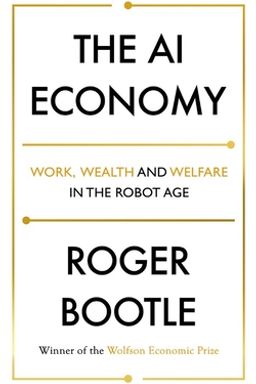
The AI Economy cover

The AI Economy

by Roger Bootle

The AI Economy explores how Artificial Intelligence will reshape work, wealth, and welfare. Economist Roger Bootle analyzes AI''s impact on jobs, productivity, and inequality, providing a roadmap for navigating the impending fourth industrial revolution.

The Rise of Intelligence and Economic Transformation

How can you make sense of the economic, social, and moral revolution triggered by artificial intelligence? In his sweeping exploration, Roger Bootle argues that to understand the forces shaping the Robot Age, you must first look back—to the Industrial Revolution, the moment when humanity truly escaped subsistence. Bootle’s central claim is that AI and robotics could match that epochal upheaval, but only if societies build the right economic, institutional, and educational scaffolding. Without it, the technology’s vast potential could produce stagnation and inequality instead of prosperity.

Bootle’s argument unfolds through history, economics, and philosophy. He begins by contrasting pre-industrial stagnation with modern growth, reveals why earlier innovations failed to lift living standards, then connects those lessons to AI’s diffusion today. He moves through macroeconomics (demand, inflation, jobs), human responses (work, leisure, education), and ends with the moral questions of whether machines might one day match or surpass human intelligence. At every step, Bootle insists that technology alone never determines outcomes—human choices do.

From Industrial Revolution to AI Revolution

For thousands of years after the Agricultural Revolution, productivity and living standards barely moved. Bootle, echoing Brad DeLong’s data, shows world GDP per capita was effectively flat from 2000 BCE until 1800 CE. Then something extraordinary happened: within two centuries, income per head soared more than thirtyfold. The Industrial Revolution wasn’t a single event but a reinforcing system—technological advances, capital accumulation, markets, and social institutions interacting to create self-sustaining growth. Bootle sees this as the true singularity of humanity’s economic history.

This historical lens matters because AI might be another general-purpose technology (GPT) of comparable magnitude. Like the steam engine or electricity, AI could permeate every sector and function. Yet Bootle cautions against technological determinism: while industrialization created prosperity, it also caused hardship—the “Engels pause” when wages lagged output, or Luddites protesting their displacement. The analogy to AI is clear: transition will be painful, benefits delayed, and diffusion uneven across regions and classes.

Why Past Technologies Failed to Enrich Humanity

Earlier breakthroughs—agriculture, the wheel, metallurgy—changed civilization but not living standards. Bootle identifies four reasons: slow diffusion, elite capture, shortage of capital, and Malthusian population pressure. Innovation alone didn’t raise average welfare because its fruits failed to spread broadly or were erased by population growth. The Industrial Revolution broke that cycle through investment, education, and institutional reform. The lesson for the AI era: invention matters, but unless we pair it with capital, governance, and equitable diffusion, productivity improvements may again enrich only a few.

Defining Robots, AI, and the Debate About Singularity

Bootle clarifies confusing terms. A robot isn’t just a humanoid—it’s any programmed device that acts autonomously, from factory arms to washing machines. Artificial intelligence refers to designed systems that learn, reason, and adapt, a field dating back to John McCarthy’s 1955 definition. He deliberately quarantines discussion of the Singularity—the hypothetical point when AI surpasses human capability—saving it for his final chapter. For Bootle, current debates should focus on the anterior world we inhabit now, where AI enhances or replaces tasks but humans remain in control.

Continuity or Break? Two Competing Futures

Bootle frames the key question: is AI simply another wave of automation or a new discontinuity? The continuity camp, citing Robert Gordon, sees limited productivity potential; the discontinuity camp believes AI’s cognitive reach marks an epochal shift. Bootle’s middle ground accepts AI as transformative but gradual—bounded by costs, adoption lags, and institutional readiness. You shouldn’t expect instant takeoff or universal disruption; instead, expect staggered revolutions across industries and regions.

The Human Context: Politics, Distribution, and Purpose

Ultimately, Bootle’s message is deeply humanistic. The Industrial Revolution taught that technology’s benefits are mediated by human systems—laws, markets, education, and ethics. That remains true. Whether AI leads to full employment or mass uselessness, to leisure or inequality, depends on institutional adaptation, cultural choices, and political courage. The lesson isn’t that machines will—or won’t—take over. It’s that their impact depends on us.

Bootle’s Core Insight

Technological change alone never guarantees prosperity. What counts is the human response: the will to invest, educate, distribute fairly, and use new tools for shared progress. In that respect, the AI revolution will replay the Industrial Revolution’s moral question—how to turn capability into collective flourishing.


How AI Reshapes Growth and Demand

Bootle dives into core macroeconomics: will AI supercharge growth or destabilize demand? His answer mixes optimism with caution. He rejects simplistic forecasts of mass unemployment or endless abundance and instead centers the analysis on demand, distribution, and policy—factors that determine whether rising productivity translates into prosperity.

Productivity and the Measurement Puzzle

AI’s potential for growth is enormous, but Bootle warns against misreading the data. Like earlier revolutions, effects appear slowly and often hide behind measurement problems. Free digital services (YouTube, Google Maps) add welfare yet show little in GDP. As with steam and electricity, it may take decades for AI investments to translate into measurable productivity increases. This perspective tempers both the hype and the despair.

Demand and Distributional Loops

AI enhances supply—machines produce more goods—but who buys them? Bootle revisits Say’s Law (“supply creates its own demand”) to show why it often fails. In modern money economies, saving habits and inequality can cause demand shortfalls. If income shifts toward capital owners who save more, consumption weakens, creating unemployment even in a productive economy. This is the Keynesian danger that has haunted industrial societies before—and could resurface in the AI age.

Countervailing Forces and Policy Levers

Bootle notes that distributional shocks don’t automatically sink demand. New investment opportunities, retiree consumption, and public spending can offset saving surpluses. Economic policy—fiscal expansion, redistribution, or even universal income—can sustain demand while AI boosts supply. The macro challenge is management, not destiny. You have levers: education, retraining, targeted transfers, infrastructure, and competition law.

Inflation and Interest Rates in the AI Era

Many assume AI will trigger permanent deflation and ultralow rates. Bootle challenges that. If AI opens vast new investment options, real interest rates may rise toward historic norms. Inflation outcomes are policy choices: productivity growth can coexist with stable prices if central banks aim for it. The notion of a “low-rate forever” economy may already be fading as investment revives around technological transformation.

Key Lesson

AI’s macroeconomic story isn’t predetermined. Prosperity depends on how consumption, savings, and policy interact with technological diffusion. With thoughtful management, productivity gains can translate into stronger growth rather than stagnation.


Jobs, Tasks, and the Future of Work

Will AI take your job? Bootle’s answer is nuanced: yes and no, depending on whether your work consists of tasks machines substitute for or complement. He switches the frame from jobs to tasks because every occupation combines both. The challenge is not just surviving automation but thriving through complementarity.

Substitution, Complementarity, and Polarization

Routine, predictable activities—data entry, clerical filing, basic manufacturing—face heavy automation pressure. Yet AI simultaneously amplifies demand for human judgement, creativity and empathy. This produces job polarization: expansion at high-skill and low-skill ends, compression in the middle. Bootle draws on Frey and Osborne’s Oxford study and OECD’s conservative counterpoint to reveal how estimates differ—but the pattern is consistent: some work disappears, other work transforms.

Human Advantage and Emerging Roles

Where AI fails—emotion, ethics, persuasion—human capability thrives. Bootle cites McKinsey’s research showing 'sensing emotion' and creative reasoning as least automatable. Result: rising employment in caregiving, leisure, education, health, and creative industries. At the same time, new occupations—AI trainers, data curators, ethics auditors—emerge. The history of technology suggests continual churn rather than collapse.

How to Stay Employable

Bootle’s practical guidance matches economists like David Autor and Hal Varian: become the indispensable complement. Learn to use AI as a tool, combine domain expertise with interpersonal intelligence, and adapt continually. Hybrid human–AI teams already outperform either alone (examples: chess “centaurs,” human–machine diagnostics in medicine). The safest income paths involve skills AI augments rather than replaces.

Rule of Thumb

Think tasks, not titles. Jobs evolve, skills compound. Your resilience depends less on what you know and more on how quickly you can learn to collaborate with intelligent machines.


Winners, Losers, and Digital Inequality

AI will not make everyone richer at once. Bootle’s realism shines in his treatment of inequality. Globalization and digitization, he argues, interact to produce 'superstar effects'—markets where the best capture global audiences and earnings while the median stagnates. Understanding these forces helps you anticipate who benefits and who needs protection.

The Mechanics of Superstar Markets

Once a service digitizes, distribution costs collapse. The best singer, lawyer, or programmer can reach billions. Hence Amazon dominates e-books, Google search, Facebook social networks. The same applies to AI platform owners. You gain as a consumer but risk as a worker: digital scale magnifies inequality between creators, owners, and users.

Who Gains, Who Risks

Low-skill routine work remains under pressure, but mid-level cognitive roles now erode too—clerks, paralegals, accountants. Meanwhile, manual and human-centric services (construction, care, hospitality) persist or rise. Thus, the losers aren’t only the least educated. The most threatened are those whose routine cognition can be cheaply replicated.

Complementarity and Adaptation

Bootle’s antidote is complementarity: Kevin Kelly’s idea that your pay will depend on how well you work with robots. The goal isn’t to compete against AI but to integrate it into your output. Complementary workers, firms, and nations benefit; substitutes lose. Policy should therefore fund reskilling, incentivize human–machine collaboration, and temper monopoly rents.

Bootle’s Takeaway

AI can widen inequality if left unmanaged, but it can also empower people who merge human strengths with digital scale. Where gains go depends on ownership, education, and institutional design—not on algorithms alone.


Geography, Nations, and Global Competition

Despite the 'death of distance' narrative, Bootle shows AI’s benefits will cluster around geographies that combine innovation, capital and culture. Robots and algorithms travel easily, but ecosystems that foster trust, risk-taking and skilled labor remain local. Hence AI will widen divides between regions and nations if policy fails to bridge them.

Agglomeration and the City Advantage

Cities like London, New York, and San Francisco still dominate finance, data, and creative industries. Proximity produces serendipity and speed. Even digital firms crave networks of human trust and collaboration. Far from dispersing work, AI may intensify clustering. Subregions within cities—like Canary Wharf or Silicon Roundabout—illustrate this layered geography.

National Gaps in Automation

Adoption rates vary sharply. South Korea leads with over 600 robots per 10,000 factory workers; the UK lags around 70. China is racing to dominate AI patents and apply surveillance technologies. These disparities signal deep structural differences: industrial mix, policy, savings, and risk appetite. Nations that coordinate education, capital, and regulation around AI gain comparative advantage.

Culture and Regulation

Bootle underlines cultural context: Asia’s cultural comfort with robots (influenced by characters like Astro Boy) contrasts with Western fears inspired by dystopias like The Terminator. The EU leans toward heavy regulation and data privacy; China embraces deployment; the US emphasizes innovation. These cultural-political differences determine speed of diffusion.

Development and Specialization

For developing countries, automation threatens the old path of 'cheap-labor industrialization'. Dani Rodrik warns of premature deindustrialization. Yet Bootle notes new options: service-led growth using digital platforms. Countries that adapt education and regulation can leapfrog even without large manufacturing bases.

Practical Watchpoints

Track AI investment, robot density, regulatory openness, and cultural attitudes. They reveal where clusters will thrive and where divides may widen. Geography still matters—even in a virtual age.


Education and Lifelong Humanics

Education, Bootle insists, is society’s master variable in the AI era. Machines learn fast, so humans must learn faster. Yet that doesn’t mean turning everyone into coders. The goal is 'humanics'—Joseph Aoun’s idea of combining technological fluency with human literacy: creativity, empathy and critical thinking. This approach prepares you to complement, not mimic, AI.

Balanced Curriculum and Human Skills

STEM is vital but insufficient. In 2016, only 40% of US schools taught programming, yet oversupply of generic degrees led to 58% of UK graduates in non-graduate jobs. Bootle argues for vocational excellence (like Switzerland’s dual model) and a rebalance toward creative, communicative and ethical capacities. Arts and humanities stay crucial because they cultivate judgement—something no algorithm can yet replicate.

AI as Personalized Tutor

AI can revolutionize pedagogy without replacing teachers. Adaptive learning systems deliver tailored content, freeing human mentors for emotion, encouragement, and higher-order thinking. The future looks like a scaled Oxford tutorial system: algorithms deliver information; humans deliver inspiration.

Lifelong Learning and Cognitive Hygiene

Careers will involve several reskilling cycles. AI lowers training costs, enabling modular, lifelong education. Yet Bootle warns of cognitive erosion: GPS dulls navigation, search weakens memory. Teaching should include when—not—to rely on automation. Learning to learn, unlearn, and relearn becomes the truest survival skill.

Core Message

Education must fuse technical with human literacy, emphasize adaptability, and extend across a lifetime. AI amplifies teachers and students—but cannot replace the human capacity to care, judge, and inspire.


Policy, Redistribution, and Ethical Governance

If AI disrupts markets and jobs, how should governments respond? Bootle’s final policy chapters weigh robot taxes, regulation, and social safety nets, dismissing easy slogans in favor of nuanced stewardship. He argues that good governance is about adaptation, not obstruction.

Why a Robot Tax Fails

Popularized by Bill Gates, a 'robot tax' sounds fair—tax machines like workers—but Bootle warns it’s ill-defined and counterproductive. What constitutes a robot: an ATM, spreadsheet, or chatbot? Taxing productive capital would discourage investment and drive innovation abroad. Better to tax overall income or wealth progressively while keeping incentives for innovation intact.

Regulating for Trust and Safety

Bootle supports targeted regulation where public risk is clear—autonomous weapons, data misuse, bias—but opposes blanket bans. Clear liability rules (who’s accountable when an AI fails?) encourage adoption by reducing legal uncertainty. Cybersecurity and AI-aided defense must become public priorities as threats accelerate. Safety and transparency—not restriction—should guide policy.

Redistribution and Universal Basic Income

Bootle dedicates careful analysis to UBI. Though championed by figures from Thomas Paine to Elon Musk, UBI at scale is exorbitant—potentially a quarter of GDP—and risks undermining work incentives. Modest pilots (Finland, Alaska) suggest limited impact. Bootle favors reforming existing systems: progressive taxation, strong education, retraining grants, and competition policy over radical blanket payments. Redistribution must remain dynamic and incentive-compatible.

Bootle’s Verdict

Avoid symbolic taxes; pursue structural fairness. Fund education, enforce competition, and set clear rules for liability and data rights. Ethical governance should empower humans, not smother innovation.


Human Futures and the Singularity Question

In his philosophical closing, Bootle tackles the ultimate question: could AI surpass human intelligence, and if so, what then? The 'Singularity' hypothesis posits recursive self-improvement leading to superintelligence. Bootle treats it seriously but not dogmatically, framing it as an ethical horizon rather than an imminent threat.

The Plausibility Debate

Proponents like Ray Kurzweil see exponential progress leading to human-level AI by mid-century. Skeptics like Steven Pinker and Noam Chomsky doubt intelligence can be reduced to computation. Bootle maps both sides, noting Roger Penrose’s proposal that consciousness may rely on quantum processes irreproducible by software. Whether you side with optimism or caution, the uncertainty itself demands humility.

Ethics and Consciousness

If AI achieved consciousness, moral obligations would follow. Jeremy Bentham’s criterion of moral worth—capacity to suffer—would apply. Would conscious AI deserve rights, property, or protection? Bootle urges preparation for such contingencies without premature legislation. Law, he reminds us, lags technology, and in this case it might lag existence itself.

Human Enhancement and Coevolution

Another path is merging with machines: genetic engineering, neural implants, or cognitive augmentation. Harari warns of new inequalities, but these tools could also preserve human relevance. The future may not be man versus machine but man with machine—or even man as machine. Bootle’s closing sentiment is pragmatic hope: humanity should guide AI’s development toward moral, inclusive outcomes through dialogue and adaptive governance.

Final Reflection

The Singularity may or may not arrive, but preparing ethically, institutionally, and psychologically for radical change is wise. Bootle calls for humility, continuous debate and a reaffirmation of what makes us human.

Dig Deeper

Get personalized prompts to apply these lessons to your life and deepen your understanding.

Go Deeper

Get the Full Experience

Download Insight Books for AI-powered reflections, quizzes, and more.