
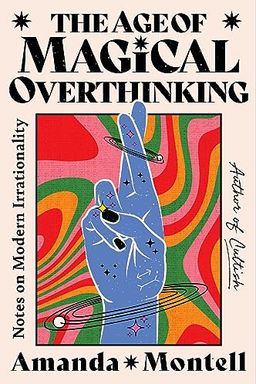
The Age Of Magical Overthinking cover

The Age Of Magical Overthinking

by Amanda Montell

The linguist and podcast host examines cognitive biases and coping mechanisms used in our current information age.

Living Sanely in the Age of Magical Overthinking

When the world stops making sense, what story does your mind reach for—doomscrolling, manifesting, stan warfare, or a throwback fantasy where life felt simpler? In The Age of Magical Overthinking, Amanda Montell argues that our brains are running ancient sense-making software on today’s infinite-information operating system. The result is a perfect cognitive storm: we overtrust shortcuts (biases) built for survival in small groups, and underappreciate how easily modern media hijacks those shortcuts. Montell contends that to live sanely now, you must learn to spot the mind’s elegant distortions—not to self-flagellate, but to keep your footing, find compassion (for yourself and others), and choose better where it counts.

Weaving memoir, interviews, and social analysis, Montell maps the biases animating today’s headline behaviors: why stan fandom swings from worship to witch hunt (halo effect), why Instagram therapy can morph into conspiracy (proportionality bias), why you stayed years too long (sunk cost), why scrolling makes someone else’s win feel like your loss (zero-sum), why survival tales crowd out the dead (survivorship bias), why yesterday’s post feels like today’s apocalypse (recency illusion), why grifters thrive and you still feel like an imposter (overconfidence bias), why viral myths stick (illusory truth), why you’ll find proof for whatever you already believe (confirmation bias), why the past looks golden and the future doomed (declinism), and why building a janky seat cushion can soothe your soul (the IKEA effect).

Why these ideas matter now

You’re living through a once-in-a-species attention crisis. Headlines, feeds, and influencers don’t just report reality; they weaponize cognitive reflexes for engagement. As Montell shows, the “information glut” meets “resource-rational” minds—brains that evolved to save effort with good-enough heuristics—and pushes them past their sweet spot. You may be “right” that you can’t read every study or weigh every comment thread; your brain has finite storage and time. But the same efficiencies that once kept you alive can now push you into social spirals, health rabbit holes, or self-mistrust. Understanding your thinking lets you redirect attention toward what’s urgent and meaningful (Peter Drucker’s matrix), restore rapport with your own mind, and swap internet catharsis for embodied awe.

How the book works

Montell’s method is disarmingly human. Each chapter centers a bias and a lived scene: a Taylor Swift stan implosion clarifies the halo effect; an LA “Manifestation Doctor” illuminates proportionality bias and “conspirituality”; a seven-year relationship postmortem transforms the sunk cost fallacy; a beauty editor’s algorithmic jealousies expose zero-sum bias; YouTube’s dying girls complicate survivorship bias; a 60 Minutes UFO clip showcases the recency illusion; scammers and geniuses meet overconfidence bias; a viral lie about medieval bouquets demonstrates the illusory truth effect; dinosaurs, Y2K, and astrology animate confirmation bias; cottagecore and Golden Age slogans reveal declinism; and a goofy, beloved DIY seat cushion embodies the IKEA effect.

From blame to belonging

You’ll recognize yourself in these pages and—crucially—Montell refuses to shame you for it. Biases aren’t bugs; they’re features of minds built to find meaning, fast. The question becomes: where are they helpful, and where are they hijacked? Her answer mixes compassion and practicality. When awe slows time (Dacher Keltner), when you mute the feed and phone a friend, when you subtract instead of add, when you hold two truths at once—your mind regains its dignity. That dignity makes it easier to replace doom-cycles with solidarity: Shine Theory instead of subtweeting (Ann Friedman and Aminatou Sow), support instead of “gotchas,” metacognition instead of certainty theater.

What you’ll take away

Practically, you’ll leave with micro-moves: ask “urgent or important?” before you click; notice the halo you’ve put on your boss or favorite pop star; spot when “this big feeling needs a big cause” is steering you toward pseudoscience; name sunk costs aloud; convert comparison into connection with one message of sincere praise; pause before sharing the catchy myth; choose a craft that moves your hands; and build a weekly pocket of awe. Philosophically, you’ll inherit Montell’s stance: a fierce, funny secular spirituality that treats your biases like koans—unsolvable riddles that break the mind just enough to reassemble it with humility. You won’t become bias-free. You’ll become bias-aware, which is the only way to get sane—and stay kind—in an age that profits when you aren’t.

A line to remember

“Meaning is our job.” Montell’s antidote to both magical and mechanical thinking: accept that nature doesn’t “care” like a person—you weave the sense, choose the scale, and pick the next right action.


The Celebrity Halo Trap

Montell shows how the halo effect—judging a person’s whole character by one glowing trait—drives stan culture’s dizzying love–hate cycles. You see it when fans infer moral courage from stagecraft, or maternal devotion from confessional lyrics. The result is a brittle pedestal: adoration converts to moral policing, then to mass dethroning when the human fails the divine brief.

From saints to stans

A century ago, halos crowned saints in paintings. Today, they settle over celebrities we “know” through feeds. Taylor Swift’s fandom cataloged Tumblrgate, Ticketgate, Lavendergate, Jetgate, and Moviegate—moral crises built from parasocial inferences. As Amy Long notes, demanding “Defund the police!” from a billionaire touring artist with ex–law enforcement security misunderstands incentives. Halo logic oversimplifies: if she writes vulnerably, she must also be the progressive crusader I need. When reality intrudes—a boyfriend choice, a sponsorship—outrage blooms because the imagined mother betrayed the child.

Why the halo feels so good

Evolutionarily, quick generalizations saved time. In small bands, one strong signal (symmetry, strength, wit) often correlated with other desirable traits. In modern media, that same efficiency collapses complex strangers into mascots for your identity. Social platforms intensify the pull: direct-to-camera stories simulate intimacy; a reply feels like answered prayer. As NPR’s Sidney Madden argues, online swarms can now redirect an artist’s choices, creating a feedback loop where performance of virtue outcompetes art.

When love flips to cannibalism

Montell catalogs the pivot from devotion to derision: Beyoncé’s vegan-announcement backlash; Charli XCX’s “Charli’s Angels” brandishing poppers and anal douches for signatures; and Swifties doxxing a critic (Jill Gutowitz) for describing Joe Alwyn as “a cup of plain oat milk.” These aren’t outliers; they’re predictable when halos shrink humanity to a single dimension. Psychological studies tie intense celebrity worship to depression, anxiety, identity diffusion, compulsive shopping, and even criminality. Research also links pathological fandom to insecure parent–child attachment and early-life isolation, which can produce “splitting” (others as all-good or all-bad).

Mother hunger, father platforms

The language gives it away: “mother,” “queen,” “legend.” With Swift’s carefully designed eras (self-titled innocence, Reputation’s vampiric vengeance, Folklore’s cottagecore), fans find archetypal mothers to cycle through. As psychotherapist Mark Epstein puts it, “the traumas of everyday life can easily make us feel like a motherless child.” Montell threads this into her own halo toward her mother, renowned cancer biologist Denise Montell. Only when Denise began writing her teenage daughter unvarnished emails did the pedestal widen into a person—and the relationship soften.

So what do you do instead?

- Notice the glow: When you catch yourself inferring morality from a performance (or a boss’s charisma), label the halo. Ask: what don’t I know?
- Prefer “good enough” mothers: Borrow Donald Winnicott’s concept—people benefit when caregivers (and idols) are allowed to fail in manageable ways. If you insist on perfection, you’ll grow fragile.
- Re-center proximity: A 2003 study found teens who “worshipped” parents/teachers had higher self-esteem and achievement than those idolizing celebrities. Choose exemplars who can contribute tangibly to your life.
- Interrogate the power gradient: Who pays when the pedestal collapses? As Sabrina Maddeaux notes, women bear harsher penance, with queer fan misogyny often amplifying the harm.

(Context: Anne Helen Petersen’s celebrity analyses, and Jessica Grose’s account of declining institutional trust, echo Montell’s diagnosis: when politics and religion lose authority, we deputize entertainers to fill the moral gap.)

Practice

Un-pedestal one person this week. Replace an absolute (“She’s perfect”) with a both/and (“She’s brilliant at X, and limited at Y”). Then send one sincere note of appreciation that doesn’t demand reciprocity.


Manifestation, Meet Conspiracy

Montell’s most unsettling chapter reframes manifestation culture as a velvet-gloved conspiracy theory powered by proportionality bias: big feelings demand big causes—and big cures. Enter Instagram’s “Manifestation Doctor,” a holistic influencer (with a lapsed license) who sells shadow work, nervous-system “reprogramming,” and $26/month self-healing circles while casting doubt on therapy and medication. Her aesthetic blends DSM buzzwords (epigenetics, dysregulation) with New Age mysticism to produce the most seductive lie: you attracted your pain, so you can cure it.

Why “the healing” lands

During COVID, conventional care was expensive or full; mental distress soared (Pew: 58% of U.S. 18–29-year-olds reported high distress). People wanted a single, on-purpose explanation that matched the enormity of their sadness. Proportionality bias lights up for a story with symmetry: my trauma is vast; there must be an equally vast root and a master key. It’s far more soothing than real life’s haphazard mosaic of biology, systems, and chance. And the algorithm rewards certainty and novelty over nuance (MIT finds false news spreads faster than truth).

From self-help to “conspirituality”

Montell follows one fan, Heather, who recommended the Manifestation Doctor to her newly-sober father. Within six months, he slid into QAnon content—the elites drink children’s blood—and abandoned meds because “the healing” was enough. The influencer’s network included Kelly Brogan (named among the “Disinformation Dozen”) and an alt-right brand selling “Lions Not Sheep” tees while glamorizing guns. Once any foundational trust cracks (media, psychiatry), suspicion seeps everywhere. If antidepressants are a plot, perhaps the moon landing was faked. Proportionality bias keeps forcing the world to line up with the initial betrayal.

Why it’s not just “buyer beware”

This isn’t simply credulity. It’s structural. Platforms amplify absolute claims (“Overexplaining is manipulation”) because they’re sticky. Behavioral health lacks tight malpractice guardrails; a charismatic “guide” can scale parasocial therapy without clinical accountability. And many claims are near truths: beliefs influence behavior; Big Pharma has erred; spirituality can buffer stress. As Aaron Weiner puts it, “The easiest lies to believe are the ones closest to the truth.”

A saner spiritual lane

- Name the biases: Three culprits drive “I manifested it” narratives—proportionality bias, confirmation bias, and frequency bias (aka Baader–Meinhof: you notice something; now you see it everywhere).
- Hold two truths: Tibetan-inflected wisdom says you can’t control events, but you can shape responses. Instagram’s remix often over-credits the self and erases systems (e.g., medical racism, poverty).
- Prefer bounded care: Follow clinicians who disclose evidence vs. anecdote, cite limits, and encourage offline help. Mentorship that makes itself obsolete is safer than guru-dependence.
- Reclaim animism, not algorithm: As clinician Laura Giles notes, perceiving “personhood” in the tree beside you can foster care, not paranoia—if it’s not hijacked by commerce.

(Comparison: Kathryn Schulz’s Being Wrong also explores the psychological relief of totalizing explanations; Gabor Maté’s The Myth of Normal pairs individual healing with social determinants rather than pitting them.)

Red flag checklist

Absolute claims, “secrets” sold behind paywalls, denigration of all meds/therapy, demands for total lifestyle adoption, and a vibe that you’ll never graduate from the teacher.


Cutting Sunk Costs in Love

Montell’s most intimate case study is a seven-year relationship she calls a “cult of one.” The logic that kept her inside—sunk cost fallacy—is the same logic that keeps you in bad projects, spiraling degrees, or hollow jobs: you’ve spent so much (time, emotion, hope), surely the win is coming. Loss aversion makes quitting feel like a personal moral failure.

How a love story becomes a trap

At eighteen, Montell fell for “Mr. Backpack,” a charismatic older man who love-bombed, then eroded boundaries. She changed cities, rushed graduation, and learned to downplay red flags (a bleeding knuckle after he punched an elevator wall). Like cults, unhealthy relationships cycle through idealization, devaluation, and discard. Leaders rename and isolate; partners criticize, then withdraw affection. The shared grammar—love-bombing, grooming, dehumanization—makes the parallel plain.

Why staying can be “rational” (in a social sense)

Philosopher Ryan Doody’s twist: while economically irrational, honoring sunk costs can be socially “sensible.” We all curate life as a coherent story. Admitting “I was wrong for years” threatens your social value (Will others trust my judgment?)—especially in an era of omnivisible feeds. So we double down to protect the narrative, even when it hurts. Add the additive solution bias—our tendency to fix by adding gadgets, trips, or apologies when subtraction (remove the person) is the cure—and you’ve got years of drift.

What actually breaks the spell

- Ask the present-tense question: Who is this person now, not who they were or who I hope they’ll be?
- Name the story pressure: Acknowledge the fear of “looking inconsistent.” Remind yourself: changing your mind is a form of self-trust.
- Subtraction beats optimization: Before you add a couple’s retreat, remove one recurring harm. Many mountains become walkable when you leave the backpack in the car.
- Offer exits: Dan Savage’s advice for friends in bad binds—no sermons, just a standing promise: “If you need to go, I’m here.” People don’t forget the open door.

Montell doesn’t varnish the aftermath. The body remembers. But the narrative can be rewritten toward compassion: not “I’m foolish,” but “I’m a social creature who wanted a beautiful story.” That reframing—plus a refusal to moralize quitting—keeps future you mobile.

(Related: Annie Duke’s Quit reframes strategic stopping; Meg Jay’s The Defining Decade explores identity formation under social pressure.)

One-liner to use

“The costs are sunk; the decision is forward-looking.” Say it out loud before you invest another month.


Escaping the Zero‑Sum Internet

Zero-sum bias tells you someone else’s gain must be your loss—even when resources are abundant or the exchange can be win–win. Montell’s laboratory was beauty media: PR mailers, Botox blowouts, and an algorithm feeding new “threats” hourly. After she quit that world, the feed obligingly swapped in authors with ritzier degrees. The feeling—there’s a finite supply of light, and her shine dims mine—didn’t change.

Why your brain loves this lie

In tight bands, many resources were finite: mates, meat, status. Scarcity sent useful danger signals. In modern economies, trade is mostly positive-sum (both buyer and seller gain), yet we default to the pie metaphor (if you get a bigger slice…). Research calls this win–win denial. Socially, overabundant, decontextualized comparison partners (the entire internet) overwhelm theory of mind. We stop considering that other people value different things—or are paying hidden costs (privacy, pressure). And capitalism whispers that worth is visibility, so visibility hoarding feels like safety.

The costs of constant comparison

Studies link upward comparison loops to anxiety, depression, and disordered social media use—effects that hit women disproportionately. Montell notes how cathartic “shit-talking” backfires: it rehearses the very envy you want to release. Psychologists call the boomerang spontaneous trait transference: insult someone’s taste, and you look tackier. Online, negativity is rewarded with clout, making the treadmill faster.

Antidotes that actually work

- Shrink the arena: Orient among a small set of embodied relationships, not infinite holograms (Annie Murphy Paul’s The Extended Mind echoes this).
- Shine Theory in practice: Montell DM’d intimidating peers with sincere praise—and many became friends. Proximity multiplied light rather than dividing it.
- Name tradeoffs: When envy spikes, list what you don’t see (time lost to posting, being “on”). This repairs theory of mind.
- Go offline, on purpose: Jonathan Haidt advocates getting phones out of schools; adults can mimic the principle during work blocks and dinners. Real admiration grows in rooms, not timelines.

Montell’s party anecdote—A-listers confessing envy (Prince of Michael Jackson, Spielberg of Scorsese, Tom Hanks of Daniel Day-Lewis)—liberates. If even the top feel “less than,” the problem isn’t you; it’s the frame. Switch frames.

A micro-habit

Every time envy bites, articulate one non-zero-sum truth: “Her book deal doesn’t reduce my odds; in fact, it grows the category.” Then take one small action toward your own work.


Who Gets Remembered, Who Gets Lost

Survivorship bias spotlights the winners and erases the fallen, distorting how you judge what works—from startups to health advice. Montell meets this bias while reporting on young people vlogging their illnesses and deaths on YouTube: Talia Joy Castellano (neuroblastoma), Sophia Gall (osteosarcoma), Claire Wineland (cystic fibrosis), and Raigda Jeha (stomach cancer) built communities that persisted after they were gone. Her closest friendship—Racheli, who survived Hodgkin’s lymphoma—complicates the instinct to treat survival as a moral victory.

The planes that didn’t come back

The classic WWII parable: engineers planned to reinforce the areas most riddled with bullet holes—until a statistician noted they’d only examined planes that returned. The deadliest hits were on crafts that never made it home. Likewise, inspiration porn zooms in on the recovered (or the charismatic), inviting you to generalize: optimism cured her; YouTube saved him. Racheli bristles: “I know amazing people who did everything ‘right’ and passed away.”

What the dying girls gave viewers

They punctured the algorithmic veneer. Between chemo ports and gallows humor, they made the invisible data visible—the bodies and families that usually disappear. McGill’s Rebecca Elson called astronomers “nomads” with “a responsibility to awe”; these vloggers model that responsibility for mortality. Their videos challenge “miracle bias”: the urge to craft a therefore (she lived because…) instead of an and then (she lived; she died). And yet, they also show a place for irrational optimism: studies link hopeful mindsets to better coping and sometimes longer lives, while acknowledging the limits—hope doesn’t cure cancer (Siddhartha Mukherjee).

Practical corrections

- Ask “Who’s missing from this dataset?” In business and health, seek failure reports alongside wins.
- Resist moralizing outcomes: Trade “lost the battle” language for concrete descriptions. It dignifies grief and reduces shame.
- Use stories to humanize, not to generalize: Narrative is sticky. Let it carry empathy, not universal rules.

(Note: Max Roser’s charts on global progress similarly correct declinism by adding back the unseen: crises shrink when you include longer time horizons and wider geographies.)

A viewer’s pledge

Engage stories of illness to expand care, not to extract lessons about who “deserves” to live.


Taming the Recency Spiral

One humid LA night, Montell and her partner watch a 60 Minutes segment on UFOs (now “UAPs”) and feel the old reptile panic rise—it’s happening. That’s the recency illusion: mistaking “new to me” for “new to the world,” and then for “urgent.” Media ecosystems monetize this reflex. Your amygdala (alarm center) gets first dibs on interpretation; the rational prefrontal cortex arrives late to the thread.

Built for bushes, not feeds

In environments where a rustle might be a predator, privileging the latest signal over background data saved lives. Now, notifications and headline refreshes (“UFOs renamed UAPs!”) mimic that rustle. As Jenny Odell argues, colonized attention plus inhuman news speed produces a permanent brinkmanship. Clickbait trips your alarm with language calibrated to urgency. Algorithms then serve you more of the same, training your body into chronic crisis (Harvard notes the dopamine/stress yo-yo).

Why we move on so fast

The same system that inflates novelty also discards it. After Orlando’s Pulse shooting, Montell watched timelines cool within weeks. Sune Lehmann’s work suggests attention windows are narrowing as content density grows. Brains need positive feedback and rest to stay in prosocial fight. Without them, outrage decays into numbness.

Reclaiming time, meaning, and awe

- Use Drucker’s matrix: Sort “urgent vs. important.” Much news is important, rarely urgent. Batch it. Delay it a day.
- Engineer awe: A few hours in the Blue Ridge Mountains slowed Montell’s inner clock. Awe (Keltner) and flow (Csikszentmihalyi) make minutes elastic and self-concern quieter.
- Shrink novelty addiction: Phone dopamine blunts joy in real-life newness. Schedule device-fast windows; replace with a walk, a concert, or a starry sky.
- Remember “Meaning is my job”: The Northern Lights aren’t a message; they’re physics. The message-making is yours.

(Parallel: Oliver Burkeman’s Four Thousand Weeks treats finitude not as a problem to solve but as a practice—choose consciously, savor deliberately.)

Try this

A weekly “news sabbath.” Catch up once, thoughtfully. Spend the saved cycles on one conversation or one craft.


The Scammer Within (and Real Humility)

Overconfidence bias arrives in three costumes: you overrate your skill, overstate your certainty, and over-credit yourself for wins. McArthur Wheeler thought lemon juice made his face invisible to cameras. Elizabeth Holmes copied Steve Jobs’s “reality distortion field” until it wrecked lives. Yet Montell argues this isn’t just about them: most of us systematically overestimate our competence—and many of us simultaneously feel like frauds.

Why confidence sells (even when it shouldn’t)

In war games, overconfident players win more often because they enter more contests—buying more lottery tickets. In boardrooms, Cameron Anderson finds that genuine self-possession (not faking) inflates perceived competence. Silicon Valley institutionalized the bluff with “move fast” mantras. The danger peaks where predictions are hardest (novel tech, disasters), and humility feels like a cost. NASA estimated a 1-in-100,000 risk before Challenger exploded; markets tank when CEOs overpromise.

Imposter syndrome isn’t a personal flaw

Psychologist Rachel Torres (a friend Montell trusts for nuance) experiences imposter syndrome despite credentials—and notes it’s systemic. Work cultures were built for a narrow demographic; everyone else contorts to “prove” belonging. That constant proving coexists with pockets of overconfidence: you sneer at others online (moral overconfidence) while questioning your own right to be in the room. Koa Beck observes how social platforms reward calling out peers (especially other white women) for “currency,” a self-serving bias in activist costume.

A better target: calibrated confidence

- Upgrade your metacognition: When confidence adjusts after errors, people become more open to correction (Royal Society study). Reward admitted mistakes—in your team and your heroes—or you’ll train them to lie.
- Use the Knowledge Illusion wisely: We pool expertise so well we mistake the internet’s knowledge for our own. Before opining, ask: what do I know, what does my group know, and where am I leaning on Google?
- Redefine humility: The APA calls it an accurate, low-self-focus appraisal—not self-loathing. “Sit down, be humble” (Kendrick Lamar) doesn’t mean stay small; it means see clearly.

Montell ends with a mischievous ethic: Let’s be gloriously average at half of what we do. Curiosity beats theater. Wonder without googling for a minute longer. It’s oddly erotic.

(For complements, see Adam Grant’s Think Again on changing your mind, and Daniel Kahneman et al.’s Noise on decision hygiene.)

Team ritual

End meetings with one “I changed my view” moment. Normalize revision over bravado.


Why Myths Go Viral (Even Cute Ones)

Montell confesses to spreading a delicious lie: medieval brides carried bouquets to mask their annual-bath stench. A historian (Eleanor Janega) promptly corrected her—bouquets were symbolic; medieval Europe had bathhouses. Why did the myth stick? The illusory truth effect: repetition and fluency make claims feel true, even when you “know better.”

The mechanics of stickiness

When you hear a claim multiple times, your brain processes it faster, and fluency masquerades as accuracy. The bias survives warnings and plausibility checks; even college students rate repeated falsehoods as more true, despite acing follow-up knowledge tests. Language devices multiply the effect: rhyme-as-reason (“Woes unite foes”), easy fonts, and parable framing. Politicians and propagandists have always known this; platforms now scale it at light speed.

From proverbs to propaganda

Folklorist Tom Mould notes that proverbs come in contradictory pairs (“The early bird…”/“Good things come to those who wait”), signaling plural wisdoms. Trouble starts when leaders collapse complexity into jingles that crowd out versions that protect the vulnerable—e.g., welfare “queen” memes on both right and left that spotlight moochers while erasing people in need. Tracy Dennis-Tiwary adds a historical layer: after the Enlightenment displaced faith’s certainties, a new, anxious mind reached for secular stories to pin down uncertainty. Today’s slogans ride that same craving.

Healthier storytelling

- Sort your “knowledge bins”: As astrophysicist–folklorist Moiya McTier says, your brain doesn’t tag facts by confidence. Do it consciously: “fun tale,” “plausible,” “verified.”
- Prefer anecdotes that humanize, not universalize: Stories make empathy portable. Use them to deepen care, not to set policy by one case.
- Counter with beauty + truth: Science communicates best when it borrows mythic language without lying (Carl Sagan’s “star stuff,” the astronomer’s “Goldilocks Zone,” Montell’s mother’s “anastasis”).

(Nearby reads: Hans Rosling’s Factfulness trains you to ask “compared to what?” and “over what time?” before you share.)

Before you repost

Check for repetition bias: “Do I believe this because it’s catchy and familiar—or because I verified it?”


Confirmation Bias, Dinosaurs & Y2K

Montell’s love letter to dinosaurs is really a love letter to confirmation bias: once you pick a conclusion, you’ll find (or invent) evidence to back it. Evangelicals once solved fossil dilemmas by revising Genesis timelines; astrologers blame Mercury for late texts; Y2K doomsday “preppers” scanned for broken ATMs on January 1, 2000, then treated the lack of collapse as proof of a cover-up.

Why disconfirming facts backfire

When faced with contrary evidence, brain imaging shows reasoning regions dim while emotional circuits flare. The result is entrenchment (the “backfire effect”). And the more your belief is tied to belonging—church, fandom, political tribe—the higher the cost of revision. Emily St. John Mandel told Montell that “consensual reality” has splintered; a news anchor’s sober facts no longer land on common ground. Identity wins over data.

Usefulness—and danger—of quick coherence

Confirmation bias isn’t purely bad. It speeds decisions when timeliness matters (“salad or fries?”), and as social psychologist Frank McAndrew notes, it reduces paralyzing uncertainty. The risk ballooned when issues demanded slow thinking—policy, medicine, relationships. Then your mind’s craving for neat symmetry oversimplifies what should stay complex.

How to get curious again

- Metacognition reps: People trained to notice their own thought process resist misinformation better (Royal Society). Try journaling one belief you revised this week—and why.
- Lower the social cost of doubt: In your circles, prize the sentence “I’m not sure.” Applaud updates, not clap-backs.
- Expand the view: Dinosaurs got less “terrible lizard” and more diverse as evidence grew (feathers! cocker-spaniel-sized species!). Your beliefs should, too.

(Kindred texts: Jonathan Haidt’s The Righteous Mind on groupish reasoning; Julia Galef’s The Scout Mindset on accuracy over identity.)

A sentence to add

“What evidence would change my mind?” If you can’t name any, you’re protecting a tribe, not a truth.


Nostalgia Porn & Golden-Age Myths

When the present feels unlivable, the past glows. That’s declinism: believing things are getting worse, and the best is behind us. Montell admits her own cottagecore binges—vintage toadstool tchotchkes and candlelit writing sessions—then interrogates the mood: tradwife aesthetics, reunion specials, live-action reboots, and political slogans promising to “make X great again.”

Why the rearview flatters

Memories of negative emotions fade faster than positive (the fading affect bias). Meanwhile, the future self feels like a stranger (present bias), so we procrastinate and panic. Tressie McMillan Cottom calls nostalgic celebrity a “neutered artist”—comfort without politics. Even our feminist reframings can ride nostalgia’s amnesia: culture once mocked Paris, Pam, and Britney; now we cherish them, not because we became purely enlightened, but because their images meet a hunger for “the Great Before.”

How populists weaponize the ache

Across countries, far-right movements sell a Golden Age that erases who was excluded then and who will be excluded now. “Make Germany Great Again” predated MAGA by decades. Declinism also feeds catastrophe fatigue: if “the world is burning” becomes a greeting, action stalls. Eddie Yuen warns that apocalypse as mood comforts us into inertia exactly when climate work needs stamina.

Grounded optimism

- Zoom out: Max Roser shows global poverty and child mortality declining over long arcs. It’s not Pollyanna; it’s math.
- Value freedoms over stuff: Mihaly Csikszentmihalyi notes happiness didn’t surge with income post-1950s, but tends to rise with freedoms (speech, bodily autonomy) and connection.
- Practice “radical imagination”: Climate activist Leah Thomas shifted from pure dismantling to joy-forward future-building. Linda Sanderville advises media fasts to let that imagination breathe.

Montell coins a word for an antidotal feeling—tempusur: nostalgia for the current moment, so fragile that noticing it makes it slip away. If you can catch even a whisper of that, you’ll fight for the present with more love.

(Read alongside Rebecca Solnit’s Hope in the Dark and Steven Pinker’s Better Angels for long-arc arguments; balance with frontline climate reporting.)

A practice

Name one present-tense detail you’ll miss later (a laugh, a streetlight color) and anchor to it. That’s actionable hope.


Build Something (IKEA Your Agency)

After failing at homesteading crafts, Montell discovers furniture flipping and sews a lumpy, beloved seat cushion. She’s captured by the IKEA effect: we overvalue things we helped make. That bias isn’t trivial; it’s a psychological hunger for effectance—the felt sense that your actions matter. In an automated world, small hand-built wins restore dignity.

From instant cake to co-creation

When Betty Crocker’s powdered cake under-sold, the fix was adding back an egg. Bakers wanted to matter. Today, Kickstarter, TikTok stitches, and meal kits scale the same co-creator thrill. Weezer’s Toto cover went #1 after a fan suggested it. The point isn’t always quality; it’s authorship. That’s why Montell and Racheli priced a fugly seashell lamp high—their labor made it lovely to them.

Healthy uses—and guardrails

- Choose crafts that move your hands: Knitting studies show mood benefits; Montell’s own cushion becomes a talisman. You don’t need mastery; you need tactile authorship.
- Mind effort justification: When you willingly suffer for a project, you’ll rationalize the outcome. That’s fine for lamps; risky for PhDs or weddings. Ask outsiders for sober readouts before doubling down.
- Invite witnesses: Sharing your “amateur” makes connection. People want to be part of one another’s making.

AI, art, and awe

Can AI generate awe? Maybe technically. But as Nick Cave argues, the awe that floors us often arises from human limitation plus audacity—the sense of you reaching past yourself. Claire L. Evans suggests we’re asking the wrong question: our cars didn’t “pass” as horses; they moved us. Likewise, let machines assist while you reclaim the egg—the part no model can do for you: care, context, communion.

(Echoes of Sylvia Plath’s “Context” essay: even in an age of headline horrors, the ancient issues remain—loving, making, conserving life. Hands-on making tethers you to those.)

Start here

Set a 60-minute, phone-free “make block” weekly. Cook, mend, draw, refinish, record. Then show one person. Effectance is a team sport.

Dig Deeper

Get personalized prompts to apply these lessons to your life and deepen your understanding.

Go Deeper

Get the Full Experience

Download Insight Books for AI-powered reflections, quizzes, and more.