
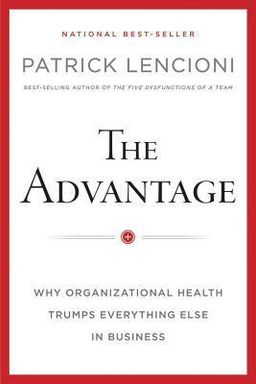
The Advantage cover

The Advantage

by Patrick M Lencioni

In ''The Advantage'', Patrick M. Lencioni reveals how organizational health trumps any other advantage in business. By fostering cohesive teams and embracing vulnerability, companies can achieve unparalleled success. This book guides leaders in transforming meetings and overcoming biases to build a thriving, competitive organization.

Organizational Health: The Ultimate Competitive Advantage

Have you ever wondered why some organizations seem to hum with energy, loyalty, and seamless coordination—while others drown in politics, confusion, and burnout? Patrick Lencioni argues in The Advantage: Why Organizational Health Trumps Everything Else in Business that the difference has little to do with intelligence, strategy, or technology. The real differentiator, he says, is organizational health—a company’s ability to function as a whole, consistent system rooted in trust, clarity, and accountability.

Lencioni’s central claim is bold: the single greatest advantage any organization can achieve is organizational health. Yet most leaders ignore it because it seems too simple, intangible, or 'beneath them.' While businesses obsess over smart disciplines like finance, strategy, and marketing, they often neglect the health of the environment in which those strategies operate. The irony? Without health, intelligence doesn’t matter. A dysfunctional culture will crush even the most brilliant strategy.

The Cost of Poor Health

Unhealthy organizations are easy to recognize: endless politics, low morale, high turnover, and constant confusion. Lencioni describes these as expensive forms of corporate waste. They drain energy, kill innovation, and cause top performers to silently disengage. The cost is not merely financial—it’s emotional. When people experience chronic workplace dysfunction, they bring that stress home, affecting families and communities. In contrast, employees in healthy organizations experience alignment, belonging, and purpose. They show up with energy and return home fulfilled, creating a ripple effect beyond the office walls.

The Smart vs. Healthy Equation

Lencioni divides companies into two dimensions: smart and healthy. Smart organizations excel in strategy, marketing, finance, and technology—the measurable, analytical domains. Healthy organizations, on the other hand, have minimal politics and confusion, high morale and productivity, and low turnover. Most companies pour their resources into getting smarter, but few invest in becoming healthier. However, Lencioni insists, the smartest companies crumble when they’re unhealthy, while healthy ones inevitably become smarter over time because collaboration replaces politics and learning accelerates.

Healthy organizations are free from dysfunction, not because they’re perfect, but because they embrace honest conversations and operate from shared values. They make fewer unforced errors, recover faster from mistakes, and attract people who want to stay. In this way, health acts as a multiplier of intelligence: it amplifies a company’s brainpower by removing internal friction. By contrast, even brilliant minds get bogged down in mistrust and miscommunication in an unhealthy workplace.

Why Leaders Resist Health

Despite its transformative power, organizational health remains neglected because of three common biases:

  • The Sophistication Bias: Leaders assume that big, complex problems demand sophisticated solutions. Health seems too simple, too soft, too unmeasurable to matter.
  • The Adrenaline Bias: Many executives are addicted to busyness and firefighting. Slowing down to build trust or clarify purpose doesn’t feel urgent, even though it’s crucial.
  • The Quantification Bias: Health’s benefits—like trust or engagement—are hard to measure with spreadsheets, so data-driven leaders overlook them.

The result? Leaders keep 'looking for their keys under the streetlight,' as Lencioni puts it, focusing on what can be easily measured rather than what truly matters. They polish their strategies but ignore the murky interpersonal work that actually drives execution.

The Four Disciplines of Organizational Health

Lencioni’s model for achieving organizational health rests on four interlocking disciplines:

  • Discipline 1: Build a Cohesive Leadership Team – A dysfunctional executive team infects the entire company. Cohesion begins with trust, productive conflict, commitment, accountability, and collective results—the same themes explored in Lencioni’s classic The Five Dysfunctions of a Team.
  • Discipline 2: Create Clarity – Leaders must agree on six critical questions (Why do we exist? How do we behave? What do we do? How will we succeed? What’s most important right now? Who must do what?). Alignment around these answers eliminates confusion.
  • Discipline 3: Overcommunicate Clarity – Once clarity is established, leaders must repeat it constantly, using cascading communication throughout the organization until every employee can articulate it.
  • Discipline 4: Reinforce Clarity – Finally, systems like hiring, performance reviews, compensation, and recognition must embed the organization’s core values and priorities into daily operations.

These disciplines reinforce one another. A cohesive leadership team builds alignment; alignment makes communication effective; communication sustains culture; and culture preserves clarity over time. Together, they form a loop that transforms organizations from the inside out.

Why Organizational Health Matters Now

In an age of constant disruption, technical advantages disappear quickly. Competitors can copy your strategy, hire similar talent, or adopt new technology. What they can’t easily replicate is a healthy culture—a team that trusts one another, debates issues without fear, and moves in unison toward shared goals. Lencioni concludes that organizational health isn’t just a moral or cultural luxury—it’s the last remaining competitive advantage that lasts.

If you’re a leader, manager, or change agent, the challenge is to recognize that health requires as much rigor as any business discipline. It’s not about being nicer—it’s about being clearer, braver, and more consistent. By the end of Lencioni’s framework, you’ll see how creating trust, clarity, and accountability can turn any company—from a family business to a Fortune 500 enterprise—into a place where people thrive and performance soars.


Building a Cohesive Leadership Team

Lencioni begins with the foundation: if the leadership team at the top is not cohesive, no amount of strategy or cultural rhetoric will matter. Like parents in a family, dysfunctional executives produce organizational dysfunction downstream. Healthy teams, by contrast, model trust and alignment that cascades throughout every department.

Trust: The Foundation of Teamwork

The kind of trust Lencioni advocates goes beyond reliability (“I know you’ll do what you say”). It’s vulnerability-based trust—the courage to say, “I was wrong,” or “Your idea is better than mine.” He encourages teams to get past formal masks through personal storytelling and profiling exercises. For instance, in one story, an executive’s colleagues only began to understand his frugality after learning he grew up in severe poverty. That empathy dissolved resentment and changed how they worked together.

To develop vulnerability, leaders must go first. Lencioni recalls watching a CEO sabotage trust by refusing to admit weaknesses revealed in a survey—teaching his team that honesty was unsafe. In contrast, leaders who model humility invite open dialogue and loyalty that no employee handbook can command.

Mastering Conflict

Once trust is established, conflict becomes a tool for truth. Most teams avoid it, mistaking politeness for harmony. But Lencioni insists that conflict about ideas, not people, is essential. Teams that argue with passion about what matters make smarter decisions faster. He distinguishes productive ideological conflict from destructive personal conflict and offers tools like “mining for conflict” (intentionally uncovering disagreement) and “real-time permission” (affirming that heated debate is a sign of commitment, not disrespect).

For instance, a division VP once instructed his team that silence in a discussion would be treated as disagreement—forcing people to contribute honestly instead of nodding along. Though uncomfortable at first, the rule led to better decisions and greater respect among colleagues.

Achieving Commitment

When every voice is heard during conflict, alignment follows. Lencioni highlights Intel’s mantra of “disagree and commit”: even when people don’t share the same opinion, they unite around a decision once it’s made. Passive agreement—the quiet smile and later sabotage—is deadly. To prevent it, teams must clarify commitments at the end of meetings, ensuring everyone leaves with the same understanding. As one pharmaceutical company learned the hard way, failing to clarify who followed a new travel policy led to anger, inconsistency, and chaos.

Embracing Accountability

Accountability, the fourth behavior, means holding peers—not just subordinates—responsible. In healthy teams, teammates directly confront poor performance or behavior rather than tattling to the boss. Lencioni calls this the antidote to politics. He reminds leaders that confrontation is an act of love: helping someone improve shows you care enough to risk discomfort. Avoidance, by contrast, is selfish—it spares the confronter’s feelings but harms everyone else. During one exercise, a team gave each member feedback on one behavior that helped and one that hurt the group. What began awkwardly became liberating, re-energizing their collaboration.

Focusing on Results

The final behavior distinguishes truly cohesive teams: collective results trump individual success. Lencioni tells of a CIO who relocated her executives into the same building to remind them their first loyalty was to the enterprise, not to their separate departments. Once they saw themselves as one team, collaboration skyrocketed. “Team number one,” she called it—a simple phrase that transformed their culture.

From vulnerability to results, these five interconnected behaviors—trust, conflict, commitment, accountability, and focus—define Lencioni’s blueprint for leadership cohesion. Without them, no strategy or process can bring unity; with them, everything else becomes easier.


Creating Clarity Across the Organization

Once a leadership team is cohesive, it must align everyone else. Lencioni argues that confusion is the silent killer of both morale and productivity. Leaders must relentlessly reinforce clarity about why the organization exists, what it values, and where it’s headed. To achieve this, he proposes six deceptively simple questions whose answers eliminate ambiguity from top to bottom.

The Six Critical Questions

  • 1. Why do we exist? Clarify the organization’s ultimate purpose. Every company should make people’s lives better in some way, not just generate profits. For example, Southwest Airlines’ purpose is not “transportation” but democratizing air travel so anyone can fly.
  • 2. How do we behave? Identify two or three core values that define acceptable behavior. These values must be authentic, even costly. A company that insists on humor, for instance, may lose customers who dislike playful flight attendants—but those who stay will love the culture that humor creates.
  • 3. What do we do? Describe simply what the organization actually does. No jargon, no marketing fluff—just a literal statement like “We manufacture and sell hard drives.” It’s surprising how few leadership teams can state this with consensus.
  • 4. How will we succeed? Determine three strategic anchors—filters for every major decision. They might include craftsmanship, customer intimacy, or operational excellence. Lencioni’s example of a premium produce company shows this in action: when certain crops didn’t meet their quality standards, they sold them through different channels rather than dilute their brand.
  • 5. What is most important, right now? Set a single, unifying top priority, or “thematic goal,” for the next 3–12 months—such as “improve manufacturing reliability” or “launch our new digital platform.” Too many priorities means no priority.
  • 6. Who must do what? Define roles clearly so no critical responsibility falls through the cracks or is duplicated. Even small leadership teams should explicitly list responsibilities to avoid confusion.

The Playbook and the Power of Simplicity

When these answers are documented, they form a living “playbook” that guides decisions and behaviors at every level. Lencioni stresses conciseness—just two or three pages summarizing the answers, distributed and referenced constantly. Unlike glossy binders that gather dust, this playbook becomes the organization’s heartbeat. Leaders use it to evaluate hiring, strategy, and even hallway conversations.

Clarity, in Lencioni’s definition, is not about slogans on posters or mission statements carved in granite (which he hilariously compares to Dunder Mifflin’s meaningless one in The Office). It’s about giving everyone the same mental map, so there are no politics, no silos, and no confusion about what matters most.


Overcommunicating Clarity Until It Sticks

Once leaders establish clarity, they must repeat it constantly until every employee understands and believes it. Lencioni jokes that leaders should be 'Chief Reminding Officers.' Communication isn’t a one-time campaign—it’s a ritual of reinforcement. Where most companies fail is assuming that one speech or email equals understanding.

Cascading Communication

The most powerful communication process is cascading: every leadership meeting ends with the question, “What will we tell our teams?” Within 24 hours, each leader relays the same key messages to their direct reports—face-to-face, not via email—who then do the same. This method spreads clarity faster than any newsletter or intranet ever could. When a global software company adopted cascading communication, employees across continents were astonished to hear consistent messages from every region—a first in company history.

Repetition and Authenticity

Lencioni argues that repetition builds credibility. Employees don’t trust messages that change every quarter or sound like corporate theater. They trust consistency over time, spoken in human language. A healthcare CEO once transformed morale by simply sending a weekly email every Friday—authentic, brief, and personal—explaining decisions and progress. His transparency built trust faster than expensive communication campaigns ever had.

Avoiding the Communication Traps

Three traps constantly undermine clarity: leaders fear insulting employees by repeating themselves, they get bored of the same messages, or they delegate communication to middle management. But people need to hear consistent truths 'seven times, seven ways.' Clarity becomes culture only when spoken relentlessly across meetings, emails, and casual conversations.

As Lencioni reminds leaders, “The point of leadership isn’t to stay entertained—it’s to stay consistent.” Overcommunication is not overkill; it’s leadership in its most human form: ensuring everyone knows exactly why their work matters and how it fits into the whole.


Reinforcing Clarity Through Human Systems

Even with constant communication, clarity fades unless it’s baked into everyday systems—especially those involving people. The fourth discipline turns culture into structure by aligning hiring, onboarding, performance management, rewards, and even firing with the organization’s purpose and values. Lencioni calls this institutionalizing culture without bureaucratizing it.

Hiring and Cultural Fit

Hiring is the first and most important filter for health. Lencioni advocates balancing structure and intuition: clear definitions of core values combined with human judgment. The best organizations hire for attitude first, skills second. He tells of a company that asked interviewees to wear khaki shorts with their suit jackets to test humility—a simple way to identify cultural fit. Those who refused to play along never would’ve thrived there anyway.

Orientation and Performance Management

Onboarding should inspire, not bore. Instead of starting with benefits paperwork, new hires should learn why the organization exists, how it behaves, and what success looks like. Managers reinforce those principles through simple, conversational performance reviews that focus on clarity and feedback—not legal protection. Overly complex HR systems, Lencioni warns, often become bureaucratic shields that sap meaning from the work.

Rewards, Recognition, and Firing

Money matters, but appreciation matters more. Real-time praise and gratitude, delivered personally, cost nothing and do more to inspire commitment than bonuses ever could. Lencioni describes an executive team who stopped a meeting to invite a junior employee in and thank her for embodying company values. The moment electrified the culture. Conversely, leaders must have the courage to remove people who don’t fit the values—even high performers. Keeping a toxic star undermines everything the company claims to believe.

From hiring to firing, every human system should reinforce the answers to Lencioni’s six critical questions. When culture becomes the default operating system—not a poster—clarity and accountability sustain themselves long after leadership meetings end.


Meetings: The Center of Organizational Life

Lencioni shocks many readers by declaring that no activity is more central to organizational health than the meeting. Far from being corporate drudgery, great meetings are where relationships are forged, values are lived, and clarity is maintained. Bad meetings, however, are 'the birthplace of unhealthy organizations.' His book Death by Meeting expands this idea, but here he distills it into a structure any team can adopt.

The Four Types of Meetings

  • Daily Check-ins (10 minutes): Quick stand-up updates on schedules or immediate issues. No chairs, no agendas—just coordination to prevent email chaos.
  • Weekly Tactical Meetings (45–90 minutes): Focused discussions on short-term priorities. Agendas form in real-time by reviewing key goals, assessing them as green/yellow/red, and addressing what’s red.
  • Ad Hoc Strategic Meetings (2–4 hours as needed): Deep dives into major topics like competitive threats or product shifts. These are thoughtful, high-energy sessions where teams wrestle with the big questions that usually get crammed into weekly meetings.
  • Quarterly Off-Site Reviews (1–2 days): Step back from execution to reflect on the organization’s trajectory, culture, and industry landscape. It’s also the time to reaffirm trust and clarity among leaders.

From 'Meeting Stew' to Productive Rhythm

Most companies dump every topic into one bloated 'staff meeting,' what Lencioni calls 'meeting stew.' By separating tactical from strategic discussions, each meeting gets purpose and energy. A team that follows this rhythm might spend 12% of their working hours in meetings—but eliminate hours of confusion, miscommunication, and rework. As one 58-year-old church executive told Lencioni, “I never thought having more meetings would make us more productive—but it did.”

In healthy organizations, meetings are not interruptions—they’re where alignment, energy, and accountability are renewed. The healthiest leaders don’t just tolerate meetings; they master them.


Leading the Charge Toward Organizational Health

Ultimately, organizational health rises and falls with the leader’s courage. Lencioni ends with a powerful truth: building a healthy organization is simple but not easy. It demands humility, persistence, and personal sacrifice. The leader must do what’s uncomfortable—be vulnerable, hold people accountable, confront division, and repeat messages until they stick. These aren’t soft skills; they’re the hard work of leadership.

The Leader’s Sacrifice

Lencioni warns that leaders can’t delegate health to HR or consultants. They must personally go first—sharing weaknesses, insisting on behavioral alignment, and living the organization’s core values with relentless consistency. As one CEO put it bluntly, “I am our culture’s ceiling. If I fake vulnerability, everyone else will too.” Healthy organizations require leaders willing to trade ego for effectiveness.

The Ripple Effect

Beyond profits, Lencioni argues, organizational health changes lives. When people leave work energized instead of drained, families and communities thrive. You can feel the difference between an organization where employees whisper complaints in hallways and one where they speak openly and laugh together. Healthy workplaces create human healing at scale—and that, Lencioni insists, is leadership’s most noble purpose.

If you’re leading—or influencing—any group of people, Lencioni’s message is simple: health is not a perk; it’s your job. Build trust. Clarify purpose. Repeat relentlessly. Institutionalize what matters. Do that, and you won’t just run a better organization—you’ll help people become more fulfilled versions of themselves.

Dig Deeper

Get personalized prompts to apply these lessons to your life and deepen your understanding.

Go Deeper

Get the Full Experience

Download Insight Books for AI-powered reflections, quizzes, and more.