
Idea 1
Making Achievement a Habit
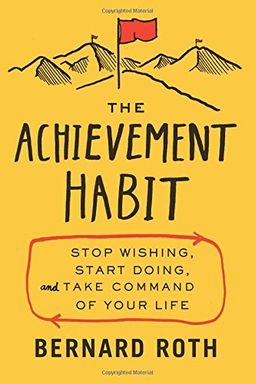
How can you turn intention into consistent action? In The Achievement Habit, Stanford professor Bernard Roth—cofounder of the university’s d.school—argues that achievement isn’t about talent or luck; it’s about learning to act. Roth contends that most people fail not because they lack skill or desire but because they rely on excuses, reasons, and passive language that distance them from action. His message is clear: if you want to live a more fulfilled life, you must learn the difference between trying and doing.
Over his five decades teaching engineering and design thinking, Roth noticed that many high-potential students and professionals never pursued their dreams. They had good ideas but waited for perfect conditions. This book grew out of his famous Stanford course, “The Designer in Society,” where he helps students design their own lives with the same principles used to design innovative products.
From Design Thinking to Life Design
Roth adapts the design thinking process—a framework for creative problem-solving—to help you approach your personal and professional goals. The process involves five stages: empathize, define, ideate, prototype, and test. Rather than just thinking about problems, you repeatedly create and test solutions, learning from what works and what doesn’t. In life, this means acting first and reflecting later—treating your choices as experiments instead of permanent commitments.
The insight that life can be prototyped is liberating. If something doesn’t work, you can redesign it. This mindset moves you from paralysis to progress, encouraging you to focus on action, feedback, and learning rather than perfection.
Why Excuses and Reasons Are “Bullshit”
Roth is refreshingly blunt: most reasons people give for not doing something—time, money, fear, other people—are lies we tell ourselves. “Reasons are bullshit,” he says, because they make us feel rational even when we’re avoiding responsibility. In his classes, students learn to stop using reasons and instead focus on whether they truly want to act.
Through interactive exercises, Roth teaches that you are the main obstacle between yourself and your goals. Your parents, boss, or environment may pose challenges, but it’s your own habits of thought that truly hold you back. This perspective can be shocking, but it’s also empowering—because it means you have the power to change.
Changing Language, Changing Life
One small yet powerful dimension of Roth’s method is language. The words you use shape how you think and behave. Subtle shifts—from “I have to” to “I want to,” from “I can’t” to “I won’t,” or from “but” to “and”—can change your sense of agency. “I have to go to work” sounds like duty; “I want to go to work,” by contrast, reaffirms your choice. Language becomes a design tool for the mind.
Bias Toward Action
Roth’s core teaching is the bias toward action—a preference for doing rather than thinking. This idea transforms ambitions into tangible outcomes. His students have started companies, written books, mended relationships, and overcome fears not through plans but through prototypes of action—small steps that made achievement habitual. As one example, a student terrified of swimming learned to swim, then learned Italian, then changed her career—all after realizing she could train her “achievement muscle.”
The book blends inspiring student stories, psychological insights, and hands-on exercises. Each chapter systematically dismantles excuses and builds in their place tools to expand possibility—showing that achievement, like a muscle, grows stronger with use. The goal isn’t to be perfect or fearless; it’s to develop habits of doing that make progress inevitable.
Ultimately, Roth wants you to see yourself not as a static personality but as a designer of your own life. With empathy, experimentation, and persistence, you can reshape your behaviors, relationships, and environment. The Achievement Habit is not about success as external validation—it’s about living intentionally, closing the gap between what you say you want and what you actually do. If you can design a chair, a building, or an app, you can design a meaningful life. The only catch, Roth insists, is that you actually have to start.