
Idea 1
Be Brilliant at a Moment’s Notice
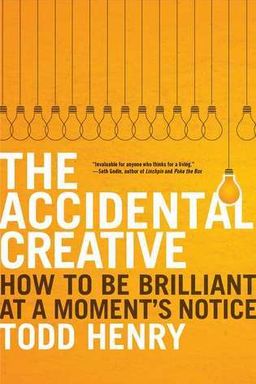
Have you ever felt the pressure to come up with a great idea on demand—to be creative instantly, even when your mind feels blank? In The Accidental Creative, Todd Henry argues that brilliance isn’t an act of luck or inspiration—it’s the result of structure, discipline, and rhythm. His central message is that those who create for a living, whether writers, designers, managers, or strategists, must learn to cultivate creativity intentionally, not accidentally. Henry contends that the myth of effortless creativity is dangerous because it leads to burnout, mediocrity, and frustration. Instead, creative professionals must install purposeful practices—habits and structures that allow them to be “brilliant at a moment’s notice.”
Drawing from his coaching with both artists and executives, Henry explains that sustained creativity isn’t about waiting for inspiration or turning on the pressure when a deadline looms. It’s about building a rhythm that continuously feeds your creative energy. The book centers on a framework encompassing five key dynamics—Focus, Relationships, Energy, Stimuli, and Hours—collectively forming what he calls a “Creative Rhythm.” Through this system, Henry shows how to manage the everyday pressures of the “create-on-demand” world by cultivating conditions that make creativity a natural byproduct of daily living.
The Create-On-Demand World
Henry begins by diagnosing the unique pressures of what he calls the create-on-demand workplace. Whether you’re solving business challenges or writing copy, your success depends on your ability to generate value through ideas. Unlike traditional work measured in hours or units, creative work is judged by insight and impact. This can lead to what he calls the “perpetual work syndrome”—the inability to switch off. The mind becomes your greatest tool, but also your greatest vulnerability. The workplace myth, Henry observes, is that more effort equals more creativity, but in reality, staring harder at a problem rarely leads to breakthrough ideas. Creativity has rhythm; it ebbs and flows. To ignore this rhythm is to court burnout.
Prolific, Brilliant, and Healthy
Henry distills the definition of a successful creative life into three overlapping goals: being prolific (consistently productive), brilliant (producing quality ideas), and healthy (maintaining long-term sustainability). He notes that most creatives manage to balance only two of these. Those who are prolific and brilliant but not healthy eventually burn out; those who are healthy and brilliant but not prolific become unreliable; those who are prolific and healthy but not brilliant risk irrelevance. The sweet spot—doing great work consistently and sustainably—requires purpose and systemization.
To illustrate, Henry profiles “Amos,” a fictional composite of his clients—a capable manager struggling to find time to think creatively amid meetings, emails, and organizational chaos. Amos’s story echoes the plight of countless professionals: creativity gets squeezed out by busyness. Henry argues that without controlling the conditions that feed imagination, no amount of passion or overtime can yield consistent brilliance. This insight serves as motivation for the rest of the book: reclaim control through rhythm.
The Five Dynamics of Rhythmic Creativity
Henry’s framework yields five essential areas of discipline—F-R-E-S-H:
- Focus: Learning to zero in on what’s truly critical rather than reacting to every stimulus.
- Relationships: Building intentional connections that shape, challenge, and refine your creative ideas.
- Energy: Managing your physical, mental, and emotional reserves to sustain engagement.
- Stimuli: Curating the inputs you feed your mind—the raw material of creativity.
- Hours: Structuring your time to protect the space for idea generation and personal expression.
These five areas, Henry explains, function like interconnected gears. Weakness in one disrupts them all. For instance, poor energy habits lead to shallow focus, which undermines productivity and increases stress. Mastery requires deliberate practices in each area, supported by regular checkpoints—weekly, monthly, and quarterly reviews that act as creative tune-ups.
Rhythm vs. Formula
A central distinction Henry makes—echoing Orson Welles’s saying that “the enemy of art is the absence of limitations”—is between structure and formula. Creative rhythms provide stability without prescribing results. A formula demands predictable outcomes; rhythm allows flexibility and flow. This is why, paradoxically, structure frees rather than constrains creativity. Just as jazz musicians thrive within key signatures and time signatures, creative professionals flourish when they build regular practices that focus their energies.
Why It Matters
Henry’s thesis resonates far beyond art studios or advertising firms—it applies to anyone who must use their mind to create value. In a world that prizes always-on productivity, creative workers risk becoming machines generating predictable mediocrity. The alternative isn’t stepping away from work but re-engineering the way we engage with it. By aligning with our natural rhythms, we create sustainably, produce prolifically, and live fully.
“Your best work is ahead of you,” Henry insists. “The key is preparation, not pressure.”
Through the rest of the book, Henry shows how to resist the “assassins of creativity” (fear, dissonance, and unrealistic expectations) and install the daily rituals that protect creative energy. By the end, you see that being an “accidental creative” isn’t about stumbling into genius—it’s about designing a life that makes genius inevitable.