
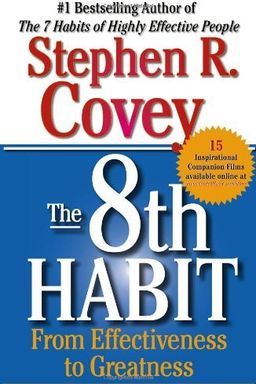
The 8th Habit cover

The 8th Habit

by Stephen R Covey

The 8th Habit by Stephen R. Covey empowers you to discover your inner voice, leading to a more fulfilled life. Learn to inspire others, embrace change, and build trust for personal and professional greatness in today''s evolving world.

The 8th Habit: From Effectiveness to Greatness

Stephen Covey’s The 8th Habit extends his classic 7 Habits of Highly Effective People from personal effectiveness to personal and organizational greatness. Where the first book taught you how to be efficient and proactive within established systems, this one challenges you to awaken the human spirit—to find your unique voice and inspire others to find theirs. Covey argues that success in the modern Knowledge Worker Age comes not from control but from liberating potential. Greatness is no longer about management mechanics; it’s about moral authority, service, and conscience-led contribution.

The Core Idea: Finding Your Voice

Covey defines your "voice" as the intersection of four realities: talent, passion, need, and conscience. When those four converge, you uncover your purpose—the work that aligns who you are with what the world genuinely needs. Muhammad Yunus and the Grameen Bank illustrate this: his small act of lending $27 to impoverished women in Bangladesh became a multibillion-dollar microfinance system that restored dignity and self-reliance to millions. (Note: Like Viktor Frankl’s existential psychology, Covey’s message rests on meaning—your unique calling within service to others.)

From Industrial Age to Knowledge Worker Age

Covey connects finding voice to a paradigm shift. The Industrial Age treated people as things to be managed—bodies in a production line. But in the Knowledge Worker Age, people’s minds, hearts, and spirits are the true assets. Old control systems produce compliance; the new Whole-Person Paradigm seeks commitment. Your leadership must honor four intelligences: physical (PQ), mental (IQ), emotional (EQ), and spiritual (SQ). Neglect any one of them and you reduce people to tools rather than creators. Studies like the xQ survey show the cost—only a fraction of employees understand their organization’s goals or feel trusted to act.

Birth-Gifts and Moral Choice

Every person is endowed with three birth-gifts: the freedom to choose, the guidance of principles, and the potential within four intelligences. Between stimulus and response lies the space for choice—that’s where personal growth and freedom begin. Living by timeless principles like fairness, honesty, and respect gives your choices moral power. Developing each intelligence through practice—exercise for PQ, study for IQ, empathy for EQ, reflection for SQ—creates balance and resilience. The more you nurture these, the stronger your capacity to lead yourself and others ethically.

Expressing Voice Through Leadership

Finding voice is internal work; expressing voice is external leadership. Covey defines expression through four dimensions: vision (mental imagination), discipline (physical execution), passion (emotional drive), and conscience (spiritual guidance). Vision and passion without conscience can lead to destructive power—history proves this. Discipline makes vision real, and conscience ensures it serves rather than manipulates. Yunus’s Grameen example again demonstrates balance: disciplined systems, passionate purpose, and moral compass aligned to lift others. Your task is similar—unite your intelligences into action that both succeeds and dignifies.

Leadership as Moral Authority

Covey divides leadership into two kinds of authority: formal (positional power) and moral (influence earned by character). True greatness depends on moral authority—trustworthiness anchored in service. Examples like Gandhi, Kim Dae-Jung, and Horst Schulze show that humility, honesty, and conscience persuade far more powerfully than command. Moral authority institutionalizes great leadership even beyond individuals; it becomes the culture. When you align systems and structures with principles, you ensure that ethical behavior is the easiest path, not the hardest.

The New Leadership Challenge

Covey concludes that the 8th Habit is not merely another step but a new era in human contribution. It asks you to treat yourself and others as whole persons—to design workplaces, families, and communities where human potential thrives naturally. You lead not by force or cleverness but by example, empathy, and system-wide integrity. Finding and expressing voice transforms everyday transactions into acts of significance, shifting entire institutions from compliance toward inspired cooperation—the path from effectiveness to greatness.

Core takeaway

Greatness grows where talent meets conscience, passion serves need, and discipline makes vision reality. Your work is not to manage people or efficiency—it’s to awaken voice, in yourself and in others.


The Whole-Person Paradigm

Covey’s Whole-Person Paradigm begins with a radical redefinition of people. You are not a 'human resource'; you are a whole human being with four interconnected dimensions—body, mind, heart, and spirit. The modern organization can thrive only when it recognizes these four facets as sources of creativity and motivation.

From 'Thing' Mindset to Human Potential

The old 'thing' mindset came from the Industrial Age, where people were treated as interchangeable labor. Management was control and compliance. Covey traces this thinking through carrot-and-stick incentives, centralized hierarchies, and accounting systems that classify people as costs. That model may generate short-term efficiency but destroys long-term innovation and engagement.

Four Intelligences in Action

Each human dimension has a corresponding intelligence: PQ (physical), IQ (mental), EQ (emotional), and SQ (spiritual). PQ enables energy and discipline; IQ offers insight and planning; EQ builds empathy and relationships; SQ provides purpose and conscience. Developing all four makes people self-motivated rather than controlled. Neglect one and you create imbalance—disengaged bodies, unchallenged minds, ignored feelings, or hollow spirits.

Leadership Applications

In the workplace, the Whole-Person Paradigm reshapes everything: compensation systems that reward contribution rather than obedience; collaborative strategy sessions that engage minds and hearts; cultures of trust built on consistent principle-centered modeling. Leaders must design for voluntary greatness—aligning each person’s gifts with organizational purposes. Covey’s statistics reveal how few organizations achieve this: only a small fraction of employees understand core goals or feel empowered to act. Shifting the paradigm is not optional; it’s vital to survival in the Knowledge Worker Age.

Practical Reflection

Begin by asking: which dimension of yourself or your team do you neglect? Rebalance by honoring all four—body with wellness routines, mind with learning, heart with genuine relationships, spirit with purpose. As you do, creativity returns, trust grows, and your organization begins to operate from internal conscience instead of external control.

Key principle

Treat people as whole persons, not parts. When body, mind, heart, and spirit align, individuals choose greatness voluntarily, and organizations unlock their hidden potential.


Choice, Principles, and Intelligence Growth

Covey teaches that you are born with three priceless gifts: freedom to choose, natural principles that organize life, and four intelligences that give you power to learn and lead. Every act of greatness begins in these foundations.

Freedom to Choose

Between stimulus and response lies your freedom. Covey recounts reading three lines that changed his life—recognizing that human choice, not circumstance, determines destiny. When you pause and respond from values rather than reaction, you expand your Circle of Influence and earn trust. He illustrates this with an HR director who shifted from fear to empathy with a harsh boss, transforming their relationship and his career. Choice is the heartbeat of leadership.

Natural Principles

Principles—fairness, honesty, respect—are timeless laws akin to gravity. Violating them eventually brings pain, no matter appearances. Covey contrasts values (personal preferences) with principles (objective truths). Living by principle builds moral authority; ignoring principle breeds distrust even when you win temporarily. This is what he calls the law of the harvest—you reap integrity only through consistent sowing.

Growing Four Intelligences

PQ trains your discipline and physical stewardship (exercise as if your heart were already challenged). IQ grows through relentless learning—professionally and personally. EQ strengthens through empathic listening and thoughtful feedback. SQ cultivates meaning through reflection and conscience—what makes you choose good even when easy options tempt. Covey likens SQ to the compass that directs all others; when SQ leads, the whole person becomes integrated rather than divided between ethics and ambition.

Daily Practice

Treat these gifts as muscles: exercise them. Use Habits from Covey’s earlier work—proactivity (choice), principle-centered decision making, and synergistic problem solving—to strengthen freedom. When you engage all intelligences daily, you develop not just effectiveness but conscience-guided greatness.

Core insight

The space between stimulus and response is your power. Exercising choice through principle and fully developed intelligence transforms reaction into creation.


Expressing Voice Through Vision and Conscience

Once you have found your voice, you express it through four capabilities that reflect the four intelligences: vision (IQ), discipline (PQ), passion (EQ), and conscience (SQ). Together they form the anatomy of inspired leadership.

Vision

Vision is imagination organized toward purpose. It is the mental picture of a better reality and the courage to design steps toward it. Covey highlights George Washington and Nelson Mandela—leaders who saw possibilities their time could not yet see. You can cultivate vision by crafting personal and organizational mission statements, writing down what 'better' looks like, and sharing these visions to anchor daily decisions.

Discipline

Discipline is the physical manifestation of commitment—doing hard things routinely. Covey quotes Albert E.N. Gray: success belongs to those who form the habit of doing what failures refuse to do. Execution demands facing brute facts, like Yunus tracking every loan repayment meticulously. Discipline bridges the dream and reality. Think of it as moral muscle; without discipline, vision stays theory.

Passion

Passion is emotional fuel—not just excitement but sustained commitment. It arises where talent meets high purpose. Covey’s story of Stone in Uganda illustrates passion’s power: an injured athlete transformed private pain into public mentorship, creating community renewal. Passion converted adversity into contribution. It’s what keeps you working even when progress is invisible.

Conscience

Conscience is the spiritual governor—it decides not only what you pursue but how. Vision, discipline, and passion without conscience can result in destructive greatness. Covey contrasts moral influence (Gandhi, Mother Teresa) with narcissistic power (Hitler). Your conscience transforms achievement into significance and ensures your methods honor your ends. Ask daily: does my discipline serve humanity? Does my passion respect truth?

Takeaway

Expressing voice is living vision with discipline, fueled by passion, and bounded by conscience. Only through this integration can you build influence that transforms lives, not just results.


Trust and Synergy

Covey calls trust the central currency of leadership. Without it, talent hides; with it, collaboration soars. He offers practical models like the Emotional Bank Account and the Talking Stick to teach how to build, repair, and expand trust into synergy—the creative harmony where two or more people produce results superior to what either could imagine alone.

Building Trust

Trust rests on two foundations: character (integrity, maturity, abundance mentality) and competence (skill, reliability, and teamwork). Both must exist. Covey’s example of a bank president whose affair shattered morale shows how character failures erode trust faster than competence can replace them. Rebuilding begins with apology and proven consistency.

Emotional Bank Account

Every relationship has an emotional account whose balance determines cooperation. Deposits include keeping promises, understanding others first, showing kindness, and loyalty in absence. Withdrawals include betrayal, broken commitments, and disrespect. Frequent, small deposits compound into massive trust reserves that survive unavoidable errors.

Synergistic Communication

When trust is high, synergy appears—creative cooperation that produces Third Alternatives better than anyone’s original idea. Covey’s Indian Talking Stick ritual embodies empathic listening: speak only when you can restate the other person’s view to their satisfaction. In business conflict, family tension, or cross-cultural negotiation, this disciplined empathy transforms debate into innovation. His South African 'Street Hawkers' case shows synergy turning conflict into shared prosperity: listening humanized both sides and produced mutual security.

Daily Application

Track your relationships like ledgers. Ask: have I listened deeply? have I kept promises? have I apologized when wrong? When trust grows, creativity doubles. Synergy is not a miracle—it’s the compound interest of trust.

Principle

Trust invites synergy, and synergy unlocks greatness. Your leadership lives or dies at the level of trust you nurture daily.


Leadership Roles and Directed Autonomy

Great leadership expresses voice through four interdependent roles: modeling, pathfinding, aligning, and empowering. Covey integrates them into a framework for moral and organizational transformation—from personal example to institutional clarity and freedom.

Modeling

Modeling is ground zero for trust. You cannot inspire what you don’t live. Horst Schulze at Ritz-Carlton exemplifies modeling: he built an extraordinary culture on the principle of dignity—"ladies and gentlemen serving ladies and gentlemen"—and twice won the Malcolm Baldrige award. Modeling converts values into behavior others can follow safely.

Pathfinding

Pathfinding transforms modeling into shared direction. It’s how mission, strategy, and values unite into collective priorities. Covey’s 'Hedgehog' idea from Jim Collins—where passion, competence, and economic engine intersect—defines sustainable pathfinding. Co-create vision statements and goals; avoid the 'off-site PR' syndrome where plans are announced but never owned.

Aligning

Aligning means designing systems that reward the right behavior. The Bermuda travel incentive story demonstrates misalignment: rewarding a single winner bred competition. Redesigning rewards for many winners fostered cooperation and raised results dramatically. Aligning institutionalizes moral authority—it makes principle-driven action automatic.

Empowering

Empowering completes the sequence. After modeling, pathfinding, and aligning, you grant directed autonomy—freedom bound by shared purpose and clear scoreboards. Win-win agreements set expectations, guidelines, and accountability. Family and workplace stories demonstrate success: children managing their mornings, janitors transforming operations. Empowerment without foundation equals abdication; empowerment built on trust equals greatness.

Trim-Tab Leadership

Covey uses the 'trim-tab' metaphor—a small rudder that changes a ship’s course—to describe moral influence. Modest, principle-based initiatives within your Circle of Influence can shift cultures over time. Leaders on the USS Santa Fe saying 'I intend to...' showcase initiative that pushes responsibility downward and trust upward.

Leadership essence

Model principle-centered behavior, find shared vision, align incentives with values, and then empower people with freedom guided by conscience. This progression institutionalizes greatness.


Moral Authority and Servant Leadership

In the final stage, Covey returns to the heart of ethical leadership—moral authority. He distinguishes primary greatness (character and conscience) from secondary greatness (position, wealth, fame). True leadership, he argues, stems not from titles but from service, humility, and sacrifice.

Primary vs. Formal Authority

Primary greatness grows through integrity and the willingness to serve others. Formal authority merely comes with organizational charts. The paradox: the more you avoid coercive power, the more influence you earn. Gandhi led a nation without position; Joshua Chamberlain led a regiment with courage and compassion that inspired devotion. Their authority was moral, not structural.

Institutionalizing Moral Authority

Covey insists that systems must embed morality to survive leadership cycles. Marriott, Ritz-Carlton, and national constitutions prove that principle-centered institutions endure beyond personalities. Leaders must design structures where ethics are routine, not optional.

Servant Leaders in Action

Servant leaders lift people rather than direct them. Kim Dae-Jung in South Korea, or community police who build trust through authenticity, demonstrate how moral strength bonds communities. Their success comes from consistency, empathy, and moral clarity practiced publicly and privately.

Cultivating Moral Authority

  • Live your principles openly; hypocrisy kills trust faster than mistakes.
  • Choose service over self; sacrificial choices earn lasting respect.
  • Build ethical systems so good habits outlast leaders.

Covey’s closing vision extends beyond personal success: a transition from the Knowledge Worker Age into an Age of Wisdom—where institutions and individuals operate by conscience, creativity, and compassion. Moral authority becomes civilization’s strongest asset.

Dig Deeper

Get personalized prompts to apply these lessons to your life and deepen your understanding.

Go Deeper

Get the Full Experience

Download Insight Books for AI-powered reflections, quizzes, and more.