
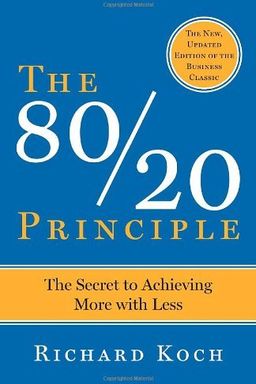
The 80/20 Principle cover

The 80/20 Principle

by Richard Koch

The 80/20 Principle reveals how 80% of results come from just 20% of efforts. Delve into strategies that enhance productivity, business efficiency, and personal happiness by focusing on what truly matters. Discover how to apply this transformative principle to various aspects of life for maximum impact.

The Power of the 80/20 Principle

Have you ever wondered why a handful of your efforts seem to create most of your results? Why a few clients, tasks, or habits deliver the biggest impact while everything else feels like noise? In The 80/20 Principle: The Secret of Achieving More With Less, entrepreneur and author Richard Koch argues that the universe—and your life—runs on a hidden pattern of imbalance. He calls it the 80/20 Principle: roughly 80 percent of outcomes come from 20 percent of causes. By understanding and harnessing this pattern, Koch claims, you can radically increase productivity, wealth, and happiness—often while working less and enjoying more.

Koch’s central contention isn’t just that this principle works in business; it’s that it works in everything. Drawing first from Italian economist Vilfredo Pareto’s 1897 discovery that 80 percent of Italy’s wealth was owned by 20 percent of its people, he extends the idea from economics into everyday life: relationships, time, creativity, and even happiness. His argument is bold but practical—if you can identify the vital few factors that truly make a difference, and stop wasting effort on the trivial many, you can multiply results with less stress. The 80/20 Principle, Koch says, is not a tool—it’s a lens for seeing reality differently.

From Pareto to Practical Mastery

Koch begins by tracing Pareto’s discovery from its roots in wealth patterns to the realization that imbalance is natural and everywhere. He shows that 20 percent of criminals commit 80 percent of crimes, 20 percent of roads create 80 percent of traffic jams, and 20 percent of computer code consumes 80 percent of processing time. The point isn’t exact numbers; it’s the systemic skew where a few forces dominate most outcomes. He tells how IBM engineers used the principle in the 1960s to streamline their mainframes—the company discovered that 80 percent of computer time came from 20 percent of code and focused improvements there, massively increasing performance. Soon, tech pioneers like Apple and Microsoft leveraged the same insight to build simpler, faster systems for ordinary users.

Efficiency Meets Elegance

At one level, Koch’s book is a manual for efficiency—how to achieve more while escaping overwork. He helps readers see where most effort is wasted: chasing mediocre clients, dealing with low-value tasks, or treating all opportunities as equal. But, he adds, the beauty of the principle is not just in productivity—it is in freedom. By freeing yourself from unnecessary 80 percent efforts, you gain time for the vital 20 percent—work that excites you, relationships that matter, and habits that genuinely enrich your life. Koch calls this “working less, earning more, and enjoying more.” In later chapters like “Work Less, Earn and Enjoy More,” he reframes 80/20 as not a tool of corporate optimization but a philosophy of living lightly and creatively.

The Yin and Yang of Progress

Koch also unveils the principle’s deeper, almost mystical side. He connects the idea to chaos theory—the scientific understanding that small causes create huge effects through nonlinear feedback loops—and sees the 80/20 Principle as nature’s way of expressing that imbalance. Feedback loops, "tipping points," and self-organizing systems explain why success breeds success (“the rich get richer”) and why small innovations—like Ford’s assembly line or a single hit movie—can reshape entire industries. In Koch’s words, “A few forces always try to grab more than their fair share of resources.” Yet he insists this doesn’t make the world unfair; it makes it opportunistic. If you can spot those powerful 20 percent forces, you can ride them instead of fighting chaos.

Why This Idea Matters Now

Koch’s vision resonates deeply in an age of overload. Between infinite choices and constant busyness, many people mistake activity for achievement. The 80/20 lens offers clarity: stop spreading effort thin; magnify the few things that matter. The principle appeals both to logical efficiency seekers and to those craving simplicity, minimalism, and meaning—the “yin and yang” Koch describes between hard productivity and soft life enhancement. In the book’s final chapters, he urges readers to become “lazy but intelligent,” focusing energy on high-impact causes and eliminating the rest. It’s not about doing everything faster—it’s about doing less, better.

Through business examples like Ford, IBM, and consulting firms, and personal ones from his own career and investments, Koch shows that when you concentrate effort on the vital few inputs, value explodes—whether it’s profits, creativity, or joy. Ultimately, The 80/20 Principle argues that success isn’t democratic—it’s asymmetric. And once you accept that imbalance, you can stop chasing equality of effort and start designing a life where the right few actions produce most of what you want. That, Koch insists, is the secret of achieving more with less.


How to Think 80/20

Koch insists that you can’t use the 80/20 Principle unless you learn to think 80/20. It’s both analytical and intuitive—a mental shift to recognize that causes and results are rarely balanced. You stop assuming that effort equals reward; instead, you ask constantly, “What few things drive most outcomes?”

80/20 Analysis vs. 80/20 Thinking

The author distinguishes two complementary methods. 80/20 Analysis is quantitative—you collect real data and chart how inputs relate to outputs, like which clients generate most of your revenue or which projects consume most of your time. Koch illustrates it with everyday examples: when 20 percent of beer drinkers consume 70 percent of the beer, or when 20 percent of a company’s products generate 80 percent of its profit. Analysis gives you proof and clarity but requires effort and data. In contrast, 80/20 Thinking is intuitive and fast. Instead of measuring everything, you use experience and imagination to guess which few actions matter most. Koch writes, “You can then act on the insight.” It’s less precise but far more practical for daily life.

Why Conventional Wisdom Fails

Most people are trapped in what Koch calls the 50/50 fallacy—believing that all tasks and people contribute equally. That mindset breeds fairness but kills productivity. He gives vivid examples: executives assume all customers matter equally, teachers think all students learn at the same pace, and individuals treat every hour as equally valuable. In reality, effort distribution is wildly uneven—often 80/20, 90/10, or even 99/1. Koch urges breaking that illusion: “Celebrate exceptional productivity rather than raise average efforts.”

Living as an 80/20 Thinker

Applying this approach means disturbing your habits. You focus only on what moves the needle—the vital few—and ignore the trivial many. Koch shares stories from his life to prove it works: how he skipped most Oxford lectures but still graduated first in his class by studying only the 20 percent of content that dominated exams; how in consulting he identified that a small number of clients created nearly all profits; and how a few key investments, like Filofax and Belgo restaurants, multiplied his wealth. These examples show that selective excellence beats general competence every time.

The 80/20 Lifestyle

For daily life, thinking 80/20 isn’t about obsession—it’s about calm focus. Koch advises prioritizing what you enjoy most and delegating or discarding the rest. He even jokes that one partner’s industriousness should be tempered by laziness: hard work often disguises inefficiency. To practice 80/20 Thinking, he recommends asking: What few things make the biggest difference to my success, freedom, and happiness? Once you find them, multiply them. This mental model flips effort on its head: life is not about doing more, but doing less of the right things exceptionally well.


Simple Is Beautiful

In one of his most persuasive chapters, Koch declares that in both business and life, simple is beautiful and complex is ugly. He argues that complexity—not size—is the enemy of profitability and meaning. Businesses fail not because they’re too big, but because they’re too complicated. Individuals fail to thrive because they fill their lives with clutter, obligations, and distractions instead of focusing on the vital few activities that make them flourish.

The Cost of Complexity

Drawing on examples from industries and his consulting work, Koch explains that companies often expand their product ranges, customer types, and internal systems thinking it will improve stability—but it actually erodes margins and clarity. Complexity generates invisible costs: communication delays, managerial confusion, wasteful bureaucracy, and slow decision-making. He cites the 1990s case of Corning, which saved itself by cutting half its product line after discovering that 50 percent of its items produced less than 5 percent of revenue. Simplifying the business reduced engineering costs, freed capacity, and restored profits. Koch calls this insight the 50/5 Principle: half of what you do might contribute less than 5 percent of outcomes.

The Myth of Overhead Contribution

Executives often resist cutting complexity, insisting that unprofitable products or customers “cover overhead.” Koch dismisses this as corporate self-deception. Overhead exists because of complexity, not in spite of it. Simplify and you automatically release trapped value. Instead of running large, chaotic operations, he says, focus ruthlessly on the top 20 percent of products and clients that generate most profit. This reduction leads to extraordinary speed and precision—the “simplicity power” that makes great firms and people unbeatable.

From Business to Personal Life

Koch extends the lesson beyond corporate walls. Your life, like a company, festers under complexity. You waste energy maintaining commitments, relationships, possessions, and habits that yield little happiness or meaning. Decluttering, he suggests, is not about minimalism—it’s about elegance. Apply 80/20 to personal priorities: concentrate 80 percent of your time on the small number of projects and people that give 80 percent of satisfaction. Simplify your schedule, circle, and aspirations until only the vital remain. Then, paradoxically, life expands. Simplicity makes space for creativity, joy, and depth—the real profits of being alive.


Hooking the Right Customers

Koch redefines marketing through an 80/20 lens: success depends not on serving everyone, but on cherishing the few right customers. The 80/20 Principle works here because a minority of buyers usually generate the lion’s share of profits. In business terms, 20 percent of clients or products deliver 80 percent of value. Applying it radically means pivoting the whole organization around those customers and products.

Profit Is Not Spread Evenly

Koch tells of companies discovering that their smallest group of customers or products accounts for nearly all profits. Lipstick retailers found that 20 percent of shades produced 80 percent of sales. Car dealers learned that elite buyers created most margins. His consulting clients often uncovered shocking patterns—like nine major corporate clients making negative profits while five small ones provided nearly all growth. Once understood, such data demanded reallocation of time, love, and marketing focus. The lesson is clear: delight the vital few, politely ignore or eliminate the rest.

Turn Customers into Lifelong Allies

Koch argues that the highest profits come not from chasing new customers, but from deepening bonds with existing core clients. In his words, “Your core customers are money in the bank.” He compares this to long-term friendships—nurture and protect them like loved ones. A company should offer perfect service to its top 20 percent and create new products tailored to their needs. True progress comes from turning customers into partners and never letting them go. This approach echoes consultant Dan Sullivan’s advice to create “outrageous service” that anticipates every need of your best clients.

The Universal Rule of Selective Attention

Whether you run a business or your own career, you gain leverage by noticing where relationships pay off most. Spend time with 20 percent of people who bring you 80 percent of joy, insight, or opportunities. The great equalization of effort—trying to please everyone—leads to mediocrity and exhaustion. Selectivity, not size, builds success. Koch’s core message for marketers and individuals alike is timeless: strategy means saying no. Only by deliberately focusing on the vital few can you fulfill the promise of doing less and achieving more.


Be Intelligent and Lazy

One of Koch’s most counterintuitive lessons is inspired by General von Manstein’s quip about the German army: “Only the intelligent and lazy are suited for the highest office.” Koch translates this into a philosophy of personal success—you should aim to be strategically lazy. Instead of trying to be both hardworking and clever, focus your intelligence on choosing what truly matters and ignore the rest. Laziness becomes a virtue when combined with judgment.

The New Rules of Professional Success

Koch observes that rewards in modern life follow the 80/20 curve more sharply than ever. A few professionals earn the majority of wealth and recognition across industries—from sports to business to entertainment. This “winner-take-all” pattern isn’t unfair; it’s how markets reflect concentrated talent. To thrive, you must specialize narrowly, master your unique niche, and focus energy only on what multiplies results. He condenses this into ten rules: specialize deeply, choose what you enjoy, build expertise, identify core customers, double down on the high-return 20 percent, learn from the best, become self-employed, hire exceptional people, outsource everything else, and use capital wisely. Together, these make effort exponential.

Lazy Intelligence in Action

Through stories of entrepreneurs and consultants, Koch shows how applying 80/20 to work creates freedom. He urges you to stop equating effort with excellence: hard work often breeds busyness, not success. Smart laziness means leveraging skill, delegation, and timing so that every hour compounds results. He himself became wealthy not by overworking but by selecting a handful of profitable ventures—like Filofax and Belgo—and letting compounding and management talent do the rest. The result: fewer hours, greater returns.

Reclaiming Time and Purpose

Koch’s advice echoes thinkers like Tim Ferriss (The 4-Hour Workweek) and Peter Drucker: effectiveness comes from focus, not effort. Being intelligently lazy means constantly asking, “What would happen if I stopped doing 80 percent of what I do?” When you dare to cut half your tasks and direct energy to the remainder that matters most, progress accelerates naturally. Laziness, paradoxically, becomes the gateway to productivity and peace—a disciplined refusal to waste life on what yields little.


The Seven Habits of Happiness

Koch closes with the ultimate promise of the 80/20 Principle: doing less, better, leads not only to success but to happiness. He finds that just as 80 percent of results come from 20 percent of actions, so too 80 percent of happiness occurs in 20 percent of our time. By identifying and multiplying the joyful few experiences, you can live more profoundly fulfilled days.

Temperament Is Not Destiny

Invoking psychologist Daniel Goleman’s claim that “temperament is not destiny,” Koch shows that happiness isn’t genetic fate—it’s behavioral design. Emotional intelligence, optimism, and active self-management matter more than circumstances. Like exercise builds muscle, deliberate habits build joy. He introduces seven habits: exercise, mental and spiritual stimulation, daily kindness, connecting with friends, self-treats, self-congratulation, and maintaining flexibility. These habits, he insists, are the vital few that yield most emotional returns.

Cutting the Valleys of Unhappiness

The easiest way to get happier, Koch says, is to stop being unhappy—avoid situations and people that drain you. Identify triggers for misery just as you identify low-profit activities and drop them: stressful commutes, empty obligations, or toxic relationships. Replace wasted time with nourishing experiences. He calls this applying 80/20 to emotion—investing in the 20 percent of activities that bring 80 percent of fulfillment.

Happiness as a Duty

Most profoundly, Koch argues that happiness is not selfish—it’s a responsibility. “Unless you are happy,” he writes, “you will make your partner and anyone else with prolonged exposure to you less happy.” Like efficiency and simplicity, joy compounds. Focusing on your vital few sources of pleasure enriches not only yourself but everyone you touch. If 80/20 applies to life’s results, why not to life’s delight? Koch’s final insight is both rational and poetic: the secret of achieving more with less is to multiply the moments that matter most.

Dig Deeper

Get personalized prompts to apply these lessons to your life and deepen your understanding.

Go Deeper

Get the Full Experience

Download Insight Books for AI-powered reflections, quizzes, and more.