
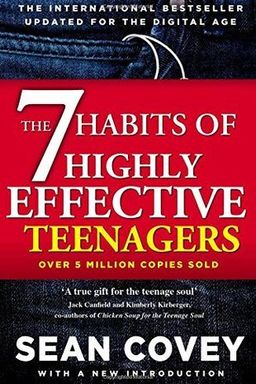
The 7 Habits Of Highly Effective Teenagers cover

The 7 Habits Of Highly Effective Teenagers

by Sean Covey

The 7 Habits of Highly Effective Teenagers equips young readers with the skills to take control of their lives. By integrating core habits like proactivity, time management, and empathy, this book guides teens toward achieving their goals, building strong relationships, and maintaining holistic well-being, all essential for a successful future.

Building a Life of Character and Purpose

How can you take control of your life and truly thrive, not just survive, during your teenage years? In The 7 Habits of Highly Effective Teens, Sean Covey argues that developing strong, principle-centered habits is the foundation for success, happiness, and balance. He contends that effectiveness—doing the right things for the right reasons—comes from building character first, and that your habits will determine the course of your life.

Covey adapts his father Stephen Covey’s famous framework from The 7 Habits of Highly Effective People into a manual for navigating the emotional jungle of adolescence. He begins with personal habits that help you manage yourself (the Private Victory), moves to interpersonal habits that help you thrive with others (the Public Victory), and culminates with personal renewal (Habit 7). Together, they form a character-building ladder that guides you from dependence to independence and, ultimately, to interdependence.

Why Habits Matter More Than Goals

Covey opens by asking you to reflect on your daily actions. The things you repeatedly do—good and bad—shape who you become. Drawing on a simple but powerful idea (“We first make our habits, then our habits make us”), Covey explains that small choices compound over time. When you choose to study instead of procrastinate, or respond rather than react, you're not just handling one situation—you’re wiring your brain for responsibility, initiative, and discipline. Conversely, blaming others or wasting time may feel small but reinforces helplessness. In this sense, your habits are both your compass and your fate.

A Compass for the Teenage Years

Covey wrote the book as a retired teenager, remembering the chaos, insecurity, and conflicting pressures of being young. The teen years, he says, aren't a playground—they're a jungle. Friends, social media, homework, family drama, and self-doubt all wrestle for your attention. Without direction, it’s easy to get lost—reacting to everything, conforming, procrastinating, or falling into comparison traps. The 7 Habits provide a compass for navigating this wilderness. Each one emphasizes principles—like honesty, service, and renewal—that don’t change, even when everything else does.

The first three—Be Proactive, Begin with the End in Mind, and Put First Things First—are personal. They help you move from dependence (“The world controls me”) to independence (“I control my life”). The next three—Think Win-Win, Seek First to Understand Then to Be Understood, and Synergize—teach you how to build lasting relationships and become interdependent (“Together, we can accomplish more”). The final habit—Sharpen the Saw—reminds you to regularly renew your body, mind, heart, and spirit, keeping your edge sharp for all the other habits.

Principles Over Popularity

According to Covey, teenagers often center their lives around things that don’t last: popularity, possessions, relationships, or even school. These “life-centers” inevitably disappoint because they shift or fade. True confidence and stability come only from a principle-centered life. Principles like integrity, loyalty, and hard work are universal laws—much like gravity or honesty. Unlike friends or trends, they never fail. Living by them may be difficult at first, but they ultimately create inner peace and power. “It is impossible for us to break the law,” Covey quotes from film director Cecil B. DeMille, “We can only break ourselves against the law.”

The Power of Small Wins

Covey’s tone throughout the book is conversational and full of humor, cartoons, and real teen stories from around the world. He doesn’t demand perfection; he invites progress. Living even one of the habits “some of the time,” he says, can improve your life in surprisingly big ways. The journey toward maturity isn’t a giant leap—it’s a series of small, consistent steps, or as Covey calls them, “baby steps.” Each chapter ends with a few of these—simple, doable actions like writing down your goals, apologizing to someone you hurt, or saying something kind to yourself in the mirror. Mastering the habits is less about finishing a checklist and more about developing strength of character.

Why These Habits Matter

Ultimately, Covey’s message is about empowerment. He insists that no matter where you come from or what challenges you face, you are not a victim of circumstance. You have the power to choose—how to act, who to become, what to stand for. The habits are tools for reclaiming that power. They teach responsibility, clarify purpose, strengthen relationships, and restore hope. “You are the driver, not the passenger,” Covey reminds you. And that makes all the difference between living life by accident or by design.

If you follow these habits, Covey promises, you’ll gain control of your life, improve your relationships, and find genuine happiness. More than a self-help book, The 7 Habits of Highly Effective Teens is a survival guide for growing up. It’s about finding your inner compass—and learning to steer your life by true north.


The Private Victory: Mastering Yourself

Before you can build great relationships or pursue meaningful goals, Sean Covey argues, you have to win what he calls the Private Victory—the battle within yourself. The first three habits (Be Proactive, Begin with the End in Mind, and Put First Things First) form the foundation of personal mastery. They shift you from dependence to independence, from blaming others to taking charge of your life.

Be Proactive: I Am the Force

Covey’s father drilled this idea into him: “Sean, no one can make you mad unless you let them.” To be proactive means taking responsibility for your reactions rather than blaming your parents, teachers, or friends. Covey contrasts proactive people, who act based on values, with reactive people, who act on impulse. Reactive people explode like shaken soda cans; proactive ones stay calm like water bottles. You can’t always control circumstances—bad weather, unfair teachers, or gossip—but you can control your response. Covey urges teens to stop saying, “You ruined my day,” and start saying, “I’m not going to let your mood ruin mine.”

Begin with the End in Mind: Purpose Before Pleasure

In Habit 2, Covey invites you to imagine your future self one year from now—or at your own graduation—and ask, “Who do I want to become?” Having a vision gives direction to your daily choices. Without it, life feels like assembling a jigsaw puzzle with no picture on the box. Writing a personal mission statement is the key exercise: a short, powerful description of what you stand for. Covey shares statements from teens who wrote things like, “I will live by my own policies” or “I will cross my bridges as I come to them.” He also warns against living by others’ expectations or drifting with peer pressure. When you know your purpose, he says, you control your future instead of letting circumstances do it for you.

Put First Things First: Discipline and Courage

Habit 3 is where rubber meets the road. Covey calls it the habit of both “will-power” (the strength to say yes to your priorities) and “won’t-power” (the strength to say no to distractions). He uses the metaphor of “big rocks” and “pebbles”: if you fill your life with trivial pebbles like video games, texting, or TV, there’s no room for your big rocks—family, school, self-respect. But if you put big rocks in first, the small things fit around them. Covey also introduces his Time Quadrant—activities fall into four zones depending on their importance and urgency. Important but not urgent (Quadrant 2) activities like exercise, relationships, and planning are where effective people invest their time. He encourages weekly planning: “Think ahead, identify your big rocks, and schedule them before the pebbles take over.”

The Private Victory concludes that success is built one disciplined step at a time. By mastering yourself—how you think, act, and prioritize—you gain the independence necessary to become a trustworthy friend, teammate, or leader. As Covey writes, “If you can’t manage yourself, it’s hard to manage anything else.”


Changing the Lens: Paradigms and Principles

Before diving into the 7 Habits, Covey stops to explore a powerful idea: your paradigm, or the way you see the world, determines how you act. “What you see is what you get.” He shares stories of teens who believe they’ll never go to college or that their stepdad will never understand them—and how those beliefs quietly become self-fulfilling prophecies. Just as faulty glasses distort your vision, faulty paradigms distort your reality. But by cleaning your lens—changing how you see yourself, others, and life—you unlock personal potential.

Paradigms of Self

Negative self-paradigms (“I’m dumb,” “I’m ugly,” “I can’t change”) limit growth. Covey tells the story of Linda, a high school girl who refused to join the Miss Madison Pageant because she thought she wasn’t “pageant material.” Encouraged by friends to try, she discovered confidence and leadership she never knew she had. Changing her self-paradigm changed her future. Similarly, the parable of the imprisoned prince—who resisted temptation because he remembered, “I was born to be a king”—illustrates how a positive self-image empowers you to live with integrity. The key to changing your self-paradigm, Covey writes, is spending time with people who believe in you until you can see yourself as they do.

Paradigms of Others

We also carry misjudged paradigms about others. Covey retells an old parable about a woman at an airport who thought a man was stealing her cookies, only to discover later she was eating his. The story reminds us how easy it is to judge without understanding. Paradigm shifts happen when we gain new information—like the girl who stopped criticizing her moody friend after learning her parents were divorcing. “We seldom see the whole picture,” Covey warns, and challenges readers to suspend judgment and seek understanding instead.

Paradigms of Life

Teens often center their lives on unstable things—friends, stuff, boyfriends or girlfriends, grades, popularity—what Covey calls “life-centers.” These make you reactive, because when they shift, so do you. The only secure life-center, he argues, is one based on timeless principles like honesty, service, and fairness. “Principles never fail,” he writes. They don’t gossip, move away, or discriminate. Centering your life on principles—not people or possessions—creates stability in a chaotic world. As Cecil B. DeMille said of his film The Ten Commandments, “It is impossible for us to break the law. We can only break ourselves against the law.”

By changing your paradigm, you change your life. When you see yourself as capable, others as complex, and principles as your compass, you start operating from strength rather than insecurity. Everything else in the 7 Habits flows from this transformation of vision.


Private Deposits: The Personal Bank Account

How do you build self-confidence? Covey likens your self-worth to a Personal Bank Account (PBA). Every time you keep a promise, show kindness, or stay honest, you make a deposit. Every time you break a promise or act against your values, you make a withdrawal. Unlike a real bank, though, PBA withdrawals carry interest—they multiply. “At any time,” Covey writes, “you can look in the mirror and say, ‘I don’t like that about myself,’ and exchange a bad habit for a good one.”

Six Major Deposits

Covey outlines six essential deposits for building self-trust:

  • Keep promises to yourself: Start small—get up when you said you would, finish that assignment. Small commitments build integrity.
  • Do small acts of kindness: Service shifts your focus outward. Covey shares how giving up his first-class seat to a mother with a baby made him feel like a million bucks.
  • Be gentle with yourself: Stop beating yourself up about mistakes. “One of the keys to happiness,” Covey quotes, “is a bad memory.”
  • Be honest: Dishonesty erodes your sense of integrity. Covey repeats a life rule: “You can’t do wrong and feel right.”
  • Renew yourself: Take time to recharge—your “secret garden” might be a gym, journal, or park bench.
  • Tap into your talents: Find what makes you thrive. One teen realized her gift for pressing wildflowers and making art—she discovered beauty in what others ignored.

Covey’s most moving example is his brother Bryce, who lost an eye in an accident but broke a mountain-climbing record by channeling his limitations into determination. “Whatever the mind of man can conceive and believe,” Covey quotes Napoleon Hill, “the hand of man can achieve.” Building your PBA isn’t about ego—it’s about self-respect, the foundation for every other relationship in your life.


The Public Victory: Building Trust and Teamwork

Habits 4 through 6 take you beyond self-mastery into the world of relationships. Covey calls this realm the Public Victory. Once you learn to lead yourself, you’re ready to cooperate, listen, and synergize with others—skills essential for leadership, friendship, and love.

Think Win-Win: Everyone Can Eat

The antidote to rivalry and insecurity, Habit 4 teaches the mindset of abundance. Life isn’t a pie with limited slices; it’s an all-you-can-eat buffet. Covey contrasts four paradigms: Win-Lose (I win, you lose), Lose-Win (you win, I lose), Lose-Lose (“if I’m going down, you’re coming with me”), and Win-Win (we both win). Real maturity, he writes, comes from caring about others’ success without surrendering your own. A girl named Dawn discovered this when she started passing the basketball to a teammate who had stopped giving her the ball. “Wanting another person to win,” Dawn realized, “filled me with joy.” Win-Win thinking feeds relationships instead of consuming them.

Seek First to Understand, Then to Be Understood

Habit 5 may be the most revolutionary: before you talk, listen. True listening, Covey says, isn’t waiting your turn to speak—it’s stepping into another’s shoes. He recommends “mirroring,” reflecting back a person’s feelings and words rather than judging or advising. One of his most powerful examples is of three college roommates who helped an anorexic girl heal, not by lecturing but by loving her and showing understanding. “People don’t care how much you know,” Covey reminds us, “until they know how much you care.” Mirroring transforms conflict into connection.

Synergize: The High Way

The final relationship habit, synergy, celebrates differences. Two or more people, working together, can produce results better than either could alone. Covey illustrates this with the story of geese flying in formation—by sharing air currents, they can travel 71% farther than flying solo. He contrasts three attitudes toward diversity: shun it (fear and reject differences), tolerate it (ignore differences), and celebrate it (see differences as opportunities). Synergy begins when we reach the “High Way,” finding creative third alternatives that satisfy everyone. Whether you’re negotiating curfews with parents or designing a group project, synergy turns opposition into innovation.

The Public Victory shows that genuine relationships are built on trust, loyalty, listening, and cooperation. Covey likens it to a “Relationship Bank Account”—the more deposits you make through kindness, forgiveness, and honesty, the stronger it becomes. These habits move you from self-focus to shared success—and lay the groundwork for a lifetime of collaboration and empathy.


Sharpen the Saw: Renewal and Balance

The seventh and final habit, Sharpen the Saw, ties all the others together. It’s about taking time to renew yourself in what Covey calls the four key dimensions of life: body, mind, heart, and soul. Without renewal, even the strongest saw dulls; you lose focus, energy, and joy. Prioritizing renewal isn’t selfish—it’s essential for sustained effectiveness.

Body: Caring for Your Physical Self

Your body is a “marvelous machine,” Covey writes, but it needs proper fuel and rest. He urges moderation: listen to your body, eat balanced meals, sleep well, and find exercise you enjoy. Walk, dance, lift weights, swim—anything that gets you moving. He also warns against abusing your body with drugs, alcohol, or tobacco, emphasizing that addiction steals control and freedom. Quoting Mark Twain, Covey jokes, “It’s easy to quit smoking. I’ve done it a hundred times.” Real self-control, he insists, comes from respecting yourself, not punishing yourself.

Mind: Keep Learning

The best investment you can make, Covey declares, is in your mind. Whether through reading, school, work, or hobbies, keep developing your brain. Like Socrates drowning his eager student to show the value of desire, Covey reminds you that wisdom takes effort. He encourages lifelong curiosity—read books, attend lectures, visit museums, debate ideas, write in journals. Education opens doors; ignorance locks them. “If you think education is expensive,” he warns, quoting Derek Bok, “try ignorance.”

Heart: Building Loving Relationships

Sharpening the heart means nurturing emotional well-being and connection. Make deposits in your Relationship Bank Accounts: listen, forgive, laugh, show empathy. Covey emphasizes the healing power of humor and service, quoting Mother Teresa: “Let no one ever come to you without leaving better and happier.” He also tackles tough issues like depression, heartbreak, and suicide, offering hope and reminding teens that pain can become strength. “Hold on,” he pleads, “You’re gonna make it.”

Soul: Finding Your Center

Your soul is your center—the quiet space where you find purpose. Covey recommends feeding it with reflection, prayer, journaling, nature, or uplifting music. He warns against a steady “diet of trash”—media that degrades rather than uplifts. Instead, cultivate inspiration. Write gratitude lists, watch sunsets, volunteer, and keep a journal that records good things. “Inside myself is a place where I live all alone,” he quotes Pearl Buck, “and that’s where you renew your springs that never dry up.”

Sharpening the saw is a lifelong process of balance. You can’t give what you don’t have. By caring for body, mind, heart, and soul, you keep your edge—empowered to keep doing, giving, and growing. As President John F. Kennedy said, “The time to repair the roof is when the sun is shining.” Renewal keeps your sun bright, your saw sharp, and your life moving forward.


Keeping Hope Alive

Covey closes his book with a reminder full of warmth and optimism: never lose hope. Change, he reassures, is gradual but always possible. Like a plane constantly correcting its course midflight, you’ll veer off track often—but small adjustments will bring you back. He quotes Jesse Jackson’s famous refrain—“Keep hope alive!”—and Dr. Seuss’s wisdom from Oh, the Places You’ll Go!: “Kid, you’ll move mountains.”

The goal isn’t perfection. It’s persistence. Don’t beat yourself up when you relapse into old habits or when relationships stumble. Pick one or two habits, Covey suggests, and work on them daily through small, consistent “baby steps.” Teach the habits to someone else—friends, siblings, parents—because explaining them reinforces your learning. And remember: effectiveness isn’t something you achieve once and forget. It’s a way of life, renewed every day you choose to live by principles rather than by pressure.

Covey’s final advice is both playful and profound: “You can’t make footprints in the sands of time by sitting on your butt. And who wants to leave buttprints in the sands of time?” In other words, act. Begin. Believe. By practicing the habits, you claim authorship of your life story and chart your own flight plan toward character, contribution, and purpose. Hope, Covey insists, is not naïve—it’s power. It’s the fuel that turns good intentions into action and action into lasting change.

If you fall, get up. If you lose your way, check your compass. If your saw is dull, sharpen it. Every time you do, you prove that effectiveness isn’t about avoiding mistakes—it’s about growing through them. Keep hope alive. The mountains are waiting.

Dig Deeper

Get personalized prompts to apply these lessons to your life and deepen your understanding.

Go Deeper

Get the Full Experience

Download Insight Books for AI-powered reflections, quizzes, and more.