
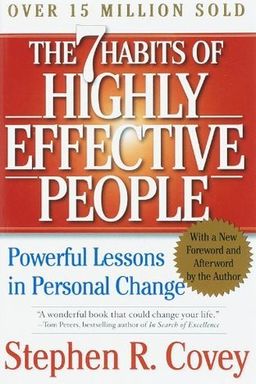
The 7 Habits of Highly Effective People cover

The 7 Habits of Highly Effective People

by Stephen R Covey

Discover the principles that have helped millions achieve personal and professional success with ''The 7 Habits of Highly Effective People.'' Learn to transform your habits and mindset to become more proactive, goal-oriented, and balanced in all areas of life.

The Inside-Out Path to True Effectiveness

How can you become genuinely effective—not just busy, not just successful by external standards, but deeply fulfilled and purpose-driven? Stephen Covey’s The 7 Habits of Highly Effective People argues that lasting growth and fulfillment require a transformation from the inside out. You don’t just manage time or relationships better; you change the very paradigms—the mental maps—you use to see the world. Covey’s central claim is that effectiveness is built on enduring principles of character, not on quick techniques or image enhancement. By reshaping how you think and what you value, you can alter not only your behavior but also the results and relationships that follow.

From Personality to Character

Covey begins by contrasting two dominant traditions in success literature. The older character ethic emphasized traits such as integrity, humility, courage, and justice. It assumed that enduring success stems from the moral fiber of a person. The modern personality ethic, which gained prominence after World War I, tends to focus on appearance and technique—communication skills, positive attitude, or persuasive tactics. Covey believes this shift has produced a culture obsessed with image over substance. Superficial strategies may yield short-term gains, but without the character foundation, true effectiveness collapses under stress.

Instead of chasing quick fixes, Covey invites you to restore the focus on principles—universal truths like fairness, honesty, service, and human dignity. These don’t change with trends or markets; they are timeless, like physical laws. The way you see any problem, he writes, is the problem. Altering your paradigms—your mental maps—requires humility and self-awareness, but it is where profound change begins.

The Inside-Out Approach

Covey calls this a transformation from “inside out.” Instead of trying to fix circumstances or other people (“outside in”), you reshape your own attitudes, values, and principles. This builds character strength that radiates outward into your work, family, and community. Real change, he says, doesn’t happen by “hacking at the leaves of attitude and behavior”; it comes from “striking at the roots” of your thought fabric.

“He who cannot change the very fabric of his thought,” wrote Anwar Sadat, quoted by Covey, “will never be able to change reality.” Covey’s entire framework gives you tools to evolve that fabric—habit by habit, principle by principle.

The Journey from Dependence to Interdependence

Covey’s seven habits trace a path of human growth through three stages of maturity: moving from dependence (relying on others), to independence (self-reliance), and finally to interdependence (collaborative synergy). The first three habits—Be Proactive, Begin with the End in Mind, Put First Things First—build private victories by strengthening self-mastery. The next three—Think Win/Win, Seek First to Understand Then to Be Understood, Synergize—create public victories through cooperation and teamwork. The final habit—Sharpen the Saw—renewal—ensures ongoing balance and growth.

Each habit represents a fundamental shift in how you direct your life energies. Rather than reacting to circumstances, you learn to act from principles. You replace short-term efficiency with long-term effectiveness. The seven habits function not as isolated techniques but as an “integrated approach” that gradually aligns your outer life with your inner values.

Why It Matters

Covey’s core argument is deeply practical. By mastering these habits, you learn to balance what he calls the P/PC Balance: “Production” (getting results) and “Production Capability” (maintaining the resources—your health, relationships, skills—that make those results possible). This balance, mirrored in Aesop’s Golden Goose story, reminds you not to burn yourself out chasing short-term gains. Maintaining your physical, mental, and spiritual capacity is just as vital as achieving outcomes.

The implications of this framework ripple outward. In relationships, Covey’s Emotional Bank Account metaphor teaches that trust must be deposited daily through courtesy and honesty before it can be withdrawn in moments of conflict. In leadership, “Begin with the End in Mind” ensures strategic alignment. And in time management, his Fourth Generation approach (later expanded in First Things First) encourages focusing on “Quadrant 2” activities—important but not urgent—as the foundation of long-term success.

An Invitation to Principle-Centered Living

Ultimately, Covey’s vision is not about productivity hacks but about principle-centered living. When your life is grounded in timeless truths rather than shifting social scripts, you gain intrinsic security. Peace of mind, he writes, comes only when your actions align with true principles. The seven habits are simply practices to bring that alignment to life—steps to discover unity with yourself and those around you.

By approaching success from the inside out, Covey reframes the question of achievement entirely. It isn’t “How can I win?” but “How can I grow in character and contribution?” Because when you change your paradigms—your inner map—you begin to see the world anew. And as T.S. Eliot wrote, quoted by Covey: “The end of all our exploring will be to arrive where we began and to know the place for the first time.”


Be Proactive: The Power to Choose

The first habit, Be Proactive, is Covey’s foundation for all the others. It’s about recognizing that between any stimulus and your response lies your ultimate freedom—the ability to choose. While animals react automatically to conditioning, humans possess four distinctive endowments: self-awareness, imagination, conscience, and independent will. These enable you to take charge of your reactions, no matter the circumstances.

“Man is not a product of his circumstances but of his decisions,” Covey insists. This echoes Viktor Frankl’s observation in Man’s Search for Meaning: even in concentration camps, one retained the power to choose one’s attitude.

Reactive vs. Proactive Living

Reactive people let conditions or emotions dictate their behavior—they’re angered by traffic, controlled by others’ moods, and driven by external approval. Proactive individuals, in contrast, act from values rather than impulses. They don’t blame the weather, their boss, or their genes; they decide how to respond. Covey calls this “response-ability”—the ability to consciously choose a response.

The Circle of Influence

Covey offers a practical model with two concentric circles: your Circle of Concern (things you worry about but can’t control) and your Circle of Influence (areas where you can act). Reactive people dwell on the outer circle, magnifying stress; proactive people concentrate on the inner one, taking small actions that expand their influence over time. By focusing energy only on what you can control—your words, habits, and reactions—you shrink frustration and grow power.

Examples in Action

Covey recalls leaders who turned adversity into triumph—Anwar Sadat, for example, who emerged from prison transformed, armed with “the necessary psychological and intellectual capacity” to lead Egypt through upheaval. Witnessing that, you see how proactive choice literally reshapes destiny. Emerson’s quote underscores this: “That which we persist in doing becomes easier—not that the nature of the task has changed, but our ability to do has increased.”

(In modern psychology, Albert Bandura’s concept of self-efficacy parallels Covey’s principle: believing in your power to influence outcomes strengthens that power itself.)

Why It Matters

To be proactive means to reclaim authorship of your life. You stop saying “I can’t” or “If only” and start asking “What can I do now?” Every choice becomes a vote for the kind of person you want to be. Life’s greatest battles, Covey reminds us, are “fought out daily in the silent chambers of the soul.” When you begin acting from principle instead of reaction, you start winning those battles—and everything else follows.


Begin With the End in Mind

If Habit 1 is about choice, Habit 2 is about direction. Covey’s second habit, Begin with the End in Mind, asks you to visualize who you want to be and what you want to contribute before you start moving. Without this clarity, you may climb the wrong ladder efficiently—only to discover it was leaning against the wrong wall.

Two Creations: Mental and Physical

Everything is created twice—first mentally, then physically. Imagine clearing a jungle: managers sharpen tools and optimize productivity, while leaders climb trees and shout, “Wrong jungle!” Efficiency alone means little if your direction is off. This principle separates management (doing things right) from leadership (doing the right things).

Building a Personal Mission Statement

Covey encourages you to draft your personal mission statement—your “constitution.” It outlines what you want to be (character), what you want to do (contributions), and the principles guiding both. It becomes your compass for decisions and priorities. The process itself is transformational, requiring introspection and visualization exercises—like imagining your funeral, your retirement, or your 50th wedding anniversary. What do you want people to say about you? These scenarios help you crystallize deeper values beyond daily distractions.

Principle-Centered Living

True effectiveness, Covey argues, means centering your life around correct principles—timeless truths that don’t depend on circumstances or recognition. Unlike possessions or status, principles remain steady amid external change. When you align with them, you gain wisdom to see things “as they really are, have been, and will be.” This clarity frees you from being tossed around by others’ expectations.

Tools for Visualization and Affirmation

Covey draws on brain science: the left hemisphere deals with logic and words, while the right governs creativity and intuition. Both must collaborate when crafting vision. He urges the use of affirmations—personal, positive, emotional, and present-tense statements—to reinforce your mission daily. World-class athletes practice this through visualization of desired outcomes; you can do the same in relationships, career, or health.

Habit 2 is personal leadership—ensuring every effort leads toward your chosen destination. When you begin with the end in mind, every action becomes part of a coherent whole rather than a series of disconnected tasks. In Covey’s framework, this habit gives purpose to proactivity—the “why” that makes the “how” meaningful.


Put First Things First

Habit 3, Put First Things First, moves from vision to discipline. It’s about time management grounded in values. Covey’s simple but profound insight is that effectiveness means focusing your energy on activities that are important but not urgent—those that build prevention, relationships, and long-term growth.

The Four Quadrants

  • Quadrant I: Important & Urgent – crises, deadlines. Necessary but draining if lived here alone.
  • Quadrant II: Important & Not Urgent – planning, relationship building, learning, recreation. The heart of effectiveness.
  • Quadrant III: Not Important & Urgent – interruptions, phone calls, emails dictated by others’ priorities.
  • Quadrant IV: Not Important & Not Urgent – trivia, time wasters.

Covey insists that great managers and leaders live primarily in Quadrant II. By saying “No”—often diplomatically—to the activities in Quadrants III and IV, you safeguard time for what truly matters.

Weekly Planning and Role Balance

Covey proposes weekly planning built around your personal mission and roles. First, identify the key roles you play—parent, employee, friend, community member. Then set two or three meaningful goals per role each week. Schedule time for those goals intentionally, ensuring balance across life’s dimensions. Each day then becomes a matter of adapting, not reacting.

Criteria for Effective Time Management

  • Coherence – ensuring harmony between mission and goals.
  • Balance – attention to different life roles.
  • Quadrant 2 Focus – prevention, opportunity-minded thinking.
  • People Dimension – recognizing others’ roles in your plans.
  • Flexibility and Portability – tailoring systems to personal circumstances and using them everywhere.

What You Gain

This habit is about living purposefully, not hectically. “Things which matter most must never be at the mercy of things which matter least,” Goethe reminds us. When your schedule reflects your true priorities, Covey says, you manage your life—not time. The habit bridges private victory (self-mastery) and public victory (effective collaboration) by teaching you to balance productivity and capacity—the essence of long-term effectiveness.


Think Win/Win

Habit 4—Think Win/Win—transforms how you relate to others. Covey argues that effectiveness in human interaction arises when you seek mutual benefit. A Win/Win mindset sees life as a cooperation, not a competition, based on an abundance mentality: there is enough success and opportunity for everyone.

The Paradigms of Interaction

  • Win/Lose – authoritarian, power-driven.
  • Lose/Win – giving in to keep peace, sacrificing integrity.
  • Lose/Lose – mutually destructive rivalry.
  • Win alone – ignoring others’ interests.
  • Win/Win-or-No-Deal – if mutual benefit isn’t possible, agree respectfully to disagree.

Covey suggests Win/Win-or-No-Deal is ideal for new relationships because it preserves emotional freedom and trust.

Five Dimensions of Win/Win

  • Character: integrity, maturity (balance between courage and consideration), and abundance mentality.
  • Relationships: the Emotional Bank Account built with deposits of loyalty and respect.
  • Agreements: focusing on desired results, resources, and accountability.
  • Systems: aligning organizational structures—reward systems, communication—with Win/Win values.
  • Processes: separating people from problems, focusing on interests, inventing mutual options, using objective criteria.

Covey warns that preaching Win/Win in a Win/Lose system of rewards ensures hypocrisy. Organizations must reinforce collaboration through fair evaluation and shared success metrics (paralleling W. Edwards Deming’s systemic management ideas).

Embracing the Abundance Mindset

Win/Win living stems from the belief that there’s plenty for everyone—love, success, opportunity. Scarcity-thinking breeds fear and competition; abundance-thinking inspires creativity and synergy. When both sides commit to mutual benefit, trust flourishes and new solutions emerge. In business and life, this habit builds cooperation that endures far beyond contracts or negotiations.


Seek First to Understand, Then to Be Understood

Habit 5, Seek First to Understand, Then to Be Understood, is about the deepest skill in human connection—listening empathetically. Most of us, Covey says, listen not to understand but to reply. We compare others’ experiences to our own autobiography and formulate responses while they’re still speaking.

Empathetic Listening

To genuinely understand someone, you must attend not only to their words but to emotions, body language, pauses, and tone. Listen for feelings and meaning before offering advice. This takes maturity and security because you open yourself to being influenced. Covey uses practical analogies: a professional doctor diagnoses before prescribing; a skilled engineer studies stresses before designing a bridge. Similarly, empathic listening is the “diagnosis” of human interaction.

The Greeks’ Trio: Ethos, Pathos, Logos

Covey reaches back to Greek rhetoric to describe effective communication: Ethos (personal credibility), Pathos (emotional alignment), and Logos (reason). Most people rush straight to logos—facts and arguments—without earning trust or emotional resonance. The right sequence is crucial: establish character and connection before logic.

Trust and Emotional Bank Accounts

You can only be truly understood after you first make deposits of empathy and integrity into others’ Emotional Bank Accounts. When people feel heard, they lower their defenses; only then can they listen back. Covey notes that satisfied emotional needs cease to motivate—so until someone feels recognized, advice won’t register.

This habit cultivates mutual influence: the courage to express your views tempered by consideration for others’. It’s the bridge between Win/Win and Synergize. As Blaise Pascal wrote, “The heart has its reasons which reason knows not of.” When you understand from the heart first, your own insights gain power and clarity.


Synergize: The Power of Creative Cooperation

Habit 6, Synergize, is where collaboration moves from compromise to creativity. Covey defines synergy as situations where the whole is greater than the sum of its parts. It’s not just teamwork—it’s the miracle that occurs when differences fuel innovation instead of collision.

Trust as the Foundation

Synergy only thrives in high-trust environments. When trust is low, interactions are defensive and wrapped in legal jargon. When trust is medium, people communicate politely but settle for compromise. When trust is high, genuine creativity emerges—solutions better than either party could have achieved alone. This is the essence of teamwork at its highest form.

Valuing Differences

Covey insists that the differences between people—mental, emotional, psychological—are not obstacles but raw material for synergy. “If two people are of the same opinion,” he quips, “one is unnecessary.” When you value diverse paradigms, you expand possibilities exponentially. This outlook counters uniformity culture, replacing it with genuine collaboration.

Increasing Driving Forces

Covey frames growth as a balance between driving forces (positive, logical, economic) and restraining forces (negative, emotional, unconscious). Most people try to increase the driving forces; synergy does both—increasing positives while reducing negatives. The outcome is an upward spiral of collective effectiveness.

Synergy is the manifestation of all previous habits. When individuals practice proactivity, clear purpose, balanced priorities, mutual benefit, and empathetic understanding, collaboration becomes transformative. You no longer merely work together—you create something entirely new and better than anyone imagined. It’s the living proof of Covey’s inside-out philosophy applied to groups.


Sharpen the Saw: Renewal and Balance

The final habit, Sharpen the Saw, reminds you to take care of the instrument through which you operate—yourself. Covey’s metaphor is vivid: sometimes we get so busy sawing that we forget to sharpen the blade. Renewal across four dimensions—physical, spiritual, mental, and social/emotional—is essential to sustain effectiveness.

Four Dimensions of Renewal

  • Physical: Regular exercise, proper nutrition, and rest. Covey reminds you that thirty minutes of daily exercise improves all other hours in the day.
  • Spiritual: Reconnecting with purpose through meditation, prayer, literature, or nature. This dimension gives leadership and direction to life.
  • Mental: Continuous learning—reading, writing, planning. He cautions against replacing study with passive entertainment. Growth fuels creativity.
  • Social/Emotional: Relationship renewal through empathy, service, and integrity. Draw intrinsic security from principles, not others’ approval.

Daily Private Victory

Covey recommends a “Daily Private Victory”—an hour devoted to renewing the physical, mental, and spiritual dimensions each morning. This self-renewal fuels a “Daily Public Victory” in external interactions. Renewal, he explains, operates in an upward spiral of LearnCommitDo repeated endlessly on higher planes of growth.

The Essence of Longevity

Neglecting one dimension undermines the others; balanced renewal enhances them all synergistically. Peace, health, and productivity flow from harmony. Gandhi’s words, quoted by Covey—“They cannot take away our self-respect if we do not give it to them”—reflect this independence born of inner balance. Habit 7 ensures that your effectiveness is not a sprint but an enduring, evolving journey of continuous improvement.

Dig Deeper

Get personalized prompts to apply these lessons to your life and deepen your understanding.

Go Deeper

Get the Full Experience

Download Insight Books for AI-powered reflections, quizzes, and more.