
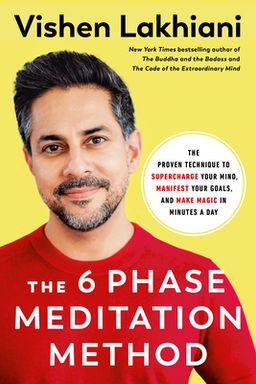
The 6 Phase Meditation Method cover

The 6 Phase Meditation Method

by Vishen Lakhiani

The 6 Phase Meditation Method is a transformative guide that helps you harness the power of meditation to enhance compassion, forgiveness, and self-awareness. In just 20 minutes a day, unlock practical life skills that lead to a peaceful, productive, and fulfilling life.

Rewriting Your Inner World Through the 6 Phase Meditation

What if a simple 20-minute mental workout could make you calmer, more successful, and more fulfilled than years of therapy or a lifetime of self-help books? In Zero Bullsh*t Meditation: The 6 Phase Meditation Method, Vishen Lakhiani—a tech entrepreneur turned transformation pioneer—argues that meditation doesn’t need incense, mantras, or monkhood. It needs a system. His 6 Phase Meditation takes ancient mindfulness and re-engineers it into a practical daily protocol for performance, emotional mastery, and spiritual wholeness.

Lakhiani positions traditional meditation and his modern framework as complementary but different. Traditional meditation, he suggests, was designed for renunciants—people trying to leave the world behind. But you have bills, families, startups, and endless pings from your phone. You need meditation that serves this world. The 6 Phase is a form of structured mental programming that builds both inner peace and outer achievement.

The Bridge Between Science and Spirituality

Lakhiani’s tone throughout is no-nonsense and often humorous—he calls his method “zero bullsh*t” because it swaps New Age mysticism for neuroscience. He grounds every phase in measurable outcomes like increased alpha brain waves, improved cardiovascular health, and better emotional balance. Yet he also bridges into metaphysical ideas such as synchronicity and higher consciousness, quoting thinkers from the Buddha to physicist Nassim Haramein. The practice, he says, lies at the meeting point between spiritual insight and scientific rigor—a place where awe and evidence coexist.

Six Phases to Upgrade Being Human

The book’s six phases are a stepwise training of the mind: (1) cultivate compassion, (2) train gratitude and happiness, (3) release the past through forgiveness, (4) envision your future, (5) master your day, and (6) receive a blessing from a higher power. Together, they reprogram the emotional, cognitive, and spiritual layers of consciousness. The early phases—love, gratitude, forgiveness—create what he calls the Pillar of Happiness: emotional cleansing and connection in the present. The later phases—vision, day design, blessing—form the Pillar of Vision, focused on purpose, manifestation, and connection to higher intelligence. When both pillars balance, you reach what Lakhiani names “bending reality,” a state where your happiness and vision fuel each other.

He contrasts this balanced life with three common traps. In low happiness and low vision, you spiral into apathy. In high happiness but no vision, you stagnate in comfort—a “current reality trap.” And in high vision but no happiness, you burn out in the “anxiety corner.” True mastery, he says, is living joyfully in the now while simultaneously shaping the future. The 6 Phase Meditation is the daily practice that trains this balance.

A Personal Origin Story: From Silicon Valley Burnout to Mindvalley

Lakhiani didn’t discover this formula in a monastery; he stumbled onto it through desperation. After being fired from Microsoft and failing as a startup founder, he found himself selling software over the phone while sleeping on a musty couch. Burnt out, he searched online for “Why does my life suck?” and found a meditation seminar. There he learned the Silva Ultramind System, a method that taught practical mental programming instead of blank-mind meditation. Within weeks of daily practice, his sales tripled, his stress vanished, and his career transformed. Meditation became his secret performance enhancement tool. That spark later evolved into Mindvalley—now a global learning platform—and the streamlined 6 Phase Method.

Like biohacker Dave Asprey or scientist Joe Dispenza, Lakhiani sees personal growth as “mental technology.” You can train gratitude like muscle fibers or engineer compassion like software. And because it’s habits that change reality—not random inspiration—the 6 Phase offers a repeatable daily code anyone can run, from athletes like Bianca Andreescu to entrepreneurs and artists.

Why This Method Matters Now

In an era of anxiety epidemics and digital overwhelm, the 6 Phase Meditation promises a “minimum effective dose” of well-being—a 15–20 minute routine proven to stabilize mood, focus, and intuition. But more profoundly, Lakhiani ends with a moral mission: global consciousness. Drawing on Google scientist Tom Chi’s warning that unchecked tech without higher consciousness could destroy humanity, he frames the 6 Phase not just as self-help but as civilization-help. If enough individuals increase compassion, gratitude, and spiritual awareness, collective consciousness rises too. In his words, every person adds “a grain of sand” to a new beach of global awakening.

Ultimately, Zero Bullsh*t Meditation argues that meditation shouldn’t detach you from life—it should make you dangerous to mediocrity. It’s both a morning ritual and a moral revolution: train your mind scientifically, connect spiritually, and you’ll not only change your day but, in time, change the world.


Phase 1: Expanding Compassion as Mental Hygiene

We shower daily but rarely scrub our minds. Lakhiani opens the meditative journey with compassion—the emotional equivalent of washing off mental grime. Compassion, he says, begins as self-care and expands into world-care. It softens judgment, builds connection, and anchors the whole 6 Phase sequence in love. He frames compassion not as saintly pity but as a pragmatic performance tool. It increases cooperation, deepens relationships, and literally makes you more attractive and younger (studies show compassion strengthens social bonds and slows cellular aging).

From Judgment to Connection

Humans suffer from “fundamental attribution error”: when someone cuts us off in traffic, we label them a jerk; when we do it, we justify our bad day. Compassion reverses this bias by humanizing others. Lakhiani’s café story illustrates it. When a frazzled waitress forgot his coffee after lockdown, instead of irritation he felt empathy: she’d likely lost income, worn a mask for ten-hour shifts, and endured stress. A €20 tip became both kindness and karmic training. Compassion reframes moments from offense to understanding, calming both giver and receiver.

The Science of the Compassion Muscle

Compassion can be trained like biceps. Lakhiani cites research from the University of Wisconsin–Madison showing that two weeks of compassion meditation changed neural circuits for empathy and altruism. Practitioners became less reactive to pain, more generous, and measurably happier. Other studies link compassion to telomere preservation—a genetic marker of aging—suggesting that “kindness keeps you young.” HeartMath Institute data add that love-based breathing synchronizes heart rhythms, promoting cardiovascular health and emotional coherence.

How to Practice: The Circle of Love

Phase 1 begins with one loved person—your partner, child, or even pet. You picture them radiating love and let that warmth fill your heart, giving it a color. You then expand it progressively: to yourself, to everyone in your home, to your city, to your nation, and finally to the entire planet. If you lose the feeling, return to your loved one as the emotional anchor. This exercise not only conditions empathy but generates measurable oxytocin, the bliss chemical. Monks evolved similar methods, but now neuroscience confirms what scriptures long claimed: love is a biochemical superpower.

By starting each morning from compassion, you clean emotional clutter before your day begins. You stop being the reactive hero of your own tiny story and rejoin the shared human narrative. Kindness becomes not moral duty but optimal strategy: compassion makes you—literally—unf*ckwithable in a combative world.


Phase 2: The Art and Science of Gratitude

Einstein once wrote that “a calm and humble life brings more happiness than the pursuit of success with constant restlessness.” Lakhiani uses this as the manifesto for Phase 2, which targets the relentless ‘I’ll-be-happy-when’ mindset. In a culture conditioned to postpone joy until goals are hit, gratitude reconditions the brain to feel abundance now. Gratitude, he says, is not just polite optimism—it’s neurology. It activates dopamine and serotonin, boosting energy, immunity, and creativity.

The Happiness Gap and the Reverse Gap

Borrowing from entrepreneur coach Dan Sullivan’s idea of the “gap and gain,” Lakhiani explains that most of us measure success by the distance to our ideal future (the forward gap). But joy comes from looking backward at how far we’ve already come (the reverse gap). Gratitude closes that loop. Instead of “I’ll be happy when I get promoted,” you reframe to “I’m grateful for the colleague who believes in me today.” This cognitive shift effortlessly raises your emotional baseline.

Science and Myths of Gratitude

University of California psychologist Robert Emmons found that writing weekly gratitude lists improved mood, exercise frequency, and physical health. Gratitude correlates with fewer doctor visits and stronger relationships. Contrary to myth, you don’t need a perfect life to be thankful; gratitude shines brightest in hardship. During tough times, focusing on one stable blessing—such as the ability to breathe or the presence of a friend—stabilizes mental health. As Lakhiani jokes, gratitude is “a pill with no side effects, free of charge.”

The 3×3 Gratitude Protocol

The technique is simple but transformative. You list three things you’re grateful for in three areas: personal life, work life, and yourself. The final category—self-appreciation—is revolutionary. Most people, he says, are trained to see flaws, not virtues. By thanking yourself for qualities like resilience or humor—or even for your body surviving another day—you replace self-criticism with respect. As self-worth increases, relationships and opportunities mirror it outwardly (a concept also central to The Magic by Rhonda Byrne).

Through gratitude, Phase 2 transforms everyday awareness into joy. When paired with Phase 1’s compassion, you create both inward satisfaction and outward generosity—the twin conditions for emotional wealth.


Phase 3: Forgiveness as Freedom and Brain Upgrade

Forgiveness, writes Lakhiani, is the mind’s detox. It dissolves resentment, rejection, and regret—the “three Rs” that poison happiness. Quoting Nelson Mandela—“If I didn’t leave my hatred behind, I’d still be in prison”—he calls forgiveness the ultimate release valve for human suffering. More than moral virtue, forgiveness is biohacking: studies show it lowers blood pressure, eases pain, and increases alpha brain waves associated with creativity and flow.

The Experiment That Changed Everything

Lakhiani discovered forgiveness’s power at the “40 Years of Zen” brain-training retreat created by Dave Asprey and neuroscientist James Hardt. There he met Sally, whose brainwave coherence skyrocketed after meditating on forgiving her ex-husband. This anomaly led scientists to realize that forgiveness generates the same alpha harmony as decades of Zen practice. One participant, Matt, forgave his abusive brother—and the brother, without knowing, later texted an apology. To Lakhiani this hinted that forgiveness might transmit subtle shifts in a “nonphysical field of consciousness,” echoing Gary Zukav’s theory that intention in the unseen realm shapes physical reality.

Luck, Healing, and Manifestation

After his own deep forgiveness session, Lakhiani’s brain showed record-high alpha levels. Soon after, his book The Code of the Extraordinary Mind unexpectedly hit #1 globally on Amazon. Coincidence or synchronicity, he interpreted it as proof that forgiveness clears energetic pathways for good fortune. As scientists told him, forgiven minds “get luckier.” He compares it to clearing the cache of resentment so reality can run smoother. Forgiveness, he adds, transforms not only psychological freedom but also one’s capacity for intuition and synchronicity.

Protocols for Letting Go

The structured Forgiveness Protocol has eight steps: identifying the person or act, visualizing a safe space, reading the emotional charge as if in court, expressing anger fully, extracting the lessons, visualizing the offender’s wounded past, seeing the scene through their eyes, and finally “forgiving into love”—symbolized by an imagined hug. If you can picture hugging them without pain, you’ve healed. The same technique applies to forgiving yourself, which Lakhiani deems even harder but essential: “The best apology is changed behavior.”

Forgiveness, he concludes, turns torment into transcendence. It upgrades your neural software, lightens emotional weight, and trains you to be, as he puts it, “unf*ckwithable”—calm, centered, and immune to drama.


Phase 4: Creating a Vision That Bends Reality

Once emotional weight is cleared, the mind hungers for direction. Phase 4 taps creative visualization—the science of picturing the future so vividly that the brain believes it’s real. Lakhiani learned this as a teenager practicing Taekwondo. Preparing for the U.S. Open, he visualized each move, even the applause. He lost his first contest—but a teammate’s injury gave him a second chance. He eventually competed, proving his mantra: focus on the what and why, not the how; the universe handles logistics. Later, he realized he had visualized entering the U.S. ring but not winning, so specific intention matters too.

The Science Behind Imagination

Research backs him up. University of Chicago studies showed basketball players who rehearsed shots mentally improved nearly as much as those who practiced physically. Another study revealed participants who imagined finger exercises gained actual strength—proof that neural rehearsal sculpts physiology. Doctors like O. Carl Simonton famously used imagery therapy to help cancer patients double survival rates. The mind, it turns out, rehearses matter.

The Lifebook Method

To clarify the right vision, Lakhiani borrows from Jon and Missy Butcher’s Lifebook framework, which divides life into twelve categories (health, relationships, career, etc.). He urges writing a “three-year manifesto,” scripting your ideal day three years from now in the present tense. This timeframe balances ambition with probability—we overestimate one year and underestimate three. Successful manifestos, like Jon and Missy’s Hawaii-based paradise life, show visualization fused with strategic action creates lived miracles.

The Visualization Protocol

In meditation, you project your life movie on a “mental screen” six feet ahead and fifteen degrees upward—the same position known to trigger alpha states in the Silva Method. You then dive in with all five senses: sight, sound, smell, taste, and feeling. Crucially, you include the emotions and the ripple effect on others, because joy shared multiplies manifestation. “Bending reality,” Lakhiani says, happens when vision and gratitude merge—when you’re already happy now yet clearly pulled by what’s coming next.

Phase 4 transforms idle dreams into future memories. By rehearsing your destiny daily, you condition your subconscious to make serendipity normal. Visualization stops being wishful thinking and becomes mental architecture.


Phase 5: Mastering Your Day with Intention

After shaping long-term vision, you bring focus to the next 24 hours. Phase 5 teaches “segment intending,” a practice inspired by spiritual teacher Esther Hicks. Each day is divided into scenes—morning routine, commute, meetings, meals, evening—and you consciously script how each will unfold. It’s mindfulness on steroids: rather than drifting through time, you direct your consciousness like a film director ensuring a great day.

Neuroscience of Intention

The engine behind intention is the Reticular Activating System (RAS), the neural filter that decides what stimuli to notice. When you declare, “My meeting today will be productive and kind,” your RAS highlights supporting cues: smiles, ideas, timing. Like noticing more white Volkswagens after buying one, your brain filters reality through expectation. The more you focus on desired outcomes, the more evidence appears. Psychologists and mystics converge: what you seek, you see.

Hope, Faith, and the Law of Attraction

For skeptics, Lakhiani says start with “Wouldn’t it be nice if…”—a gentle way to train optimism. For believers, command it as reality. Both work because mental rehearsal produces physiological calm and behavioral precision. Spiritually, he aligns it with deliberate creation: by pre-living your day in peace and productivity, you magnetize those probabilities. The technique echoes Jim Carrey’s quote: “Hope walks through fire. Faith leaps over it.”

From Meditation to Action

Lakhiani’s two-step Master Your Day Protocol starts with pulling up the mental movie of your coming day, then watching each segment unfold perfectly—meetings flowing, meals joyful, sleep restorative. This primes your mood and focus before reality begins. Over time, great days stack into great weeks, months, and lives. Gratitude and visualization build fertile soil; daily intention plants seeds. Eventually, your consistent focus makes coincidence obsolete—your day dances to your design.


Phase 6: The Blessing and the Higher Mind

The final phase ties spirituality back into science. Even though Lakhiani grounds his work in research, he insists that meaning also comes from mystery. Phase 6—The Blessing—invites connection with a higher power, but without dogma. God, Universe, Gaia, or your Higher Self—choose your language. For atheists, he suggests imagining your older, wiser self offering love. The point is to end meditation with a feeling of being supported by something greater.

Availability Quotient: Asking for Help

Drawing from Reverend Michael Beckwith’s near-drowning story, Lakhiani illustrates the humility of asking for divine intervention. Beckwith shouted “Help me!” to the ocean, and three waves carried him to shore. A medium later told him an archangel had stirred those waves. The lesson: assistance arrives when you request it. Lakhiani calls this raising your AQ—Availability Quotient—the degree to which you’re open to universal support. IQ manifests plans; AQ allows miracles.

Faith Beyond Religion

Quoting his mentor Srikumar Rao, he says the most productive mental model is “The universe loves me.” Believing life conspires in your favor reduces fear and boosts creativity. Whether you imagine divine energy or a field of infinite intelligence, the feeling of being loved fuels resilience. Even Richard Dawkins, he notes, calls pantheism “sexed-up atheism.” Meditation, then, isn’t confined to belief systems—it’s the felt sense that reality is friendly.

The Blessing Ritual

The Blessing Protocol unfolds simply: call on your higher power; feel its golden light streaming through your body; let it form a protective bubble around you; thank it in your own way—prayer, bow, or cheeky fist pump; then open your eyes. The exercise takes under a minute yet seals the meditation in warmth. It shifts you from giver to receiver. After five phases of pouring energy outward—love, gratitude, forgiveness, vision, intention—you end by letting energy flow to you.

Lakhiani closes by expanding this idea into planetary purpose. In a conversation with Google X innovator Tom Chi, he argues that as technology evolves exponentially, human consciousness must evolve too. The 6 Phase Meditation is his contribution to that evolution—a daily bridge from the primitive survival mind to the Higher Mind capable of compassion, creativity, and cooperation. Phase 6 reminds you you’re never alone in that mission.

Dig Deeper

Get personalized prompts to apply these lessons to your life and deepen your understanding.

Go Deeper

Get the Full Experience

Download Insight Books for AI-powered reflections, quizzes, and more.