
Idea 1
The Power of a Five-Second Decision
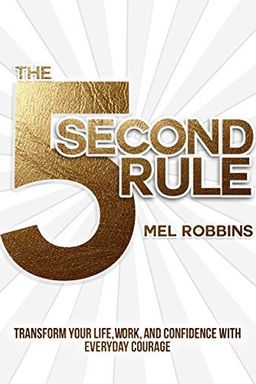
Have you ever sensed that your life could change in an instant, if only you had the courage to act? In The 5 Second Rule, Mel Robbins argues that every breakthrough begins not with motivation or inspiration, but with one deliberate, five-second decision. Robbins contends that waiting to “feel ready” is a trap that keeps you stuck, and that true transformation depends on the ability to override hesitation and act on instinct before your brain kills the impulse. Her central claim is simple yet profound: by counting down 5-4-3-2-1 and moving, you can reclaim control of your mind, habits, and confidence—five seconds at a time.
Drawing on personal struggles and scientific research, Robbins presents the 5 Second Rule as a metacognitive tool—one that teaches you how to change your behavior, master your emotions, and transform your mindset. The book blends neuroscience, habit theory, and everyday stories, showing how those five seconds between impulse and hesitation can make all the difference. Robbins opens by revealing how she discovered the Rule while stuck in a spiral of financial stress, drinking too much, and hitting snooze every morning. Watching footage of a rocket launch inspired her to ‘launch herself out of bed,’ and that simple countdown became her catalyst for change.
Why Five Seconds Matters
Behind the simplicity lies deep science. Robbins explains that the brain is wired to avoid discomfort and risk. Within seconds of feeling an instinct to act—whether to speak up in a meeting or start a workout—the prefrontal cortex triggers hesitation and self-doubt. The 5 Second Rule interrupts this pattern by activating the prefrontal cortex before excuses take over. It turns hesitation into deliberate action. By counting backward, you generate a moment of assertive control that forces your body to move while the mind recalibrates.
This idea echoes concepts in behavior science, like Newton’s concept of “activation energy” (the initial push needed to start a reaction) and Charles Duhigg’s “cue-routine-reward” habit loop from The Power of Habit. Robbins integrates these frameworks to show how micro-decisions can rewire thought patterns. What’s radical is that the Rule doesn’t rely on emotion—it frees you from waiting for motivation, something that she calls “a myth” because humans rarely feel like doing hard things.
Courage, Not Motivation
Robbins reframes courage as a series of small, non-dramatic acts. Courage isn’t reserved for heroes like Rosa Parks or Martin Luther King Jr.—it’s the mother pushing through exhaustion, or the employee daring to speak up. She reveals that courage is a “birthright,” not a rare gift, and the Rule serves as a bridge to uncover it. Everyday courage is the decision to act when you don’t feel like it, to trust your instincts in five seconds despite fear. By practicing this repeatedly, you build “real confidence,” not through pep talks but through experiential proof that you can rely on yourself.
Stories of people transforming their lives bring this abstract idea to life: a recovering addict counting down to resist a drink, a teacher facing anxiety by reframing fear as excitement, a shy engineer using it to approach a company CEO. These vignettes mirror Robbins’ own metamorphosis from hitting snooze to becoming a CNN contributor and bestselling author. The key insight: change doesn’t require massive transformation—it needs five seconds of courage.
The Scope of the Rule
Throughout the book, Robbins divides the Rule’s impact into four domains—behavior, mind, confidence, and relationships—demonstrating that courage compounds across life areas. The technique helps people end procrastination, increase productivity, beat anxiety, pursue passions, and deepen relationships through the simple habit of saying or doing what matters before fear interferes. When combined with research-backed strategies—from locus of control (Julian Rotter, 1954) to the progress principle (Teresa Amabile)—the Rule functions not merely as a motivational trick but as a cognitive reset, retraining the mind to favor action over avoidance.
Why It Matters Now
Robbins’ argument resonates because modern life is paralyzed by overthinking. Technology, social comparison, and perfectionism amplify hesitation, making courage scarce. The 5 Second Rule offers an antidote by returning agency to real time. It reminds you that your instincts—the quick urges to act—are often wiser than your fears. You don’t need therapy, endless self-analysis, or waiting for confidence; you just need five seconds of decisive movement. The result isn’t just action—it’s identity change. You stop being someone who waits and start becoming someone who moves.
Robbins closes by underscoring the broader truth: life changes not through grand epiphanies but through everyday acts of courage. Whether saving yourself from self-sabotage, pursuing love, or calling for help, every life-altering turning point begins with a moment of choice. The 5 Second Rule gives that choice form—a countdown, an impulse, and motion. One decision, five seconds, unlimited possibility.