
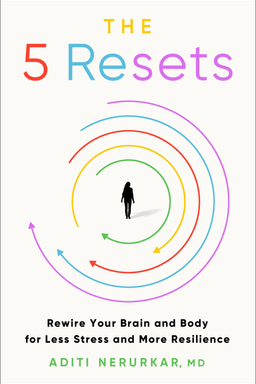
The 5 Resets cover

The 5 Resets

by Aditi Nerurkar

The 5 Resets provides transformative strategies to manage stress effectively. Through engaging stories and practical advice, Harvard physician Aditi Nerurkar guides readers in making lifestyle adjustments that enhance resilience, balance, and mental well-being.

Reset Stress, Rewire Resilience

Have you ever caught yourself saying, “I’m just burnt out,” yet kept trudging forward because you thought that’s what resilience means? In The 5 Resets, Harvard physician Aditi Nerurkar challenges that very idea. She argues that our culture’s definition of resilience—power through, keep hustling, ignore exhaustion—is dangerously wrong. Real resilience, she says, isn’t about endurance at all; it’s about resetting. In other words, learning to harmonize your brain and body so that stress becomes fuel, not poison.

Stress, she contends, isn’t the enemy. It’s a biological constant woven into our existence, but when it runs unchecked—like a tea kettle boiling too long—it morphs from adaptive to destructive. Through personal stories, patient experiences, and cutting-edge research, Nerurkar lays out a practical, science-backed roadmap for outsmarting the “biology of stress,” showing that burnout and chronic tension are reversible with small, deliberate lifestyle shifts called The 5 Resets.

The Myth of Pressure and Productivity

From high-performing friends like Liz, who went from ultramarathons to utter depletion, to her own near collapse in the cardiac ICU, Nerurkar illustrates what she calls the resilience myth: the false belief that staying tough through pain equals strength. Modern hustle culture rewards toxic resilience—late nights, multitasking, productivity at all costs—until our minds and bodies revolt. Stress isn’t a flaw in our character; it’s a function of biology misused by lifestyle design. That’s why nearly 75 percent of adults report burnout.

She reframes resilience as a biological process that needs tension and recovery. Without rest and recalibration, stress ceases to instruct and starts to erode. Instead of erasing stress, we must reset it—shifting our nervous system out of chronic threat mode. This approach reflects discoveries from neuroscience on neuroplasticity—the brain’s capacity to rewire itself through repeated, intentional actions. (Other writers like Kelly McGonigal, author of The Upside of Stress, echo this idea: that learning to interpret stress differently transforms biology itself.)

The Tea Kettle Metaphor and the Path Forward

Nerurkar’s central metaphor compares the human stress system to a tea kettle on a burner. You can’t remove the heat of life’s obligations—work, parenting, illness—but you can control the steam valve. Learning to release stress gently rather than letting it boil over keeps the system safe. Each of The 5 Resets opens that valve through practical micro-habits rooted in biological science:

  • Get Clear on What Matters Most – Define core priorities and align daily choices to purpose.
  • Find Quiet in a Noisy World – Protect mental bandwidth from digital overload.
  • Sync Your Brain and Your Body – Use breath, movement, and the gut-brain connection to restore equilibrium.
  • Come Up for Air – Build recovery into productivity through breaks and monotasking.
  • Bring Your Best Self Forward – Replace negative self-talk with gratitude and expressive healing.

Each reset translates neuroscience into everyday language and gives two to three tools, totaling fifteen actionable techniques that can be practiced quietly, at home, without apps or gurus. Like pressing “refresh” on a computer, each reset restores your system’s default settings for clarity, calm, and emotional safety.

Why These Ideas Matter Now

The timing of this work couldn’t be more urgent. In the wake of global uncertainty—the pandemic, economic shifts, and relentless digital noise—stress has reached epidemic proportions. We’re collectively living the stress paradox: though stress is universal, its isolating shame silences us. Nerurkar shows that acknowledging it publicly, much like group therapy’s “common humanity,” is the first step toward healing. Her work bridges high-tech medicine and high-touch compassion, showing that no matter your profession or circumstance, your biology holds the blueprint for recovery.

Ultimately, The 5 Resets is a guide for taking control of what you can—the inner circuitry of your own stress response—without waiting for external conditions to soften. You’ll learn to listen to your “canary in the coal mine” (your body’s first warning signals), adopt the Rule of 2 (only two small changes at once for lasting impact), and celebrate progress over perfection. Nerurkar’s message is clear: stress is not weakness, burnout is not inevitable, and resilience isn’t born from pushing harder—it’s cultivated through compassionate restoration.

Key Essence

Stress makes you human, but how you reset it makes you whole. Nerurkar’s five-part system helps you rewire your biology for calm strength—a new definition of resilience for the modern age.


The Biology of Stress and Resilience

Nerurkar begins by taking us inside the body’s hidden control panel for stress—the brain’s limbic system. When calm, the prefrontal cortex handles rational decisions and planning; under pressure, the amygdala hijacks control, activating our primal fight-or-flight mechanism. She calls this shift “cave-dweller mode.” The amygdala partners with the hypothalamus and pituitary gland to unleash cortisol and adrenaline—ancient chemical messengers that treat a work deadline or a tense call as if we’re fleeing predators.

From Survival to Burnout

This mechanism protects us during short-term crises but destroys us when chronic. Whether you’re rushing kids to daycare, answering work emails at midnight, or dealing with illness, your brain can’t tell the difference—it stays in escape mode endlessly. That’s why chronic stress creates brain “overuse injuries”: insomnia, exhaustion, irritability, and eventually burnout. Nerurkar calls burnout the biological result of too much cave-dweller activation and too little reset.

Delayed Stress Response

A striking insight from her clinical work is the delayed stress response—the surge that hits only after danger passes. Patients like Raquel, a cancer survivor, or refugees she studied in Geneva didn’t collapse during crisis; they fell apart once it was over. Our brains act like dams—holding strong until psychological safety returns, then releasing a flood of emotions. Recognizing this pattern helps you decode why you often break down after things are “fine.”

Neuroplasticity and the Rule of 2

The hopeful flip side is neuroplasticity—your mind’s power to rewire itself. Using incremental, repeated habits, you can strengthen the pathways that calm stress. However, too much change too quickly backfires, overwhelming your biology. Nerurkar’s Resilience Rule of 2 allows only two new habits at a time, ensuring durability and mental ease. She cites the research of psychologists Holmes and Rahe, who showed that even “positive” life events register as stress. Limiting change honors your body’s pace. (Think James Clear’s Atomic Habits—tiny steps that compound.)

Listening to Your Canary

You also learn to recognize your body’s warning signals—your “canary in the coal mine.” For the author, it was nighttime heart palpitations; for others, headaches, stomach pain, or irritability. These symptoms aren’t nuisances but messengers telling you to intervene before stress becomes illness. Nerurkar offers a stress scoring quiz (0–20 scale) so you can monitor progress like checking blood pressure. Over time, lowering that score translates to stronger emotional resilience.

Your biology isn’t broken—it’s responding perfectly to an unsustainable reality. When you honor its limits, apply small changes, and watch the canary’s signs, your brain starts healing itself.


Get Clear on What Matters Most

The first reset, “Get Clear on What Matters Most,” asks you to answer a deceptively simple question: not ‘What’s wrong with me?’ but ‘What matters most to me?’. Shifting from self-criticism to purpose changes your biology of stress. When Wes, a single father working two jobs, admitted he was burned out and overweight, Nerurkar helped him define his “MOST goal”—a specific, motivating, objective, small, timely goal—to align his actions with meaning.

Discovering Your MOST Goal

She teaches that each goal must be Motivating (energizing), Objective (trackable), Small (achievable), and Timely (within 3 months). For Wes, it was losing weight to stay healthy for his kids. By doing only two things—packing dinner the night before and walking while video-calling his children—he turned draining habits into restorative ones. This small Rule of 2 slowly improved his health and mindset.

The Backwards Plan

Once you have a MOST goal, Nerurkar introduces the Backwards Plan: start with your endpoint, then trace the steps backward to today. This reverse engineering removes overwhelm by visualizing each milestone. Wes’s list began with “buy smaller pants” and ended with “shop for groceries with the kids.” Seeing the path makes success tangible. Her structure mirrors what sports psychologists call goal visualization, used by elite athletes to prime neural circuits for success.

Eudaimonic vs. Hedonic Happiness

Nerurkar deepens the idea of purpose by distinguishing two kinds of happiness: hedonic (pleasure-based) and eudaimonic (meaning-based). Patients like Ryan, a wealthy but anxious music executive, discovered that chasing pleasure—luxury and status—led to emptiness. When he reconnected with his childhood joy of hiking and guitar playing, his anxiety eased and resilience grew. Similarly, Carmen, a terminally ill lawyer, found healing through sculpting and sitting on her porch—small acts that awakened meaning even amid mortality.

Feeling the Possibility

Finally, Nerurkar encourages you to feel the physics of possibility. Like potential energy transforming into motion, visualizing success “charges” the brain-body system. It’s not magical thinking; it’s neurophysiology. Small actions build self-efficacy—the quiet conviction that you can change. If your inner skeptic resists, that’s fine. Start with two tiny steps, imagine your destination, and let biology do the rest.

Getting clear on what matters isn’t just goal-setting—it’s turning stress into direction. Once you know your why, resilience becomes inevitable.


Find Quiet in a Noisy World

If your phone is the first thing you touch each morning, you’re not alone—and you’re probably robbing your brain of rest. The second reset helps you protect mental bandwidth amid digital overload. Nerurkar recounts Nicole’s triumph—managing ADHD-like distraction not by medication, but by learning to stop checking her phone. After practicing her ‘digital diet,’ she celebrated two hours of uninterrupted focus as a victory.

The Media Diet

The prescription isn’t abstinence but moderation: twenty minutes of screen scrolling twice daily. Set boundaries through time, geography, and logistics—timed use, phones out of sight, and no notifications. Julian, a train conductor consumed by around-the-clock news, followed these steps. Within eight weeks, his fatigue lifted, sleep improved, and mood stabilized. By redesigning his environment, he reset his biology.

Popcorn Brain and Doomscrolling

Digital overstimulation rewires neural circuits—creating popcorn brain, where constant pings make thoughts pop relentlessly. You crave novelty even during rest. Doomscrolling, the compulsive search for bad news, activates fear pathways identical to fight-or-flight. By limiting input, you soothe the amygdala and let the body reenter calm mode. (In Cal Newport’s Digital Minimalism, similar habits restore deep work.)

Healing Sleep and Social Connection

Screens sabotage sleep through blue light and dopamine-triggered alertness. Tanya, a graduate student, retrained her circadian rhythm using bedtime alarms, yoga stretches, and a 10 p.m. cutoff. Her GPA and mood soared. Nerurkar adds that hyperconnection online breeds disconnection in life—half of Americans report loneliness correlated with smartphone saturation. Cultivating offline social rituals, such as Selma joining a women’s soccer league, restores belonging and joy.

Finding quiet doesn’t mean shutting out the world—it means reclaiming your attention so that rest, laughter, and genuine human connection can fill the silence.


Sync Your Brain and Your Body

In the Third Reset, Nerurkar reveals the power of the mind-body connection—the constant dialogue between thoughts, emotions, and physical sensations. She teaches that stress lives as much in muscles and breath as in the mind. Through simple techniques, you can retrain this dialogue to serve healing instead of harm.

Stop–Breathe–Be and the Power of Breath

Her favorite technique, Stop–Breathe–Be, takes five seconds and can transform your day. By pausing before tasks—checking email, entering a meeting—you activate the body’s parasympathetic “rest-and-digest” system, cooling cortisol surges instantly. Breathing becomes the bio-gateway to emotional regulation because it’s the only bodily process both voluntary and automatic. Stanford researchers even identified a “pacemaker for breathing” that links respiration to calm emotions.

Movement Meditation and Small Steps

Next comes body movement as medicine. Miles, the former athlete turned sedentary manager, learned that twenty minutes of daily walking reversed his high blood pressure and mental fatigue in months. Exercise thickens the prefrontal cortex, enhancing focus and memory. Even ultrashort bursts—a flight of stairs or a walk around the block—lower mortality risks by up to 50%. Nerurkar reframes exercise not as fitness but as mental hygiene, like brushing your teeth.

The Gut-Brain Connection

She also illuminates the gut-brain cross talk: your intestines host trillions of neurons and microbiota that influence mood through serotonin production. Patients like Raina with IBS found that managing stress through sleep, walking, and mindful eating eased symptoms better than drugs alone. The Mediterranean Diet emerges as her gold standard for the microbiome—fruits, legumes, olive oil, and fermented foods strengthen gut health and mental clarity.

Progress Over Perfection

Mastering these physical resets calls for patience. Missing days or missteps doesn’t derail progress; consistency rebuilds neural pathways. Each breath and each walk is an invisible training rep for resilience.

Your body isn’t just the container for stress—it’s the cure. Sync it with your mind, and healing becomes inevitable.


Come Up for Air

Burnout feels like drowning in your own efficiency. The Fourth Reset, “Come Up for Air,” helps you reclaim time and focus through rest and ritual. Nerurkar’s patient Holly, a tech executive panicked by A.I. disruption, discovered that working less paradoxically improved output. This reset gives concrete tools for productivity without depletion.

The Goldilocks Principle

Imagine stress as a bell curve: too little leads to boredom; too much to burnout. The sweet spot fuels creativity and stamina. Holly found her balance by honoring micro-breaks of three to five minutes—stretching, breathing, or stepping away from screens. Microsoft’s brain-scan research confirms that short pauses between meetings reduce mental overload. Rest, not hustle, optimizes cognition.

Monotasking vs. Multitasking

Nerurkar debunks the myth of multitasking, showing that our brains merely “task switch,” weakening focus by 40%. Instead, she prescribes time blocking—the Pomodoro method’s 25-minute deep-work intervals followed by short breaks. Over weeks, these compact units rebuild concentration and guard against burnout. Holly’s productivity, once fragmented, became fluid; she finally entered the “flow state,” that timeless zone of effortless focus described by psychologist Mihaly Csikszentmihalyi.

Fake Commute and Rituals

For remote workers like Giselle, Nerurkar introduces the fake commute: replicate the mental buffer a real commute provides. A morning walk or café stop signals the shift from “home” to “work,” while an evening ritual—closing the laptop, walking again—acts as a bookend. Even drivers like Henry learn to ground themselves through “sticky feet,” focusing mentally on where their feet are to calm racing thoughts. Each ritual creates a boundary that lets your brain breathe.

To come up for air is not to escape work—it’s to reclaim the oxygen your mind needs to sustain it. Rest is science, not luxury.


Bring Your Best Self Forward

The Fifth Reset turns inward to tame your most relentless stress trigger: the inner critic. When your amygdala’s survival instincts overfire, the mind produces scarcity thoughts—“I’m failing,” “I can’t cope.” Nerurkar reframes this not as psychological weakness but as biology trying (incorrectly) to protect you. The antidote? Gratitude and expressive writing—tools that rewire the brain for calm self-compassion.

From Self-Criticism to Gratitude

Robyn, an entrepreneur and new mother, found herself spiraling over a coffee stain, hearing inner doomsday predictions. Through Stop–Breathe–Be and nightly journaling of five items she was thankful for, she muted her inner critic within a month. Gratitude practices shift focus from scarcity to abundance, making negative experiences slide off “like Teflon.” Research confirms that consistent gratitude lowers stress hormones and boosts resilience.

Expressive Writing and Living a Lifetime in a Day

The second technique, Expressive Writing, developed by psychologist James Pennebaker, asks you to write freely for 15–20 minutes about emotional truths for four consecutive days. Patients like Jeanette and Carmen used it to release anger and regret. Carmen, dying of cancer, also adopted Nerurkar’s philosophy to “live a lifetime in a day”—experiencing childhood wonder, work purpose, community, solitude, and reflection within every 24 hours. It’s a framework for meaningful living, whether you have decades or only days left.

Self-Compassion as Protection

Finally, the author highlights self-compassion as the ultimate stress shield. Studies show it lowers cortisol and calms the amygdala compared to self-criticism. It changes stress from fear-driven reaction to love-driven motivation. Nerurkar’s closing message: progress, not perfection. Healing unfolds like bamboo growing underground—silent at first, then rising ninety feet in weeks. To be resilient is not to resist stress but to honor it gently.

Your best self isn’t stress-free—it’s stress-wise. Gratitude, expression, and compassion make resilience a daily, living practice.


The Fast Track to Sustainable Change

In her conclusion, Nerurkar insists that transformation isn’t instant—it’s biological. Change unfolds through five Stages of Change: precontemplation, contemplation, preparation, action, and maintenance. Real progress begins when the desire for something better outweighs the need to stay the same. Like the tortoise beating the hare, slow steady resets outlast frantic ones.

Trusting the Messy Middle

Growth is nonlinear and often messy—filled with frustration and self-doubt. Nerurkar urges you to trust that your biology is recalibrating even when it feels stagnant. We misjudge progress because internal rewiring precedes visible results. Just as Chinese bamboo appears dormant for years before skyrocketing seventy feet, your stress circuits are strengthening underground.

Self-Compassion and Future Self Visualization

Combining behavioral science with mindfulness, she advises using visual cues—affirmation notes, checkmark streaks, and reminders—to reinforce action. Self-compassion fuels change more effectively than self-criticism, biologically lowering stress markers. Visualizing your future self—healthy, calm, purposeful—activates neural pathways for motivation, mirroring findings in positive psychology and sports visualization.

Progress Over Perfection

Healing is the accumulation of tiny wins: a mindful breath, one walk, one decent night’s sleep. Nerurkar closes with humility—she doesn’t fix stress for you; she mirrors your capacity to fix it yourself. Her metaphor of the raincoat reminds readers that the techniques prepare you not to avoid future storms but to endure them with clarity and calm. As Pema Chödrön said, “You are the sky; everything else is just the weather.”

Lasting change doesn’t come from hacks or haste. Trust the process. Two steps at a time, your biology learns to blossom.

Dig Deeper

Get personalized prompts to apply these lessons to your life and deepen your understanding.

Go Deeper

Get the Full Experience

Download Insight Books for AI-powered reflections, quizzes, and more.