
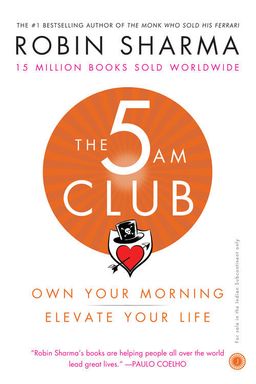
The 5 AM Club cover

The 5 AM Club

by Robin Sharma

The 5 AM Club by Robin Sharma unveils a revolutionary morning routine to transform your life. Through the inspiring journey of an entrepreneur, artist, and their billionaire mentor, discover how waking at 5 AM can boost creativity, productivity, and personal growth. Unlock the secrets to mastering your mornings and achieving extraordinary results.

Owning Your Morning, Elevating Your Life

Can the first hour of the day change the rest of your life? In The 5 AM Club, Robin Sharma argues that it can—and that mastery, peace, and creativity start long before the world wakes up. His story, told through the encounters of an artist, an entrepreneur, and a mentor disguised as a homeless man, anchors a simple but profound claim: if you own your morning, you elevate your life.

Across Mauritius beaches, the Taj Mahal chambers, and the vineyards of Franschhoek, Sharma dramatizes a journey from confusion to clarity. The billionaire mentor, Stone Riley, transmits The Spellbinder’s teachings through experiences, rituals, and models—each designed to help ordinary people reach extraordinary levels of focus, productivity, and inner calm. These teachings form an integrated life system that blends neuroscience, psychology, philosophy, and spirituality into a practical manual for purposeful living.

The Science and Spirit of 5 AM

The pre-dawn hour is not simply symbolic; it’s biologically strategic. The brain’s early-morning chemistry—lower cortisol, higher dopamine, and elevated BDNF—creates an ideal environment for creative insight and emotional regulation. Sharma’s narrative shows what that looks like in practice: when the entrepreneur works in solitude at dawn, her ideas deepen; when the artist paints before sunrise, his creativity returns. The world’s noise hasn’t yet invaded, so concentration sharpens naturally.

In contrast, distraction—anchored by device addiction and digital overload—erodes what Sharma calls “the sovereignty of attention.” The 5 AM practice restores that sovereignty, giving you focus and flow before external demands deplete willpower. (Note: Sharma aligns this idea with research by psychologists like Roy Baumeister on ego depletion and Kahneman’s bandwidth theory.)

Transformation as a System, Not a Slogan

What makes The 5 AM Club more than a time-management gimmick is its structured ecosystem of habits. Riley’s teachings unfold as a sequence of frameworks: the 3-Step Success Formula (awareness → choices → results), the 4 Interior Empires (Mindset, Heartset, Healthset, Soulset), the 20/20/20 Victory Hour, and the Habit Installation Protocol. Each concept interlocks so change moves from abstract aspiration to concrete practice.

For instance, you begin by recognizing your limiting stories (awareness), replace them with better micro-decisions (choice), and discipline those decisions through ritual and neuroscience-backed repetition (habit installation). You grow internally through the four empires, strengthen resilience through discomfort drills, and compound progress through day stacking. Everything converges into one lived truth: small daily wins multiply into mastery.

The Human Drama Behind the Habit

The novel format matters because it turns theory into lived journey. The artist’s self-doubt, the entrepreneur’s grief, and the billionaire’s hard-won wisdom make the principles emotionally real. You see that waking early is not punishment—it’s an act of self-respect. Riley’s barefoot walks, quiet swims, and disciplined solitude demonstrate gentleness alongside rigor. That paradox—intensity with compassion, routine with grace—is the rhythm of sustainable excellence.

Sharma’s characters embody the broader arc of change: resistance, messy practice, then integration. The idea that “all change is hard at first, messy in the middle, and gorgeous at the end” recurs as both warning and promise. It’s the rhythm of neuroplasticity and personal growth alike.

Beyond Productivity: Toward a Heroic Life

Ultimately, the 5 AM discipline is not about hacks or hustle; it’s about identity. By mastering mornings, you reclaim authorship over your inner and outer world. The final sections—on Twin Cycles, Heroic Legacy, and leadership—reveal why: greatness lies in oscillating between work and renewal, and between ambition and service. The goal is not only peak performance but also moral elevation. As The Spellbinder insists, leadership is for everyone who chooses to serve with excellence and empathy.

In the end, Sharma fuses productivity with philosophy. Morning rituals train your neurobiology; nightly discipline restores it. Solitude builds strength; service gives it meaning. When you treat your life as an integrated system—mind, body, heart, and soul—you become, in his phrase, “a hero of your own life,” combining mastery with humanity.

Core message

Lead yourself before you lead the world. Start with one sacred hour at dawn, and let that discipline ripple outward until it shapes your destiny.


Early Rising and The Victory Hour

The 5 AM habit is the keystone of Sharma’s philosophy—a simple ritual that initiates profound results. Stone Riley calls it “The Mother of All Routines,” because it is both a marker of discipline and a mechanical trigger for neurochemical optimization. The hour between 5 and 6 AM, dramatized in the book as the Victory Hour, operates as a daily master key for clarity and performance.

The 20/20/20 Formula

The Victory Hour divides into three deliberate twenty-minute pockets: Move, Reflect, and Grow. The first twenty minutes—Move—leverages intense physical activity to drop cortisol, increase dopamine, and boost BDNF, building mental sharpness. The next block—Reflect—invites journaling and meditation to anchor emotional stability. Finally, Grow—through reading or study—expands intellectual capacity. These three segments together train the four Interior Empires: Mindset, Heartset, Healthset, and Soulset.

Riley portrays these moments vividly: journaling in Rome, sunrise runs on Mauritius beaches, and reading under Italian domes. Simple routines gain gravitas through place and ritual, showing how symbols and sacred spaces reinforce habits.

Freedom from Distraction

Sharma argues that distraction is the modern epidemic sabotaging this practice. Device addiction, he warns, leads to “digital dementia.” Your attention is finite capital; if you spend it on notifications, you can’t invest it in creation. The 5 AM hour offers you uninterrupted focus before the economy of noise awakens. (Note: neuroscientists like Sophie Leroy call the lingering cost of context-switching “attention residue.”)

Riley’s counsel: stop managing time, start managing focus. You design conditions of deep work through solitude, silence, and one protected golden hour. That is how the few create what the many envy—consistent deep output.

Practical Implementation

Sharma emphasizes process. Rising at 5 AM isn’t about willpower alone—it’s engineered: external alarm (trigger), Move-Reflect-Grow blueprint (routine), self-praise or tracking progress (reward), and repeated execution (repetition). Using this reinforcement cycle, habits gain automaticity after roughly 66 days. Expect the Destruction, Installation, and Integration phases; each signals neural rewiring. Persevering through “the messy middle” is the rite of passage from effort to identity.

Key reminder

Don’t try to fit 5 AM into your old life—use it to build a new one. The Victory Hour isn’t about time; it’s about becoming the kind of person who guards what matters.


The Four Interior Empires

Sharma rejects the popular notion that mindset alone drives success. He insists that true mastery begins inside with four equally crucial dimensions: Mindset, Heartset, Healthset, and Soulset. These 'Interior Empires' are trained every morning within the Victory Hour, creating balanced growth rather than brittle high performance.

Mindset

Your Mindset governs your narrative—how you explain events to yourself. Riley teaches the entrepreneur to replace her limiting 'fatherless daughter' story with a narrative of worth. Visualization, goal rehearsal, and self-talk are the morning tools. What you believe eventually scripts what you build. (Note: this idea echoes Carol Dweck’s growth mindset research.)

Heartset

Heartset manages your emotional hygiene. Riley reminds his students that cognitive mastery is only 25% of change; emotional healing is the rest. Gratitude journaling, forgiveness, and releasing resentment clear the inner space for courage. The artist’s creative renewal begins not with technique but with forgiving his past failures.

Healthset

Healthset is physical stewardship—exercise, nutrition, and sleep. Riley’s dawn runs and disciplined eating are not vanity practices but acts of longevity. A healthy body multiplies cognitive power and emotional resilience. “Do not die” becomes a professional strategy, not melodrama.

Soulset

Soulset cultivates spiritual clarity—the alignment of daily action with moral compass. Meditation, reflection, and service feed this dimension. Riley equates it with inner nobility—doing what’s right, not what’s easy. Soulset transforms success into significance, anchoring purpose amid productivity.

Core teaching

“External always expresses internal.” You can’t upgrade your performance without upgrading the person performing.


Habit Science and Discipline

The difference between fleeting motivation and lasting transformation, according to Riley, lies in habit architecture. He frames change as neurobiological engineering, not emotional luck. Through the Habit Installation Protocol and the 5-3-1 Creed, you learn how to translate intent into identity by design.

The Habit Installation Protocol

Riley’s model defines four components of every habit: trigger, routine, reward, repetition. By scripting these elements consciously—like setting an analog alarm, placing journals by your bedside, or rewarding yourself with sunrise quiet—you shift from decision fatigue to automation. Crucially, you commit for 66 days to cross three stages: Destruction (breaking old habits), Installation (the messy middle), and Integration (automatic behavior). After this, the habit runs on autopilot—what Riley calls “The Automaticity Point.”

Willpower as a Trainable Muscle

Sharma reframes willpower as physiological capacity, not abstract virtue. Riley’s 'Strengthening Scenarios'—cold showers, fasting, sleeping on the floor—are deliberate discomfort drills that stretch resilience. Just as muscles grow by resistance, your self-control circuits strengthen through temporary strain. Riley’s mantra: “To voluntarily enter hardship is to recruit your sovereign self.” (Note: this aligns with Stoic premeditation and contemporary resilience training.)

Repetition and Reward Structures

Each act of discipline reinforces neural patterns through dopamine signaling. You celebrate consistency, not performance. Journaling micro-wins, reflecting after each Victory Hour, and teaching others what you’ve learned accelerates integration. The practice transitions from external effort to internal identity—“I am the kind of person who rises early.”

Implementation rule

Habits don’t change your life instantly; they change your identity gradually. Commit long enough, and the person who struggled to start becomes the one who can’t imagine stopping.


High Performance and Daily Compounding

Performance excellence in Sharma’s framework is a game of compounding micro-wins, not sudden breakthroughs. Through concepts like Capitalization IQ and Day Stacking, Stone Riley teaches that ordinary people become extraordinary by maximizing existing resources and improving by fractional increments daily.

Capitalization IQ

Capitalization IQ measures how well you exploit your potential rather than how much raw talent you possess. Riley’s coaching of the artist illustrates this: skill gaps matter less than consistency and rigor. This mirrors psychologist Anders Ericsson’s research on deliberate practice—the disciplined conversion of capacity into competence.

Day Stacking and 1% Improvements

Sharma’s math is simple: a 1% improvement each day compounds beyond 365%. Each well-run Victory Hour, each protected focus block, stacks invisible dividends. Riley’s metaphor—Formula One pit crews cleaning the bay—shows that greatness is granular. Those marginal gains yield cumulative leverage over time.

Tactics for Genius

Practical amplification comes through his Ten Tactics of Lifelong Genius: the Tight Bubble of Total Focus (TBTF), the 90/90/1 Rule, and the 60/10 Method. Implemented together, they create orchestration between intensity and renewal. TBTF limits distractions; the 90-day, 90-minute ritual ensures progress on what matters most; the 60/10 rhythm cycles deep effort with recovery. These are not hacks but structural rhythms of excellence.

Mantra of compounding

“The hours the 95% waste, the top 5% treasure.” Small disciplines, repeated daily, create what luck only pretends to explain.


Recovery, Rigor, and Legacy

Sharma concludes his system with two integrated principles: the Twin Cycles of Elite Performance and the Heroic Human Circle. Together, they prevent burnout and elevate success into service, ensuring that mastery sustains itself rather than consuming the person who achieves it.

Oscillation and The Twin Cycles

The Twin Cycles model alternates High Excellence Cycles (HEC) with Deep Refueling Cycles (DRC). Just as athletes periodize training, you must periodize life: intense creative sprints followed by deliberate rejuvenation. Riley lives this cadence—zero-device days weekly, quarterly refuels, annual detachment. Stress plus recovery equals growth plus endurance. Without refueling, excellence collapses into exhaustion.

The Dark Side of Genius

Riley warns that the same traits that create extraordinary output—obsession, precision, control—can corrode relationships and joy if unmoderated. The antidote is internal balance through Heartset and Soulset practices. Genuine leadership demands rigor with empathy. “To lead is to serve,” The Spellbinder insists—a shift from status to stewardship.

Legacy and Virtue

Through the Heroic Human Circle, Riley links performance to virtue: courage, compassion, forgiveness, and service. Refusing comfort, facing pain, and using success to uplift others is the final maturity stage of mastery. The Robben Island sequence, invoking Mandela’s moral leadership, demonstrates that discipline without decency is hollow.

Nightly Systems for Renewal

Evenings close the loop. Sleep activates the brain’s glymphatic cleaning system, regulates hormones like HGH, and restores decision capacity. Riley prescribes five 90-minute cycles—around 7.5 hours—for recovery, along with digital curfews and reflective journaling. You can’t bolt heroic mornings atop chaotic nights; restoration is as strategic as exertion.

Final lesson

Sustain excellence through rhythm: push hard, rest deeper, serve wider. The purpose of mastery is not perfection but contribution.

Dig Deeper

Get personalized prompts to apply these lessons to your life and deepen your understanding.

Go Deeper

Get the Full Experience

Download Insight Books for AI-powered reflections, quizzes, and more.