
Idea 1
The Path to Inclusion and Innovation Through Psychological Safety
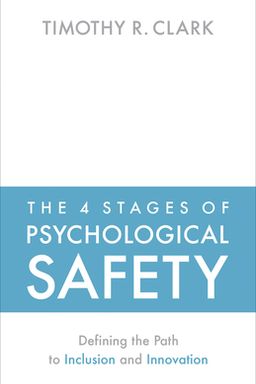
Have you ever been in a meeting where you wanted to share an idea but held back—maybe out of fear of looking foolish or being dismissed? In The 4 Stages of Psychological Safety, Timothy R. Clark argues that this moment of silence is more than just hesitation—it’s a signal of a deeper cultural problem. Psychological safety, he contends, is the invisible force that determines whether people will speak up, learn, contribute, and innovate together. Without it, organizations stagnate; with it, they thrive.
Clark’s central argument is both humanistic and practical: to achieve genuine inclusion and innovation, we must fulfill four sequential human needs—the need to be included, to learn, to contribute, and to challenge the status quo. Together, these constitute the four stages of psychological safety. Each stage represents a deeper level of trust, respect, and permission in any human system—from families to corporations. Clark weaves social science, leadership anthropology, and personal storytelling into a model that gives leaders a roadmap for building cultures of candor, accountability, and creativity.
From the Steel Mill to Psychological Safety
Clark’s journey toward this framework began unexpectedly. Fresh out of Oxford with a PhD in social science, he found himself managing Geneva Steel, one of the last fully integrated mills in America. In this gritty, hierarchical environment, he witnessed how fear silenced workers—even in matters of safety. After a tragic accident caused by rule violations, Clark realized that safety was not merely procedural—it was psychological. He observed that employees feared their superiors more than physical danger, and that this fear suffocated communication and collaboration. His insight would later crystallize into one of the book’s central lessons: fear is the hallmark of weak leadership.
“If you can banish fear, install true accountability, and create a nurturing environment that allows people to learn and be vulnerable, they will perform beyond your expectations—and theirs.”
This became the foundation for Clark’s model, grounded in leadership as a moral responsibility to protect and empower others. Over the next twenty-five years, he studied how psychological safety unfolds in organizations across cultures and industries. He discovered that every team, family, and institution operates somewhere along a spectrum of psychological safety—and that this progression follows a predictable pattern rooted in basic human needs.
The Four Stages of Safety
Clark’s model advances in four stages:
- Stage 1: Inclusion Safety – You feel accepted for who you are; others value your humanity, not just your performance. Belonging comes before contribution.
- Stage 2: Learner Safety – You feel safe enough to ask questions, make mistakes, and engage in the messy process of learning. Failure becomes part of growth, not humiliation.
- Stage 3: Contributor Safety – You are trusted to exercise autonomy, take ownership, and deliver results. You get to “play in the game” rather than sit on the bench.
- Stage 4: Challenger Safety – You can question outdated norms and propose new ideas without fear of retribution. Here, innovation begins.
Progressing through these stages depends on balancing two forces: respect—how much you value others as human beings—and permission—the degree to which you allow others to participate, influence, and express themselves. When both are high, teams enter the “lane” of psychological safety; when either is low, they fall into the “gutters” of paternalism (high respect but low permission) or exploitation (high permission but low respect).
Fear, Power, and Leadership
A recurring theme in Clark’s framework is the role of power. At Geneva Steel, Clark learned how authority shapes behavior: when status dominates, honesty evaporates. He found that effective leaders must “simultaneously increase intellectual friction and decrease social friction.” In other words, encourage robust debate but eliminate hostility. Creativity thrives in high intellectual tension and low social tension. Most organizations, he argues, get it backward.
This insight reframes leadership as a moral act rather than a technical one. It’s not enough to have strategy, vision, or funding; a leader must create and protect a space where people feel respected, heard, and safe to contribute. As Maya Angelou and Hannah Arendt remind us (both quoted in the book), our greatest struggles are not technological but social—how we treat each other determines whether society progresses or perishes.
The Path from Belonging to Bravery
Clark’s four stages trace a path from belonging to bravery. We begin with the primal need to be accepted (inclusion safety). Only when that need is met can we move into the vulnerability of learning (learner safety), the accountability of contribution (contributor safety), and finally, the courage of challenging systems that no longer serve their purpose (challenger safety). When leaders and organizations fail to progress through these stages, fear fills the vacuum, and fear, as Clark repeatedly warns, “freezes initiative, ties up creativity, yields compliance instead of commitment, and represses what would otherwise be an explosion of innovation.”
Why It Matters in Today’s World
In a world that prizes inclusion and innovation but often achieves neither, Clark’s work offers both a diagnosis and a cure. It challenges leaders to replace positional power with moral power—to liberate human potential by replacing fear with trust. It’s no coincidence that Clark closes his book with a call to “crack yourself open” and examine your own biases and behaviors. Leadership, he suggests, begins with the humility to listen and the courage to change.
“The real frontier of modernity isn’t artificial intelligence—it’s emotional and social intelligence.”
Through this lens, The 4 Stages of Psychological Safety isn’t just a management book—it’s a guide to humane leadership and collective ingenuity. The question is not simply how to build better teams but how to become better humans together.