
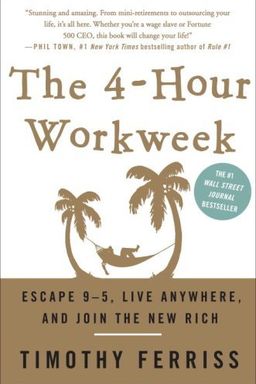
The 4-Hour Workweek cover

The 4-Hour Workweek

by Tim Ferriss

The 4-Hour Workweek by Tim Ferriss is a transformative guide to escaping the traditional work model. It offers strategies for achieving financial freedom, maximizing productivity, and living a life of luxury and mobility without waiting for retirement.

Redefining Success and Freedom in the Modern World

What if the secret to living your best life wasn’t about grinding harder, but about redesigning how you work entirely? Through The 4-Hour Workweek, Tim Ferriss makes a bold claim that flips traditional success on its head: you don’t have to wait until retirement to enjoy freedom, adventure, and meaning. Instead, you can restructure your life to earn more money in less time and reclaim control over your schedule, location, and purpose. It’s not just a productivity book—it’s a manifesto for a lifestyle revolution.

Ferriss introduces readers to the idea of the New Rich (NR), people who have escaped the old paradigm of deferred living—the idea that you must work tirelessly for decades and enjoy life only once you retire. The “Deferrers,” as Ferriss calls them, follow conventional rules: they work 9–5, climb a corporate ladder, and equate money with happiness. The New Rich, by contrast, understand that time and mobility are the real forms of wealth. They use technology, leverage automation, and pursue excitement—not just comfort—to craft a life that blends income and adventure in the present.

The Freedom Multiplier

A central concept Ferriss shares is the “Freedom Multiplier,” defined as controlling four W’s in your life—what you do, when you do it, where you do it, and with whom you do it. The more W’s you control, the richer your life becomes, regardless of your bank balance. This is a subtle but powerful shift: instead of measuring success by income, measure it by autonomy. A person earning $40,000 who works four hours a week and travels the world actually lives better than someone making $500,000 chained to an 80-hour grind.

The DEAL Formula

The book’s method revolves around four phases—D.E.A.L.: Definition, Elimination, Automation, and Liberation. Each step helps move you from dream to execution:

  • Definition forces you to question assumptions about work, success, and wealth. You define what truly excites you rather than what merely makes you comfortable.
  • Elimination strips time-wasting tasks and distractions—emails, meetings, and overconsumption of media—that impede real progress.
  • Automation empowers you to delegate repetitive tasks through technology and outsourcing, building systems that run without your direct involvement.
  • Liberation then applies the previous three steps to break free from office constraints and create a location-independent lifestyle, enabling mini-retirements and global mobility.

Escaping the Default Path

Ferriss insists that most people stay stuck not because of lack of opportunity, but because of fear—fear of risk, of quitting, or of appearing irresponsible. In one story, Hans Keeling, a burnt-out lawyer, promised himself if he ever spent more than three nights sleeping under his desk, he’d quit. He did exactly that and moved to Brazil to run surf tours. His leap wasn’t luck—it was a deliberate rejection of pessimism and imagined fears that paralyze action. Ferriss helps you visualize your worst-case scenario (“fear-setting”) and realize that the fallout is rarely catastrophic. This process frees you to pursue bold choices with rational calm.

Shifting from Happiness to Excitement

One of Ferriss’s most provocative points is that happiness isn’t enough. Happiness can come from a pleasant dinner or a short vacation. It’s too fleeting to build a life around. Instead, aim for excitement—the kind that wakes you up in the morning eager to act. Excitement drives creative risk taking, fuels entrepreneurship, and counters boredom, which Ferriss calls “the enemy.” The antidote to mediocrity, then, is ambitious dreaming paired with structured execution, what he terms Dreamlining.

Building a Life That Runs Itself

Ultimately, The 4-Hour Workweek is about designing a life that works even when you don’t. Ferriss shares practical tools—like outsourcing repetitive tasks to virtual assistants, batching email responses, and applying the Pareto Principle (80/20 rule) and Parkinson’s Law to focus only on high-impact work in minimal time. These tools combine philosophy and practicality: simplify, automate, and liberate. When work stops being a life sentence and starts being a tool for freedom, you join the ranks of the New Rich.

“Money is multiplied in practical value depending on the number of W’s you control: what you do, when you do it, where you do it, and with whom you do it.” – Tim Ferriss

For readers burnt out by endless work cycles, Ferriss offers a practical escape hatch: focus less on surviving until retirement and more on crafting life now. His blend of data-backed productivity hacks and audacious lifestyle experiments makes this book not just a guide but a challenge—to reject the ordinary and become truly free. Through Definition, Elimination, Automation, and Liberation, you can transform your workweek, and more importantly, transform your world.


The DEAL Framework: A Blueprint for Lifestyle Design

Tim Ferriss structures his roadmap around four transformative steps—Definition, Elimination, Automation, and Liberation. This framework isn't just a productivity system; it's a new way of thinking about time, work, and freedom. Each phase challenges long-held assumptions about what it means to be successful and offers actionable steps to break free from the constraints of ordinary living.

Definition: Rethink What You Really Want

Definition asks you to confront uncomfortable truths. Are you pursuing money or meaning? Do your goals excite you or merely fill time? Ferriss suggests creating Dreamlines—a six- or twelve-month timeline listing goals in three categories: having, being, and doing. Example: owning a new wardrobe (having), learning German (being), and mastering windsurfing (doing). These dreams help you calculate a Total Daily Income (TDI), the amount you’d need daily to make your dreams real. Suddenly, dreams become measurable rather than abstract fantasies.

Elimination: Cut the Noise, Focus the Signal

This is where you dismantle the culture of busyness. Ferriss uses the Pareto Principle—80% of outcomes come from 20% of efforts—and Parkinson’s Law, which states that tasks swell to fill the time allotted. Applying both, you identify work that truly matters and impose tight deadlines that compress inefficiency. You also take on Ferriss’s “Low-Information Diet,” cutting out news, social media, and trivial distractions. Instead of multitasking, you focus entirely on one high-impact objective at a time. The payoff is not just productivity, but liberation from mental clutter.

Automation: Build Machines That Earn While You Sleep

Automation is Ferriss’s secret weapon. By outsourcing tedious tasks using virtual assistants (VA), automated billing systems, and fulfillment centers, you create a self-running business—a muse. These muses are income-generating systems that operate with minimal oversight. Ferriss breaks down how to micro-test business ideas using $50 websites and Google Ads campaigns before scaling them. Once a concept proves profitable, you systematically delegate sales, customer service, logistics, and marketing until your role shrinks to supervision. Less work, more income, and full scalability.

Liberation: Escape the Office, Live Anywhere

Liberation puts everything into practice. By demonstrating efficiency and autonomy, employees can negotiate remote work or even transition into entrepreneurship. Ferriss outlines how to persuade managers through trial remote days, manage expectations, and build trust—eventually creating complete location independence. “Being bound to one place,” Ferriss notes, “will become the defining feature of the middle class.” Once liberated, people can take “mini-retirements”—extended stays abroad where living is cheaper and learning is priceless.

Through DEAL, you realize that personal freedom isn’t a distant dream—it’s a system you can design, refine, and automate.

The DEAL framework transforms ambition into a process. You stop reacting and start designing, taking deliberate steps to build a life that prioritizes time, mobility, and purpose over perpetual busyness. It’s the ultimate antidote to a life spent waiting for weekends and retirement.


Fear-Setting: Turning Anxiety into Action

Most people’s biggest obstacle isn’t lack of opportunity—it’s fear. In a society obsessed with stability and “realism,” Ferriss argues that fear—not failure—is what kills dreams. His antidote is a practical mental exercise called fear-setting, inspired by stories like Hans Keeling, the lawyer who left his desk job after realizing his worst-case scenario wasn’t truly catastrophic.

Mapping Your Worst Nightmares

Ask yourself: what’s the worst thing that could happen if you took the leap? Losing your job? Facing criticism? Moving back home temporarily? Ferriss walks you through seven questions to define your fears, assess repairability, and evaluate consequences realistically. When quantified, fears lose their stranglehold. This process reveals that most “disasters” barely register beyond a 4 out of 10 in life impact, and that recovery, not ruin, tends to follow bold moves.

The Power of Perspective

Fear-setting transforms paralysis into motion. When you write down your fears, you shift from imagination to evidence, revealing that action costs less than inaction. Ferriss states, “Being able to quit things that don’t work is integral to being a winner.” Quitting toxic jobs or misguided projects becomes an act of wisdom, not weakness. Optimism without realism, what he calls “optimistic denial,” is merely another form of stagnation.

(Comparable advice appears in Susan Jeffers’s Feel the Fear and Do It Anyway: both authors focus on the productive role of discomfort in transformation.)

From Fear to Eustress

Ferriss distinguishes between distress (harmful stress) and eustress (positive, growth-oriented stress). When you take risks that challenge your limits, eustress ignites creativity and confidence. Saying “yes” to adventure and “no” to stagnation rewires how you experience stress. This mindset aligns with stoic philosophy—it’s the art of detaching fear from failure.

Fear-setting reframes risk from something to avoid to something to manage. Once you see your fears clearly, you realize the real danger lies not in failing, but in never trying.


The End of Time Management

Ferriss argues that traditional time management—scheduling, goal-setting, and staying busy—is fundamentally broken. “What you do,” he says, “is infinitely more important than how you do it.” Real productivity means focusing on the tasks that matter, not organizing trivial ones more efficiently.

Applying the Pareto Principle

The 80/20 rule is central: 80% of results come from 20% of effort. Identify your top 20%—clients, projects, or actions that drive most rewards—and eliminate the rest. Ferriss even recommends “firing” the 80% of customers who waste time with endless complaints and little revenue. While this sounds radical, it frees space for quality over quantity. When you analyze revenue sources, marketing channels, or relationships through the 80/20 lens, focus sharpens, efficiency skyrockets, and stress plummets.

Parkinson’s Law: Deadlines That Cultivate Speed

Parkinson’s Law states that work expands to fill the time available for its completion. Give yourself less time, and you’ll concentrate on essentials. Ferriss uses this principle to compress workdays—turning eight hours of drifting into two hours of focused output. Short deadlines spur action, eliminating procrastination disguised as productivity. Together, Pareto and Parkinson form a one-two punch that reshapes work: fewer tasks, shorter deadlines, more results.

Creating an Anti-To-Do List

Ferriss encourages writing two lists: what to do, and what not to do. The “Not-To-Do” list pinpoints activities that feel productive but drain focus—like excessive meetings or multitasking. Being busy, he says, is “lazy thinking and indiscriminate action.” Replace busyness with deliberate minimalism. This creates creative energy and accurate prioritization.

Ferriss reframes productivity as output, not hours. Success becomes defined by effectiveness, not endurance.

By unlearning traditional time management and mastering focus, you achieve what Ferriss aims for: more life in fewer hours of work. This realignment between effort and reward fuels every step toward the 4-hour lifestyle.


Outsourcing and Automation: Creating Your Muse

Ferriss believes the path to freedom isn’t just better efficiency—it’s building self-running systems. Outsourcing, paired with automation, transforms passive work into passive income. The centerpiece: your muse—a small, automated business designed to fund your ideal lifestyle while demanding minimal oversight.

Choosing and Testing a Product

Instead of betting everything on intuition, Ferriss insists on micro-testing. With a $50 website and $250 in Google Ads, you can gauge demand before investing in full-scale operations. Create test advertisements, analyze click-through rates, and refine taglines until proof of concept emerges. This lean validation approach mirrors methods in Eric Ries’ The Lean Startup—fail quickly, learn rapidly, scale efficiently.

Building the Dream Machine

When your product sells, design the business so it functions independently. You outsource fulfillment, customer service, and manufacturing to specialists. Ferriss reminds you: “Our goal isn’t to create a business that is as large as possible, but rather one that bothers us as little as possible.” Size isn’t the metric—freedom is. The result: a scalable, stress-free enterprise that delivers income without constant involvement.

Hiring Virtual Assistants

Virtual Assistants (VAs) epitomize the automation revolution. By assigning repetitive tasks like scheduling, research, or customer outreach, you reclaim time for creativity and adventure. Ferriss provides caveats—be specific, set deadlines (Parkinson’s Law), and prioritize tasks. Always use credit cards, not debit cards, to prevent fraud, and verify VA companies through trials. The key: trust systems, not micromanagement.

Automation isn’t about laziness—it’s about leverage. When your muse works for you, freedom becomes the new measure of success.

By using outsourcing as an ally instead of a luxury, Ferriss helps you step out of the endless loop of busywork and into a life engineered for exploration, learning, and growth.


Mini-Retirements and the Joy of Slow Travel

Rather than saving travel and leisure for old age, Ferriss encourages taking multiple “mini-retirements” throughout life. This idea flips conventional retirement planning upside down and teaches that enriching experiences can—and should—happen now.

Redefining Retirement

In Ferriss’s world, retirement isn’t a reward—it’s a trap. Working 80-hour weeks for 40 years to earn freedom later is both foolish and inefficient. Instead, consider series of short sabbaticals spent abroad, each lasting several weeks or months. These breaks refuel creativity, deepen cultural awareness, and prevent burnout. Living abroad often costs less than staying home, making mini-retirements financially smarter.

Excuses and Objections

Fear—of danger, cost, or disruption—keeps many people home. But Ferriss dismantles these myths. Children thrive from travel exposure; health risks are manageable; and global accommodations are safer and cheaper than news stories imply. If you can live in New York, you can live in Bangkok for less money and more sunshine.

Decluttering for Clarity

Travel also forces minimalism. With only a suitcase’s worth of belongings, you free yourself from clutter—both physical and mental. Ferriss calls this process a psychological cleanse, where you replace accumulation with experience. Packing light becomes a metaphor for living light: choose relationships, habits, and possessions that enhance joy, not weight you down.

Mini-retirements prove that freedom isn’t postponed—it’s practiced. Slow travel deepens life instead of speeding it up.

Ferriss’s approach mirrors philosophies found in books like Vagabonding by Rolf Potts, but adds practical financial and technological frameworks. The result is a vision of life unbound by geography, where every few years you recharge your spirit by slowing down somewhere new.


Filling the Void: Finding Meaning Beyond Work

Freedom doesn’t equal fulfillment. In one of his most introspective sections, Ferriss explores what happens after liberation—when the adventure starts to feel empty. Moving from busy office to beachside villa can trigger unexpected loneliness and existential doubt. The cure? Purpose through connection and contribution.

Rebuilding Structure Abroad

After the initial euphoria of escape, many travelers experience what Ferriss calls “post-liberation depression.” Workplace chatter, deadlines, and routines provided structure—and losing that can leave a void. Ferriss advises actively rebuilding social and creative networks: learn a new language, take classes, volunteer, or start a new project. Exchange isolation for exploration.

The Existential Reboot

Ferriss asks a timeless question: what is the meaning of life once you’ve achieved freedom? His simple answer: living well. Measuring yourself against others—friends buying sports cars or landing promotions—only breeds dissatisfaction. True meaning arises from growth, service, and authentic relationships. Helping others, whether at home or abroad, converts leisure into legacy.

“Service is an attitude,” Ferriss reminds us—giving back transforms freedom into fulfillment.

By turning downtime into impact—volunteering, teaching, creating—you solve the existential challenge that arises after liberation. The goal isn’t just escaping work—it’s embracing a life of purpose. Freedom, when paired with meaning, becomes truly sustainable.

Dig Deeper

Get personalized prompts to apply these lessons to your life and deepen your understanding.

Go Deeper

Get the Full Experience

Download Insight Books for AI-powered reflections, quizzes, and more.