
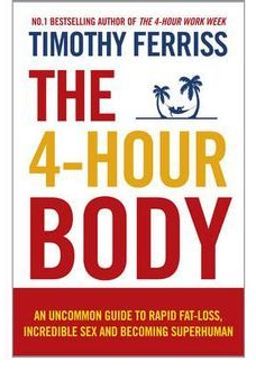
The 4-Hour Body cover

The 4-Hour Body

by Timothy Ferriss

The 4-Hour Body offers unconventional, research-backed methods for achieving rapid fat loss, enhanced intimacy, and peak physical performance. Tim Ferriss tests these strategies, revealing shortcuts for transforming your body and lifestyle. Dive into a world of expert insights and practical advice for achieving extraordinary results with minimal effort.

The Science of Doing Less for More

Tim Ferriss’s The 4‑Hour Body is not just a fitness book—it’s a working manual for engineering the human body through minimal interventions anchored in measurement and experimentation. Ferriss argues that most people waste energy chasing volume and willpower when tiny, well‑timed actions produce better outcomes. The core thesis is that your body, like any adaptive system, has thresholds—once triggered, extra effort adds noise, not results. His guiding principle, the Minimum Effective Dose (MED), defines the smallest change that produces the desired outcome. The rest of the book expands that logic into nutrition, physique transformation, sleep, sex, injury repair, and endurance.

The logic of measurement and experimentation

For Ferriss, transformation begins with data. He urges you to establish a “Ground Zero” of measurements—circumference, body‑fat percentage, and photos—before applying any program. This baseline prevents false failure (thinking you’re stuck when you’re not) and corrects the illusion of progress. He combines measurement with emotional ignition through what he calls the Harajuku Moment—a psychological trigger that converts a wish into action. Measurement establishes accountability; emotion fuels adherence. These two elements underpin every protocol, from dieting to muscle gain.

Efficiency applied to fat loss and muscle gain

Ferriss demonstrates MED through simple interventions: short high‑tension sets for muscle and the five “Slow‑Carb Diet” rules for fat loss. Instead of chronic cardio, he uses hormonal levers—protein timing, carb elimination, and a single weekly cheat day—to manipulate insulin and accelerate fat oxidation. Likewise, in Occam’s Protocol, he condenses muscle training into one set per exercise, under tension for 80–120 seconds, with long recovery phases. Both programs deliver disproportionate results because they match stimulus precisely to biological thresholds.

From diet to damage control

Even “failure” gets optimized. Ferriss’s Damage Control plan treats binging as a controllable science experiment: use small bouts of movement (wall presses, squats), caffeine, and targeted supplements (alpha‑lipoic acid, yerba mate, Cissus quadrangularis) to redistribute calories toward muscle glycogen instead of fat storage. He encourages enjoyment over guilt—if you plan physiology correctly, a feast becomes part of the larger metabolic rhythm.

Manipulating metabolism and hormones

Ferriss explores deeper biochemical levers. His PAGG stack—Policosanol, Alpha‑Lipoic Acid, Green‑Tea extract, Garlic—allegedly enhances insulin sensitivity and fat metabolism. He experiments personally before endorsing, insisting that supplements amplify, not replace, diet and recovery. Using continuous glucose monitors (CGMs) expands control further: tracking moment‑by‑moment responses reveals how simple modifiers like cinnamon or lemon juice change blood sugar curves. These feedback loops turn abstraction into precision—allowing you to tune the “glucose switch” for fat loss, muscle energy, or stable cognition.

Cold, sleep, and repair as performance tools

Ferriss’s fascination with biological triggers continues with cold exposure (after NASA scientist Ray Cronise) to activate brown adipose tissue (BAT) and accelerate thermogenesis. “Ice Age” experiments show fat loss spikes with short cold showers or neck‑pack sessions, a literal hack for raising metabolic rate. Sleep, treated as another system, follows the same pattern: measure first (using Zeo or FitBit), then adjust temperature, meal timing, or supplements based on REM and delta-wave data. His principle—change one variable at a time and confirm improvement three nights in a row—transforms guesswork into predictable recovery engineering.

Applied physiology beyond fat and muscle

Ferriss extends MED thinking to uncomfortable or ignored areas: sex, endurance, and injury. He shows how structured practice enables repeatable female orgasms (“15‑Minute Orgasm”), and natural testosterone manipulation via diet, cold, and micronutrients restore male performance without drugs. His endurance chapter with Brian MacKenzie dismantles marathon orthodoxy—replacing hours of running with short sprints and strength work that “move the aerobic line.” Even injury care becomes algorithmic: first movement correction, then manual therapy (MAT, ART), then injections only if conservative methods fail. Across domains, the same pattern reappears—measure base state, apply minimal targeted stress, and validate outcomes with data.

The underlying philosophy

Ferriss connects all chapters through a singular ethos: become your own scientist. Drawing inspiration from Seth Roberts’s self‑experimentation and Ben Goldacre’s skepticism about bad studies, he teaches you to design personal trials, interpret real effects, and ignore industry dogma. Whether increasing speed (Barry Ross’s “lift heavy but not hard”) or reducing injury risk (Gray Cook’s FMS “Critical Four”), you rely on small, measurable, reversible steps. The book’s most radical promise is that human optimization isn’t about effort—it’s about precision. Once you master how to find and apply your personal MED, every domain—fitness, sleep, sex, health—responds exponentially while freeing your time and sanity.


Mastering the Minimum Effective Dose

Ferriss defines the Minimum Effective Dose (MED) as the smallest unit of input that yields the desired output. It’s where science meets common sense: more is not better; the right amount is. Originating with Arthur Jones and refined by mentors like Doug McGuff, the idea challenged mainstream fitness dogma that worships sweat volume. Practical application means targeting biological thresholds—the tiny point where stimulus flips adaptation on.

Applying MED in fitness

For muscle building, Ferriss recommends one 80–120‑second high‑intensity set per muscle group weekly. The cadence (five seconds up, five down) removes momentum and forces deep fiber recruitment. For fat loss, single hormonal triggers matter more than hours on the treadmill: protein within 30 minutes of waking or cold exposure can ignite cascades that burn fat for hours. The key is precision, not volume—never confuse effort with effectiveness.

Mental models that make MED practical

  • Use Pareto logic: identify the ~2.5% of actions that yield 95% of results.
  • Measure what matters: body‑fat, circumference, glucose—if you can't quantify, you can't refine.
  • Protect recovery: stimulus without rest is wasted effort, as biological growth occurs during recovery windows.

Beyond exercise—MED across life domains

Ferriss applies MED to diet, sleep, sex, and learning. He recommends small levers—one cheat day instead of calorie counting, one variable change per sleep experiment, one 15‑minute structured intimacy session to improve relationships. These interventions work because they respect feedback thresholds. The result isn’t laziness; it’s sustainable control. As he often says, “Doing less isn’t minimalism—it’s optimization.”

Core insight

Stop chasing superlatives—find sufficiency. The smallest dose that produces real change is not just efficient; it's the only dose you can sustain.

If you embrace MED, you redesign your routines around proven triggers instead of cultural myths. You train less, eat simpler, rest better, and iterate smarter. It’s not about being minimal—it’s about being effective on purpose.


Systems that Measure and Motivate

Before changing anything, Ferriss insists that you create a clear “before” picture—your body, your metrics, your habits. He calls this your Ground Zero. Measurement isn’t vanity; it’s accountability. The moment you quantify reality, progress becomes visible and motivation solidifies. You pair this with a Harajuku Moment—the emotional spark that transforms intent into commitment. Both data and emotion form the operating system for every lifestyle redesign.

Measurement rules

Use circumference, reliable body‑fat methods (DEXA or BodPod ideally), and photos. Scales alone deceive because muscle gain masks fat loss. Ferriss even created the “Total Inches” metric—summing biceps, waist, hips, and thighs—as a simple home‑tracking method. Photos act as visual anchors; visible contrast fuels adherence better than numbers alone. When combined with public accountability (social posts or bets), minor measurements evolve into major motivation.

Psychological activation

Ferriss’s behavioral approach mirrors BJ Fogg’s or Charles Duhigg’s habit frameworks: an emotional jolt plus a visible metric equals sustained action. The Harajuku Moment often emerges from embarrassment or sudden clarity—Chad Fowler’s public humiliation sparked 70‑lb loss. Without that emotional ignition, data stays inert. Together, they create a self‑reinforcing feedback loop.

Practical starter method

Take your photos and circumference measures, choose one reliable body‑fat tool, make a public or time‑bound commitment, and record daily food/exercise logs. This transforms vague desires into quantifiable experiments. As Ferriss summarizes, “If you don’t measure, you can’t know whether you’re winning.” Once you establish a feedback loop between emotion and data, every intervention—diet, muscle, sleep—becomes easier to control.


Nutrition Engineering and the Slow‑Carb Diet

The Slow‑Carb Diet is Ferriss’s answer to overly complex nutrition systems. It has five simple rules: avoid white carbs, repeat simple meals, don’t drink calories, skip fruit, and include one cheat day per week. The design favors consistency and sustainability over theoretical perfection. If followed precisely, Ferriss claims, nearly everyone can lose 20 pounds in a month—because the protocol aligns food timing with insulin and glycogen traffic.

Physiology behind simplicity

By restricting fast carbs and fructose, you minimize insulin spikes and prevent lipogenesis. Chronic stable blood sugar encourages fat oxidation and satiety. The cheat day prevents metabolic down‑regulation—by periodically over‑feeding, you reset hormones like leptin and thyroid output, paradoxically accelerating fat loss. Ferriss backs his approach with case studies ranging from Andrew Hyde’s budget diet ($38/week) to corporate workers losing 70+ pounds while eating repetitive restaurant meals.

Psychological sustainability

Ferriss eliminates decision fatigue by prescribing repetitive meals. Simplicity is strategic—every time you remove choice, you increase compliance. A single cheat day becomes a reward mechanism that keeps long‑term adherence high. It transforms restriction into rhythm. Mistakes like under‑eating protein or over‑snacking on nuts are treated as data points to fix, not failures.

Complementary systems

He supports the diet with damage‑control rituals (for big meals), the PAGG stack for metabolic support, and cold exposure for additional calorie burn. Collectively, these are “adjunct levers”—not magic pills, but tiny synergistic boosts. The Slow‑Carb framework reveals Ferriss’s broader insight: food is software, and you can reprogram metabolism with consistent small inputs instead of complex macro tracking.


Engineering Recovery, Sleep, and Hormones

Ferriss approaches recovery like an engineer debugging systems—measure, isolate, and modify. Sleep becomes a laboratory. Using trackers from FitBit to Zeo, he learns that movement sensors misclassify rest as sleep, while EEG‑based devices show real brain patterns. His discovery: morning performance correlates more with REM percentage than total hours. Once you measure correctly, you can design interventions that matter.

Environmental variables

  • Room temperature around 67–70°F improves onset; socks or sheets fine‑tune peripheral warmth.
  • Pre‑bed fat‑protein snacks reduce nocturnal hypoglycemia and morning fatigue.
  • Alcohol timing matters more than quantity—avoid within 4 hours of sleep.

Techniques and biohacks

Ferriss experiments with targeted cold exposure an hour before bed to induce sleepiness, uses f.lux software to manage blue light, and applies “smart alarms” to wake during light sleep phases. Supplements such as magnesium and Huperzine‑A are tested cautiously for REM enhancement. Each experiment is validated across at least three nights of consistent change before acceptance—a statistical discipline rare in self‑help.

Hormonal optimization

On the hormonal front, Ferriss documents natural testosterone manipulation—dietary cholesterol, Brazil nuts (selenium), vitamin D3, and cold exposure tripled his levels from 245 to 653 ng/dL. For women and men alike, he integrates sexual experimentation to remove psychological pressure and improve performance through structure. Once again, measurement and reproducibility replace mysticism.

Core principle

Recovery amplifies all other gains. Treat sleep and hormones as active levers—not passive consequences—and the rest of the body systems follow.

Ferriss’s sleep and hormone chapters epitomize his central theme: start by measuring the invisible. With data, even rest becomes a designable skill.


Rebuilding and Preventing Injuries

Ferriss’s injury sections combine firsthand surgery disasters and miraculous recoveries into a pragmatic ladder for repair. He establishes a four‑stage progression—Movement, Manual Therapy, Injection, Surgery—to ensure conservative escalation. Most chronic issues, he finds, stem from neural inhibition or asymmetry, not structural damage.

Stage 1–2: Movement and manual reactivation

Corrective movements (Egoscue method, barefoot training) restore posture and balance. Practitioners like Craig Buhler (“Dr. Two Fingers”) used MAT/AMIT protocols to reactivate dormant muscles—Ferriss’s supraspinatus strength jumped from 6 lb to 28 lb in minutes. Active Release Technique (ART) cleared shoulder adhesions instantly. These mechanical resets underline that pain often reflects communication errors between brain and muscle, not torn tissue.

Stage 3–4: Targeted injections and surgery only when necessary

Ferriss’s experience with expensive PRP/stem‑cell injections proved costly and risky—he contracted staph and required additional surgery. In contrast, low‑risk options like prolotherapy and biopuncture (Traumeel microinjections) delivered fast relief. His lesson: practitioner skill and sterility outweigh fancy biologics. Escalate only after measurable failure of movement and manual layers.

Pre‑hab: preventing problems before they arise

Gray Cook’s Functional Movement Screen (FMS) identifies asymmetries, and the Critical Four exercises—Chop & Lift, Turkish Get‑Up, Two‑Arm Single‑Leg Deadlift, Cross‑Body Single‑Leg Deadlift—rebalance coordination. A six‑week schedule emphasizing the weaker side first dramatically cuts injury risk. By investing 45 minutes twice weekly in pre‑hab, you prevent months of rehab.

Key takeaway

Pain is often fixable without surgery when you treat movement and neural function as first‑line medicine. Strength comes from symmetry and activation, not aggression.

Ferriss transforms injury recovery from desperation to system design: identify dysfunction, progress methodically, and measure real structural improvement. In doing so, he merges biohacking with physical therapy realism.


Speed, Endurance, and Physical Efficiency

Performance, for Ferriss, follows the same law as fat loss and muscle gain—intensity over volume. With Barry Ross and Brian MacKenzie, he redefines athletic training: fewer reps, shorter sessions, deeper recovery, and precise timing replace endless miles or sets. Whether sprinting 100m or running ultramarathons, output stems from neural optimization, not exhaustion.

Barry Ross and the “Effortless Protocol”

Ross trains athletes like Allyson Felix by prioritizing neural efficiency—one near‑maximal heavy lift (95% 1RM for 2–3 reps) and one lighter set for 5 reps, followed by explosive plyometrics. Long rests prevent lactic overload, preserving speed. His mantra: “Lift heavy but not hard.” The result is a system where neuromuscular energy, not fatigue, drives sprint power.

Brian MacKenzie and moving the aerobic line

MacKenzie’s CrossFit Endurance replaces long runs with intervals and strength. By training metabolic pathways through short sprints, you teach the body to use fat at higher intensities, avoiding the “bonk.” Strength training supports ionic recovery and resilience. In Ferriss’s recounting, athletes completing 50Ks on minimal mileage prove that efficiency, not mileage, determines endurance success.

The universal lesson

Principle in Action

Strength, speed, and stamina all obey the same rule: target neurological efficiency, recovery windows, and metabolic leverage. Precision beats repetition.

Ferriss’s athletic chapters extend MED thinking into high‑performance territory—doing less so your body adapts smarter. Training becomes coding: specify stimulus, rest, and feedback loops, and let biology compute the result.


Self‑Experimentation and Scientific Skepticism

Ferriss closes his framework by teaching readers how to think like experimenters. Guided by Seth Roberts’s rapid self‑testing methods and Ben Goldacre’s exposure of bad science, he reveals that personal data can be more trustworthy than published studies if collected rigorously.

Designing effective self‑experiments

The method: record baseline daily metrics (sleep, mood, weight), change one variable at a time, and replicate success. Roberts’s work showed that small N=1 tests reveal personal causality faster than clinical averages. The advantage is control—you care more about your outcome than academic statisticians do.

Spotting bad science

  • Look for absolute vs. relative data—percentages often hide trivial effects.
  • Demand randomized trials—correlation ≠ causation.
  • Watch for self‑reporting bias and funding conflicts in nutrition studies.

Ferriss’s full checklist essentially teaches statistical literacy for personal health. By combining fast experimentation with critical reading, you escape both pseudoscience and corporate manipulation.

Core idea

Be your own controlled study. Measure, question, and iterate. Your body is both the lab and the publication.

This final chapter closes Ferriss’s circular message: optimization starts with data and returns to data. When you merge skepticism and experimentation, you gain independence from trends—and the tools to become your own scientist for life.

Dig Deeper

Get personalized prompts to apply these lessons to your life and deepen your understanding.

Go Deeper

Get the Full Experience

Download Insight Books for AI-powered reflections, quizzes, and more.