
Idea 1
Executing What Matters Most
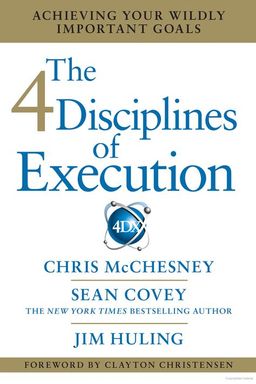
How many times have you seen a great idea die before it even got off the ground? In The 4 Disciplines of Execution, Chris McChesney, Sean Covey, and Jim Huling ask why so many strategic plans fail to translate into meaningful action. Their answer is simple yet profound: leaders don’t fail because they can’t think—they fail because they can’t execute. The greatest challenge isn’t coming up with the next big idea; it’s getting people to change their behavior to make that idea happen.
The authors argue that execution lives in the tension between the urgent and the important. Daily operations—what they call “the whirlwind”—consume energy and time, leaving little attention for what really moves an organization forward. So even the most promising initiatives are slowly suffocated by the chaos of day-to-day demands. To win, you must shift from managing the whirlwind to executing deliberately and consistently on your priorities.
The Core Premise
At the heart of the book is a framework built around four principles—focus, leverage, engagement, and accountability—known as the 4 Disciplines of Execution (4DX). These disciplines aren’t theoretical. They emerged from more than 1,500 real-world implementations across companies like Marriott, Eli Lilly, and the State of Georgia. The authors emphasize that 4DX is a system—a reliable operating mechanism that enables teams to achieve strategic goals even while the whirlwind never stops blowing.
The 4 Disciplines are:
- Focus on the Wildly Important. Narrow your attention to one or two goals that matter most—what the authors call WIGs. More goals mean less success.
- Act on the Lead Measures. Identify specific actions and behaviors that predict success on your big goal, and focus energy there.
- Keep a Compelling Scoreboard. People play differently when they know the score. Build simple, visible metrics that make progress clear to everyone.
- Create a Cadence of Accountability. Hold regular, focused meetings where team members make and keep commitments toward moving the lead measures.
This system may sound straightforward, but it’s intentionally designed to be simple. The real challenge lies in living it with discipline. As one FranklinCovey client put it, “4DX says easy, does hard.” The payoff? A culture where execution isn’t accidental but deliberate, measurable, and empowering.
Execution vs. the Whirlwind
One of McChesney’s most memorable concepts is the whirlwind—the day job that never ends. It’s not the enemy, since it keeps your business alive, but it competes relentlessly with your strategy for time, energy, and attention. The authors compare launching a new initiative in the whirlwind to “trying to move a giant rock.” Without a lever (lead measures) and a consistent rhythm (accountability), the rock won’t budge. You need the 4 Disciplines to apply focused, sustained pressure on what truly matters.
This idea isn’t just theory. The authors share stories like that of B. J. Walker, who turned around Georgia’s Department of Human Services by reducing repeat cases of child maltreatment by 60 percent, or hotel manager Brian Hilger of Marriott, whose team achieved record-breaking guest satisfaction after implementing 4DX. These examples demonstrate that the disciplines work in government agencies, Fortune 500 companies, and anywhere teams must change behavior at scale.
A System for Changing Behavior
Execution, the authors insist, is about human behavior, not just process. It’s one thing to issue a directive—to hire new staff or buy new equipment—but quite another to get people to adopt new habits that drive results. 4DX provides the behavioral structure leaders need to make change stick. As W. Edwards Deming famously said, “If the majority of people behave a particular way most of the time, the people aren’t the problem. The system is.” McChesney and his coauthors show leaders how to fix the system.
Section by section, the book walks you through mastering each discipline: how to choose and formulate WIGs that focus energy, how to find measurable lead indicators you can influence, how to design scoreboards that motivate teams, and how to create accountability rhythms that sustain momentum. Later sections cover scaling these disciplines across large organizations, automating the process with tools, and maintaining results long-term.
Ultimately, The 4 Disciplines of Execution offers more than a management method—it provides a new way to lead. It transforms the leader’s role from commanding compliance to creating commitment, from setting goals to building systems that guarantee progress. As Clayton Christensen, who wrote the foreword, observed, most leadership books focus on strategy—the “what” of business. This one teaches the “how.” The difference, as McChesney’s clients discovered, can turn a demoralized workforce into a focused team of winners.