
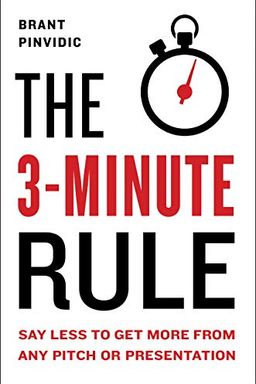
The 3-Minute Rule cover

The 3-Minute Rule

by Brant Pinvidic

The 3-Minute Rule is your ultimate guide to crafting a captivating pitch in just three minutes. By focusing on clarity and brevity, Brant Pinvidic offers a transformative blueprint for effectively communicating ideas, products, or services, ensuring you leave a lasting impact on any audience.

Say Less to Get More: The Power of the 3-Minute Rule

How often have you felt you were losing someone’s attention halfway through your pitch? Everyone can relate to that moment—when your audience’s eyes glaze over even though you thought your idea was brilliant. In The 3-Minute Rule, Hollywood producer and communication strategist Brant Pinvidic argues that the secret to capturing attention in our information-saturated world is surprisingly simple: learn to say less.

Pinvidic contends that everything of value about your idea, company, or proposal can—and should—be conveyed clearly, concisely, and accurately in three minutes or less. His mantra is: simplicity is power, clarity is compelling, and information is value. Whether you’re pitching an investor, interviewing for a job, or persuading a friend, you have 180 seconds to capture and maintain attention long enough for people to conceptualize what you’re offering, contextualize how it benefits them, and actualize their decision to engage further.

A New Kind of Attention Economy

Pinvidic opens with an alarming statistic: the average human attention span has dropped to about eight seconds—less than that of a goldfish. It’s not that audiences have grown dull; rather, they’ve become more efficient evaluators. With constant access to instant information, they’re hypersensitive to fluff, hype, and rambling. So the person presenting must quickly prove that what they’re saying has value. He likens communication today to a world where everyone is yelling louder to be heard—yet counterintuitively, the real power lies in speaking less and more clearly.

This reduction isn’t just about being brief for its own sake. It’s built on neuroscience. Pinvidic draws on research into “approach motivation”—the study of how people are driven to engage with a stimulus. The science shows that focus creates desire. If you hold someone’s focus for three minutes, you cultivate their curiosity and willingness to act. That’s radically different from outdated “sales-y” approaches that try to generate desire first with exaggerated claims or flash. In today’s world, leading with information wins over self-promotion every time.

The Two-Step System and the WHAC Framework

The core process behind the 3-Minute Rule unfolds in two steps: first, simplify and condense everything into only the most compelling, necessary elements of your idea. Then, connect those pieces with narrative story devices that keep your audience engaged for the full three minutes. Later in the book, this becomes the WHAC framework: What is it? How does it work? Are you sure? Can you do it? These four questions mirror the mental stages every listener goes through when deciding whether to buy in. Mastering them helps you structure a clear, logical, emotional arc—very much like how Hollywood structures a screenplay.

The first half of the book teaches you how to strip your content down through bullet-point exercises, physical Post-it notes, and ruthless editing. The second half dives into how storytelling activates emotion and retention. Pinvidic reveals why executives, investors, and even network producers unconsciously filter ideas through these questions, and how to align your narrative to their rationalization process.

Rooted in Hollywood and Real-World Results

Pinvidic’s authority comes from his improbable journey as a Hollywood producer. In just three minutes, he pitched and sold hit TV shows like Extreme Makeover: Weight Loss Edition and Bar Rescue to major networks, generating almost a billion dollars in revenue. When he later coached executives, plumbers, and lawyers using the same system, they found it worked just as well outside the film industry. A plumber selling re-piping services or a biotech CEO meeting investors both need to communicate value efficiently—the industry changes, but the human psychology remains universal.

Why It Matters Today

More than a presentation guide, The 3-Minute Rule is an antidote to communication fatigue. Pinvidic teaches that success is dictated by your ability to convey your information so others understand it the way you do. Once they see your idea through your lens, everything else—sales, funding, persuasion—becomes a byproduct. The book redefines modern communication for a world where attention is scarce but appetite for clear, valuable information is infinite.

Core Principle

You only get three minutes—but inside those three minutes lies everything you need to connect, convince, and convert. Say less, and you’ll get more.


The Rationalization Story: How People Decide

One of Pinvidic’s most revelatory ideas is that every decision you or anyone else makes is dictated not by logic alone, but by something he calls the rationalization story. This mental story explains why someone says yes or no—and it’s almost always summarized internally in less than three minutes.

How Rationalization Shapes Decisions

Pinvidic notes that humans are the only species capable of rationalizing their choices. A person doesn’t buy a product because it’s perfect—they buy it because they can justify that purchase to themselves later. Your audience will always condense your message into a simple internal narrative they can repeat (“I liked that,” “It makes my life easier,” or “It’s affordable”). What’s striking is that this rationalization process happens instinctively, and if your presentation doesn’t align with it, your audience will rewrite their own less flattering version of your story.

Building Their Story for Them

The author urges you to construct your pitch so that it mirrors the rationalization your audience will use after you leave. Imagine someone explaining your idea to their boss or spouse—they’ll do it in approximately three minutes, organized around a few statements of value. Your job is to make sure those statements are the ones you chose intentionally. Pinvidic gives the example of the Extreme Makeover: Weight Loss Edition pitch, which he sold to ABC using just nine sentences. Each sentence answered an implicit “why” question, letting the network rationalize the value easily: transformation, impact, profitability, and audience appeal.

The Decision-by-Committee Reality

Pinvidic’s anecdote about pitching to forty-three executives at National Geographic epitomizes the modern dilemma. Even when the top decision-maker loves your idea, it’s eventually relayed and reshaped down a chain of meetings. The original story erodes each time it’s retold. The solution? Build a three-minute version so compact and clear that even people far removed from the initial discussion can retell it accurately. If the rationalization story survives the corporate game of telephone, you’ve won.

Why Simplicity Wins Over Persuasion

Traditional persuasion relies on emotional tactics, body language, and buzzwords. Pinvidic replaces all of that with information clarity. You don’t need to “sell”—you need to make understanding inevitable. When people feel they understand your value as you do, they naturally convince themselves. In other words, clarity is self-persuading.

Key Lesson

Your audience will always rationalize your pitch down to their own three-minute version. The smarter strategy is to give them that version yourself.


The WHAC Method: Craft Your Story’s Spine

To help you structure those three minutes, Pinvidic introduces the WHAC method—a deceptively simple four-step process used in Hollywood storytelling and corporate sales alike. WHAC stands for What is it? How does it work? Are you sure? Can you do it?

Step 1: What Is It?

This is the big picture—the clear, no-hype statement defining what you offer. When Pinvidic pitched Extreme Makeover: Weight Loss Edition, he began with “We take overweight people too big for The Biggest Loser and follow them for one year as they lose 300 pounds.” That one sentence was enough to conceptualize the idea instantly. In business, this might sound like “We provide software that automates compliance for hospitals” or “We build apps that pay for your Uber ride if you visit our restaurant.” Your first minute should answer exactly that.

Step 2: How Does It Work?

Once your audience conceptualizes what you do, they begin contextualizing how it functions. This section explains the mechanics—the process, the technology, or the structure. In Hollywood terms, it’s the exposition. Pinvidic’s client Jeff, who re-pipes homes without tearing down walls, used this stage to describe how his crew threads flexible pipes through tiny holes, keeping projects clean and fast. The explanation converts curiosity into comprehension.

Step 3: Are You Sure?

Here you validate your claims with evidence: data, credibility, or results. A biotech CEO might share trial results; a contractor might reveal testimonials. This is the logical checkpoint where doubts ease into trust. Pinvidic calls it context verification—proof points that answer the listener’s natural skepticism.

Step 4: Can You Do It?

Now comes execution. Who are you and why can you deliver? This might cover experience, reliability, scalability, or pricing. Pinvidic’s oil-sector client David used this stage to show that his company could keep drilling profitably even when oil dropped to $32 a barrel. That concrete feasibility closed the deal.

Each stage corresponds to a natural psychological process: conceptualize, contextualize, actualize. Within three minutes, your audience has gone from understanding what it is to believing it works—and finally, seeing it as real enough to act on.

Guiding Principle

Every successful pitch answers WHAC. Skip one, and your audience will fill the gap with doubt.


Simplify with Bullets and Statements of Value

For Pinvidic, clarity begins on the wall—with dozens of Post-it notes. The simplest but most transformative exercise is the bullet-point method, born from his struggle to explain a complex TV show idea that later became Extreme Makeover: Weight Loss Edition. When he and his team wrote every single idea on Post-its and eliminated everything unnecessary, seven short lines remained—and that clarity sold a multimillion-dollar series to ABC in under three minutes.

Bullet-Point Brainstorming

Pinvidic instructs you to write down every word or phrase describing your product or idea. Don’t censor yourself—volume matters. Then physically place them where you can see connections. By eliminating redundant or trivial notes, you reveal the core value of your idea. The physical act keeps you honest and focused on essentials. His team’s board for that show looked like “Too big for The Biggest Loser | One year transformation | 300 pounds | Single episode per person | National impact.” Simple, potent, unforgettable.

Statements of Value

Once you have bullet points, expand them into short, declarative sentences—never paragraphs. Each statement represents something meaningful for your audience. “We re-pipe an entire house in a day” is far clearer than “Our proprietary multi-step process saves time.” These statements build the foundation for the WHAC framework later. Pinvidic calls them truth fragments—snapshots that, when strung together, form your story’s skeleton.

Story Trumps Style

In a memorable anecdote with biotech CEO Peter from GTK Therapeutics, Pinvidic helped him cut a 39-slide deck down to six simple bullet points describing his 18-year development and pending FDA approval. Peter’s presentation collapsed stylistically—but investors were engaged enough to ask dozens of follow-up questions. The lesson? You can stumble through delivery if your story structure is solid; clarity trumps charisma. This insight aligns with Carmine Gallo’s work in Talk Like TED, emphasizing that substance outranks showmanship.

Takeaway

If your story can’t fit into clear, direct bullet-size statements, your audience will never fit it into their minds.


Information First, Engagement Second

Information comes before engagement—a mantra repeated throughout Pinvidic’s teaching. He warns that confusing the two is the number one reason pitches fail. Audiences can’t engage with ideas they don’t yet understand.

The Plumber’s Bus Ride

Pinvidic’s story of Jeff, the plumbing contractor, is the ultimate illustration. On a long bus ride to a ski lodge, Jeff tried to explain his re-piping business, rambling about copper versus PEX pipes and call centers. Pinvidic reorganized his scattered facts into a chronological story: “We can re-pipe your entire home in one day without ripping down walls. The old pipes stay. There’s no mess.” Suddenly, everyone on the bus leaned in with fascinated questions. Information organized properly became engagement.

The Puzzle Analogy

He compares crafting a presentation to assembling a jigsaw puzzle: first, dump all the pieces (your statements), find the edges (your main informational points), and only then fill in the middle (the engaging storytelling). The problem most presenters face is trying to start with color and emotion—the middle—before giving the border that defines what the picture even is.

Before-and-After Thinking

To move from chaos to clarity, Pinvidic uses a “before and after” exercise. For every statement, ask: What must they know before hearing this? What will they want to know after? The result is linear, logical flow—a Hollywood-style “and then” sequence that keeps audiences oriented. This process echoes Robert Cialdini’s concept in Influence: once people grasp the logic, they naturally reciprocate attention.

Rule

Inform first. Engagement is earned only after understanding.


Hooks and Edges: Making People Say “That’s Cool”

A great pitch needs both a hook and an edge—Pinvidic’s equivalent of a movie’s “aha moment.” The hook is what makes your audience think, “That’s cool,” while the edge pushes it over the top.

Finding the Hook

Hooks aren’t slogans or grand promises; they’re the essence of desire revealed through clarity. When Paraag Marathe of the San Francisco 49ers pitched Vince McMahon to host WrestleMania at Levi’s Stadium, his hook was unexpected: WWE would make more money on merchandise there than anywhere else, thanks to a stadium app that delivered purchases directly to fans’ seats. Every detail before that statement primed McMahon to see why—a digital ecosystem surrounded by Silicon Valley giants. When presented, he literally said, “That’s pretty cool.”

Avoiding State-and-Prove

Pinvidic contrasts hooks with flashy openings. The wrong approach is the “state and prove” method—starting with big claims and spending the rest of your time trying to justify them. Instead, let facts unfold until your audience naturally reaches your hook themselves. He dramatizes this with his playful Katy Perry example: when he first announces “Katy Perry is the most successful female performer in history,” audiences resist. But after sequentially listing her achievements—five number-one hits, multiple billion-view videos, Guinness records—the audience agrees before he even says it. They’ve rationalized it on their own.

Finding the Edge

Edges are concrete anecdotes or features that make your story stick. For Jon Taffer’s Bar Rescue, it was “The Butt Funnel”—a design concept that forces patrons to brush against each other in a narrow passageway, triggering social and emotional engagement that leads to higher bar sales. The edge gives your pitch color and memorability. Pinvidic advises finding your own “Butt Funnel” story—a crazy but true proof of concept that encapsulates why your idea works.

Hook vs. Edge

The hook earns interest; the edge locks loyalty. Together they turn understanding into excitement.


Use Negatives as Strengths

Pinvidic takes a contrarian stance on weakness: stop hiding it. He proposes that the most credible way to build trust is to address flaws directly and use them as support for your strengths.

Jon Bon Jovi’s Breakfast Epiphany

For his show If I Wasn’t a Rock Star, Pinvidic met with Bon Jovi, who argued that the premise was flawed—there was no version of him that wouldn’t have been in music. Rather than dodging that inconsistency, Pinvidic decided to weave it into the pitch: celebrities would explore impossible alternate lives and confront the truth that their talent made other paths unrealistic. When he presented the show to networks, this honesty made the premise more compelling, not less.

Preempt the “What About” Question

Every audience silently asks, “What about [the problem]?” The longer you delay answering it, the more mental energy they waste searching for the flaw. Addressing negatives early prevents distraction and reframes doubt as depth. When Pinvidic coached a biotech CEO with minor debt issues, acknowledging it upfront turned skepticism into opportunity—a potential investor offered refinancing instead of criticism.

Turning Weakness into Validation

The real magic, he says, lies in pairing negatives with proof points that flip perception. He calls this finding “props.” When you admit that early production faced chaos but show how it inspired solutions, you validate adaptability. When Paraag mentioned the building pains of Levi’s Stadium before boasting about its digital perfection, it made his claims more believable. Transparency signals competence.

Principle

People hate surprises and skepticism but love vulnerability with evidence. Own your problem before they find it for you.


Openings, Callbacks, and Endings: Crafting Flow

How you begin and end your three minutes determines whether people listen beyond them. Pinvidic distills decades of Hollywood storytelling into practical advice on openings, callbacks, and endings.

The Opening: Pre-Suasion

Borrowing from author Robert Cialdini’s concept of “pre-suasion,” Pinvidic explains that the moments just before your pitch are crucial. A well-designed intro shapes how your audience thinks before you present facts. His example: Jimmy Fallon’s story about Cameron Diaz and forty-eight bunnies on a hammock—an absurd tale that opened a pitch for the show That’s a Record. It made network executives curious and primed them for the idea of fun, viral records before the show’s details appeared. Like Disney killing Bambi’s mom or Braveheart’s tragic prologue, pre-suasion creates emotional framing.

The Callback: “See What I Mean”

Callbacks echo your reason for being later in the pitch. After establishing credibility or discovery in the opening, you reinforce it mid-presentation with proof. In Bar Rescue, Pinvidic used Jon Taffer’s Butt Funnel moment as a callback—confirming the show’s premise that personality plus expertise equals entertainment. The callback invites the audience to recognize, “Ah, that’s what he meant,” giving closure before the final point.

The Ending: Stop Talking

Forget grand conclusions. After three minutes, stop. Pinvidic tested dozens of endings—from clever catchphrases to puns—but found that silence signals confidence. When you simply end with your logo or final slide, it tells the audience you believe your information stands alone. The quiet pause prompts reflection and genuine engagement—the next words will come from them, not you.

Key Rule

Start strong, circle back, and end in silence. When your story breathes, your audience fills the air with desire.


PowerPoint-Less Communication

Pinvidic’s hatred for PowerPoint borders on artistic. To him, flashy slides kill clarity. His solution is not to outlaw presentation software but to discipline its use. “People who know what they’re talking about don’t need PowerPoint,” he reminds readers, quoting Steve Jobs.

The Ten Commandments of PowerPoint

He converts his frustration into ten “PowerPoint Commandments,” a humorous set of rules that amount to a manifesto for simplicity: Don’t use handouts as slides; keep text minimal; limit animations and fonts; never exceed ten slides; use images sparingly; and remember that white space is your friend. Animation should support, not distract. Every slide must exist for a reason. (Edward Tufte’s The Cognitive Style of PowerPoint parallels this argument.)

The Dad Test

Pinvidic tells of his father, a salesperson whose luggage—and presentation materials—were once stolen before a big pitch. Forced to go in with nothing, he offered pure verbal clarity instead. It was his best pitch ever. From then on, he handed out printed materials after speaking, keeping audiences focused on him first. Pinvidic uses this story to challenge you: Could your pitch stand alone without slides? If not, your visuals are doing the talking—and that’s a problem.

PowerPoint as Wingman, Not Crutch

Instead of banishing slides, Pinvidic reframes them: use them as a wingman to emphasize—not substitute—your points. A single picture of a bar blueprint with the Butt Funnel marked by an arrow beats paragraphs of text. Less decoration, more direction. When visuals and message act like Michael Jordan and Scottie Pippen—each amplifying the other—you’ve found balance.

Lesson

If your message dies without PowerPoint, it was never alive to begin with.


Red Lipstick and the Pitfalls of Passion

In his final chapter, Pinvidic warns against mistaking style for substance. His mother’s phrase—“Are you putting on red lipstick?”—becomes a metaphor for dressing up poor content with flashy performance. Whether you’re pitching or speaking, energy can’t replace value.

Passion vs. Promotion

He distinguishes true passion (enthusiasm for your information) from promotional passion (desperation to close). The more you desire an outcome, the more likely you’ll cross into self-serving salesmanship. He recalls a corporate “sales guru” who faked fishing stories to bond with clients—a perfect example of passion turned manipulation. Real trust arises when excitement targets information, not transaction.

Avoiding Unjustifiable Passion

Unjustifiable passion—being overly thrilled about mediocre ideas—destroys credibility. Like recommending a bad movie too enthusiastically, your audience questions your judgment. This section reads like behavioral psychology wrapped in a masterclass on authenticity. Pinvidic urges you to channel excitement into factual moments: be inspired by results, not opinions. Facts earn conviction; exaggeration erodes it.

The Director’s Cut and Collaboration

Finally, he cautions against falling in love with your own version—the “director’s cut.” Feedback improves clarity. Even in Hollywood, movies succeed because other editors sharpen them. Show your pitch to others, especially skeptics, and refine until your information stands unassailable. Communication, like film, is collective craft.

Moral

Don’t add red lipstick to blur clarity. Passion works only when it’s earned by substance.

Dig Deeper

Get personalized prompts to apply these lessons to your life and deepen your understanding.

Go Deeper

Get the Full Experience

Download Insight Books for AI-powered reflections, quizzes, and more.