
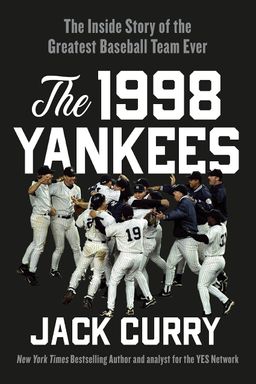
The 1998 Yankees cover

The 1998 Yankees

by Jack Curry

The sports journalist looks back 25 years at the successful New York Yankees team that played that season.

How a Team Became The Greatest Ever

What does it take for any team you’re part of—at work, in family, in sports—to move from excellent to historically great? In The 1998 Yankees, Jack Curry argues that greatness isn’t just about talent or one-off heroics; it’s the compounding effect of culture, clarity, and clutch execution under pressure. He contends that the ’98 Yankees are the Greatest Team Ever not simply because they won 125 games, but because of how systematically they did it—wearing opponents down with patience at the plate, precision on the mound, and a clubhouse culture that made the hard things look ordinary.

Across 25 years of hindsight, Curry reconstructs the season as a living case study in team dynamics. You meet the steady compass of Joe Torre, the calm pilot who never panics; the fierce competitor Derek Jeter, who insists, “We wanted to pummel teams”; the brainy-madcap pitchers David Cone and David Wells, who form an unlikely brotherhood on and off the field; the mysterious, fearless El Duque, who literally saves the season; the reborn Scott Brosius and the late-blooming Shane Spencer, whose surprise surges make a great team unbeatable; and the ironclad bullpen finishing games with Mariano Rivera’s cutter—"a gift from God."

A Blueprint of Ruthless Consistency

At the core of Curry’s argument is a structural blueprint. The Yankees attacked from the leadoff spot to the ninth hitter with an OBP-first offense (echoing what Moneyball would popularize five years later), squeezed extra outs with Gold Glove-caliber defense, and locked games down with a layered bullpen. They went 120–1 when leading after eight innings. They didn’t just win; they eliminated variance. And they did it after an 0–3 start, after a literal beam fell at Yankee Stadium and forced them into road-gypsy mode, and after early season noise about Torre’s job and Brian Cashman’s future. They stabilized because their culture stabilized them.

Fuel: The Pain of 1997

Curry’s narrative opens with the sting of the 1997 ALDS loss to Cleveland—a clubhouse so silent that Torre sat among his players saying nothing, then hugging each one. That pain becomes rocket fuel. "Unfinished business" is Torre’s spring training message. Bernie Williams vows to return sharper and tougher. Rivera learns to let go of the Sandy Alomar Jr. home run and becomes even more ruthless. The point for you: teams don’t become great by avoiding pain; they alchemize it into purpose.

The People Puzzle

Curry foregrounds people decisions: 30-year-old Brian Cashman thrust into the GM chair, the trades for Chuck Knoblauch and a seemingly washed Scott Brosius, the veteran DH insurance in Chili Davis. Torre’s role clarity (he tells Luis Sojo bluntly he might not play in April) avoids drift. The clubhouse is star-studded yet egoless: Tim Raines, Darryl Strawberry, and Chili accept part-time roles; Cone mentors Wells; Posada relentlessly manages pitchers and pace. You see a mosaic of micro-leadership that lets stars be stars—and role players swing the World Series.

Pressure: Passed, Not Avoided

The 1998 team’s myth is not that they never felt pressure; it’s that pressure never broke them. They lose Game 3 of the ALCS and suddenly trail the Indians. Bartolo Colon silences them; Chuck Knoblauch’s brain cramp becomes tabloid copy. Then El Duque coolly utters, "Mañana, no problema," and delivers seven scoreless. Game 1 of the World Series flips in a single inning when a borderline 2–2 pitch to Tino Martinez is called a ball; on the next pitch he hits a grand slam. That’s not luck; that’s preparedness meeting fortune.

Why This Matters to You

Curry’s story is a masterclass in how to build, lead, and contribute to a team that sustains excellence. You learn how Torre neutralizes chaos with calm; how Jeter leads more by standard than by speech; how your ninth hitter (Brosius) or your last call-up (Spencer) can tilt everything if the culture is right; how a bullpen (or cross-functional team) built around one insanely reliable finisher (Rivera) frees everyone else to dominate their lane. It’s Moneyball’s discipline fused with The Yankee Years’ human nuance (Torre/Verducci) and the high-performance snapshots you’d find in Legacy (James Kerr) about the All Blacks.

The Book’s Core Claim

The 1998 Yankees are the greatest team of all time because they combined historical output (125 wins, +309 run differential) with a replicable system of culture, roles, and relentless execution under the year’s biggest stresses.

In the pages ahead, you’ll see how a team transforms pain into fuel, assembles the right pieces, keeps its cool, and wins the moments that define legacies. Most importantly, you’ll see how you can borrow their blueprint for your own teams—wherever you play.


From Pain To Purpose

Teams don’t stumble into greatness; they decide to pursue it after a reckoning. Curry opens with the 1997 ALDS loss to Cleveland—Bernie Williams’ fly ball dying in Brian Giles’ glove, Mariano Rivera’s first great October wound, Joe Torre sitting in silence amid his players. That night becomes the seed of 1998. Torre’s spring training message is blunt: “We have unfinished business.” If you lead a team, notice how he starts by naming the pain before laying out expectations. That honesty creates buy-in.

The Silent Meeting That Said Everything

After the ’97 loss, Torre doesn’t give a speech; he gives presence—and hugs every player. Cone calls it “respect, pure respect.” You’ve likely sat in meetings where leaders talk too much and say very little. Torre’s restraint says, “We own this together.” Months later in Seattle, with the 1998 Yankees stumbling to 1–4, Torre finally snaps: he details sloppy play, invites response, and Cone spins anger into edge, calling out Edgar Martinez swinging 3–0 as “disrespect” to manufacture urgency. Next night: Knoblauch homers on the first pitch; the Yankees blitz to a 13–7 win and launch a 64–16 run.

Converting Setbacks Into Systems

Curry tracks how individual scars become systems. Rivera metabolizes his 1997 mistake, doubles down on his routine, and trusts the cutter that “found” him in a 1997 game of catch with Ramiro Mendoza. Bernie Williams, gutted by making the final out in ’97, trains “like I’d never trained before” and wins the 1998 batting title at .339. Even structural adversity—like a 500-pound expansion joint falling at Yankee Stadium and forcing a road detour—becomes part of the club’s identity. They go 11–1 around the repairs. The message for you: process beats panic.

A Young GM, Bold Moves, and Role Clarity

When Bob Watson resigns unexpectedly, 30-year-old Brian Cashman takes the GM chair—"scared" but smart enough to accept a one-year, non-guaranteed deal. Within days he trades for Chuck Knoblauch, then quietly brings in Scott Brosius in a Kenny Rogers salary dump and signs DH Chili Davis. Torre delivers tough clarity to Luis Sojo (“you might not play in April”) to give Brosius a runway. By May’s end, Brosius is hitting .333 and never looks back. Leaders: give new pieces a real window and tell veterans the truth about their role.

Culture: Egoless, Not Starless

You won’t mistake this for a starless team—Jeter, Williams, Rivera, Cone, Wells, O’Neill loom large. But the clubhouse is egoless. Strawberry, Raines, Chili Davis accept part-time roles. Posada and Girardi share catching. Dale Sveum even stays on as a bullpen catcher and BP thrower after being DFA’d, because the ride matters more than ego. In business terms, this is a high-talent, low-ego culture—less Silicon Valley unicorn bravado, more Toyota Production System: do your job, improve the process, respect people.

Lesson

Name the loss; design the response. Torre’s combination of quiet ownership (1997), prickly accountability (Seattle), and clear roles (Sojo/Brosius) turns pain into purpose.

Your move: after a setback, hold space before you solve; then translate the pain into specific role decisions, routines, and early wins that reset momentum. That’s how you engineer a 125-win culture from a gut-punch loss.


Pitching: Genius And Grit

Curry’s pitchers are characters you won’t forget—each one teaches a different lesson about performance. David Wells, the free spirit, throws a perfect game hungover; David Cone, the craftsman, mentors, mediates, and finds 20 wins; Andy Pettitte, the rock, throws the clincher while his father recovers from heart surgery; and Mariano Rivera, the closer, reduces chaos to a single late-breaking cutter. Blend their mindsets, and you get a durable system for delivering under pressure.

Wells: Imperfect Prep, Perfect Execution

On May 17, 1998, Wells parties with SNL’s Jimmy Fallon until dawn, staggers to the stadium, can’t find the strike zone in the bullpen—then needs just 120 pitches to retire 27 straight Twins. He never shakes off Jorge Posada once. The point isn’t to idolize bad prep; it’s that routines exist to produce trust when it’s time to compete. Wells trusts two things: Posada’s brain and his ability to “throw to the glove.” (Compare to Michael Lewis’s take in The Undoing Project on decision-making under uncertainty—you simplify to a trusted heuristic.)

Cone: The Intermediary And Engineer

Cone bridges Torre and the mercurial Wells—“Let me handle Boomer”—then quietly runs a two-man hotel offsite strategy to keep Wells relaxed on the road. From Wells’s perfecto forward, Cone goes 15–6 with a 2.88 ERA and sticks a 20th win on the final day. He also gives El Duque a crucial cue: finish the changeup like a fastball. Think of Cone as your senior architect who still ships code—he mentors, protects culture, and delivers at the deadline.

Pettitte: Compete With A Clear Head

Pettitte’s season is heavy—his newborn initially struggles; later his father needs double-bypass surgery. Pettitte watches Games 1 and 2 of the World Series from a Houston hospital, then flies to San Diego and throws 7.1 scoreless in Game 4. He calls the feeling “a good peace.” If you’ve ever had life intrude on work before a big deliverable, this is your model: get your people safe, then narrow the focus. Pettitte’s trancelike routine—“big dummy” self-talk and all—shows that composure is a practiced skill.

Rivera: Close The Loop

In 1998, Rivera allows one run all postseason—actually, none—facing 47 batters with six hits. He saves 36 in the regular season with a 1.91 ERA. The cutter “appears” in a 1997 game of catch; Rivera accepts the gift and never overcomplicates it. Teammate Jim Thome later calls it “the single best pitch ever.” Your version: pick the one thing you do better than anyone, then organize your process so the team’s last mile runs through you (and your “cutter”).

The Bridge To Mo

It isn’t only the aces. Mike Stanton, Jeff Nelson, Graeme Lloyd, and Ramiro Mendoza create a fail-safe bridge—New York goes 120–1 when leading after eight. Nelson even hurts his back in the Benítez brawl that galvanized the club, rehabs, and returns sharp in September. (This is bullpen as DevOps: invisible when it works, catastrophic when it doesn’t. The 1998 team made it invisible.)

Lesson

Build a rotation of distinct strengths, a bridge team that never blinks, and a closer with a single, unambiguous finish. Then everyone knows their job when it’s tight.

Whether you run a product launch or a playoff series, you win when your people can trust their lane—and trust the handoff.


El Duque’s Fearless Masterclass

Orlando “El Duque” Hernández is the book’s most cinematic figure: exiled from Cuba, adrift on a boat to the Bahamas, signing with the Yankees, and debuting with a leg kick that grazes his chin and a presence Brian Cashman compares to Michael Jordan. Curry’s portrait of El Duque shows how identity, creativity, and nerve can change a team’s destiny—especially in the one game that matters.

From Exile To Aura

Banned from Cuban baseball after his half-brother Liván defects, El Duque leaves Cuba on Dec. 26, 1997, survives days on Anguilla Cay, and chooses Costa Rican residency (not a U.S. visa) so he can become a free agent. When he finally throws a bullpen in Tampa, coaches feel a charge—“greatness”—before he’s logged a major-league inning. He’s 28 or 32 depending on which paper you believe; either way, he’s built like a dancer (Baryshnikov legs, Federer torso, Cone jokes) and pitches like a chess player.

The Show Begins

El Duque debuts only because David Cone’s dog bites his finger. He throws seven innings, allows one run, and weeps when he sees Cuban flags in the stands. A week later he spins a four-hitter. By August, he’s 12–4, 3.13. Catcher Jorge Posada—whose own father defected from Cuba—becomes his brother on the field and off, handling not just pitch selection but translation and trust. Cone adds the finishing touch: “Throw the changeup like a fastball.” Keep that partnership in mind; it saves their season.

ALCS Game 4: “Mañana, No Problema”

Down 2–1 to Cleveland, the only real wobble of the year, the Yankees hand El Duque the ball. George Steinbrenner tells him, “If you can’t stop them, we’re through.” El Duque shrugs: “Mañana, no problema.” He buses dishes at the hotel breakfast to help the staff—utterly loose—then throws seven scoreless that night. He gets Manny Ramírez on a fastball, fans Jim Thome with a 3–2 change, and hands the ball to Rivera. Series tied. Clubhouse exhales. Your takeaway: the right temperament in the right role beats the abstract idea of “ace.”

Craft Over Raw Stuff

John Flaherty, catching against him for Tampa Bay, notes the scouting report missed the point: it’s not his “stuff,” it’s the hide-the-ball deception, shifting arm slots, and timing theft. Against lefties, he flips first-pitch slow curves “like a softball” (Cone’s words) to steal strikes. When the Angels torch him in July, he adjusts by pitching in to lefties; two weeks later, he one-hits Texas. He’s a living reminder that innovation often means recombining familiar tools in unfamiliar sequences.

A Family Finally Reunites

Throughout the run, El Duque is lonely—two daughters and his mother still in Cuba. After the Series, with John Cardinal O’Connor’s help, Castro grants them 30-day visas, and El Duque embraces them at the parade. For all his swagger, this is the book’s quiet heart: greatness costs something; reunions redeem it.

Lesson

Hire for presence and adaptability as much as pedigree; pair creators with translators (your Posadas) who convert brilliance into repeatable execution.

If you lead teams under pressure, keep an El Duque-type in your rotation: a teammate whose calm creativity turns crisis into “no problem.”


Jeter’s Quiet, Relentless Standard

Curry calls it “The Joy of Jeter,” but the joy is earned. Jeter leads in a way you can steal: he sets a standard, repeats it daily, and nudges teammates when it slips. He taps Joe DiMaggio’s “Thank the Good Lord…” sign before games; he shows up two weeks after the season to the Tampa complex; he chases excellence in batting practice with the clubhouse “RBI Game” he simply renames “I win.” It’s accountability as habit, not speech.

Pummel Every Inning

Jeter’s key strategic idea: “We wanted to beat you EVERY INNING.” That becomes the Yankees’ MO: grind at-bats, take walks, foul pitches, trust the next guy. General manager Gene “Stick” Michael had already seeded an OBP culture in the early ’90s (well before Moneyball), and Jeter’s generation industrializes it. By 1998, the Yankees have nine regulars with OBP ≥ .350; they see 3.85 pitches/PA; they lead MLB in defensive efficiency; they are, in Scott Brosius’s words, a “lineup from hell.”

A Captain Before The Title

Posada says Jeter is “the captain” even in year three. He rarely calls teammates out—except once, when David Wells throws up his arms after a bloop falls between Jeter, Chad Curtis, and Ricky Ledée. Jeter jogs the ball back, tells Wells: “We don’t do that shit around here.” Then it’s over. That’s how you protect standards without drama: short, specific, and done.

Keep The Main Thing The Main Thing

Jeter briefly chases his 20th HR in September—hits .250 down the stretch—and learns the lesson he preaches: don’t trade identity for goals. His opposite-field, inside-out swing is his superpower; he returns to it for October. Jason Varitek’s scouting report from the rival Red Sox explains why Jeter is so maddening: “He covered 90% of the plate.” Only a truly elite down-and-in sinker beats him.

Simple Gestures, Big Signals

Two Jeter touches you can steal: after wins in April he’ll say “153 more,” counting down to a World Series, not just October; and during games he sprints out of the dugout to be first to high-five a scoring teammate. He learned it as a 10-year-old when his father told him he had to be a better teammate. Leadership here isn’t complicated; it’s consistent.

Lesson

Make your standard visible (rituals), non-negotiable (quiet corrections), and scalable (systems like pitch selection and OBP). Then the results—125–50—take care of themselves.

Jeter says it plainly about his squad: “We wanted to pummel teams.” If you lead, your job is to define what “pummel” looks like in your domain, then repeat it every day.


Scott Brosius, Unsung MVP

Scott Brosius arrives as a utility footnote—announced as a “player to be named later” in a salary dump of Kenny Rogers—and becomes World Series MVP. If you’ve ever been underestimated, this is your chapter. A Disneyland phone call—his agent singing “Start spreadin’ the news…”—ushers him to New York, where Torre gives him daily reps and a clean slate. By May, he’s raking; by October, he’s indispensable.

From .203 To .300

In Oakland, Brosius hit .203 in 1997, endured 0-for-17 and 3-for-41 troughs, and had knee surgery. Yankees scout Ron Brand insists he’ll bounce back. Torre clears Sojo’s path so Brosius can start every day. He posts .300/.371/.472 with 98 RBIs, plays pristine defense (Jeter calls him the best defensive 3B he played with), and throws “four-seam strikes” to Tino at first—never a short-hop.

The At-Bats That Swing History

Game 1, World Series: bases loaded, two out, 2–2 cutter from Mark Langston clips the edge; called ball. Brosius watches, resets the zone in everyone’s head. Next pitch, Tino’s grand slam. Game 3: Padres up 3–2, Trevor Hoffman enters to “Hell’s Bells” with 53 saves; Brosius hammers a center-field three-run shot off a 95-ish (but flat) fastball. Torre leans to Don Zimmer: “That’s the SI cover.”

Defense As Offense

Curry highlights the subtle economy that fuels big moments. After an early-season pop-up clanks off his glove and boos rain down, Jeter “calls him off” on every pop for weeks—until he playfully screams “AHHH!” as Brosius finally secures one. Brothership forms. In Game 6 of the ALCS, with Rivera on the mound, Brosius lays out for a sizzling Wilson grounder to start the ninth. Last out of the World Series? A one-hopper to Brosius. He’s rehearsed it every day in infield drills, pretending it’s for a title. Then it is.

The Lesson Of Fit

Brosius didn’t change who he was; the Yankees changed what he was asked to be: a ninth hitter with starter gloves, a pressure sponge with simple asks: see pitches, hit line drives, make every throw exact. (In Good to Great terms, he’s a “right seat on the bus” triumph.)

Lesson

Underestimate roles at your peril; over-index on superstars and you miss the player who wins you Game 3 and secures the last out.

If you manage talent, give a Brosius type a long runway and a clear lane. If you are one, own the details—because they add up to MVP.


Shane Spencer, The Natural

September heroes aren’t supposed to exist on 114-win teams. Yet Shane Spencer, a nine-year minor leaguer who once boarded his call-up flight with a baseball card as ID (his wallet had been stolen), hits 10 homers in 67 at-bats—three grand slams—and forces his way into a juggernaut. His story reminds you why development is nonlinear and why you should keep improving even when the system overlooks you.

Late Bloom, Right Changes

After being passed over in 1997, Spencer chooses Venezuelan winter ball to work on using the whole field and controlling the barrel. He hits .303 there, then .322/.397/.570 at Columbus in ’98. In the Bronx, he sees more fastballs when hitting ahead of Brosius, stays simple, and everything “clicks.” Manager Johnny Oates of Texas sums it up: “He knows what that piece of wood is made for, and it’s not for cleaning his shoes.”

A Nine-Game Supernova

From Sept. 18 to season’s end, Spencer goes on a video-game run: seven HR in nine games, including slams off Jesse Orosco and Wilson Álvarez. A scoreboard gag ranks McGwire 66, Sosa 66, Spencer 9—and it doesn’t feel ridiculous. In October, he homers twice against Texas and ropes a double vs. San Diego. His personal highlight isn’t a homer; it’s catching a Tony Gwynn liner in his only start of the World Series—then golfing with his idol weeks later. That’s joy.

Culture That Catches You

The Spencer chapter doubles as a culture check. Dale Sveum, the veteran displaced by Spencer’s arrival, is released—then stays as a bullpen catcher and BP thrower. On the day Spencer arrives, Jeter, Posada, Pettitte, and Rivera—former minor league peers—hug him hard. Later, when reliever Mike Buddie is demoted the day before rosters expand, Strawberry stops him from storming out: “Stay for the team photo.” Buddie does; he’s on the famous picture because a teammate thought like a teammate.

Lesson

Keep getting better when no one’s watching; be the kind of team that’s ready when a Spencer arrives—and generous when a Buddie leaves.

Spencer’s arc is development wisdom in one month: upgrade your skill, simplify your plan, trust your shot when it finally comes.


Calm, Chaos, And Clubhouse Glue

Great teams master emotional regulation. Curry shows Torre’s steady pulse (never panics, rarely yells; when he does, it lands), Steinbrenner’s volatility (threatens to send Cashman home after an 0–3 start), and how veterans absorb the turbulence so players can play. When Armando Benítez drills Tino Martinez after a Bernie Williams bomb, the Yankees storm the Orioles’ dugout; Darryl Strawberry is the enforcer; then they go right back to grinding. Anger becomes solidarity, not splintering.

A Manager Built For New York

Torre shields players from Steinbrenner (“I’ll deal with the Boss”), tells them effort and professionalism matter as much as results, and designs the schedule like a metronome. He’s furious only when it counts—like the 1–4 wake-up in Seattle, or a late-September mistake when Homer Bush jogs on what he thinks is a homer. Torre barks, then minutes later puts an arm around Bush: “Kid, this is the time I need you.” Accountability with dignity keeps people from spiraling.

Facing Fragility Together

The clubhouse also faces real life. In the ALDS, Strawberry’s mysterious fatigue and stomach pain become colon cancer. Torre delivers the news at an off-day workout; the room goes as quiet as it had in 1997, only heavier. The team wears “39” on their caps; Cone starts Game 3 with 39 stitched on his; Wells toasts “the Straw Man” after the final out in San Diego. You can feel how gravity ties people together when their rituals are real, not performative.

Benches And Bridges

Because the stars trust Torre, the role players trust him, too. Chili Davis plays only 35 games but is a daily presence; Tim Raines jokes and tutors; Sojo turns Jeter’s double-play footwork into a safer, faster pivot. Buddie calls the ’98 Yankees “the gift that keeps on giving” because even the 25th man gets prepared. That’s not glamorous leadership, but it’s the glue.

Lesson

Keep your room calm, convert outrage into unity, and carry your people when life hits hard. Then you can compete without emotional drag.

If you manage people, borrow Torre’s cadence: protect your team from noise, correct their lapses swiftly, and restore them personally. It’s how you build trust that lasts beyond a season.


Surviving The ALCS Stress Test

The only time the 1998 Yankees looked mortal was a four-day stretch in October. Cleveland’s Jaret Wright (the Yankees’ 1997 tormentor) gets blitzed in Game 1, but Bartolo Colon shoves in Game 3 and the Indians take a 2–1 series lead. Chuck Knoblauch’s mental freeze—pointing at Travis Fryman’s baseline violation while the live ball rolls and a runner scores—becomes "Blauch Head" tabloids. This is the hinge of the book: what looks like collapse becomes composure.

Owning The Blunder

Knoblauch initially defends himself (“He was way inside the line”), then, urged by Cone, holds a press conference in Cleveland and says it three ways: “I screwed up.” He gets ovations (taunts) from Indians fans next night, then helps flip the narrative with production across the final four games. The teachable piece isn’t his mistake—it’s the rapid pivot from denial to ownership.

El Duque Stops The Bleeding

Game 4 belongs to El Duque: seven scoreless, a 2–0 win, a clubhouse exhale. Game 5 goes to Wells (11 Ks, shrugging off vile taunts about his late mother). Game 6 turns from rout to squeaker when Jim Thome launches a grand slam off a tired Cone; Torre rides Ramiro Mendoza (the “Witch Doctor”) for nine of ten outs; Rivera ends the ALCS without allowing a baserunner. Crisis solved by roles, not rants.

A System Beats A Slide

There’s no rah-rah speech in Curry’s telling; just the machine turning: OBP pressure, elite defense (Brosius’s diving stop in the ninth of Game 6), the bridge to Mariano. Steinbrenner calls it: “We’ll see what we’re made of.” Answer: the same thing, only tighter.

Lesson

When you wobble, return to roles. Clarity under pressure restores performance faster than rhetoric.

That’s why the ALCS becomes a footnote; the process wins again, and keeps winning.


Finishing The Job: The World Series

The Padres are a worthy foil—98 wins, Kevin Brown dealing, Tony Gwynn peaking, Trevor Hoffman tolling "Hell’s Bells." But Curry shows how the Yankees flip each inflection point, as if executing a checklist they’ve rehearsed all year.

Game 1: Margin For Error

Down 5–2 in the seventh, Donne Wall replaces an ill Kevin Brown and faces Chuck Knoblauch with two on. First two pitches aren’t close; on 2–0, Knoblauch ambushes and ties it with a three-run shot—redemption echoing off the upper deck. Later, with the bases loaded, Mark Langston dots a 2–2 cutter on the edge to Tino Martinez; called ball. Next pitch, Tino hits a grand slam into the right-field upper deck. That’s the whole year in one inning: discipline, a little luck, and instant punishment of mistakes.

Game 2: Ledée And El Duque

Ricky Ledée, on the roster because Strawberry is ill, rips a 3–2 double down the right-field line off Brown in his first big spot; later he adds another. Bernie Williams fouls off four two-strike pitches, then bangs a two-run shot. El Duque, as always, throws seven surgical innings. It’s 9–3 and the series feels mathematical.

Game 3: “Hell’s Bells” Meets Brosius

San Diego finally gives Hoffman a ninth-inning lead; he walks Tino, faces Brosius, and leaves a fastball up. Brosius hits it 420+ to center. Cone ices it; Torre whispers to Zimmer that it’s the SI cover. From there, the narrative belongs to Pettitte in Game 4—7.1 scoreless with his father just out of surgery—and Rivera closing without a ripple. Sweep.

Legacy: Best Of All Time

Curry closes with historian John Thorn’s verdict: the 1998 Yankees are tops because they dominated everywhere (6.0 runs scored/game; 4.0 runs allowed; +309 run differential), had nine regulars with .350 OBP+, and were 120–1 when leading after eight. Thorn argues they could beat an AL All-Star team in a seven-gamer. Other greats—’27 Yanks, ’39 Yanks, ’76 Reds, ’06 Cubs—had superpowers, but none combined breadth, depth, and October conversion like ’98.

Lesson

Finish the exact way you practiced: grind the zone, lengthen the lineup, trust your bridge, hand it to your closer. Simplicity at the end is a feature, not a bug.

That’s how you get to 125–50, and why Jeter still says, without flinching, “Greatest team ever.”

Dig Deeper

Get personalized prompts to apply these lessons to your life and deepen your understanding.

Go Deeper

Get the Full Experience

Download Insight Books for AI-powered reflections, quizzes, and more.