
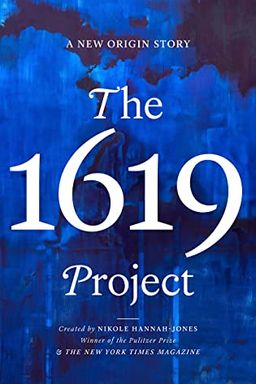
The 1619 Project cover

The 1619 Project

by Nikole Hannah-jones, Caitlin Roper, Ilena Silverman And Jake Silverstein

Viewing America’s entanglement with slavery and its legacy, in essays adapted and expanded from The New York Times Magazine.

1619 and the American Blueprint

1619 and the American Blueprint

How do you make sense of a nation that proclaims liberty while profiting from bondage? The book argues you begin in 1619, when a privateer brought captive Africans to Point Comfort, Virginia, launching slavery in the English colonies that became the United States. Nikole Hannah-Jones asks you to read American history through this lens: slavery is not an aberrant footnote; it is a formative institution that shaped law, economy, culture, and citizenship for four centuries.

When you treat 1619 as an origin point, contradictions you once saw as anomalies become structural patterns. Revolutionary-era freedom and constitutional design, the rise of American capitalism, political institutions that thwart majorities, and the enduring racial wealth and health gaps look different. You stop asking why inequality persists and start tracing how it was built—and rebuilt—across generations.

Reframing the founding

You grew up on 1776, but the plantation world long preceded the Declaration. Slavery influenced independence (think the 1775 Dunmore Proclamation offering freedom to enslaved people who joined the British) and the Constitution (the Three-Fifths Clause, fugitive-slave clause, and the 1808 delay on ending the import trade). Founders like Jefferson articulated equality while profiting from bondage, crafting a system that shielded slavery without naming it (parenthetical note: see Woody Holton and Eric Foner for the founders’ compromises and Reconstruction’s “second founding”).

Black Americans as democracy’s “perfecters”

Across the book, Black people appear not as passive subjects but as agents who forced the nation toward its ideals. From Crispus Attucks at the Boston Massacre to the 200,000 Black Union soldiers who compelled Lincoln’s evolution (Frederick Douglass both praised and pressed him), to Reconstruction-era lawmakers who established public schools and civil-rights regimes, you see democracy expanded from the margins inward—and repeatedly attacked when Black power grew.

Racial capitalism’s engine

Sugar is the book’s emblematic commodity. Whitney Plantation’s mills, British shipping through Liverpool and Bristol, and Wall Street credit show how enslaved labor financed modern capitalism. Planters used human beings as collateral, created an agrarian proletariat (including displaced poor whites), and concentrated wealth in a small elite. After emancipation, convict leasing and sharecropping carried the logic forward. Today’s wealth concentration and racial wealth gap are not accidental; they’re inheritances of a system built on extraction (parenthetical note: Eric Williams and Sidney Mintz connect sugar to capitalism’s rise).

Law, sex, and the making of race

Beginning with Virginia’s 1662 partus sequitur ventrem (a child’s status follows the mother), the law invented race and turned Black women’s reproductive capacities into capital. Anti-miscegenation regimes and Virginia’s 1924 Racial Integrity Act policed identity (long after Loving v. Virginia, a Virginia judge in 2019 had to strike down racial boxes on marriage licenses as purposeless holdovers). Cases like Celia (1855) reveal a legal order that rendered Black women unrapeable in the eyes of the state, a logic later echoed in eugenic sterilizations and the “adultification” of Black girls.

Fear, policing, and punishment

Slave patrols in South Carolina (1704) foreshadowed modern policing: curfews, cabin searches, surveillance, and force to contain freedom. Rebellions from Stono to Nat Turner provoked harsher codes. That through-line runs to Stand Your Ground disparities (Trayvon Martin’s killing vs. Jessie Murray Jr.’s failed defense), to the Black Panthers’ open-carry patrols and the Mulford Act’s backlash, to mass incarceration built on the Thirteenth Amendment’s punishment exception. Law and violence worked in tandem to limit Black mobility and political power.

Health, medicine, and lived bodies

From J. Marion Sims’s surgeries on enslaved women to Tuskegee and COVID-era neglect (Dr. Susan Moore’s pleas), medicine often served hierarchy. Persistent myths—Black people feel less pain; “race correction” in spirometry—combine with environmental and social determinants to shorten lives. Medical bias is not a footnote; it is a predictable output of the same structures that sorted people for labor and control.

Memory, culture, and repair

Control of history—textbooks, monuments, and bans on teaching hard truths—narrows what you imagine possible (Michel-Rolph Trouillot’s lesson: “history is the fruit of power”). Against this, the Black church’s prophetic tradition (Jeremiah Wright, James Cone), and music from spirituals to Motown, supplied moral language and solidarity. The book closes the loop with policy: Reconstruction’s reversal, the myth of racial progress, and colonization schemes all deferred equality; reparations and institutional reforms are the concrete antidotes.

Key Idea

Start your story in 1619 and you gain a map: slavery structured American freedom, wealth, and memory. Once you hold that map, today’s disparities stop looking mysterious—and repair stops looking optional.


Founding Contradictions, Black Perfectionists

Founding Contradictions, Black Perfectionists

If you absorb only one political lesson, make it this: the United States built its democratic edifice around slavery, and Black Americans became the nation’s most relentless reformers. The Revolution itself was shaped by slavery—Lord Dunmore’s 1775 offer of freedom to enslaved people willing to join the British sharpened Virginia’s case for independence. The new Constitution then protected slavery in euphemism: the Three-Fifths Clause inflated slaveholder power; the fugitive-slave clause nationalized human recapture; and the 1808 import ban delay bought planters time (parenthetical note: the framers’ “silences” were strategies, not oversights).

Black agency at the nation’s hinge points

You meet Crispus Attucks, a man of African and Native descent, as the first to fall at the Boston Massacre. You see enslaved fugitives weigh British promises against patriot hypocrisy and, during the Civil War, 200,000 Black soldiers force the Union to redefine its aims. Frederick Douglass captured the tension: Lincoln evolved, but not without pressure; emancipation was both moral act and military calculation. In Reconstruction, Black delegates rewrote southern constitutions, created public schools, and briefly lived within a multiracial democracy.

Backlash and the anti-majoritarian tradition

Progress triggered a counterrevolution. The Compromise of 1877 ended federal enforcement. White supremacist militias and lynch mobs—from Wilmington (1898) to Tulsa (1921)—destroyed communities and governments. The Supreme Court’s 1883 Civil Rights Cases framed protection as favoritism, undermining federal authority. Underneath this lay a political theory: John C. Calhoun’s “concurrent majority,” a constitutional reimagining that gave sectional minorities veto power. His ideas migrated into the filibuster, Jim Crow, and modern procedural blockades that let political minorities thwart multiracial majorities (think of anti-lynching filibusters, or contemporary uses of Senate rules; see also William F. Buckley’s early defenses of southern “autonomy” and later voter-suppression strategies).

January 6, double standards, and democratic fragility

The book pairs historical vigilantism with the present: while Black protests after George Floyd’s murder met militarized responses, white insurrectionists on January 6 initially faced lighter resistance. This asymmetry mirrors older patterns where Black political assertion was criminalized and white violence excused. When rules let entrenched minorities nullify majorities—through gerrymanders or the filibuster—your democracy becomes vulnerable to those asymmetric enforcements.

Patriotism as perfection

Hannah-Jones threads a personal story—her father’s flag flying at their home—with a civic one: critique is not betrayal. Black Americans perfected democracy by making its paper promises real—through conventions, courts, war service, and organizing. That work reframes patriotism as commitment to the ideal, not deference to the myth (parenthetical note: this echoes James Baldwin’s moral demand that we “achieve our country” by telling the truth about it).

Key Idea

Democracy’s growth in the U.S. tracks Black struggle, not elite benevolence. Each expansion of freedom—Revolution, Reconstruction, civil rights—came with Black leadership at the center and with fierce counter-moves designed to contain it.


Citizenship Contested and Won

Citizenship Contested and Won

Who counts as American? The book shows that birthright citizenship—the bedrock principle you may take for granted—was wrestled into existence by Black activists long before Congress ratified it. Starting in 1830 at Mother Bethel A.M.E. in Philadelphia, “colored conventions” forged a grassroots constitutionalism. Delegates like Frederick Douglass argued that birth under the Declaration’s creed implied citizenship; at Rochester in 1853, they linked Black belonging to American founding principles and demanded national recognition.

Dred Scott and judicial negation

The Supreme Court’s Dred Scott (1857) tried to obliterate these claims, declaring Black people could not be citizens. Yet dissents by Justices John McLean and Benjamin Curtis echoed the conventions’ argument that free, native-born Black people already held citizenship in several states. The Court’s majority opinion did not end the debate; it radicalized it, making Civil War and Reconstruction the arenas where citizenship would be remade (parenthetical note: Taney’s opinion stands as a cautionary tale about courts entrenching hierarchy under color of interpretation).

Legislating belonging: 1866 and the Fourteenth

Congress answered with the Civil Rights Act of 1866, declaring all persons born in the U.S. citizens (with limited Native exceptions), and with the Fourteenth Amendment (1868), constitutionalizing birthright citizenship. Attorney General Edward Bates’s 1862 opinion prefigured the shift: birth on U.S. soil makes one “prima facie” a citizen. Later, Wong Kim Ark (1898) affirmed birthright for children of immigrants, extending the conventions’ vision beyond Black-white binaries to an inclusive civic principle.

Colonization and gradualism as evasions

Alongside this fight ran a powerful counter-current: colonization and gradual emancipation. From Thomas Jefferson’s Notes on the State of Virginia to the American Colonization Society, elites proposed “freedom” that excluded equality—train Black people, then deport them. Some white reformers saw colonization as humane pragmatism; many enslavers saw it as removing a “dangerous” free Black presence. Either way, the policy deferred integration and justice while preserving white political dominance.

Why this history matters now

Debates over birthright citizenship, voting rights, and who gets counted still surface Calhoun’s veto logic and colonization’s spirit. When leaders call to restrict birthright or to redraw districts to dilute multiracial majorities, you’re hearing echoes of older strategies to define the polity narrowly. Remember that citizenship—who belongs and who votes—was not a gift from on high; it was won by grassroots constitutional argument and must be protected by institutional design (anti-gerrymandering rules, robust voting-rights protections).

Key Idea

Birthright citizenship is the child of Black activism and Reconstruction politics. Treat it as contingent—because history shows it can be narrowed by courts and procedure unless defended in law and practice.


Racial Capitalism’s Sugar Economy

Racial Capitalism’s Sugar Economy

To understand today’s inequality, follow sugar’s sticky trail. Khalil Gibran Muhammad uses sugar to show how enslaved labor powered a global machine: plantations in the Caribbean and Louisiana fed mills and distilleries; molasses became rum; European banks financed shipbuilders, insurers, and planters; and New World profits underwrote Old World industry. Whitney Plantation in Louisiana operates as a counter-monument, centering the enslaved whose labor made “white gold” so lucrative—and lethal.

Extraction, finance, and the Atlantic world

The Royal African Company, merchants in Liverpool and Bristol, and insurers intertwined human trafficking with commodity markets. In the U.S., enslaved people served as collateral; mortgages and bonds securitized their bodies. Louisiana’s sugar boom demanded 24/7 cane grinding during harvests, depressingly short life expectancies, and child labor. The Haitian Revolution (1791) terrified slaveholders and reshaped policy, revealing how Black liberation rattled an entire financial order (parenthetical note: Eric Williams argued profits from slavery seeded British industrialization; Muhammad places the U.S. squarely in that story).

The psychological wage and labor politics

By the 1850s–60s, southern planters consolidated land and power. In Houston County, Georgia, overseer households doubled as their landownership collapsed (26% to 8%), producing an agrarian proletariat. Poor whites accepted precarious status because whiteness conferred a “psychological wage” (Du Bois’s term), keeping multiracial labor solidarity at bay and locking wealth into planter hands. By 1860, two-thirds of men with estates over $100,000 lived in the South—proof of concentrated gains.

Post-emancipation continuity

The Thirteenth Amendment’s exception—slavery “as punishment for crime”—enabled convict leasing, a lethal labor regime documented by Douglas Blackmon and Talitha LeFlouria. States criminalized trivialities to feed chain gangs and private contractors, extending extraction under new legal cover. If you think capitalism modernized into benign markets, the book insists you account for how capital adjusted to preserve cheap Black labor and white accumulation.

From diet to disease to demographics

Sugar’s harms didn’t end at the mill. Aggressive marketing and food deserts tie high-sugar diets to diabetes and cardiovascular disease, disproportionately in Black communities—descendants of those who labored in the cane fields now bear metabolic fallout. The commodity that built banks now burdens bodies, closing the circle between racial capitalism and public health.

Policy as wealth machine

After the war, federal policy showered assets upward and outward—but not evenly. The Homestead Act moved 246 million acres to mostly white settlers; New Deal and FHA programs grew a white middle class while redlining starved Black neighborhoods of credit; the GI Bill was administered to exclude Black veterans. Meanwhile, organized violence—from Wilmington to Tulsa—torched Black wealth that did accumulate. The result is a staggering wealth chasm: the average Black family with children holds about one cent for every dollar held by a white counterpart.

Key Idea

America’s capitalism took the lowest road—commodifying human beings. If you want to narrow today’s gaps, you must address the financial architecture built on slavery and its policy descendants that kept compounding white advantage.


Law, Sex, and Making Race

Law, Sex, and Making Race

Race in America is not just about skin; it is a legal technology that once turned wombs into wealth and still polices intimacy and identity. In 1662 Virginia codified partus sequitur ventrem, decreeing that a child’s status followed the mother. That single statute transformed sexual violence into a business model: rape of enslaved women generated more property for enslavers. The law incentivized reproduction without consent and stitched racial hierarchy into family formation.

Policing boundaries of whiteness

Anti-miscegenation laws (Virginia 1682, 1705) criminalized interracial intimacy, and bureaucrats like Walter Plecker (1924 Racial Integrity Act) patrolled birth certificates to maintain a hard “color line.” Loving v. Virginia (1967) toppled marriage bans, but the regime’s remnants lingered: in 2019 a Virginia judge had to strike down race checkboxes on marriage licenses as purposeless echoes of Plecker’s taxonomy. The point is not just legal prohibition; it’s the administrative state’s quiet, daily sorting of bodies.

Sexual exploitation and legal erasure

Celia’s case (Missouri, 1855), where a Black woman killed her enslaver in self-defense against repeated rape, exposes the logic: as “property,” she could not claim self-defense. The “Jezebel” myth rationalized sexual violence by casting Black women as insatiable and unrapeable. That logic did not end with emancipation. In the twentieth century, eugenics programs sterilized Black women, and policymakers pathologized Black families (e.g., the Moynihan Report’s narrow focus on Black pathology) rather than addressing structural deprivation.

Adultification and contemporary control

The book tracks “adultification”—seeing Black girls as older and less innocent than their peers—which shows up in schools, courts, and medicine. The Danielle Hicks-Best case becomes emblematic of how institutions discount Black girls’ vulnerability. These attitudes intersect with health care, where Black women’s pain is often dismissed, contributing to a maternal-mortality crisis that shames a wealthy nation.

Reproductive justice, not mere rights

Against centuries of control, Black feminists developed a reproductive-justice framework. Loretta Ross and SisterSong center the right to have children, not have children, and to raise them in safe communities—linking bodily autonomy to housing, food, health, and freedom from violence. This reframing moves you from procedural legality to material conditions: do Black women have the resources and respect necessary for genuine choice?

Guns, militias, and uneven self-defense

Even the right to armed self-defense, often celebrated as universal, has been racially filtered. Southern states barred Black people from bearing arms to suppress uprisings; the Second Amendment’s militia language reassured slaveholders that armed whites could control Black populations. In practice, modern Stand Your Ground regimes protect white shooters more reliably than Black defendants (studies cited in the book report vastly higher “justifiable” rulings for white-on-Black killings). When the Black Panthers legally open-carried in Oakland to monitor police, California passed the Mulford Act to shut it down.

Key Idea

American law did not merely reflect race; it manufactured it by regulating sex, reproduction, and self-defense. If you want equality, you must dismantle the legal and cultural assumptions that still make Black bodies less protected and more policed.


Fear, Policing, and Punishment

Fear, Policing, and Punishment

A straight line connects slave patrols to the modern carceral state. In the 1700s, southern patrols enforced curfews, raided cabins, and hunted fugitives. Rebellions—from Stono (1739) and Gabriel’s conspiracy (1800) to Nat Turner (1831)—fed white fear and harsher codes like South Carolina’s Negro Act (1740). The response to Black resistance was always the same: more surveillance, more force, more law in service of order.

Vigilantism and the state

Lynchings, Red Summer pogroms (1919), and organized coups like Wilmington (1898) reveal collaboration between mobs and officials. The state’s failure to prosecute white terror hardened a message: Black political and economic gains would be punished. The Equal Justice Initiative documents at least 6,500 lynchings between the Civil War and 1950, a terror campaign whose memory work (EJI’s memorial and museum) the book highlights as crucial to truth-telling.

The punishment exception and its descendants

The Thirteenth Amendment’s carve-out enabled “slavery by another name.” States criminalized vagrancy and “idleness,” feeding Black bodies into convict leasing. Later, the War on Drugs, mandatory minimums, and three-strikes laws expanded incarceration, ignoring the Kerner Commission’s call to address segregation and poverty. Today, the U.S. imprisons at world-leading rates, disproportionately Black, a system built to manage social problems as criminal deviance.

Self-defense and prosecutorial asymmetry

The book contrasts cases to expose bias. George Zimmerman killed Trayvon Martin and prevailed with a self-defense claim under Florida’s Stand Your Ground logic. Jessie Murray Jr., a Black man in Georgia who said he fired to protect his white wife from an assault, saw his claim rejected and took a plea on a weapons charge. Research by Jennifer Eberhardt and Phillip Atiba Goff explains why: people more readily perceive threat in Blackness, and that perception shapes policing, prosecution, and juries.

Protest and counterinsurgency

When millions protested George Floyd’s murder in 2020—largely peaceful demonstrations—they met federal shows of force and militarized policing. This matched a long pattern: COINTELPRO surveilled and disrupted Black movements; legislatures respond to Black armed self-defense by narrowing gun rights (Mulford Act), while white militias often receive leniency. The double standard delegitimizes Black dissent and normalizes white paramilitarism.

Reform, not shortcuts

To change outcomes, you must change incentives and design. That means limiting the punishment exception, investing in communities (as the Kerner Commission urged), rewriting use-of-force statutes and self-defense instructions to reduce racial bias, and ensuring independent accountability for police. Without structural reform, episodic outrage recedes and the punitive continuum endures.

Key Idea

Policing and incarceration are not race-neutral projects gone awry. They are updated tools of social control born in slavery, refined through Jim Crow, and sustained by policy choices you can unmake.


Medicine, Culture, and Survival

Medicine, Culture, and Survival

If you expect clinical neutrality, the book asks you to look harder. Medicine has a race problem rooted in slavery: Samuel Cartwright invented “drapetomania” to pathologize escape; physicians like Thomas Hamilton tortured John Brown to test theories; J. Marion Sims refined gynecological techniques on unanesthetized enslaved women. Tuskegee (1932–1972) then taught generations that authorities would experiment on Black bodies without consent. This isn’t academic trivia; it’s why mistrust persists and outcomes diverge.

Bias in the exam room

Contemporary studies show medical trainees still believe nonsense about Black physiology (e.g., thicker skin, higher pain tolerance). “Race corrections” in tools like the spirometer build discrimination into diagnostics, underestimating disease in Black patients. Dr. Susan Moore’s recorded pleas during her COVID hospitalization—documenting how staff dismissed her pain—underscore that even a physician’s expertise does not shield a Black patient from bias. The National Medical Association exists in part because mainstream medicine historically excluded Black clinicians and dismissed Black patients.

Weathering and the social body

Arline Geronimus’s “weathering” research finds that chronic stress from racism and poverty ages Black bodies faster, raising risks for complications in pregnancy, hypertension, and diabetes. Add environmental racism—polluted neighborhoods, lead exposure, heat islands—and you see why life expectancy gaps persist. Health is not just what happens in clinics; it’s what zoning, transit, and policing produce day after day.

Church and music as medicine

The Black church and music operate as parallel health systems—spiritual triage, mutual aid, political therapy. Jeremiah Wright’s jeremiad and James Cone’s liberation theology come from a prophetic tradition that diagnoses national sin to spur collective healing. Music—from ring shouts and spirituals to Motown—transformed pain into power, built networks, and funded organizing (the Fisk Jubilee Singers raised money for Black education; Freedom Songs catalyzed courage in the face of violence).

Native entanglement and shared repair

Tiya Miles adds a vital layer: treaties at Hopewell (1785) recognized Native nations while subordinating them, requiring return of “property” (including enslaved people). U.S. “civilization” programs pushed some Native elites to adopt plantation slavery (James Vann among the Cherokee), trapping them in a politics that didn’t save their land. After the Civil War, 1866 treaties promised citizenship for Freedmen within the Five Tribes, a promise still litigated by descendants like Marilyn Vann. Repair requires holding these entangled histories together, not pitting them against each other.

From myth to policy

The myth of steady racial progress—peddled in Cold War pamphlets like “The Negro in American Life”—lets institutions declare the job done and ignore structural fixes. The book urges a different prescription: honest history in schools (despite censorship campaigns), clinical reforms (end race corrections, mandate bias training and accountability), and investment in the social determinants of health. Culture is not a distraction—it’s the soft tissue binding policy bones.

Key Idea

To heal American bodies, you must treat American history. That means pairing medical reform with cultural power—church, art, song—and with policies that reduce the stressors baked into daily Black life.


Memory, Power, and Reparations

Memory, Power, and Reparations

Who writes the past writes the future. The book shows how curricula that call enslaved people “workers,” monuments that center 1776, and political bans on the 1619 Project manufacture public ignorance. Michel-Rolph Trouillot warned that silences in the archive are acts of power; the book documents how Texas boards and national publishers embedded those silences in classrooms. When people don’t know slavery caused the Civil War—or how the Constitution protected slavery—they misdiagnose today’s inequities and oppose structural remedies.

The myth of racial progress

From Jefferson’s colonization fantasies to Cold War propaganda celebrating token success, elites used “progress” as a story to avoid repair. After Reconstruction’s amendments, the nation declared victory while permitting terror and disfranchisement. After Brown and the Civil Rights Act, the nation again declared victory while redlining and segregated wealth kept compounding. After Barack Obama’s election, many proclaimed a “post-racial” era even as voting rights were gutted and inequality widened (parenthetical note: compare to Ibram X. Kendi’s warning against progress narratives that breed complacency).

Reparations as civic repair

William Darity and A. Kirsten Mullen’s framework anchors the book’s policy turn: reparations are a federal obligation because federal law created, protected, and subsidized racial plunder. A practical program would combine direct payments to descendants of enslaved people with targeted public investments in historically excluded communities, aggressive enforcement of civil-rights law, and reforms to voting, housing, and education. This is not punishment; it is restitution—akin to how the Homestead Act, FHA, and GI Bill functioned as “reparations” for white America.

Education as infrastructure

Teachers who adopted the 1619 Project saw students recognize themselves in the national story—an antidote to educational malpractice. Civic literacy about the Three-Fifths Clause, the punishment exception, and Reconstruction’s reversal is as crucial to democracy as bridges and broadband. Memory work—museums, accurate textbooks, public rituals of acknowledgment—expands the political imagination and makes repair thinkable.

Coalitions across entangled histories

The book refuses zero-sum thinking. Black and Native histories interlock through treaties, removal, and slavery; the Descendants of Freedmen of the Five Tribes show how treaty enforcement can be a model for reparative policy. Building coalitions around shared harms—land theft, labor extraction, legal exclusion—gives repair a broader base and a more accurate moral claim.

From memory to majority rule

Finally, dismantling anti-majoritarian guardrails—abusive gerrymanders, the filibuster deployed to nullify civil rights—translates memory into power. Otherwise, old Calhounism will keep multiracial majorities from acting. Repair needs rules that let majorities govern and institutions that protect vulnerable minorities, not property-based vetoes that freeze inequality in place.

Key Idea

Truth-telling is step one; redistribution and institutional redesign are steps two and three. Reparations, voting-rights enforcement, and honest curricula are not radical departures—they are the overdue completion of America’s unfinished founding.

Dig Deeper

Get personalized prompts to apply these lessons to your life and deepen your understanding.

Go Deeper

Get the Full Experience

Download Insight Books for AI-powered reflections, quizzes, and more.