
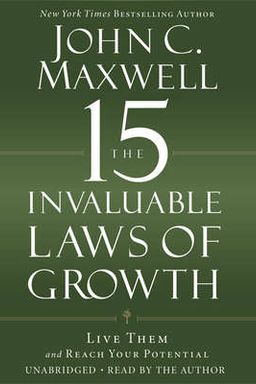
The 15 Invaluable Laws of Growth cover

The 15 Invaluable Laws of Growth

by John C Maxwell

Discover John C. Maxwell''s powerful strategies for personal growth in ''The 15 Invaluable Laws of Growth.'' By embracing intentional actions, self-awareness, and community support, you''ll learn to navigate life''s challenges and unlock your full potential. This engaging guide empowers you to transform adversity into opportunity and live a life of fulfillment and success.

Personal Growth as the Foundation of Potential

Have you ever looked at your life and wondered, “Am I truly living up to my potential?” In The 15 Invaluable Laws of Growth, leadership expert John C. Maxwell argues that growth doesn’t happen automatically—it must be intentional. Every person has potential, but only those who cultivate deliberate personal development can progress from success to significance. Maxwell contends that continual self-improvement is not only possible but essential; it is the only way to fully realize who you are capable of becoming.

The book proposes 15 “laws” that describe how growth works, how it’s sustained, and how it ultimately transforms not just your career but your entire life. These laws range from simple but profound shifts—like the Law of Intentionality (“Growth doesn’t just happen”)—to more advanced principles like the Law of Contribution (“Growing yourself enables you to grow others”). Each law offers a blueprint for overcoming internal and external barriers, cultivating discipline, and building a life defined by purpose rather than accident.

Why Growth Must Be Intentional

Maxwell begins with a story from his early life: when a mentor asked if he had a plan for personal growth, he realized he didn’t. His achievements were mostly the result of hard work and goals, but not a structured effort to become better. That realization changed everything. He learned that hoping for improvement is not a strategy—growth must be chosen and pursued deliberately. “You cannot change your destination overnight,” he writes, “but you can change your direction overnight.”

Maxwell categorizes common mental blocks as growth gap traps: the Assumption Gap (“I’ll grow automatically”), the Knowledge Gap (“I don’t know how”), and the Timing Gap (“It’s not the right time”), among others. His point is that you must stop waiting for “someday.” Beginning today—no matter how imperfectly—is the key that unlocks all other doors of personal transformation.

Self-Awareness and Direction

To grow intentionally, you must know who you are and where you want to go. That’s where the Law of Awareness comes in: you must know yourself to grow yourself. According to Maxwell, there are three types of people—those who don’t know what they want, those who know but don’t act, and those who know and consistently do it. The last group is composed of fulfilled individuals who live in alignment with their purpose. To join them, you need self-awareness: define your passions, identify your strengths, and clarify your direction.

Maxwell’s guidance mirrors the ideas of other thinkers like Viktor Frankl (Man’s Search for Meaning), who argued that purpose precedes fulfillment. By understanding your unique gifts and values, you can design a more meaningful growth strategy.

From Success to Significance

Maxwell defines personal growth as a lifelong process that moves you beyond career advancement toward moral, relational, and spiritual maturity. The ultimate goal is contribution: growing yourself so you can grow others. Inspiration without implementation never endures, but growth grounded in daily discipline transforms both character and capability. By applying these laws consistently, you transform potential energy into purposeful momentum. In his words, “Motivation gets you going, but discipline keeps you growing.”

Throughout the book, Maxwell weaves stories—from his own journey and from others, such as Nelson Mandela, Benjamin Franklin, and struggling entrepreneurs—to illustrate how personal expansion consistently precedes external success. Life, he emphasizes, “is now in session. Are you present?” If you desire to become more, do more, and give more, your first and most important task is to master the art of intentional growth.


The Power of Intentionality

Maxwell’s first principle—the Law of Intentionality—sets the foundation for all growth. His message is simple yet profound: growth doesn’t happen automatically. Without intentional effort, you will always operate below your potential. Many people assume that maturity and progress are the natural by-products of time, but Maxwell argues that time only passes—you must decide to improve within it.

Closing the Growth Gap

Maxwell identifies eight mental barriers, or “growth gaps,” that stop people from developing. These include excuses like “I don’t know how,” “I’m waiting for the right time,” or “I’m afraid of failing.” Each one reflects passive thinking. To escape them, Maxwell advises immediate, actionable decisions. Start where you are with what you have. Progress is far more a matter of direction than perfection.

His early career story makes the point concrete: when offered the best church position in his denomination, Maxwell realized that success wouldn’t follow hard work alone. After a mentor challenged him to plan his personal growth, he spent $799—nearly a month’s salary—on a self-improvement course. The sacrifice forced him to take responsibility for his development. What he gained wasn’t just knowledge but a mindset shift: success comes from growing yourself, not simply from achieving goals.

The Role of Discipline

Intentional growth requires structure. Maxwell recommends scheduling growth time daily—a lesson echoed by other productivity experts like James Clear (Atomic Habits). You can’t improve what you never measure or prioritize. Even reading fifteen minutes a day compounds into hundreds of hours over a year. The Law of Intentionality therefore connects motivation to discipline: motivation gets you started, but the rhythm of consistent effort is what keeps you developing over the long haul.

Maxwell’s challenge is direct: do it now. The “law of diminishing intent” says that the longer you wait to act on an idea, the less likely you are to do it. So even small daily progress surpasses perfect intentions. For Maxwell, growth is not an event but a way of life—a direction chosen anew every morning.


Knowing Yourself to Grow Yourself

The Law of Awareness teaches that you must understand who you are to get where you want to go. Maxwell compares this awareness to reading a map—you can’t plan your route forward until you know your current location. Clarity about your strengths, weaknesses, passions, and values creates the foundation for growth.

Discovering Direction and Passion

Through reflective questions, Maxwell invites you to examine your desires: What do you love doing? What motivates you? What are you naturally good at? He recounts the story of a factory worker, Jerry Anderson, who became a successful entrepreneur only after clarifying his purpose and studying core principles weekly with peers. That process of directed awareness turned failure into flourishing.

Likewise, self-understanding guards against chasing dreams that don’t fit your abilities. One of Maxwell’s examples, a worship leader who wanted to become a baseball announcer, demonstrates the mismatch between desire and gifting. Purpose, Maxwell insists, arises at the intersection of passion and strength.

Motives and Accountability

Once you’ve identified what you want, it’s crucial to examine why. Acting for the right reasons—such as serving or creating meaning—produces lasting fulfillment. Wrong motives, like ego or comparison, lead only to frustration. Accountability partners or mentors help ensure your motives and actions align.

Ultimately, the Law of Awareness connects self-discovery with responsibility: you own your direction. As Nathaniel Branden said, “The first step toward change is awareness. The second step is acceptance.” Growth, then, begins with honesty about your starting point and courage to move toward who you were created to be.


Changing from Motivation to Consistency

The Law of Consistency warns that bursts of inspiration fade—discipline is what sustains growth. Maxwell admits that early in his career he believed motivation was the magic key to success, but he eventually learned that emotion wears off quickly. Like maintaining physical fitness, sustained growth requires daily habits, not occasional enthusiasm.

Developing Daily Disciplines

Consistency is about process, not outcome. Drawing from both his faith and leadership experience, Maxwell notes that people don’t decide their future—they decide their habits, and their habits decide their future. He compares personal growth to compound interest: a small deposit of effort each day yields exponential results over time. His advice mirrors Darren Hardy’s concept in The Compound Effect: “Small, smart choices repeated consistently create massive results.”

Maxwell also teaches that consistency starts with knowing why you want to improve. Without an emotional anchor, routines become mechanical. Clarity of purpose converts discipline into devotion.

Learning from John Williams’s Habit of Mastery

To illustrate consistency’s power, Maxwell points to composer John Williams. Rather than waiting for inspiration, Williams writes music every day, good or bad, trusting that regular work produces genius. Across sixty years, this discipline created the soundtracks for Star Wars, Jaws, and more. The analogy is clear: talent starts the journey, but consistency finishes it. For readers, that means transforming “someday intentions” into structured daily effort. Greatness doesn’t erupt—it accumulates.


The Law of Pain: Turning Setbacks into Growth

Maxwell’s Law of Pain argues that growth often hides inside hardship. The question isn’t whether you’ll experience pain, but how you’ll use it. Every crisis exposes who you are and offers a mirror for self-discovery. If managed well, pain can become your most profitable teacher.

Learning from Loss

Maxwell illustrates this with the story of Cheryl McGuinness, whose husband died as a pilot on 9/11. Though devastated, she chose to grow from the loss—speaking publicly, helping widows, and reshaping her faith. Pain, managed wisely, can become purpose. Like Viktor Frankl, Maxwell insists that when you can’t change your circumstances, you can still change yourself.

Responding, Not Reacting

Everyone has a default response to pain: avoidance, anger, or withdrawal. But Maxwell advises choosing growth instead. That means reflecting on what the situation can teach you, developing creativity to adapt, and making changes to prevent repetition.

The Law of Pain converts suffering into strength. Each disappointment—whether a failed business, broken relationship, or health crisis—contains lessons. As psychiatrist Fritz Perls said, “Learning is discovering that something is possible.” Pain, properly processed, expands not just endurance but imagination.


The Law of Environment: Growth Thrives in the Right Surroundings

Maxwell’s Law of Environment states that growth thrives only in conducive surroundings. You can’t reach your potential in a toxic, uninspiring, or limiting environment. The right environment exposes you to people and situations that challenge and lift you higher.

Changing Where You Grow

Maxwell shares how, early in his career, he was being prepared for senior leadership in his denomination—but that also meant hitting a ceiling of growth. “If you’re always at the head of the class, you’re in the wrong class,” he writes. Leaving that environment was painful but necessary. Like a plant that can’t thrive in poor soil, people must sometimes transplant to flourish.

Choosing the Right People

Environment, for Maxwell, is most shaped by people. Social psychologist David McClelland found that your “reference group” accounts for 95% of your success or failure. Therefore, you must surround yourself with positive, growing individuals. The company you keep determines the ceiling on your potential. As mentor Charles “Tremendous” Jones famously said, “You’ll be the same person in five years except for the people you meet and the books you read.”

Changing your environment means entering circles that intimidate, stretch, and inspire you. It’s in those places that growth transforms from theory into habit.


Expanding Capacity through the Law of Expansion

In the Law of Expansion, Maxwell declares that “growth always increases your capacity.” He argues that human potential is virtually limitless—most of us use only 10% of what we’re capable of. To expand that capacity, you must first change your thinking, then your actions.

Changing Thought Patterns

Maxwell outlines three mental shifts: stop thinking “more work” and start thinking “what works”; stop asking “can I?” and start asking “how can I?”; and stop seeing “one door” and begin imagining “many doors.” This mindset transforms limitations into possibilities. It aligns with Carol Dweck’s growth mindset—believing that ability expands through effort and learning.

He illustrates this through stories of artists like Michelangelo, who encouraged Raphael by writing “Amplius” (greater) across his sketch, and through leaders who repeatedly risked failure to embody continual improvement. Expansion, Maxwell says, begins in the mind but matures through consistent action.

Acting Beyond Comfort

To expand capacity, Maxwell names three practices: doing new things (“You grow when you do what you could and should”), doing more than expected (“Excellence means going the extra mile”), and doing important things daily. True mastery, like that of 95-year-old cellist Pablo Casals, requires daily devotion to improvement. Living the Law of Expansion means embracing lifelong learning and perpetual growth until your final day.


Character: The Ladder You Climb On

The Law of the Ladder declares that character growth determines the height of your personal growth. Skills and ambition can take you far, but only integrity keeps you there. Maxwell uses the story of entrepreneur Jerry Anderson to demonstrate how living by principles rather than expedience built lasting success in business and beyond.

Inside-Out Growth

True progress starts on the inside. Reputation is what others think of you; character is who you really are. Aligning the two requires cultivating humility, honesty, and consistency. Maxwell reminds us that “inside victories always precede outside ones.” That means winning private battles—resisting shortcuts, managing emotions, keeping promises—before demanding public influence.

Humility and Service

Humility anchors every mature leader. Quoting Confucius—“Humility is the solid foundation of all virtues”—Maxwell explains that we become better people by valuing others and focusing on service rather than ambition. Character isn’t built through comfort but through challenges that test integrity.

Legacy, he concludes, isn’t measured by wealth or position but by the quality of the soul that remains after success fades. When you devote yourself to finishing well, you ensure that achievement will one day mirror virtue.


The Law of Contribution: Growth Worth Giving Away

Maxwell’s final law—the Law of Contribution—brings the journey full circle: growing yourself enables you to grow others. Personal growth finds its highest purpose in service. Success is about adding value to yourself; significance is about adding value to others.

From Success to Significance

Maxwell quotes Benjamin Franklin, who said, “I would rather have it said ‘he lived usefully’ than ‘he died rich.’” This philosophy drives the shift from accumulation to altruism. True fulfillment doesn’t come from possessions but from people—mentoring, encouraging, and investing in others’ growth. When you become a “river, not a reservoir,” you let wisdom flow through you to others.

Giving as Growth

Contribution takes many forms: teaching, serving, or simply inspiring others by example. Maxwell recounts his father’s desire, even in old age, to move into a new care home early so he could welcome and encourage incoming residents—proof that contribution doesn’t retire. He also cites Jim Rohn, whose path from stock clerk to world-class mentor shows how continual self-development transforms into collective growth. Rohn’s principle—“The greatest gift you can give to someone is your own personal development”—captures Maxwell’s thesis perfectly.

In the end, your growth matters not merely for your own success but for its ripple effect on others. To live usefully, you must learn ceaselessly, give generously, and serve joyfully. That is the essence of significance—the point where personal transformation lights the way for others to follow.

Dig Deeper

Get personalized prompts to apply these lessons to your life and deepen your understanding.

Go Deeper

Get the Full Experience

Download Insight Books for AI-powered reflections, quizzes, and more.