
Idea 1
Mastering Business Through Numbers and People
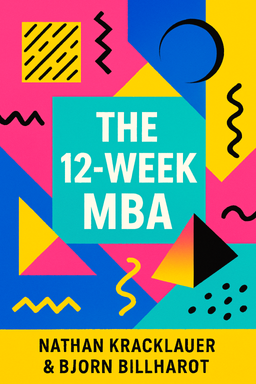
What if you could learn everything essential about an MBA in just twelve weeks? That’s the premise behind The 12‑Week MBA by Bjorn Billhardt and Nathan Kracklauer, a book that promises to distill decades of graduate‑level business education and frontline corporate leadership into a practical, accessible framework focused on two timeless domains: numbers and people. The authors argue that most MBA programs devote too much time to specialized case studies and functional silos that quickly become outdated, when the enduring skills that make leaders effective can be taught, practiced, and internalized far more efficiently.
Drawing on twenty years of experience designing leadership programs for companies such as Dell, Coca‑Cola, and Marriott, Billhardt and Kracklauer anchor their book around one central idea: administration – literally, the craft of coordinating resources and people to deliver value. They divide that craft into two universal challenges that every business leader faces: understanding value creation through financial and strategic reasoning (“the numbers”) and managing collective action through trust, motivation, and decision‑making (“the people”).
Why We Still Need MBAs — but Not the Traditional Kind
The book opens with a tongue‑in‑cheek critique of traditional MBA programs. At Harvard Business School, legendary professor Bill Sahlman once joked that industries collapse shortly after a wave of MBAs enter them—an ironic reminder that credentials don’t guarantee judgment. While the authors still affirm the value of MBA education for those who can afford it, they insist that it’s now possible—and far more efficient—to learn the core competencies of business management outside the lecture hall. In an era when disruption is constant, understanding how to measure profitability and inspire people matters more than memorizing formulas for supply‑chain optimization or case studies about Friendster‑era marketing.
Two Lenses: Poets and Quants
Business schools often joke that students fall into two tribes: poets and quants. Quants are drawn to numbers, data, and structure; poets gravitate toward leadership, communication, and human dynamics. The authors’ genius lies in showing that both lenses are not merely complementary but inseparable. They argue that the most effective modern leaders learn to fluently switch between financial logic and human empathy—to translate the language of spreadsheets into the behavior of people who bring those spreadsheets to life.
Part I, “The Numbers,” teaches how to think in terms of value drivers: profitability, growth, and risk. You learn to read a profit and loss statement not as an accounting ritual but as a story of how customer value turns into shareholder returns. You see how strategy, pricing, cost structure, and cash flow interact. Most importantly, you understand why trust—between investors, managers, employees, and customers—is the unseen foundation of all value creation.
Beyond the Balance Sheet: The Human Engine
Part II, “The People,” shifts to the psychology of organizations. Here the authors turn from finance to philosophy: Why do individuals cooperate, and how can leaders design environments that make cooperation productive rather than painful? This section serves as a practical guide to the human operating system of business: setting expectations, giving feedback, motivating teams, and making decisions together under uncertainty. Drawing on behavioral economics and social psychology, they show that managing people is less about exerting authority and more about cultivating trust and alignment—mirroring how financial management aims to align short‑term performance with long‑term confidence.
A Universal Curriculum for the Real World
Across twenty chapters, The 12‑Week MBA unfolds as a holistic blueprint for business acumen and leadership. You’ll understand how to analyze profitability like a CFO and manage collective action like a seasoned CEO. The book ranges from concrete tools—such as breakeven analysis and the cash‑flow statement—to subtle human skills, like framing feedback that builds trust or recognizing the difference between alignment and agreement. Case studies such as GE’s breakup, Nokia’s fall, Netflix’s valuation swings, and United Airlines’ PR disaster illustrate how the “numbers” and “people” dimensions constantly intertwine.
Ultimately, the authors reclaim the term “MBA” as a mindset rather than a degree. Their message: anyone can master the essentials of leading a business—an entrepreneur, a team lead, a nonprofit manager, even a teacher or scientist learning to coordinate projects. Management, they argue, is humanity’s most powerful collective invention, the social technology that allows people to accomplish what no individual ever could. By understanding value and mastering trust, you can lead not just companies but communities toward sustainable growth.