
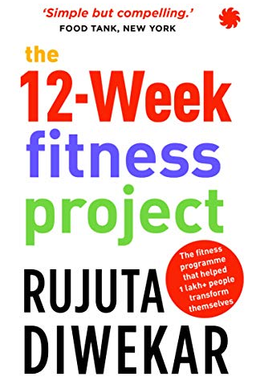
The 12-week Fitness Project cover

The 12-week Fitness Project

by Rujuta Diwekar

The 12-week Fitness Project redefines health by steering away from restrictive diets to embrace lasting, holistic well-being. Rujuta Diwekar offers a unique, time-tested approach that fosters sustainable change through mindful habits, enhancing both physical health and mental clarity.

Don't Lose Out—Work Out! The Science and Soul of Movement

When was the last time you felt truly alive in your body—not tired, not numb from work, but pulsing with energy and strength? In Don't Lose Out, Work Out!, celebrated Indian nutrition and fitness expert Rujuta Diwekar poses this question as both a challenge and an invitation. She argues that modern life—with its seductive screens, busy schedules, and obsession with quick weight loss—has disconnected us from our natural state of movement and vitality. Diwekar’s thesis is simple yet powerful: exercising right is not a luxury or punishment—it’s biologically, psychologically, and spiritually necessary to live well and age gracefully.

What makes her book stand apart is that it’s not just a manual for workouts—it’s a philosophy of living. Diwekar approaches fitness as a bridge between science and daily reality, blending exercise physiology with cultural wisdom and a touch of humor. She claims that real fitness comes from understanding how your metabolism works (your body’s constant balance between breakdown and buildup), how different types of exercises influence your heart and muscles, and how food, sleep, and emotions determine your ability to heal and grow stronger. And yes, she insists—you can reverse aging by twenty years with consistent movement and correct exercise.

From Survival to Flourishing

Diwekar begins by describing how our bodies are in a constant state of renewal. Every moment, cells break down (catabolism) and rebuild (anabolism), and together they form your metabolism—the ultimate indicator of health. She jokes that while evolution made sure we die eventually (so the bedroom passes to the next generation), it also gifted us the power to delay aging through movement. The problem? Most of us do everything possible to accelerate decay—sitting all day, sleeping late, starving ourselves on fad diets, and calling leisurely morning walks "exercise." Her message is clear: you can’t outsource your vitality. The process of staying strong must start today, with small steps and lifelong commitment.

Exercise as Anti-Aging Medicine

Every time you work out, Diwekar explains, your body goes through microscopic breakdowns. Muscular tissues tear, and when repaired, they rebuild stronger—this is adaptation, the true fountain of youth. She calls exercise the most effective anti-aging medicine there is, better than creams, surgeries, or diets. Through intelligent loading and recovery, you tell your body that your muscles are needed, prompting the body’s “wisdom” to preserve and strengthen them. The irony, she notes, is that the same obsession with quick results—pursuing the weighing scale instead of stamina—undermines these deeper healing processes.

Breaking the Myths and Rediscovering Movement

Much of Diwekar’s book is myth-busting with style and humor. She tackles every misunderstanding that the urban Indian carries—spot reduction, fear of bulking up, sweating as ‘fat melting,’ or cardio as the ‘best exercise.’ She explains, through examples like Mrs. Khanna doing 500 crunches or a runner terrified of knee damage, how these myths stem from ignorance of exercise science. Real movement, she says, needs structure, understanding of energy systems, and respect for recovery. Otherwise, training becomes abuse.

Holistic Fitness: Strength, Endurance, Flexibility, and Heart

Instead of siloed workouts, Diwekar introduces a multidimensional approach. Exercise should improve strength (the body’s ability to produce force), endurance (its ability to sustain activity), flexibility (the range of motion of joints), and cardio-respiratory fitness (the efficiency of heart and lungs). Focusing only on one parameter—say, endless cardio—means leaving others to deteriorate. Balance, variety, and intelligent sequencing are at the heart of her program, what she calls “wholesome workouts.”

Why This Matters: The Cultural and Emotional Angle

Beyond biology, Diwekar delves into why exercise is emotionally significant. She connects it to dignity and independence—especially for Indians who wish to “die hasthé hasthé,” without burdening their children. Through playful anecdotes about treks in Kashmir or conversations with friends from tribes in Darjeeling, she shows that movement isn't vanity—it’s a language of joy, morality, and connectedness. Exercise, she says, makes you happy because it changes your neurotransmitters—serotonin and norepinephrine—more effectively than antidepressants. It’s literally a way to “dance your demons out.”

A Science Hidden in Culture

Throughout the book, Diwekar seamlessly blends scientific rigor with cultural humor, reminding readers that wisdom already existed in grandma’s habits—balanced meals, everyday activity, and laughter. Modern fitness may disguise these truths behind gym jargon, but their essence remains the same: eat real food, move daily, sleep well, love deeply. In that sense, Don’t Lose Out, Work Out! isn’t just a manual—it’s a cultural manifesto that reclaims movement as the Indian art of staying young.

By the end of the overview, the reader grasps the book’s holistic aim: to teach the science behind exercise while reviving its soul. You’ll learn how metabolism and aging work, how strength training, cardio, and yoga affect different systems in your body, and how to design exercise based on principles like progressive overload, recovery, and regularity. Most importantly, you’ll discover that fitness isn’t a race—it's a lifelong dialogue between your body and your spirit, one workout at a time.


The Science of Moving Right

Diwekar builds her entire argument around understanding exercise as a biological process, not a cosmetic one. She dives deep into the science of muscular contractions and metabolism—but in her trademark style, translating jargon into relatable stories from everyday Indian life. Sitting, she says, is the new smoking, an independent risk factor for obesity, diabetes, and anxiety. Whether you eat homemade food or stay calm at work, prolonged inactivity will sabotage your health. Exercise is the body’s way of reminding evolution that we intend to survive.

Energy Systems: Aerobic vs. Anaerobic

Every movement you make draws on energy systems. The aerobic pathway uses oxygen and burns carbohydrates, fats, and proteins for sustained effort—like walking or light activity. The anaerobic pathway (comprising ATP-CP and glycogen-lactic systems) kicks in for quick, intense actions like sprinting, lifting weights, or climbing stairs. Both are essential. Aerobic training builds stamina, while anaerobic training reshapes your muscles and bone density, enhancing metabolic rate.

Diwekar compares this to running toward a train (anaerobic) versus walking to the platform (aerobic). Most people optimize one at the cost of the other. Aerobic exercise feels safe but limited; anaerobic feels risky but transformative. Sustainable fitness, she argues, must train both pathways.

Fuel and Muscle Type

She explains two muscle fiber types—slow twitch (Type 1, red) for endurance and fast twitch (Type 2, white) for power. The first burns fat and lasts longer; the second burns glycogen fast and gives explosive strength. Both need training. A sedentary lifestyle erases Type 2 fibers quickly, leading to weakness even in simple tasks. Strength training rebuilds them; stretching keeps them supple; cardio keeps them efficient. Ignoring any of these creates imbalance, visible in joint pain and fatigue.

The Miracle of After-Burn

The “after-burn” phenomenon—or EPOC (Excess Post-exercise Oxygen Consumption)—is central to Diwekar’s case. During anaerobic exercise, the body oxygen debt continues after the workout as it repairs and restores muscle tissue. This burns calories up to 48 hours later, unlike aerobic workouts that stop calorie burning once you rest. This explains why lifting weights or doing intervals makes one leaner than endless running. She calls it the ‘miracle metabolism loop’: train, recover, and stay in a higher fat-burning state for two days.

(Other experts like Brad Schoenfeld mirror this understanding in The Science of Lifting, confirming that intensity—not duration—correlates with metabolic growth.)

The Borg Scale and Real Effort

To help normalize intensity, Diwekar introduces the Borg Scale—a self-rating of perceived exertion from 1 (very light) to 10 (max effort). The aim isn’t to overstrain but to stay in the zone that stimulates adaptation. She reminds readers that progress stems from small overloads, not heroic exhaustion: “Don’t crawl when you can walk; don’t sprint when you can barely balance.” Real change comes from consistent, intelligent effort matched to your body’s signals.

Her humorous touch turns physiology into storytelling—laughing at people who wear hoodies in saunas to ‘sweat out toxins,’ explaining how lactic acid protects joints from overstrain, and showing how each scientific insight translates into common sense once properly understood. The moral: science isn’t complicated, just ignored. Understanding these inner mechanics makes you fall in love with exercise—not fear it.


Strength Training: The Anaerobic Advantage

In her third major section, Diwekar champions strength training as the heart of anti-aging and metabolic renewal. Contrary to Indian fears of becoming “bulky” or “masculine,” she argues that resistance training is not about size—it’s about intelligence and empowerment. From reversing diabetes to improving bone density, gym workouts create the very conditions evolution coded for longevity.

Debunking the Fear of Muscles

Through stories of clients—Sunita afraid of big arms or Shyam babu lifting wrongly—she dismantles misconceptions. Muscles aren’t vanity; they’re metabolic gold. Fat is inert, demanding no calories to sustain, whereas muscle constantly burns fuel. When you lose muscle, you lose the ability to lose fat. That’s why gymming properly keeps you lean long-term while crash diets make you sag.

Planning Strength Training

Diwekar translates gym language into human. Warm-up means 50% of your working load for 15 reps; workout means targeting big compound movements first—squats, rows, presses—for multi-joint recruitment. Keep sessions under 60 minutes to avoid catabolism and immune suppression. She introduces the rule of splits: beginners start with full-body workouts once a week, progress to two-day (upper and lower body), then eventually three-day splits. Brevity and quality beat obsession and quantity.

Recovery and Meal Planning

Strength training schedules demand careful recovery. She introduces her signature “4 Rs”—Rehydrate, Replenish, Repair, Recover. Within 20–45 minutes post-exercise, drink water, eat a banana or potato, add whey protein, and take antioxidants (vitamins C/E and minerals like selenium, zinc, chromium). The window of insulin sensitivity after exercise is magical—use it or lose it. This ensures muscle restoration instead of cortisol-driven breakdown.

Whey protein, she insists, is the only supplement worth considering—simple, milk-derived, and effective. Myths that high protein harms kidneys are debunked by science and common sense. Balanced eating with traditional foods (poha, dal-chawal, ghee) remains the foundation; the shake is only an enhancer, not a replacement.

Beyond the Gym

For Diwekar, strength training isn’t limited to barbells. Arm wrestling, carrying children, gardening—all count as resistance. What matters is effort against load. Her comic storytelling—of wealthy clients who honk instead of opening gates—highlights how social status kills physical strength. In her view, every act of self-reliance, whether squatting for chores or lifting groceries, can preserve muscle and dignity.

This section reads as both a scientific manual and social satire. Above all, Diwekar redefines strength training as the antidote to aging and entitlement—a revolution that starts with lifting not just weights, but your own body responsibly.


Cardio and the Heart Connection

Cardio, Diwekar claims, has been both overhyped and misunderstood. She opens by challenging the notion that running is always ‘good for the heart.’ The heart, she says, adapts differently to endurance (aerobic) and resistance (anaerobic) training. True heart health requires both. Without strengthening muscles to handle body weight, you’ll injure joints faster than you’ll burn fat.

How the Heart Works

She introduces basic cardiac physiology: the heart pumps about five liters of blood per minute. Fitness improves this via stroke volume—increasing the amount pumped per beat—and thus lowers resting heart rate. Every drop in your beats per minute lengthens your life by thousands of ‘saved’ beats a day. Through anecdotes—from Boris Becker’s legendary heart rate of 32 bpm to yogic masters lowering theirs to near meditation levels—she shows how movement reshapes longevity.

Training Both Systems

To make progress, Diwekar stresses “periodization”—rotating intensity and training paths weekly to avoid burnout. The FITT formula (Frequency, Intensity, Time, Type) helps structure cardio sessions: two times a week, alternating short high-intensity sessions and longer moderate ones. Walking can evolve to intervals and eventually running, but only after strengthening the TBLJ—bones, tendons, ligaments, joints. Otherwise, cardio will break what it intends to fix.

The Lactate Threshold

Running faster periodically pushes the body into the lactate threshold, where muscles shift from aerobic to anaerobic metabolism. Training here teaches your body to clear lactic acid efficiently, enhancing stamina. It’s the reason pro athletes sustain intensity longer. For normal people, this means mixing easy and fast intervals wisely rather than nonstop jogging.

Fueling the Heart: Eat Fat to Burn Fat

Her most surprising insight is nutritional: eating natural fats (like ghee or coconut oil) improves aerobic fat metabolism. Dietary fats raise free fatty acids in blood, making muscles burn more fat and spare glycogen. In short: eat ghee to burn fat. She ridicules Western fads of loading supplements, noting that traditional Indian thalis—with rice, dal, and a spoon of ghee—are perfect pre-cardio meals.

Marathons, Moderation, and Misconceptions

Diwekar humorously critiques marathon mania: middle-aged “runners” chasing medals but collecting injuries. Running long distances without muscular conditioning invites degenerative damage. Her guideline: run for joy, not ego. Strength-train, rest, and eat right to make cardio constructive instead of punishing.

Ultimately, cardio is redefined not as calorie burning but as a dialogue between breath, movement, and endurance—a way to slow down aging by literally saving heartbeats.


Yoga: The Philosophy of Fitness

When Diwekar arrives at yoga, she shifts tone—from scientific to philosophical. Yoga, she says, is not about flat stomachs or Instagram-worthy poses but about self-discipline and union. It’s India’s original science of movement and mind, systematically structured in Patanjali’s Ashtanga system—the eight limbs of ethical and embodied living.

The Lineage and the Loss

She traces yoga’s journey from ancient sages like Swami Sivananda and Krishnamacharya to modern commercialization. What was once a sacred daily practice became a quick-fix commodity. Through humor and historical anecdotes—from Mahmud of Ghazni’s raids to yoga’s rediscovery by the West—she laments how we traded depth for packaging. “You can start a brand called Juta Yoga tomorrow,” she jokes, “and legally no one can stop you.”

Ashtanga and Authentic Practice

Real yoga, she explains, begins not with asanas but with Yama (self-restraint) and Niyama (discipline). Physical postures are only the third limb. Breathing (pranayama) and meditation (dhyana) come much later, once the body and senses have learned mastery. Yoga isn’t fast or competitive—it’s subtle learning through patience. It’s why Iyengar’s precision or Sivananda’s sequences remain timeless: they balance strength, flexibility, and breath without ever exhausting the practitioner.

Food and Yogic Living

Food, in yogic philosophy, is divine. Diwekar explains mitahar—eating in moderation and mindfulness. Eating traditional meals with gratitude is superior to fasting or following green-juice fads. She connects this to the annamaya kosha—the physical sheath built from food—arguing that wrong eating clouds not just digestion but thought and emotion. Yoga teaches balance: eat local, eat fresh, never indulge or starve.

Yoga Beyond Modern Confusion

She categorizes yoga fads—mixing with dance or aerobics, practicing on mountain tops or heated rooms, or doing it “for abs.” All, she says, misinterpret yoga’s essence. Authentic yoga aims inward, not toward appearances. It regulates posture, breath, and mind until awareness dissolves into equanimity. Yoga thus complements all other exercise—it heals what strength and speed strain.

An Integrated Vision

By weaving spirituality into physiology, Diwekar restores yoga’s dignity as the original holistic workout—uniting intelligence, movement, breath, and modesty. Practised this way, yoga becomes the art of aging gracefully—strong, calm, and curious.


The Four Principles of Exercising Right

After exploring every form of movement, Diwekar culminates her philosophy into four guiding principles that apply to all fitness journeys: Stimulate, Adapt, Recover, and Regular. These form the framework for sustainable progress—simple to understand, profound to apply.

Stimulate: Do a Little More Each Time

The body grows only when challenged. Progressive overload means adding 10% more effort—distance, weight, or depth—without overdoing. A walk that’s always the same isn’t stimulation—it’s stagnation. Whether you carry heavier grocery bags, squat deeper, or add a minute to your run, small difficulty sparks biological adaptation. But excess strain leads to fatigue. “Don’t confuse torture with progress,” she warns.

Adapt: The SAID Principle

Specific Adaptation to Imposed Demands (SAID) explains why effort must match intent. Running builds endurance, not flexibility; lifting builds strength, not speed. You become exactly what you train for. That’s why balance—combining different stimuli—is vital. Warm up for what you’ll do, not for comfort. She jokes about “warming up on a cycle for yoga”: irrelevant movement yields irrelevant results.

Recover: Growth Happens in Rest

True fitness blooms during recovery, when the body turns breakdown into repair. Sleep, nourishment, and emotional peace transform effort into change. Without recovery—physical or psychological—you plateau into exhaustion. Diwekar uses cinematic humor, comparing stressed executives to “urban males with slow sperm” in Vicky Donor. The metaphor captures how fatigue drains vitality on all fronts.

Regular: Discipline Over Drama

Consistency trumps intensity. Exercise compliance—just showing up—is the hardest part. Patanjali’s sutra of abhyasa (practice) over vairagya (detachment) applies here. Rational excuses multiply, but stepping out the door silences mental noise. Regular movement rewires your brain chemistry; the endorphins and dopamine loop nourish self-worth and calm. “Once you begin, the mind bows down to the intellect,” she says.

These four laws make fitness sustainable—they’re as spiritual as they are scientific. Diwekar thus closes the circle: from anatomy to philosophy, from motion to meaning.

Dig Deeper

Get personalized prompts to apply these lessons to your life and deepen your understanding.

Go Deeper

Get the Full Experience

Download Insight Books for AI-powered reflections, quizzes, and more.