
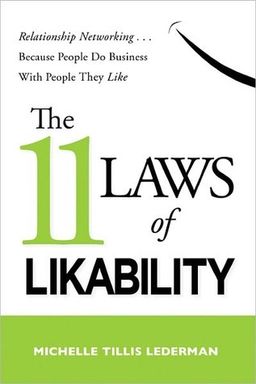
The 11 Laws of Likability cover

The 11 Laws of Likability

by Michelle Tillis Lederman

The 11 Laws of Likability is your ultimate guide to mastering the art of networking through genuine connections. Learn how to harness your natural likability, communicate effectively, and build enduring relationships that benefit both your personal and professional life.

The Power of Likability: Building Authentic Relationships that Last

Why do some people effortlessly attract opportunities, collaboration, and goodwill while others struggle to make genuine connections? In The 11 Laws of Likability, Michelle Tillis Lederman argues that the key to success—in life, career, or business—isn’t charm or manipulation, but authentic likability. She contends that professional success and personal fulfillment hinge on your ability to build genuine relationships based on who you truly are, not who you think you should be.

Lederman reframes traditional networking, rejecting the transactional “what can you do for me” mindset in favor of a human-centered approach: relationship networking. Her central claim is that people do business with people they like—and likability comes from self-awareness, authenticity, and a sincere interest in others. Instead of viewing networking as an act of self-promotion, she invites you to view every interaction as an opportunity to create connection, learn, and give value.

From Transaction to Connection

In most professional settings, connection is often reduced to performance—the handshake, the pitch, the elevator speech. Lederman dismantles that approach. Networking, she says, isn’t strategic schmoozing; it’s about resonating with people by aligning intention and authenticity. Drawing from her experiences in business school, her consulting practice at Executive Essentials, and her teaching at NYU, she reveals that when people “get real,” relationships grow naturally. The more genuine you are, the more effectively your energy and message are received.

The book unfolds across three stages—before, during, and after the conversation—each representing a facet of relationship-building that shapes your overall likability. Part A focuses on discovering your authentic self and maintaining energy that attracts connection. Part B dives into the art of meaningful conversation through curiosity, listening, similarity, and mood memory. Part C explores follow-up: how familiarity, giving, and patience sustain long-term relationships. Together these stages form a sustainable roadmap for connection.

Authenticity and Self-Liking as Foundations

Lederman’s first laws—Authenticity and Self-Image—remind you that before expecting others to like you, you must like yourself. Through clients like Sandy, a fifty-something mother reentering the workforce, and students like Dave, a self-conscious MBA presenter, Lederman demonstrates how internal perceptions shape external reality. “Perception is reality,” she insists—what you believe about yourself becomes visible in how you carry yourself, speak, and interact. If self-doubt dominates your thinking, others notice; if self-confidence is grounded in genuine self-acceptance, it draws people naturally.

By identifying your core strengths and transforming negative self-talk into constructive self-belief, you reprogram how you communicate value. You shift from “I hope they like me” to “I have real value to offer.” Her exercises on free writing, feedback-gathering, and self-talk tracking help you see your inner narrative—the words you use to define yourself—as a blueprint for outward success.

Energy, Perception, and Emotional Intelligence

A recurring theme throughout the book is energy is contagious. In Lederman’s workshops, she observed professionals like Rick, whose dread of a student meeting bred hostility until he changed his energy. By shifting his mindset and recalling positive interactions, Rick transformed the dynamic from tension into trust. Likability, in this sense, is an interplay of perception and energy: how you view yourself, how others perceive you, and how emotional signals flow between both. This mirrors Daniel Goleman’s work on emotional intelligence—our ability to read and regulate emotions becomes a hidden force behind influence and connection.

Conversation as Human Bridge

Once you’ve built an authentic foundation, Lederman guides you into real conversation. The laws of curiosity and listening turn simple exchanges into reciprocal storytelling. Curiosity creates openings; listening builds bridges. By practicing awareness across three levels of listening—inward, outward, and intuitive—you learn to go beyond words and tune into tone, body language, and unspoken emotion. The conversation becomes not an information exchange but a mutual discovery of common ground.

When combined with the Law of Similarity, curiosity and listening unlock trust. People are drawn to others who reflect their values and energy. Whether through shared challenges (like Mateo and Michelle’s unexpected connection in a tech collaboration) or mutual passions (rescuing dogs, volunteer efforts, creative pursuits), these similarities deepen communication beyond surface-level affinity, creating long-term relational ease.

Sustaining Connection: Familiarity, Giving, and Patience

Lederman’s last stretch—Part C—shifts focus from interaction to maintenance. Relationships, she says, need follow-up and generosity. You build familiarity by staying in touch, offering small acts of kindness, and showing genuine interest in others’ lives. This echoes Adam Grant’s Give and Take, but with more warmth: giving first not only nurtures others—it cultivates trust and opportunity. When you freely offer introductions, invitations, information, or advice, you signal abundance, not expectation. The Law of Patience completes this cycle. Lederman’s stories of clients like Aaron illustrate that good relationships often take months—or years—to blossom. What matters most is consistency, gratitude, and faith that value eventually “comes back or goes somewhere else.”

Why Likability Matters Today

In a world obsessed with speed, tactics, and self-branding, The 11 Laws of Likability restores humanity to networking. Like Dale Carnegie’s How to Win Friends and Influence People, it moves beyond social skills into personal authenticity. Lederman’s message is refreshingly simple: it’s not about charm—it’s about connection through authenticity, empathy, and giving. Whether you’re reentering the workforce, climbing the leadership ladder, or just hoping to build better relationships, these laws offer a timeless truth: People do business with people they like—and people like those who are real.


Authenticity: The Real You is the Best You

“Authenticity,” Michelle Tillis Lederman begins, “is about being your true self when the world pressures you to be someone else.” This first law is the foundation for all likability because it underpins everything from trust to communication. If you’ve ever tried too hard to “fit in,” sound professional, or impress others, you’ve felt how draining it can be. Lederman reminds you that that fatigue comes from being inauthentic—the mental strain of performing a false self.

The Courage to Be Real

To illustrate, she shares the story of Samuel, a museum manager who dreaded networking events. Wanting to “act like a successful person,” he laughed loudly and worked the room with forced charm. His plastered smile may have fooled a few guests, but it exhausted him. When Lederman observed his performance, she gently told him, “You were trying to be engaging—but I saw through the smile.” The revelation was liberating: his real passion for art was likable; his artificial enthusiasm was not. Lederman counseled him to focus on one-on-one conversations, where he felt most comfortable. When Samuel began engaging authentically, he connected meaningfully and even thrived professionally.

The Authenticity Test

Lederman gives you an actionable tool called the Authenticity Test. Ask: “Am I being me?” If yes, continue. If not, identify why—are you nervous, trying to impress, or following an assumed script? Ground yourself by reconnecting with what feels honest. Authenticity doesn’t mean blurting everything or being overly familiar; it means aligning behavior with truth. When you act from authenticity, energy flows effortlessly rather than being drained by performance anxiety.

Do It, Reframe It, or Delete It

Lederman proposes a framework for managing tasks so authenticity remains intact: you either do it, reframe it, or delete it. For instance, Samuel had to attend fundraisers (“have to”), but he reframed the dread by focusing on “wanting to share the museum’s mission.” Reframing turns forced obligations into authentic opportunities. If reframing fails and the task doesn’t serve your values, delete it when feasible.

Introverts, Extroverts, and Authentic Connection

Introverts often believe they’re disadvantaged in networking. Lederman debunks this myth: introverts’ listening and reflection are assets. Her example of Julie, who feared dinner with her boyfriend’s parents, shows how accepting shyness instead of fighting it allowed her genuine personality to shine. Similarly, extroverts must temper their instincts to dominate conversations. Authenticity is not about volume—it’s about congruence between feeling and expression.

Finding the Good—even When You Fake It

Everyone encounters people they don’t naturally like. Lederman’s advice? “Find the good.” When dealing with Kevin, a frustrating junior employee, she looked beyond mistakes to recognize his cheerful rapport with clients. By focusing on his strengths, she moved from resentment to constructive mentoring. This transforms “fake it” into “make it real”—reframing interactions through authenticity and empathy.

Networking with Integrity

Authenticity is more than a trait—it’s a strategy. It means attending events because you want to connect, not because you should. When you approach networking from honesty, interactions become meaningful rather than mechanical. Lederman’s mantra—“Be you, but be aware”—captures this balance perfectly. Networking works when genuineness meets self-awareness, making people respond not to what you say, but to who you truly are.


Self-Image and Perception: How You See Yourself Shapes Reality

“Before others can like you,” Lederman declares, “you must like you.” The Law of Self-Image deeply explores why your internal self-concept sets the tone for every external relationship. Self-image, she explains, is not vanity—it’s belief in your worth. Through practical coaching stories and psychological research, she demonstrates that changing how you see yourself can transform how the world responds to you.

The Sandy Transformation

Meet Sandy, fifty-something, reentering the workforce after years raising children. She approached Lederman apologetically: “I’m over fifty with no recent experience.” Her posture, voice, and eye contact screamed “unworthy.” Lederman flipped the script by asking, “Let’s forget what you haven’t done. What have you done?” As Sandy listed her years organizing PTA events, scheduling family logistics, and mentoring students, her energy shifted. Slowly, she saw herself as resourceful, strategic, and reliable—qualities she had dismissed. This reframing elevated her confidence and effectiveness.

Perception Is Reality

Lederman echoes the adage “Perception is reality” (a principle echoed by psychologists like Albert Mehrabian). If you believe you’re capable, that confidence radiates outward; if you doubt yourself, body language betrays you. The good news: you can consciously reshape perception. For MBA student Dave, seeing his recorded presentation helped him realize he looked far calmer than he felt. Rewatching himself allowed him to align internal anxiety with external competence—proof that perception can be retrained.

Talk to Yourself—but Be Nice

Lederman introduces self-talk tracking, grounded in sports psychology studies (Joan A. Finn, Daniel Gould). Negative internal repetition (“I can’t”) replicates outwardly. Coaching athletes has proven that positive self-talk reduces anxiety and enhances performance. The same applies to professionals: every internal statement becomes visible through expression. Her exercise to monitor weekly self-thoughts quantifies positivity as points: rewarding encouraging self-talk and subtracting critical ones. The goal? Make kindness toward self measurable.

Frame, Celebrate, and Fake It Till It’s Real

Lederman’s trio of techniques—be your own best friend, frame positive pictures, and celebrate small wins—offer a roadmap for reshaping self-perception. Reframing shifts “I can’t” to “I’m learning”; celebrating small progress builds momentum; “faking it till you make it real” means practicing new confidence until it feels natural. When Lederman presented to J.P. Morgan Chase for the first time—without a company name or website—she imagined herself as already successful. Acting “as if” changed perception both ways: she landed the client, proving belief precedes reality.

Outward Expression of Inner Belief

Even clothing plays a role. Dressing sharp despite a gloomy mood projects competence, which others mirror back to you, reinforcing self-esteem. As Lederman concludes, self-image is self-perception. By curating your thoughts, reframing fears, and embodying positivity, you become not only more likable but more effective.


Energy: What You Give Is What You Get

Energy, Lederman insists, is contagious. It determines whether an interaction drains or uplifts both parties. The Law of Energy is built on a simple truth: what you put out, you get back. Every exchange generates an emotional circuit, and your ability to tune into both your own and others’ energy defines the quality of connection.

Shifting Your Energy

The story of Rick, a career counselor, exemplifies how awareness transforms relationships. Rick dreaded meetings with an aggressive student, entering each session defensive and tense. Predictably, interactions spiraled. When Lederman asked him to recall a positive student he enjoyed working with, he shifted his mental focus and demeanor. To his surprise, the formerly combative student responded positively. The mere act of energy redirection changed outcomes—a concept echoed by William Hazlitt’s quote: “Our energy is in proportion to the resistance it meets.”

Meeting People Where They Are

You can’t control another’s energy, but you can meet them close to where they are and lift them. Lederman calls this “meeting them where they are—almost.” When dealing with an upset person (like Sheila lost en route to an event), responding calmly yet empathetically helps them recalibrate. Instead of amplifying panic (“Calm down!”) or matching frustration (“What were you thinking?”), you validate emotion, then gently shift tone to calm resolution. This relational approach parallels emotional leadership models that emphasize empathy as the bridge from chaos to clarity.

Energy Knowledge and Expectations

“Energy knowledge” is awareness of both your personal energy patterns and those shared with others. Every relationship carries tacit energy expectations—roles people assume you’ll fulfill (comforter, problem-solver, cheerleader). When these expectations clash with authenticity, frustration brews. Lederman’s client Carrie learned this firsthand: her strong, nurturing energy made friends assume she never needed help. Once she intentionally softened, she received the support she had long craved. Authentic energy signals real need and builds reciprocal bonds.

Networking Energy

Lederman challenges you to identify your “networking energy.” Are you more vibrant in small lunches or cocktail receptions? Daytime or evening events? Recognizing your natural energetic zones helps you choose settings where you can thrive authentically. Yet, she encourages gentle stretching: introverts might showcase listening strength at larger events; extroverts might practice restraint. Energy alignment isn’t about being upbeat—it’s about being real.

Leadership Through Energy

Lederman’s law mirrors leadership psychology studies showing that leaders with “emotional contagion awareness” foster greater collaboration. Like Rick discovering his impact, you can set the tone that others follow. Every conversation becomes a reflection of your energy choices—reinforcing her father’s metaphor from the introduction: “The world is a mirror.” What you give truly is what you get.


Curiosity and Listening: The Gateway to Genuine Conversation

When you meet someone new, do you ever worry about what to say? Lederman’s Laws of Curiosity and Listening dissolve that fear. Together, they turn conversation from a dreaded chore into an enjoyable discovery. If likability begins with authenticity, connection begins with curiosity—the desire to know others—and listening—the ability to understand them.

Curiosity Creates Connection

Lederman recounts how lunch with Sylvia, a stranger from a cocktail reception, led unexpectedly to partnership. By asking about Sylvia’s ventures and genuinely engaging, she uncovered mutual interests in youth coaching. Their one-hour meeting transformed into collaboration. “Curiosity may have killed the cat,” she jokes, “but it never killed a conversation.” Questions are the lifeblood of likability because they shift attention from self to other.

The Art of Asking Questions

Lederman operationalizes curiosity through practical question types: open-ended questions (“What brings you here?”), opinions, hypotheticals (“What if you were CEO?”), advice-seeking, and compliments followed by inquiry. The key is authenticity—ask only what you genuinely want to know. Her exercise challenges you to expand your repertoire for each question type so curiosity becomes second nature.

Listening on Three Levels

Curiosity opens doors, but listening builds trust. Through stories like Jed’s marketing mentees misunderstanding the word “fresh,” Lederman reveals how surface hearing misses meaning. True listening happens on three levels: Inward (relating it to yourself), Outward (focusing on the speaker), and Intuitive (reading what’s unsaid). When Ellie intuitively told her classmate Naomi she sensed readiness for motherhood, she unlocked truth Naomi couldn’t verbalize. Effective listeners validate others’ feelings by articulating what they sense—without presumption.

Active Presence and Managing Distraction

In our multitasking world, Lederman’s advice to “catch your drift” reminds you that focus builds respect. Her methods—verbal acknowledgment (“Give me a moment”), jotting notes, inviting others along (“Let’s grab a drink”)—help prevent distraction from eroding connection. Listening isn’t passive; it’s an act of leadership.

Empathy as Connection

By listening intuitively and curiously, you demonstrate empathy—“the currency of connection.” This aligns with Dale Carnegie’s timeless principle: “Talk in terms of the other person’s interests.” In Lederman’s framework, curiosity starts the dialogue; listening turns it into rapport. Together, they transform ordinary chatter into authentic relationship-building.


Similarity and Mood Memory: Trust and Emotional Lasting Power

The Laws of Similarity and Mood Memory explain why relationships either flourish or fade. People naturally gravitate toward those who feel familiar or emotionally safe. Lederman frames these as two sides of connection: Similarity builds trust, and Mood Memory sustains it.

Finding Common Ground

Lederman’s story of Mateo—a Ukrainian CEO who shared none of her personal attributes—shows similarity beyond surface. Despite differences of age, culture, and background, a shared work ethic and humor made them compatible. “People like people like them,” she writes, emphasizing that likeness isn’t about sameness but resonance. Common values, professional approaches, or emotional styles form bridges faster than shared demographics.

The “You Too, Me Too” Effect

Lederman illustrates how simple dialogue can uncover similarities. When she met Maya at a workshop and realized they both worked with teens, they instantly connected. Moments of “you too, me too”—shared passions, experiences, or even struggles—activate comfort and rapport. Self-disclosure is key: sharing your story invites others to reciprocate.

Mirroring and Chemistry

Lederman links similarity to body-language science. Mirroring gestures—leaning in, smiling, nodding—create subconscious messages of agreement. When two teens in her workshop unintentionally mirrored each other's posture, they formed immediate connection. This echoes rapport-building studies in social psychology: physical synchronization signals emotional alignment.

Mood Memory: The Emotional Aftertaste

Even after a conversation ends, people remember how you made them feel more than what you said. Lederman’s roommate Elaine exemplifies negative mood memory through demanding friendships; her constant criticism created anxiety instead of comfort. Positive mood memories, like compliments or empathy, trigger endorphins and a faster heartbeat—physiological evidence that emotion imprints memory. Smiling, eye contact, and attentive listening generate warmth that lasts long after words fade.

Applying Emotional Intelligence

To build lasting trust, Lederman urges you to leave conversations with people “wanting more of you.” Creating good mood memory means ending interactions with affirmation, gratitude, and genuine energy. Whether by admiring (“You handled that so gracefully”) or appreciating (“I learned a lot from you today”), you imprint positivity. Likability, she concludes, is not an event—it’s a lingering emotion.


Familiarity, Giving, and Patience: Sustaining Relationships Over Time

The final trio of laws—Familiarity, Giving, and Patience—explain the art of relationship sustainability. Once you’ve made connections, how do you keep them alive? Lederman emphasizes consistency, generosity, and trust in time.

Familiarity: People Like What They Know

Familiarity breeds comfort, not contempt. The more people encounter your name, face, or goodwill, the more trust you earn. Lederman’s colleague Mark embodies this: his regular emails and thoughtful greetings keep him top of mind, transforming acquaintances into advocates. Online tools—LinkedIn updates, Google Alerts, friendly check-ins—help sustain this presence. Authentic follow-up, not spammy frequency, builds relational ease.

Giving First

The Law of Giving captures Emerson’s idea that “no man can help another without helping himself.” Lederman recounts how Amy mentored her over lunch, freely sharing wisdom. That generosity empowered Lederman to launch her consulting business. Giving—through introductions, invitations, favors, or advice—creates value beyond reciprocity. Tanya’s boss, who supported her skill development only to become a future client, embodies this law: generosity ignites cycles of mutual success.

Pay It Forward

Lederman’s grandmother used guilt to demand repayment; Amy used kindness to inspire pay-it-forward giving. The difference is motivation. True giving expects nothing, trusting that goodness circulates. She challenges you to create an action plan: list specific people, what you’ll do for them (a connection, event invite, resource share), and when. When giving becomes proactive, relationships transform from transactions into legacies.

Patience: Trust the Process

Patience closes the circle. Lederman’s yearlong correspondence with Aaron, a potential client, illustrates delayed reciprocity. After six proposals and endless queries, Aaron finally hired her—proof that consistency outlasts rejection. She contrasts this with her younger self’s impatience with colleague Todd, whose quiet recommendation she discovered only later. “Give it time,” she concludes. “Things happen.”

Friendship and Long-Term Growth

Patience also nurtures friendships. Her evolving relationship with Gabby—from neutral acquaintance to trusted friend—shows that genuine connection grows slowly. Her sister April’s opposite personality demonstrates complementarity: time refines relationships through shared experiences and mutual reliance. You don’t control timing; you only control consistency and care.

Living the Cycle of Likability

When familiarity keeps you visible, giving keeps you valuable, and patience keeps you grounded, relationships thrive naturally. Lederman ends where she began: “People do business with people they like.” Likability isn’t a tactic—it’s a lifetime habit of authenticity, generosity, and belief in connection’s enduring power.

Dig Deeper

Get personalized prompts to apply these lessons to your life and deepen your understanding.

Go Deeper

Get the Full Experience

Download Insight Books for AI-powered reflections, quizzes, and more.