
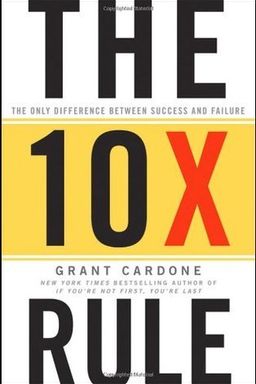
The 10X Rule cover

The 10X Rule

by Grant Cardone

The 10X Rule introduces a transformative strategy for achieving success beyond your wildest dreams. By setting ambitious goals and committing ten times the effort, you''ll gain the tools needed to overcome challenges and unlock your true potential. Discover how this powerful mindset can lead to unprecedented personal and professional growth.

The 10X Rule: Elevate Your Thinking and Action

What would happen if you multiplied every effort you make by ten? In The 10X Rule, entrepreneur and sales expert Grant Cardone argues that success is not the result of luck, talent, or timing—it’s the outcome of taking massive action at levels far beyond what most people believe is necessary. Cardone’s central claim is simple yet radical: to achieve extraordinary success, you must set goals ten times higher than you think you can reach and then work ten times harder than what feels reasonable. Anything less leads to mediocrity, disappointment, and failure.

Cardone contends that life’s setbacks don’t stem from doing too much—they come from doing too little. Most people underestimate the effort needed to reach success and overestimate the safety of average goals. He argues that “average is a failing formula,” and that a person’s biggest problem isn’t overexposure—it’s obscurity. No one can buy your product, hire your company, or notice your talents if you’re invisible. The antidote is relentless, unreasonable, consistent action—the 10X way.

Success as Duty, Not Option

One of Cardone’s most provocative ideas is reframing success as an ethical duty. Success, he says, isn’t a luxury—it’s a responsibility. You owe it to yourself, your family, and your society to thrive, create value, and contribute. When you treat success as an obligation, you move beyond wishful thinking to disciplined execution. Like a parent who feels responsible for their child’s wellbeing, success must become a nonnegotiable mission.

This concept resonates with the approach of authors like Napoleon Hill (Think and Grow Rich) and Stephen Covey (The 7 Habits of Highly Effective People), who advocate for proactive responsibility. But Cardone frames it with urgency—ethical people, he says, do whatever is necessary to achieve results. Effort without outcome, in his view, is not ethical because it fails the duty to fulfill one’s potential.

Fear, Criticism, and Resistance as Fuel

Every great pursuit will generate fear, criticism, and setbacks. Instead of retreating, Cardone insists you must turn these signals into indicators of progress. Fear is the compass pointing toward growth—the feeling that emerges when you step outside comfort zones. Criticism, too, is proof you’re succeeding. If no one’s complaining, it likely means no one’s noticing. “Criticism is a sign of success,” he writes; it means you are seen, relevant, and disrupting mediocrity.

Cardone gives personal examples—from building companies from scratch to breaking into television and publishing—of how he faced ridicule from colleagues and competitors. Yet, he argues, the only rational response to attack is more success. In his words, “The best revenge is massive success.” Author Robert Greene echoes this principle in The 48 Laws of Power: when you rise, envy often precedes admiration. Cardone’s advice—don’t wait for applause. Use resistance as validation that you’re playing big.

From Average to Omnipresence

Cardone’s ultimate vision for achievement goes beyond traditional success to total domination—what he calls omnipresence. He encourages readers to become unavoidable: to be “everywhere, all the time” like Coca-Cola, Google, or Oprah. When people think of your profession, they should automatically think of you. Achieving omnipresence requires massive promotion, relentless visibility, and advocating for yourself until your brand becomes embedded in cultural consciousness.

Cardone’s own story serves as a blueprint. He produced 200 videos, wrote hundreds of blogs, did hundreds of radio appearances, and published books in quick succession—all designed to overcome obscurity. In his philosophy, you cannot oversell yourself; only invisibility kills opportunity. The mantra “Be everywhere” captures the essence of 10X thinking—scale up your actions until your success is impossible to ignore.

Why the 10X Rule Matters

The power of the 10X Rule lies in its simplicity and audacity. It reframes goals, time, effort, and responsibility. It forces you to confront comfort, eliminate excuses, and commit at unreasonable levels. Cardone’s message is not just about business—it’s about personal freedom. Average thinking traps people in fear of loss and scarcity; extraordinary effort, on the other hand, builds confidence, abundance, and momentum.

In this book, Cardone will teach you to spot fear as a green light for action, dismiss time management myths, treat criticism as a milestone, prioritize customer acquisition, and pursue omnipresence until your name becomes a global symbol of value. Ultimately, The 10X Rule is a philosophy of life: don’t just seek to do better—choose to dominate, expand, and burn so bright that others can’t ignore your fire.


Fear as a Great Indicator

Grant Cardone reframes fear with a bold twist: instead of treating it as a warning to stop, see it as a signal to go. Fear, in his view, isn’t an enemy—it’s a directional compass pointing toward the very actions you must take to grow. In The 10X Rule, Cardone reminds us of the acronym FEAR—False Events Appearing Real—to illustrate that most imagined catastrophes never happen. What holds people back is not danger but delay: waiting, preparing, analyzing—all feeding the fear.

Fear Is Fuel, Not Fire

Cardone offers a striking metaphor, comparing fear to fire: if you move too slowly around it, it burns you. But if you move decisively through it, you exhaust its oxygen and snuff it out. Backing off gives fear oxygen. Acting kills it. This means when you’re scared to call a client, to speak up, or to launch something new, the right reaction isn’t avoidance—it’s immediate action. He recalls how delays—like making coffee before dialing prospects—allow fear to grow stronger. The longer you wait, the more fear feeds on time.

Time: The Enemy of Courage

For Cardone, time is fear’s best friend. Overthinking magnifies anxiety because it gives emotions the opportunity to override reason. His remedy is simple: remove time from the equation. “The time is always now,” he insists. If hesitation creeps in, act before your mind can invent excuses. This echoes Mel Robbins’s “5 Second Rule,” where immediate movement disrupts patterns of paralysis. The principle works: when fear signals, move straight into action.

Fear Defines Growth

Cardone warns that the only thing more terrifying than fear itself is its absence. When you’re no longer scared, it’s a sign you’ve stopped stretching. Every breakthrough—from cold sales calls to launching multimillion-dollar ventures—comes with discomfort. In his own life, he claims to feel fear constantly but refuses to “feed it with time.” Acting quickly replaces fear with confidence, which then becomes addictive. Success isn’t the elimination of fear; it’s mastery over your response to it.

“Eat your fears; don’t feed them by backing off,” Cardone says. “If you aren’t experiencing fear, you aren’t taking new actions and growing.”

Seen this way, fear becomes the best success indicator: if you feel it, you’re advancing. Treat fear as a cue for speed—move now, move often, move massively—and you’ll transform hesitation into momentum. To succeed at 10X levels, your courage must be a daily decision, not a mood.


The Myth of Time Management

Cardone dismisses one of modern productivity’s sacred cows—time management—as a myth. Instead of managing minutes, he argues, you must command them. Counting time is useless if you’re not using it to advance your primary purpose: success. His reasoning is ruthless in its logic: everyone has 168 hours a week, but only a small fraction is truly productive. The difference between winners and losers is not hours worked but what happens inside those hours.

Abundance vs. Balance

In a world obsessed with “work-life balance,” Cardone offers a radical alternative: forget balance—embrace abundance. He believes that life shouldn’t be divided between competing priorities like career, family, and health. Instead of choosing one, choose all. The successful pursue “everything” because success expands capacity. As he jokes, “I’m not interested in balance; I’m interested in abundance in every area.” This thinking aligns with Tony Robbins’s philosophy of ‘both/and’—achieve wealth and happiness, health and success—not one at the expense of the other.

Multiplying Time Through Action

Cardone reframes time as a multiplier, not a limiter. You can “create time” by increasing what you accomplish per minute. If you make 15 calls in 15 minutes while others take an hour, you’ve gained 45 minutes. Multiply that by delegating and hiring—the moment you get others producing for you, your time turns into money. He calculates that if you live 75 years, you have roughly 657,000 hours—that’s finite. But those hours expand through productivity. As he says, “The only way to increase time is to get more done in the time you have.”

Priorities and Scheduling

Success begins with clear priorities. Make it your “duty, obligation, and responsibility” to direct time toward the highest-value actions. Cardone uses personal examples—getting up one hour earlier to spend time with his daughter, designing her sleep schedule around his work priorities, and turning every second into purposeful engagement. His mantra is control: create structure, map priorities, and eliminate wasteful activities like TV or idle social media scrolling.

“You have to command, control, and squeeze every second out of your time in order to increase your footprint and dominate the marketplace.”

Cardone concludes that time management advice—“relax, slow down, find balance”—is poison. True security, confidence, and happiness come from utilizing every moment at 10X levels. Work is not a burden; it’s your purpose. Control time, and you’ll control success.


Criticism as a Sign of Success

In Cardone’s world, criticism isn’t an obstacle—it’s applause disguised as resistance. Every time you take massive action and start winning, expect backlash. It’s a psychological law: when you create attention and momentum, others will attack. People who do less condemn those who do more. Cardone encourages readers to see criticism as validation that you’re on the right path.

Why Success Provokes Judgment

Highly visible action threatens the comfort zone of those who have settled. When Cardone dominated his sales industry and later hit the New York Times bestseller list, competitors mocked his titles and demeaned his work. Yet these critics reinforced his success—they proved he was visible and relevant. “Wouldn’t you rather be criticized by those jealous of your success,” he asks, “than reprimanded by your boss for not taking enough action?”

Turning Criticism into Leverage

Cardone demonstrates that complaints and criticism actually measure progress. When a client complained his staff followed up too aggressively, Cardone rewarded the team. He recognized that pushback meant momentum; irritation was the price of standing out. This is practical psychology—assertive action elicits emotional reaction, but stagnation attracts none. As Dale Carnegie noted decades earlier, “You’ll have enemies if you accomplish anything great.”

Expect Criticism, Use It as Momentum

The remedy, Cardone says, is anticipation. Know criticism will arrive with success—then use it as propulsion. When others question your intensity (“You’re working too hard,” “You’re too aggressive”), treat it as feedback that your 10X actions are noticeable. Cardone’s mantra: “Don’t retreat when criticized; expand.” Eventually, critics either emulate you or lose interest. Success always transitions resistance into respect.

“Criticism precedes admiration… The very same people who put you down will one day be singing your praises.”

In short, criticism is proof of progress. It’s not personal; it’s physics—the friction created by forward motion. When you start getting complaints, don’t slow down—double down. You’re not failing; you’re being noticed.


Customer Satisfaction Is the Wrong Target

Cardone flips a common business paradigm: don’t chase customer satisfaction—pursue customer acquisition. Satisfaction can’t exist without customers in the first place. You can’t make people happy who haven’t bought from you. For Cardone, the obsession with surveys, feedback forms, and “brand protection” often hides a deeper problem—companies simply aren’t reaching enough people.

Acquisition First, Then Loyalty

Customer satisfaction begins at acquisition. Starbucks, Google, and Apple dominate not because they serve perfectly but because they reach massive audiences first. Cardone warns executives against focusing on existing clients while ignoring the millions who never heard of them. “The biggest problem with companies,” he notes, “is that they never make customers in the first place.” Thus, prioritize expansion—seek ten times more clients, not ten percent happier ones.

Expansion Through Overdelivery

Once you do acquire customers, Cardone insists on overdelivering. His company never says no until it must, and always gives more than expected—whether it’s a free tip, a $30 book, or a $1 million training deal. But the focus isn’t service; it’s reach. Even complaints are opportunities. More customers mean more feedback, and those interactions fuel improvement. Avoid fear of negative reviews; they’re signs of growth.

Quantity Creates Quality

Cardone challenges the myth that quality and quantity compete. In truth, quantity breeds quality. The more people you serve, the more experience you gain and the more your systems refine. When he expanded his seminars tenfold, both client satisfaction and reputation improved—proof that scale elevates quality. He cites Apple’s transformation from niche luxury to mass product as evidence of “thinking big.”

“Don’t put the cart before the horse. You can’t satisfy customers you never made.”

For entrepreneurs, this mindset is revolutionary: spend less time protecting your brand and more time flooding the market with attention, offers, and value. Make quantity your goal, and satisfaction will follow as a natural byproduct.


Omnipresence: The Final Stage of Success

Cardone reserves his most ambitious idea for the end—omnipresence: the state of being everywhere, all the time. For him, true success equals visibility so vast that your name becomes synonymous with your industry. Think Coca-Cola, Disney, Apple, or Oprah. You see them, hear them, and depend on them daily. That’s not coincidence—it’s deliberate 10X domination.

Be Everywhere

Omnipresence means flooding all channels—physical, digital, and personal—until you can’t be ignored. Cardone’s personal campaign to brand himself as the ultimate sales trainer demonstrates this principle. He produced hundreds of videos, wrote thousands of posts, accepted every interview, and spoke everywhere he could. Eventually, people began saying, “I see your name everywhere.” That was his goal achieved—visibility equals authority.

Purpose Fuels Omnipresence

Cardone warns that omnipresence requires purpose beyond money. Wealth alone becomes hollow; the higher your mission, the greater your energy to sustain omnipresence. He quotes his wife reminding him, “The best revenge is massive success,” urging him to channel criticism into exposure. Coming back stronger—not retreating—builds reputation until skeptics can’t escape your presence.

How to Build It

  • Say yes to every opportunity—speaking, writing, appearing—because obscurity kills.
  • Create content constantly: articles, videos, blogs, podcasts, social posts.
  • Connect locally and globally—participate in your community while building digital reach.
  • Turn every attack or failure into a chance to expand visibility.

“Make your fire so big and so hot that others will sit around it in amazement.”

Omnipresence isn’t vanity—it’s survival at 10X scale. The world forgets quiet achievers. It remembers those who are seen everywhere, every time. For Cardone, that’s the true destiny of massive action: not just success—but legacy.

Dig Deeper

Get personalized prompts to apply these lessons to your life and deepen your understanding.

Go Deeper

Get the Full Experience

Download Insight Books for AI-powered reflections, quizzes, and more.