
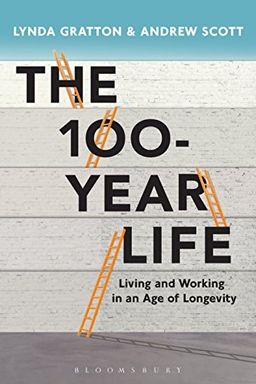
The 100-Year Life cover

The 100-Year Life

by Lynda Gratton and Andrew Scott

The 100-Year Life explores how increasing life expectancies challenge traditional retirement models, urging readers to adopt new strategies for financial planning, career adaptability, and personal growth, ensuring a fulfilling life well into their centenarian years.

Living a 100‑Year Life

You are living through a demographic revolution: an era in which life expectancy is stretching far beyond the boundaries previous generations assumed. In The 100‑Year Life, Lynda Gratton and Andrew Scott argue that longevity is not a distant prospect but a defining feature of your own lifetime. Many children born in developed countries today have a 50% chance of living past 100. The consequences are profound: not just more years, but fundamentally different ways of thinking about work, relationships, education and purpose.

The data behind the demographic shift

For over 180 years, average life expectancy in the leading countries (from Sweden to Japan) has increased at a remarkably steady rate—around two to three years per decade (Oeppen & Vaupel’s “Broken Limits” analysis). A child born in 2007 in Japan has roughly a 50% chance of reaching 107. This is not science fiction; it is the continuation of a long-run empirical trend. The major gains have come in waves: first from public health and sanitation, then from chronic disease management, and next—potentially—from breakthroughs in biotechnology and the biology of aging itself.

The arithmetic of longevity

Longer lives change the basic math of savings, pensions and time. Old three‑stage assumptions—education to 20, work to 65, retirement to death—collapse under the new numbers. If you live to 100, you either save much more or work much longer. Yet this isn’t simply a financial problem; it also demands a new psychological and social model. The book’s central metaphor is that longevity gives you the “gift of time,” but only if you learn to invest that time wisely in productive, vital and transformational capacities.

From certainty to complexity

The predictable life course of the industrial age—school, work, retirement—once made identity easy. Age and role were tightly linked: 20s meant learning, 40s meant working, 60s meant resting. In a 100‑year life, those links dissolve. Education can happen at 40, parents may retrain at 60, and careers may pause or reinvent at 70. The book calls this the shift from a three‑stage to a multi‑stage life: one that cycles through learning, producing, exploring, and regenerating phases repeatedly. The key challenge becomes how to manage transitions and keep your options open without losing coherence or income.

The promise and peril of longer lives

Longevity can be a tremendous gift—a deeper life with multiple careers, richer relationships and longer vitality—but it also risks becoming a curse if inherited institutions lag behind. Pensions, corporate HR structures, housing markets, and education systems still assume a 70‑year arc. Without adaptation, individuals face either decades of financial strain or decades of purposeless drift. The authors take a realistic middle ground between techno‑optimists who expect radical life extension and pessimists who fear stagnation. Planning for 100 years is prudent, not fanciful.

What you will need to thrive

To make those extra decades meaningful, you must invest in three categories of intangible assets:

  • Productive assets—skills, knowledge, reputation and social capital that generate income and opportunities.
  • Vitality assets—health, energy and trusted relationships that sustain engagement.
  • Transformational assets—the self-knowledge and adaptability that let you transition gracefully between life stages.

Each requires deliberate, repeated investment. This is the overarching argument of the book: in an age of longevity, tangible savings and intangible skills must be managed together across multiple life stages.

Core message

“The gift of a long life is the gift of time.” Whether it becomes burden or blessing depends on how you plan, learn and re‑create over the decades to come.

This book teaches you to reimagine life itself as an evolving design project. You learn to earn, learn to transform, and learn to renew—all while accepting that reinvention is not just possible but essential. Your 100‑year life will not fit inherited scripts; it will be something you compose and revise many times over.


The End of the Three‑Stage Life

The traditional three‑stage life—education, career, retirement—was built for lives of 60 to 70 years. As life extends to 100, that model strains to breaking. Gratton and Scott show how the old rhythm creates an impossible trade‑off: work constantly to save enough for a long retirement, or face decades of insecurity. Either way, energy, purpose and wealth degrade. The solution is to abandon the linear structure entirely and embrace a multi‑stage life that alternates between learning, earning and renewal.

Why linear lives fail

The fable of Ondine—a woman cursed to live a long life without rest—illustrates the risk of longevity within an old model. For Jack (born 1945), a short linear career with defined pensions created stability. For Jane (born 1998), the same pattern would require saving more than 25% of income annually—financially unrealistic. Working 60 unbroken years is equally grim. The curse of the prolonged middle stage is exhaustion without fulfillment.

The rise of age‑agnostic lives

As life extends, age loses meaning as a marker. You may study again at 40, pivot careers at 55, or launch a new business at 70. In multi‑stage lives, periods of exploration and education recur throughout life, redefining identity beyond chronology. This “age‑agnosticism” will reshape everything from HR systems to higher education. Universities will need open‑door lifelong admission policies, and companies must stop equating age with potential.

Optionality and experimentation

When you might live 100 years, keeping options open becomes an asset in itself. Younger cohorts already delay milestones like marriage and home purchase—sometimes derided as indecision, but often adaptive risk management. Every extra decade compounds the value of flexibility. A longer horizon magnifies the payoff from learning and broadens the tolerance for trial and error.

Re‑creation over recreation

In a long life, leisure is no longer just consumption; it is an essential tool for renewal. “Re‑creation” means using downtime to build vitality and transformation—re‑skilling, exercising, building communities. What looks like play may be strategic maintenance. (Note: this echoes ideas from Cal Newport’s Deep Work about intentional focus, but stretched across decades.) A sabbatical or mid‑career break becomes not indulgence but investment.

Practical principle

Stop equating age with stage. Design life as a series of recyclable phases—learning, working, exploring, regenerating. The skill is sequencing them intentionally to maintain purpose and resilience over a century.

Abandoning the three‑stage template can feel destabilizing, but it is liberating. Once you decouple identity from chronology, you can re‑engineer life as a flexible, lifelong learning cycle—where aging means growth, not decline.


Financing a Longer Life

Longer lives require financial redesign. You face the unavoidable arithmetic: more years demand either more savings, later retirement, or new income streams. Gratton and Scott use three illustrative cases—Jack (1945), Jimmy (1971) and Jane (1998)—to reveal how rising longevity stretches financial models beyond viability and why you need to rethink savings and work from first principles.

The numbers that break the system

Jack retired comfortably by saving only 4.3% of his salary thanks to generous company pensions and a 70‑year lifespan. Jimmy, born later, would need to save 17% annually to retire at 65. Jane, born into a 100‑year horizon, must save 25–30%. These rates are unrealistic for most. Extending working life by one or two more decades is therefore both necessary and beneficial: if Jane works to 85, her savings target drops to roughly 11%.

Why public pensions can’t keep up

Pay‑As‑You‑Go systems, where current workers fund retirees, crumble under demographic pressure as birth rates fall and the old‑age dependency ratio climbs (Japan’s extreme case illustrates this vividly). Reforms lag politically, so responsibility shifts from state to individual. Employer defined‑benefit pensions have also eroded—down to under 20% coverage in the US private sector. You are now your own actuary, investor and risk‑manager.

Behavioral finance lessons

You may know the math but still fail the psychology. Present bias (“I’ll save later”), inertia, and optimism bias undermine rational plans. The authors reference behavioral tools like Thaler and Benartzi’s Save More Tomorrow (commitment device) and automation apps like Acorns that round up transactions to save passively. Even showing people aged‑progressed photos of themselves doubles saving choices. Protect your older self by acting now—your midlife rational period is when compound returns make the biggest difference.

Financial literacy and low fees

Financial literacy produces measurable returns: better‑informed investors often earn 1–1.3% more annually. Over decades, that compounds to massive advantages. Avoid high fees: a 2% annual charge can halve your final wealth over 40 years. Choose diversified, low‑cost vehicles and learn the arithmetic of inflation and compounding (the “Rule of 70”). Re‑evaluate assumptions periodically as you add new life stages.

Financial design insight

The strongest hedge against longevity risk is working longer, not gambling on higher returns. Build flexible careers that let you stay productive, curious and employable well into later life.

A 100‑year life isn’t sustained by one long, tedious career but by smart sequencing—periods of paid work interspersed with re‑skilling and renewal. Treat each transition as both a financial and emotional investment, and plan explicitly for midlife “re‑creation funds,” not just retirement savings.


New Work Landscapes and Lifelong Employability

Living longer also means working through one of history’s fastest technological revolutions. Gratton and Scott describe how globalization, automation, and urbanization will reshape work ecosystems and what this means for your employability. With careers potentially spanning 60 years, adaptability becomes the core competency.

The reorganization of sectors

Over the 20th century, economies shifted from agriculture to services to digital ecosystems. The next reshuffle will be driven by demographic, environmental and AI advances. Entire industries will vanish while new clusters emerge. The old dream of lifelong employment in one company fades. Instead, you will move through ecosystems of big firms, start‑ups and independent projects—an archipelago of temporary roles rather than a single employer island.

Technology’s double‑edge

Automation now threatens not only manual but also cognitive middle‑skill jobs. Autor’s “hollowing out” and Frey & Osborne’s forecast of 47% job automation risk highlight the danger. The “second half of the chessboard” metaphor captures exponential acceleration—machines encroaching on creative and judgmental tasks once thought uniquely human. Yet implementation lags and replacement demand (as older workers retire) mean opportunities remain, particularly for those blending technology with human insight.

Smart cities and creativity hubs

Talent concentrates locally. Smart cities like London, San Francisco and Bangalore act as thick markets where innovation networks flourish. Moretti’s research shows each high‑skill job creates several support jobs. For you, location choices become career accelerators. Live near your network ecosystem or risk isolation from opportunity.

Human skills as a durable edge

In a world of AI and gig work, human skills—creativity, emotional intelligence, collaboration—are your defensible assets. Automation can replicate outputs but not meaning. Continuous learning and strong social capital (a trusted “posse”) are what let you pivot between roles and industries across long lives. Build them deliberately.

Practical takeaway

Invest every decade in non‑routine human skills and networks. Choose ecosystems where you can both learn fast and contribute visibly—those are the new employment safety nets of longevity.

Work will no longer mean simple stability but dynamic evolution. You won’t retire from employment; you’ll transition across a sequence of purpose‑filled roles that sustain both income and meaning.


Building and Managing Intangible Assets

In the 100‑year life, financial wealth alone won’t shield you. Lynda Gratton and Andrew Scott identify three critical categories of intangible assets—productive, vitality, and transformational—that determine whether you age with opportunity or depletion. Each functions as a renewable resource that can appreciate or depreciate depending on your behaviors.

Productive assets

These include skills, qualifications, professional networks and reputation. They generate future income much like financial capital, but they decay if you neglect reinvestment. Evidence such as Boris Groysberg’s study of Wall Street analysts shows that human capital is context‑dependent—skills transfer imperfectly without networks. Protect your productive assets by keeping your “posse” active and refreshing credentials regularly through learning and side projects.

Vitality assets

Vitality assets encompass health, fitness, and psychological well‑being. Research on “compression of morbidity” suggests lifestyle choices can postpone illness and preserve functional years. The Harvard Grant Study linked lifelong friendships and community engagement to happiness and health more strongly than income. Your vitality portfolio grows from exercise, sleep, nutrition, and relationships—a virtuous cycle that sustains both productivity and purpose.

Transformational assets

Transformational assets are your capacity for change—self‑knowledge, diverse networks, and openness to experimentation. Herminia Ibarra’s insight—“act your way into change”—anchors this idea. Transformation is not theoretical reflection but iterative action. You grow this asset by crossing disciplines, seeking feedback, and testing possible selves. These capabilities will become decisive as you navigate multiple transitions over a century.

Portfolio metaphor

Treat your life as an asset portfolio: monetary wealth funds your needs, but intangible assets generate energy, adaptability and future returns. Track them as carefully as you track your bank balance.

A century‑long life magnifies returns on personal maintenance. The core insight is that your intangible assets are compounding resources. Periodically audit, diversify and reinvest in them with the same rigor you apply to finances.


Exploration and Identity Transitions

Exploration is how you discover new possible selves and refresh meaning across decades. In the book’s scenarios, Jane’s immersive travel in South America and Jimmy’s mid‑life experiments both illustrate purposeful exploration—structured risk‑taking that tests identity and builds transformational capacity. The aim is not tourism but self‑reinvention.

Crucible experiences

Leadership scholars Warren Bennis and Robert Thomas show that many leaders’ moral and professional clarity arises from “crucible moments”—intense challenges that force reflection. For you, it might be volunteering abroad, switching sectors, or starting over after failure. What matters is reflection: experience itself changes little unless processed through questioning and narrative construction (Philip Mirvis emphasizes this interpretive step). Transformational learning converts stress into stored wisdom.

Managing liminality

Transitions are liminal: you’ve left an old identity but not yet stabilized a new one. This in‑between state feels disorienting. Charlotte Linde’s research on life stories shows that maintaining narrative continuity (“what remains the same about me”) enables psychological resilience. Articulating your story—through journaling, mentorship, or portfolio reflection—helps integrate change into coherence.

Acting your way into change

As Herminia Ibarra argues, identity change happens through doing, not planning. Small experiments—side projects, retraining weekends, networking outside your field—are low‑cost prototypes for your next stage. Over time, these “routine‑busting acts” accumulate into credible new selves and make major transitions less perilous. Exploring new contexts builds confidence and optionality.

Exploration mindset

Plan one crucible experience per decade. Make it deliberate, high‑intensity, and reflective; that’s how you transform experience into wisdom instead of mere biography.

Exploration turns extra lifespan into expanded possibility. By deliberately stepping into new contexts and interpreting the experience, you continuously build the transformational capital that sustains a 100‑year life.


Independent and Portfolio Lives

Gratton and Scott envision many of us becoming “independent producers” or “portfolio workers” at various life stages—roles blending autonomy, collaboration and diversification. This emerging lifestyle enables longer careers with periodic renewal, particularly for experienced professionals seeking flexibility and purpose.

Independent production

Independent producers create value through projects, pop‑ups or prototypes rather than conventional firms. This could be a designer launching micro‑brands, a consultant freelancing, or a mid‑career professional testing ventures. The focus is learning‑by‑doing. Otto Scharmer calls this “prototyping”: rapid experimentation that refines ideas through feedback. Reputation—via LinkedIn presence, case studies, open‑source contributions—becomes the primary credential.

Creative clusters

Such producers thrive in creative urban hubs—London’s Silicon Roundabout, San Francisco, Bangalore—where peer learning and mentorship are dense. These “thick markets” accelerate innovation but require tolerance for uncertainty. The sharing economy helps independence economically feasible: renting instead of owning liberates mobility and financial flexibility during exploratory periods.

Portfolio living

Later in life, portfolio living becomes common: you may combine part‑time professional work, volunteer roles, governance seats, and personal projects. The key is synergy—reducing switch costs by aligning roles that share skills or networks. You might work three days in paid consulting and two on community boards. Small transitions accumulate vitality and purpose.

Financing transitions

Transitions cost time and money. Plan “transition funds” as actively as retirement savings. Coordinate with partners to alternate re‑training and earning phases. Behavioral nudges—automated saving, commitment contracts—turn good intentions into stability. Over decades, well‑financed transitions let you sustain curiosity without financial collapse.

Principle

Diversify your time portfolio the same way you diversify investments: balance return, risk, and renewal across simultaneous roles.

Independent and portfolio living allow freedom within structure—a way to keep working, learning and contributing over decades without burnout or obsolescence. They transform longevity into creative variety.


Partnerships and the Social Side of Longevity

Long lives are lived socially. Relationships, parenting and community structures must adapt to extended timelines. Gratton and Scott contrast traditional specialization‑based families with modern “pure relationships” grounded in equality, negotiation and role rotation. Your partnership becomes a dynamic joint enterprise spanning many transitions.

Evolving partnership models

In Gary Becker’s economic model, households specialized: one earned, one managed home. As both partners now pursue careers, modern couples maximize shared consumption and diversify risk by alternating roles across stages. In the book’s Jane‑and‑Jorge scenario, each takes turns leading in earning, retraining and caregiving. Success relies on explicit planning—aligning finances, geography and timing of transitions.

Parenting in multi‑stage lives

Fertility remains biologically constrained while careers stretch. Many younger adults postpone children (the “YAHOOs”—Young Adults Holding Options) to explore and establish identity first. Yet delays bring risks. The key is deliberate choice: integrate childrearing into life design rather than default sequencing. Shared parental leave and flexible education make balancing easier when both partners plan over 100‑year arcs.

Multi‑generational living

Longevity extends families across four generations. In Asia, such structures provide intergenerational support; in the West, age‑segregated living erodes that benefit. Encouraging cross‑age networks in homes, communities and workplaces yields emotional and practical dividends—from childcare to elder mentorship. Age diversity becomes a source of resilience and empathy.

Partnership insight

If partners agree to alternate leadership and care phases over decades, both careers and relationships grow stronger. Treat the relationship as a collaborative start‑up with iterative planning and review.

Longevity will reshape not only how we work but how we love and raise families. Conscious coordination over a lifetime converts potential conflict into shared growth.


Institutional Change and the Longevity Agenda

A 100‑year life cannot thrive inside 70‑year institutions. The final message of Gratton and Scott’s work is systemic: unless governments, companies and educators adapt, longevity will widen inequality and create social strain. Cohort‑based thinking must replace outdated period assumptions across policy and practice.

Corporate adaptation

Firms must move beyond age‑based hierarchies and linear careers. The authors propose six priorities: valuing intangible assets; supporting transitions; reframing careers as multi‑stage; adapting to evolving family roles; using age‑agnostic HR; and celebrating experimentation. Currently, front‑loaded training and fixed retirement ages waste both human potential and corporate knowledge. Employers who lead in flexibility will capture loyal, capable talent.

Government policy

Policymakers must shift from period to cohort models of life expectancy, incorporate lifetime learning credits, encourage midlife re‑skilling funds, and address the longevity inequality gap—where the rich live more than a decade longer than the poor. Fiscal sustainability depends on enabling people to work and contribute longer rather than punishing them for living longer.

Why change lags

Institutions resist change—locked by short political cycles and an older voting base. Yet individual experimentation drives reform from below: as talent seeks flexible employers and ed‑tech or fintech innovations emerge, markets push organizations to adapt faster than laws do. Personal agency thus becomes a social force; every person who redesigns their own life erodes outdated norms.

Final imperative

If institutions do not evolve, longer lives will deepen inequality. But if they adapt, the 100‑year life can become a social good—extending opportunity, wisdom and contribution for all.

The 100‑year life is not just an individual challenge: it is humanity’s next design project. Institutions must support reinvention at scale, or risk turning extra years into lost potential.

Dig Deeper

Get personalized prompts to apply these lessons to your life and deepen your understanding.

Go Deeper

Get the Full Experience

Download Insight Books for AI-powered reflections, quizzes, and more.