
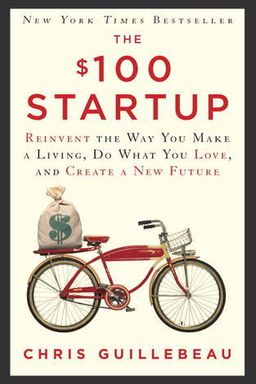
The $100 Startup cover

The $100 Startup

by Chris Guillebeau

The $100 Startup by Chris Guillebeau offers a blueprint for escaping traditional employment by launching a microbusiness with minimal investment. Through real-life case studies, it provides practical advice on defining products, understanding customer needs, and creative marketing, empowering you to achieve financial independence and pursue your passions.

Freedom and Value: The Core of the $100 Startup Revolution

Have you ever wished you could earn a living while doing something you truly love—without the shackles of a traditional job or the need for massive startup capital? In The $100 Startup, Chris Guillebeau argues that now, more than ever, freedom and value are within reach. You don’t need permission, investors, or years of planning. What you do need, he explains, is a simple mindset shift: trade old ideas of risk and employment for resourcefulness, creativity, and a deep understanding of how to deliver value to others.

Guillebeau’s central contention is that you already possess the skills to start a profitable microbusiness—one that brings independence, purpose, and income—often for less than $100 in startup costs. Across dozens of real-life case studies, from accidental mattress dealers and yoga instructors to coding consultants and adventure photographers, he proves that ordinary people are quietly building extraordinary lives. These are not corporate CEOs or tech billionaires. They are individuals who chose to build a life of freedom by crafting products and services rooted in value.

From Employment to Independence

Freedom is the consistent thread in every story. Michael Hanna’s transition from a laid-off salesman to owner of a thriving Portland mattress store epitomizes this theme. His success came not from an MBA or funding but from improvisation, empathy, and action. When he delivered mattresses by bicycle—a creative touch that delighted customers—he demonstrated a truth Guillebeau hammers home: small, bold gestures that express authenticity create enormous value.

Guillebeau calls this movement a “microbusiness revolution.” With technology lowering barriers and global connectivity growing, people can sell directly to audiences across continents. The result isn’t a world of startups chasing millions in venture capital but one of micro-entrepreneurs exchanging value with hundreds of loyal fans. He insists that independence now is less risky than traditional employment; a job can disappear overnight, but a business based on your passion and useful skill set is yours to shape indefinitely.

The Convergence of Passion and Usefulness

The book’s most powerful lesson is what Guillebeau calls convergence—the intersection of what you love, what you’re good at, and what others are willing to pay for. It’s not enough to “follow your passion”; you must connect that passion to other people’s needs. “Give them the fish,” he advises wryly, flipping the old adage about teaching a man to fish. Customers don’t want to learn everything—they want a solution that makes their lives easier, happier, or more meaningful.

For example, Barbara Varian’s V6 Ranch doesn’t just offer horse rides; it sells freedom and adventure, helping visitors “become someone else” for a weekend. Similarly, a yoga instructor, Kelly Newsome, realized that what her clients truly wanted wasn’t yoga itself but peace and relief from the stress of working in Washington D.C. The lesson is universal: value is emotional, not technical.

Blueprint, Not Theory

Guillebeau spent years interviewing more than a hundred entrepreneurs who built businesses earning at least $50,000 annually with minimal startup costs. His findings form a blueprint for readers to replicate. Rather than vague inspiration, he provides a “how they did it” manual that balances vision and strategy. The building blocks are simple: you need a product or service, a group of people willing to pay for it, and an easy way to get paid. Everything else is optional.

Unlike traditional business education, Guillebeau’s approach depends on rapid action and real feedback. He mocks the endless business plan cycle, recommending instead a One-Page Business Plan and immediate market testing. “Action beats planning,” he writes. By testing offers early, entrepreneurs can learn what works, pivot quickly, and keep costs near zero. This fluid, hands-on model mirrors lessons from lean startup methodology (Eric Ries’s The Lean Startup) but focuses more on personal freedom than on scaling for investors.

Freedom, Value, and Change

What ties the diverse stories together is the belief that freedom and value are inseparable. Freedom isn’t lazy idleness; it’s the ability to define your own life, choose your own projects, and serve others in meaningful ways. You’re not escaping work, Guillebeau insists—you’re choosing better work. Each case study—from Brandon Pearce, a piano teacher turned software creator earning over $30,000 a month, to Benny Lewis, who transformed his love of languages into a global brand—illustrates that transformation happens when passion meets usefulness.

In the end, The $100 Startup isn’t about quitting your job to chase a dream; it’s about realizing you already have the tools to design your life. With clarity, empathy, and courage, you can begin now—with $100 or less—and create work that both sustains you and sets you free. That is Guillebeau’s revolution: a guide for anyone who wants to stop living someone else’s script and start following their own map to freedom.


Finding the Sweet Spot: Convergence and Skill Transformation

One of Guillebeau’s most actionable frameworks is the concept of convergence—the overlap between what you love to do, what you’re good at, and what others find valuable enough to pay for. It’s a deceptively simple idea but one that separates weekend hobbies from sustainable businesses. Successful businesses exist not just in your passion but in their usefulness to others. As Guillebeau quips, “You can be very passionate about eating pizza, but no one’s going to pay you for it.”

The Power of Convergence

Understanding convergence allows you to reframe your life experiences as assets. Michael Hanna loved meeting people—so when he began selling mattresses, he transformed that friendliness into trust and customer loyalty. Kelly Newsome combined her passion for yoga with empathy for burned-out professionals, turning personal transformation into a full-time career.

Convergence thrives where passion meets market gap. Instead of trying to create need from nothing, look for inefficiencies or unmet desires. (This echoes Peter Drucker’s view that entrepreneurship is about innovation and opportunity recognition, not invention.) Whether it’s designing easier software tools for music teachers or creating custom wedding maps, the winning formula begins in the intersection of self-expression and service.

The Secondary Layer: Skill Transformation

Beyond identifying convergence, Guillebeau highlights skill transformation—applying what you already know in new ways. Teachers, for example, can repurpose their classroom skills—communication, planning, empathy—into online courses, consulting, or community-based ventures. A waitress with great interpersonal skills, like Kat Alder, turned her friendliness into a thriving PR firm across four cities after realizing she was already doing “public relations” informally while serving customers.

Scott Adams, creator of Dilbert, describes this principle as “combining ordinary skills in an extraordinary way.” You don’t need to be world-class at one thing; combining several modest skills creates rare value. That’s how Guillebeau’s entrepreneurs succeed—the magic happens not in mastery but in creative recombination.

A Formula for Success

Bringing both ideas together, Guillebeau offers his “magic formula”: Passion or skill + usefulness = success. Passion fuels creativity and persistence; usefulness ensures others value your output. When Jaden Hair launched her cooking site, Steamy Kitchen, she combined her love of Asian food with accessible, family-friendly recipes—useful to busy parents seeking inspiration. Within months, readers followed by the thousands, turning her enthusiasm into full-time income through cookbooks and sponsorships.

Key takeaway

Identify what excites you, determine who needs it, and design a simple offer that meets both. Convergence turns passion into profit and everyday skills into extraordinary pathways to independence.

By continuously analyzing your convergence zone and transforming your abilities, you not only uncover hidden income streams but create work perfectly aligned with your life. It’s a dynamic process: as your passions and markets evolve, so can your business. That adaptability, Guillebeau insists, is the true foundation of freedom.


Give Them the Fish: Creating Real Value

In one of the most memorable metaphors in the book, Guillebeau warns against the popular saying “teach a man to fish.” In business, he jokes, “If you teach a man to fish, you ruin a wonderful business opportunity.” His point is simple but revolutionary: most customers don’t want to learn—they want results. They want the fish, not a training session.

Understanding this truth about human behavior is essential for any entrepreneur. Too many businesses complicate their offers or build things that satisfy the creator’s ego rather than the customer’s desire. People don’t buy what you think they need; they buy what they actually want. Master that, and you unlock the secret to profit and loyalty.

The Emotional Core of Value

As Guillebeau defines it, value means helping people. Every profitable venture—from the V6 Ranch’s promise of escape to Purna Duggirala’s Excel tutorials—solves a problem or fulfills an emotional need. Many entrepreneurs articulate features (“I sell yoga classes”), but the winning ones articulate benefits (“I help busy executives reclaim serenity”). Emotional resonance converts casual interest into sustained demand.

Three Strategies for Delivering What People Want

First, dig deeper to uncover hidden needs. Wedding photographer Kyle Hepp learned that her clients, who claimed they didn’t want traditional poses, still cherished family portraits when provided later. She listened beyond words to discover their true desires. Second, make the customer the hero. Purna Duggirala sold Excel training not as dull technical instruction but as empowerment: becoming the “hero in front of your boss.” Third, sell what people already buy. When Guillebeau’s travel guide “Frequent Flyer Master” failed to attract customers, he realized travelers wanted cheaper tickets, not complex systems. He repackaged his offer accordingly—and it sold.

The Six-Step Startup Sequence

True to his action-oriented approach, Guillebeau breaks down launching a value-driven business into six steps: (1) Decide on a product or service, (2) set up a simple website, (3) craft a compelling offer, (4) choose a payment method, often starting with PayPal, (5) announce it to the world, and (6) learn, adjust, and repeat. Perfection isn’t required—progress is.

Core lesson

Give customers results, not complexity. The easier and more directly your business helps people achieve what they want, the faster it will grow.

By focusing on immediate, emotional value and resisting the urge to overteach or overcomplicate, you create offers that people can’t refuse. In Guillebeau’s world, happiness, not education, is the ultimate form of commerce—and the entrepreneurs who deliver it prosper.


Follow Your Passion—But Only If It Pays

“Follow your passion,” Guillebeau writes, “but only if it connects to what other people want.” In other words, passion is not a license for self-indulgence; it’s a foundation for service. Many entrepreneurs fail because they treat passion as a strategy rather than a starting point. What transforms passion into a business is the addition of value and structure.

Consider Gary Leff, who parlayed his fascination with frequent flyer miles into a consulting side hustle that earns six figures. He didn’t get paid to love travel; he got paid to solve travelers’ frustration with redeeming miles. Similarly, Megan Hunt built a bridal design brand not because she wanted to sew for fun but because she offered brides emotional meaning and craftsmanship in a sea of impersonal gowns.

Beyond Hobbyism

Guillebeau cautions that not every hobby should become a business. The test? If you’d enjoy doing it for twenty hours a week, teaching others about it, and handling the administrative side, then it might be viable. Passion transforms into a profession when it consistently improves other people’s lives—not just your mood.

Benny Lewis’s story highlights this shift. He loved learning languages but discovered that what people truly wanted was to learn his method. His “Fluent in 3 Months” course turned a personal obsession into a scalable learning system by focusing on results, not enthusiasm alone.

Different Business Models, One Mindset

Whether your passion turns into consulting (Gary’s travel service), product creation (Megan’s gowns), or content (Benny’s courses), Guillebeau insists you must locate the business model—the mechanism that connects your passion to profit. Some models earn per project; others automate revenue through digital products or subscriptions. The right model fits the scale and rhythm of your life.

Ultimately, passion becomes powerful when joined to pragmatic empathy. Ask not just what excites you but who benefits. As Benjamin Franklin advised, “Let reason hold the reins.” Passion plus purpose plus profitability equals a sustainable business you’ll love for years to come.


Start Small, Launch Fast: The One-Page Plan

Forget the 80-page business plan. Guillebeau shows that a single page is enough. Entrepreneurs waste precious energy imagining the perfect plan instead of executing an imperfect one. The mantra is simple: start from where you are with what you have.

The Action Bias

The defining quality of successful microbusiness owners, from artists Jen Adrion and Omar Noory to coffee entrepreneur James Kirk, wasn’t funding or foresight—it was action. Jen and Omar launched their map store after spending $500 on printing. They made sales overnight, then refined and expanded. The same story plays out repeatedly: act, test, learn, and improve.

Seven Steps to Instant Market Testing

Guillebeau presents a rapid framework: (1) Care deeply about the problem you’re solving, (2) ensure the market is large enough, (3) solve “blatant admitted pain,” (4) offer a clear, different solution, (5) create a customer persona, (6) test your idea with real people, and (7) refine based on feedback. Each step is designed to shortcut bureaucracy and ensure your product connects emotionally and practically with real buyers.

He also champions the “market before manufacturing” mindset—testing an offer before building it. One entrepreneur sold a $900 guidebook before writing it, ensuring real demand first. That validation created momentum and immediate profitability.

Business simplicity

Product or service + customers + a way to get paid = business. Everything else is optional.

By demystifying planning, Guillebeau restores entrepreneurship to its rightful place—as experimentation driven by curiosity and courage. The best way to start, he insists, is by starting.


Crafting Offers People Can’t Refuse

To stand out, your offer must be irresistible—a combination of the right audience, the right promise, and the right timing. Guillebeau likens it to an orange slice during a marathon: exactly what someone needs, exactly when they need it. The wrong offer—a donut at mile eighteen—misses the mark. Consumers act on relevance, not persuasion.

Understanding What People Really Want

Customers often buy at emotional peaks: convenience, relief, pride, or belonging. The Alaska TourSaver coupon book thrived because it offered outrageous value—“use one coupon and the book pays for itself.” Yoga studio owner Jonathan Fields packed his downtown classes by creating urgency with time-limited memberships. In both cases, the offers removed friction, made benefits obvious, and inspired immediate action.

The Compelling Offer Toolkit

Guillebeau provides practical tools to frame any offer:

  • Frequently Asked Questions – anticipate objections and provide reassuring transparency.
  • An Incredible Guarantee – like Nev Lapwood’s 120% satisfaction promise for snowboarding courses, confidence builds trust.
  • Overdeliver – offer small surprises that exceed expectations, reinforcing buyer delight.

He stresses that perceived value often outweighs logical cost. Customers judge price emotionally. If your offer solves a painful problem or delivers joy, higher pricing often boosts confidence rather than deters buyers.

Takeaway

A great offer is not about manipulation—it’s about empathy. Understand your audience so well that your product feels designed for them personally, then make taking action easy and rewarding.

From airfare hacks to handmade art, entrepreneurs who master this empathy-driven approach turn simple ideas into irresistible experiences—and that, Guillebeau shows, is the heartbeat of sustainable success.


The Gentle Art of Hustling

Hustling, in Guillebeau’s world, isn’t about hard-sell marketing; it’s about authentic connection and continuous creation. He divides workers into three types: charlatans (all talk, no work), martyrs (all work, no talk), and hustlers (a perfect mix of both). The winners, he argues, are the ones who proudly share their work while staying grounded in its value.

Strategic Giving and Relationship Building

One of Guillebeau’s most effective marketing philosophies is “strategic giving.” Dressmaker Megan Hunt sends handwritten notes and gifts to clients, creating loyalty and buzz. Architect John Morefield offered “5-cent architecture advice” at a farmer’s market—genuine help that turned into national media exposure. Giving first builds goodwill; as trust compounds, so do sales.

The principle mirrors Dale Carnegie’s timeless truths in How to Win Friends and Influence People: help others, listen more than you pitch, and make interactions personal. Guillebeau reinforces that relationships aren’t tactics; they’re long-term strategies.

Say Yes, Then Say “Hell Yeah”

Early on, Guillebeau recommends saying yes to opportunities unless you have a strong reason not to. As you gain traction, apply Derek Sivers’s “Hell Yeah or No” test—if an offer doesn’t excite you deeply, decline. This two-step evolution keeps you open to growth while maintaining focus as your plate fills.

The One-Page Promotion Plan

To make hustling manageable, he distills marketing into daily, weekly, and monthly habits: daily engagement on social media, weekly outreach or collaboration, monthly customer follow-ups. This rhythm replaces sporadic promotion with consistency. Hustling, in this sense, becomes artful coordination—connection, not coercion.

“Good things happen to those who hustle,” Anaïs Nin once said—and Guillebeau brings that concept to life. For microbusinesses, hustle is less about chasing fame and more about nurturing communities who believe in your mission.


Money, Profit, and Pricing for Freedom

A business that doesn’t make money is a hobby. Guillebeau strips away romantic notions of entrepreneurship to remind readers: profit equals freedom. His formula is both ethical and empowering—earn fairly, spend wisely, and stay independent. Most $100 startups begin with tiny budgets; success comes not from funding but from focus.

Low Cost, High Value

Across Guillebeau’s research, the average startup investment was $610, with many under $100. Chelly Vitry’s gourmet food tours began with $28; Tara Gentile’s content business started with $80 and grew to $75,000 per year. The message: your constraints are creative assets. Avoid debt, bootstrap, and prioritize activities directly tied to revenue.

Three Rules for Profit

First, price for value, not cost. Charge based on transformation, not production time. (For instance, frequent-flyer consultant Gary Leff’s $250 fee reflected results, not minutes worked.) Second, offer a limited range of prices to appeal to different buyer levels and increase average order value. Third, get paid more than once—through subscriptions, memberships, or repeat services. Recurring income equals stability.

Brett Kelly’s Evernote Essentials guide is a textbook example. Released for $25, the digital manual generated $120,000 in a year—twenty times more than it might have earned through traditional publishing. Automation and global access replaced scarcity with abundance.

Golden rule of microbusiness

Spend as little as possible and make as much as you can—then reinvest in freedom, not overhead.

Guillebeau echoes the practical wisdom of minimalists like Joshua Becker and efficiency experts like Tim Ferriss: the point of money is not possession but flexibility. Profit enables impact and choice—the ultimate currencies of freedom.


Scaling Without Selling Out

When your microbusiness succeeds, what next? Guillebeau explores how to “franchise yourself”—expanding smartly without sacrificing independence. Growth can mean outsourcing, partnerships, or duplication, but only if aligned with your vision of freedom. Size is optional; fulfillment isn’t.

Different Roads, Same Destination

Case studies illustrate divergent paths. Nathalie Lussier built both a raw-foods brand and a tech consultancy, leveraging existing systems across industries. Brooke Thomas scaled horizontally, teaching wellness providers business skills learned from her own clinic. Others, like Tom Bihn, scaled vertically—keeping production local and rejecting big-box distribution to maintain integrity. Growth, Guillebeau insists, must serve your mission, not the market’s expectations.

Still, partnerships can multiply reach when designed carefully. Endurance Nation founders Patrick McCrann and Rich Strauss grew their triathlon community using complementing skills—tech and training—to create “1 + 1 = 3.” A one-page agreement, clear communication, and shared vision replaced complex contracts.

Freedom Through Leverage, Not Employees

Guillebeau warns that outsourcing isn’t automatically liberating. For some, like designer Brandy Agerbeck, solo operations protect creativity; for others, like Megan Hunt, contractors extend capacity without bureaucracy. The rule: build only what enhances joy and autonomy. Use virtual assistants or partnerships when they remove friction, not when they add complexity.

Guiding principle

Grow by design, not default. Expansion should amplify your freedom, not diminish it.

Through stories of restraint and experimentation, Guillebeau shows that “bigger” is neither inevitable nor ideal. The real measure of success isn’t scale—it’s sovereignty.


Facing Fear, Failure, and the Future

Every entrepreneur faces doubt and fear—fear of failure, competition, or simply getting started. Guillebeau reframes these anxieties as creative signals: if you’re scared, you’re stretching. Many of his entrepreneurs, like John T. Unger, who rebuilt his art business after disasters and even near-death experiences, discovered that breakdowns can become breakthroughs.

The Mindset Shift

Freedom requires resilience. External fears—losing money, changes in markets—are manageable with multiple income streams and strong relationships. Internal fears—imposter syndrome, burnout—demand perspective. As one creator told Guillebeau, “If nobody’s going to die, what the hell am I so afraid of?” That courage, not capital, is what sustains entrepreneurs.

Failures in Guillebeau’s world are feedback loops. When a product flops or a client disappears, the entrepreneur pivots and applies the lesson. Kyle Hepp, the photographer, went from an accident victim and unemployed expat to a $90,000-a-year global artist because she refused to quit after setbacks.

Defining Your Own Success

Near the book’s close, Guillebeau reminds readers that freedom doesn’t mean laziness. It’s the discipline to define success on your terms—whether that’s a six-figure e-book, a small art studio, or a tuk-tuk business that supports a family. Like Rhett, the Cambodian driver who earns ten times his peers by combining reliability with strategy, success starts with ownership and service, not luck.

You don’t need permission to begin. The riskiest choice today isn’t self-employment—it’s staying stuck. With small steps toward value and freedom, you build not just a business, but a life. That’s the ultimate startup.

Dig Deeper

Get personalized prompts to apply these lessons to your life and deepen your understanding.

Go Deeper

Get the Full Experience

Download Insight Books for AI-powered reflections, quizzes, and more.