
Idea 1
Unlocking the 1% Windfall: The Power of Pricing for Profit
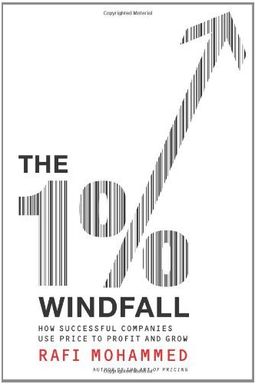
What if your business could boost profits by 10%, 20%, or even 50%—without selling a single extra product? Rafi Mohammed’s The 1% Windfall reveals that tiny, strategic changes in pricing can ignite extraordinary gains. The book’s central promise is deceptively simple: a 1% increase in price can lead to double-digit growth in operating profit. But achieving that increase isn’t about arbitrary markups—it’s about understanding and capturing the full value your customers already see in your product.
Most businesses, Mohammed argues, miss out on this opportunity because they set prices by habit—marking up costs, matching competitors, or maintaining margins. Instead of treating pricing as an active growth lever, they leave money on the table. This, he calls, the “profit disconnect.” At its core, The 1% Windfall is a manifesto for value-based pricing—setting prices according to what your customers actually perceive as fair value, not just what it costs you to make something.
The Profit Multiplier Effect
Mohammed opens with vivid examples that reframe pricing as a powerful strategic tool. In one striking scenario, Costco’s $1.50 hot dog-and-soda combo—untouchable for years—illustrates the pricing paradox. A mere two-cent increase applied uniformly across Costco’s prices could raise its operating profits by 48%. As Mohammed points out, once you grasp the mathematics of margins, the domino effects of small price shifts become obvious. A company with 5% operating profit that raises prices by 1% without cutting demand enjoys an immediate 20% profit lift. When scaled to corporate giants, the results are staggering: a 1% bump would add $37 billion to Walmart’s market capitalization, $13 billion to Amazon, and 155% more profit for Sears (based on 2008 data).
These numbers dramatize Mohammed’s thesis: pricing is the quickest, most overlooked path to profitability. Unlike costly marketing campaigns or innovation bets that take months or years to unfold, pricing tweaks take effect overnight—and flow straight to the bottom line. And because price touches every department—sales, marketing, finance, and leadership—it’s the one variable everyone influences but few coordinate strategically.
Why Pricing Is Usually Broken
Mohammed discovered through two decades consulting—from startups to Fortune 500s—that most companies’ pricing approaches are fragmented, reactive, and even emotional. Managers are wedded to traditional methods (“This is how we’ve always done it”), while departments pursue conflicting goals: marketers chase market share, CFOs fixate on margins, and sales teams hand out discounts to close deals. The result is chaos—pricing fiefdoms, inconsistent philosophies, and an “Oh well…” attitude toward profit leaks.
The solution begins, he says, with a shared philosophy: use price to capture value and grow profitably. To achieve that, Mohammed builds what he calls a “Pricing Blossom”—a model integrating four complementary strategies that together create pricing harmony: value-based pricing, pick-a-plan options, product versioning, and differential pricing. This framework empowers companies to not just optimize a number but design pricing as an ecosystem that reflects customer diversity.
Beyond Raising Prices: Win-Win Strategies
Critically, The 1% Windfall isn’t about gouging customers. “Better pricing,” Mohammed stresses, “is more than raising prices.” Instead, it’s about creating equitable exchanges between customer and company—where pricing plans, product options, and promotions align with customer needs. Examples like Southwest Airlines’ Business Select tickets show how customers sometimes volunteer to pay more when offered meaningful upgrades: guaranteed A boarding, drink vouchers, and frequent flyer bonuses. The insight? Pricing innovation can deepen loyalty rather than alienate buyers.
The book reveals dozens of stories like this—from Parker Hannifin’s switch to value-based pricing that quintupled its net income, to Terminix’s pick-a-plan model that reanimated a shrinking market. Whether in airlines, restaurants, or high-tech manufacturing, companies that rethink pricing as a customer alignment tool—not a transactional lever—see immediate, sustainable windfalls.
The Comprehensive Pricing Mindset
Mohammed organizes the book into three major sections. Part I explains value-based pricing—how to think like your customer and set prices that reflect the worth of your product’s differentiators. Part II outlines tactical strategies—pick-a-plan (multiple pricing plans to activate new buyers), versioning (offering good/better/best options), and differential pricing (charging different customers different prices appropriately). Part III shows how to implement these ideas across an organization: designing a companywide pricing culture, staying resilient during recessions or inflation, and creating profit-driven teams that treat pricing as shared responsibility.
Ultimately, The 1% Windfall reframes pricing not as math but as insight. It’s about empathy—understanding how customers perceive value and crafting choices that serve them while improving your margins. By replacing cost marks-ups and random discounts with structured, value-capturing techniques, any company—whether a single café or a multinational—can transform price from a neglected afterthought into its most potent growth weapon.
“Pricing is the fastest route to profit.” Mohammed’s message is both simple and radical: you’ve already done the hard work of creating a great product—now price it like it’s worth it. Small, smart adjustments made through the lens of value can compound into windfalls that reshape your company’s entire financial future.